|

The universe will expand forever. It moves
in response to energy fluctuations in the vacuum of empty space. Today, evidence is accumulating that most of the energy density in the universe is in an unknown form dubbed dark energy. The form and genesis of dark energy is almost
completely unknown, but postulated as related to vacuum fluctuations similar to the Casimir Effect but generated somehow by space itself. This vast and mysterious dark energy appears to gravitationally repel all matter and hence will likely cause the universe to expand forever.
Our universe is filled with galaxies. Galaxies -- huge conglomerations of stars, gas, dust -- and mysterious dark matter are the basic building blocks of the large-scale universe. Although distant galaxies move away from each other as the universe expands, gravity attracts neighboring galaxies to each other, forming galaxy groups, clusters of galaxies, and even larger expansive filaments.
The Virgo Cluster is so massive that it is noticeably pulling our Galaxy toward it. The cluster contains not only galaxies filled with stars but also gas so hot it glows in X-rays. Motions of galaxies in and around clusters indicate that they contain more dark matter than any visible matter we can see.
This strange energy dominates the cosmos and provides a repulsive force accelerating the large scale expansion of the Universe. In fact, recent brightness measurements of distant and therefore ancient, stellar explosions or supernovae indicate that the universal expansion began to speed up in earnest four to six billion years ago, when the Dark Energy's repulsive force began to overcome the attractive force of gravity over cosmic distances.






|
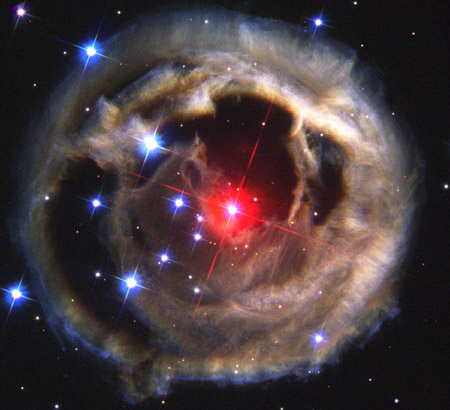
Ever since a sudden outburst was detected in January 2002, this enigmatic star has taken the center of an astronomical stage while researchers try to understand where it fits into the picture of stellar evolution.
V838 Mon lies about 20,000 light years away toward the constellation of Monoceros, while the largest light echo above spans about six light years in diameter.

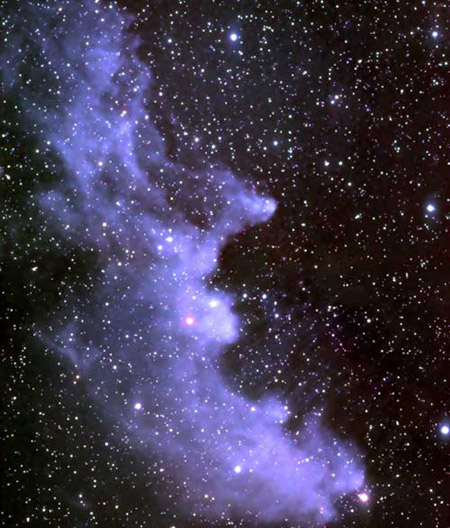
Double, double toil and trouble; Fire burn, and cauldron bubble -- maybe Macbeth should have consulted the Witch Head Nebula, the suggestively shaped reflection nebula. The blue color is caused not only by Rigel's blue color but because the dust grains reflect blue light more efficiently than red. The same physical process causes Earth's daytime sky to appear blue, although the scatterers in Earth's atmosphere are molecules of nitrogen and oxygen. The nebula lies about 1000 light-years away.
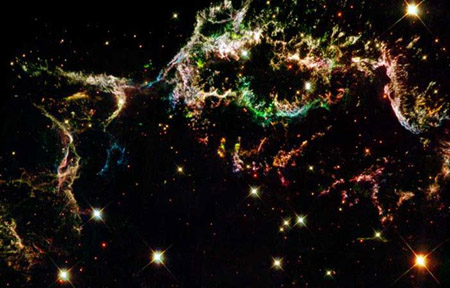
After a few million years, the enriched material is blasted back into interstellar space where star formation begins anew. The expanding debris cloud known as Cassiopeia A is an example of this final phase of the stellar life cycle. Light from the explosion which created this supernova remnant was probably first seen in planet Earth's sky just over 300 years ago, although it took that light more than 10,000 years to reach us.
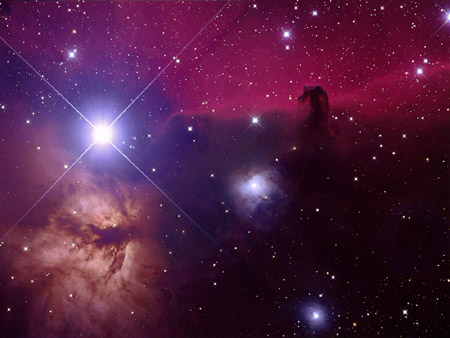
While drifting through the cosmos, a magnificent interstellar dust cloud became sculpted by stellar winds and radiation to assume a recognizable shape. Fittingly named the Horsehead Nebula, it is embedded in the vast and complex Orion Nebula. The dark molecular cloud, roughly 1,500 light years distant, is cataloged as Barnard 33 and is visible only because its obscuring dust is silhouetted against the bright emission nebula IC 434.
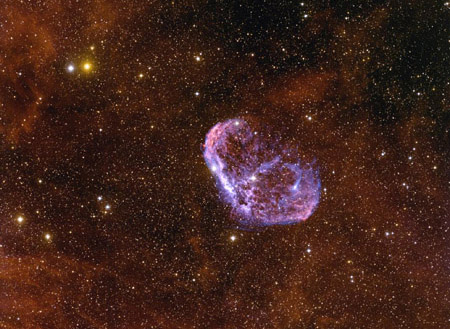
Looking
like an emerging space cocoon, the Crescent Nebula, also known as NGC 6888, lies about 4,700 light-years away in the constellation of Cygnus.. A leading progenitor hypothesis has the Crescent Nebula beginning to form about 250,000 years ago.
Shedding its outer envelope in a strong stellar wind, this star was ejecting the equivalent of our Sun's mass every 10,000 years. This wind impacted surrounding gas left over from a previous phase, compacting it into a series of complex shells, and lighting it up.
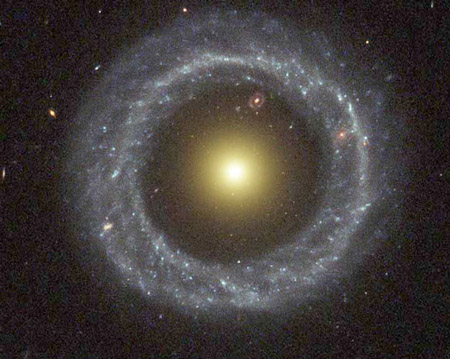
Is this one galaxy or two?
On the outside is a ring dominated by bright blue stars, while near the center lies a ball of much redder stars that are likely much older. Between the two is a gap that appears almost completely dark. Genesis hypotheses include a galaxy collision billions of years ago and
gravitational interactions involving an unusually shaped core. It spans about 100,000 light years and lies about 600 million light years away toward the constellation of
Serpens.

|