|

Welcome to the universe. We are in the Milky Way galaxy.
Our solar system is but a speck of dust in comparison.
We are somewhere in the Orion arm of the Milky Way galaxy.
Our own galaxy consists of about 200 billion stars, with our
own Sun being a fairly typical specimen. It is a fairly large
spiral galaxy and it has three main components: a disk, in which
the solar system resides, a central bulge at the core, and an
all-encompassing halo. The disk of the Milky Way has four spiral
arms and it is approximately 300pc thick and 30kpc in diameter.
It is made up predominantly of Population I stars, which tend to
be blue and are reasonably young, spanning an age range between a
million and ten billion years. The bulge, at the center of the
galaxy, is a flattened spheroid of dimension 1kpc by 6kpc.
This is a high-density region where Population II stars predominate ---stars that tend toward red and are very old,
about 10 billion years. There is growing evidence for a very
massive black hole at its center. In fact, there is strong evidence of a
black hole in the center of every galaxy. The halo, which is a diffuse
spherical region, surrounds the disk. It has a low density of
old stars mainly in globular clusters (these consist of between
10,000 - 1,000,000 stars). The halo is believed to be composed
mainly of dark matter that may extend well beyond the edge of the
disk. Once you look out beyond our home galaxy,
you see that the universe really is a strange place.
The universe is 13.7 billion years old, composed of 73 percent dark energy, 23 percent cold dark matter, and only 4 percent
atoms. It is currently expanding at the rate of 71 km/sec/Mpc , underwent episodes of rapid expansion called inflation, and will expand forever.






|
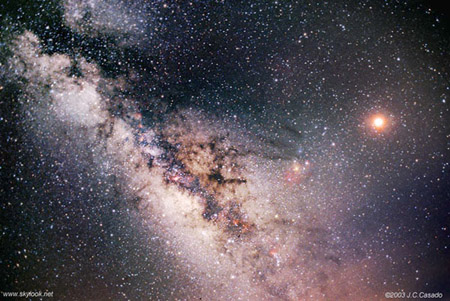
This is the Milky Way as seen from Earth.
The Milky Way system is a spiral galaxy consisting of over 400 billion stars , plus
gas and dust . Since the Earth lies in the disk of the Milky Way, dust prevents us from determining the large scale structure of the Galaxy's spiral pattern beyond a few thousand light-years. Radio observations have detailed the structure of the gas in the spiral arms, but it is still not known if our galaxy is a normal spiral like our neighbor
Andromeda.

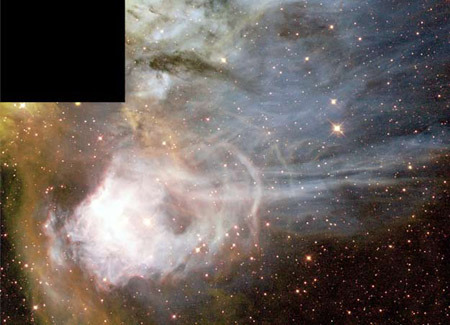
N44C is an emission nebula in the
Large Magellanic Cloud. It would take light about
125 years to cross N44C. The star that appears to power the nebula,
although young and bright, does not seem hot enough to create some of the colors observed. A search for a hidden hotter star in X-rays has come up empty. One hypothesis is that the known central star has a neutron star companion in a very wide orbit.
Hot X-rays might only then be emitted during brief periods when the neutron star nears the known star and crashes through a disk of surrounding gas.
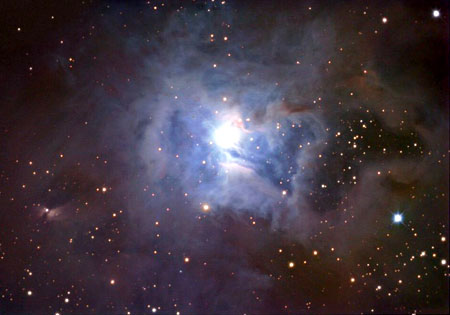
Like delicate cosmic petals, these clouds of interstellar dust and gas have blossomed 1,300 light-years away in the fertile star fields of the constellation Cepheus. Sometimes called the Iris Nebula and dutifully cataloged as NGC 7023, this is not the only nebula in the sky to evoke the imagery of flowers. Still, the beautiful digital image shows off the Iris Nebula's range of colors and symmetries in impressive detail. Within the Iris, dusty nebular material surrounds a massive, hot, young star in its formative years.
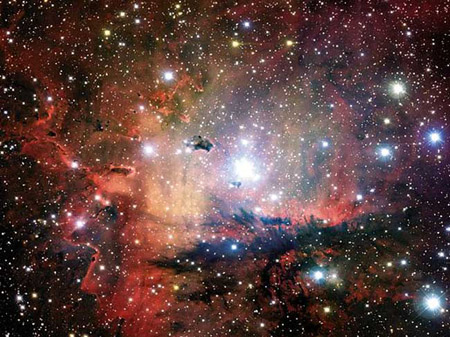
NGC 281 is a busy workshop of star formation. Prominent features
include a small open cluster of stars, a diffuse red-glowing emission nebula, large lanes of obscuring gas and dust, and dense knots of dust and gas in which stars may still be forming.
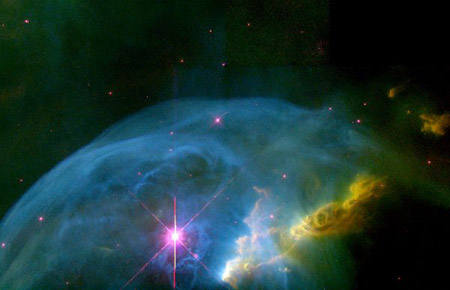
A massive star that is not only bright and blue, but also emitting a fast stellar wind of ionized
gas created this huge space bubble. The Bubble Nebula is the smallest of three bubbles surrounding massive star BD+602522, and part of gigantic bubble network S162.As fast moving gas expands off BD+602522, it pushes surrounding sparse gas into a shell. The energetic starlight then ionizes the shell, causing it to glow.
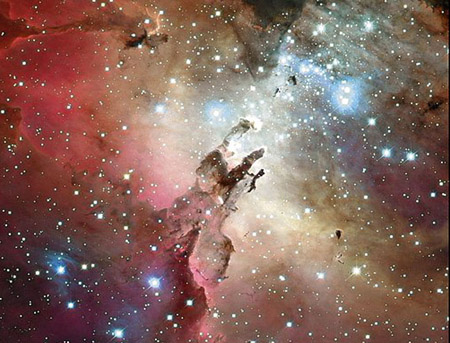
From afar, the whole thing looks like an Eagle. A closer look at the Eagle Nebula, however, shows the bright region is actually a window into the center of a larger dark shell of dust. Through this window, a brightly-lit workshop appears where a whole open cluster of stars is being formed.
Bright blue stars are still forming in the dark pillars of the Eagle Nebula. Light takes about 7000 years to reach us from M16, which spans about 20 light years.
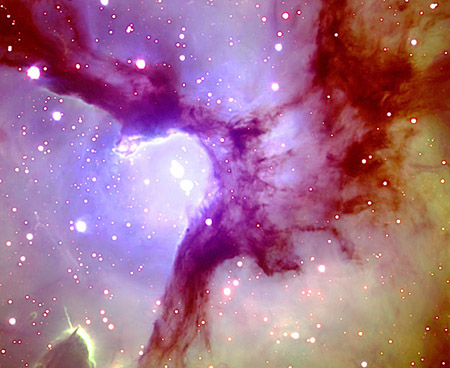
Clouds of glowing gas mingle with lanes of dark dust in the Trifid Nebula, a star forming region toward the constellation of Sagittarius. In the center, the three huge dark dust lanes that give the Trifid its name all come together.
A single massive star visible near the center causes much of the Trifid's glow. The Trifid, also known as M20, is only about 300,000 years old, making it among the youngest emission nebula known.

|