|
Resources
Main
Disclaimer
Divisional History
Squad Members
Medals
Rules and Regulations
Screenshots
Links
Chat
Forum
|
Historical Division, Virtual Squad
Regiment General Göring: The facade lifted, RGG joins the Wehrmacht as a Luftwaffe land defense force.
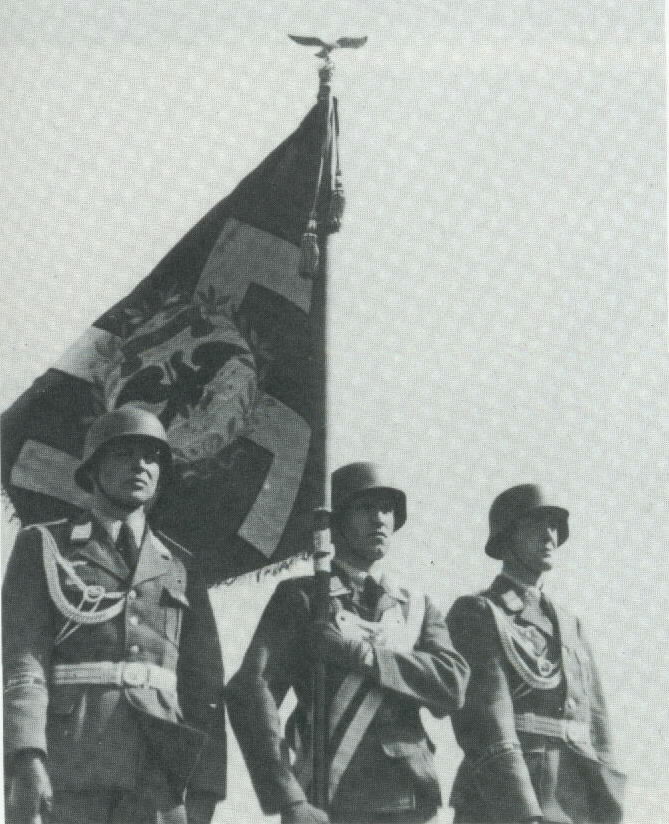
The peacetime units of the RGG (Guard Battalion, III Searchlight Unit, and IV Anti Aircraft Unit) were given a flag of the same pattern as the police flag when they were organized, from the HG Panzer Division, by Alfred Otte.
In September, 1935, a top secret order from the Reichminister for Aviation and Commander of the Luftwaffe, Göring, reorgainzed L.P.G. General Göring into the Regiment General Göring. This order detailed the future responsibilites of the RGG. Part of it's duties were the guarding of the Headquarters of the Commander of the Luftwaffe, including air defense in times of war. Their guard duties also included Göring's official residence in Berlin and his offices in Karinhall, as well as the responsibility for cermonial duties of the Luftwaffe in Berlin.
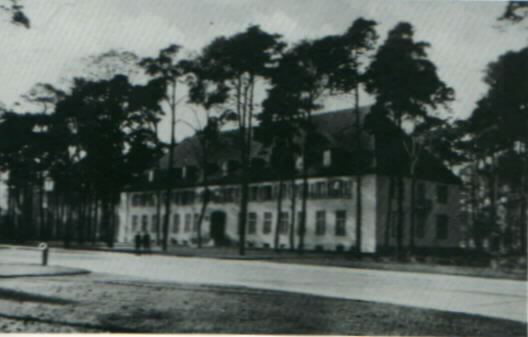
The barracks of the RGG in Berlin-Reinickendorf. The buildings and grounds were luxurious, even including an indoor pool, which was unheard of at that time, from the HG Panzer Division, by Alfred Otte.
The green uniforms of the army were changed in April, 1936, to the blue ones of the Luftwaffe. Up until that point, to indicate their inclusion into the Luftwaffe, the men had wore an air force emblem on their cap and jacket.
Being the only unit in the Luftwaffe, the soldiers of the RGG wore on their Luftwaffe uniforms white collar patches with pride. They were considered the premier regiment of the Luftwaffe. The green sleeve band of the L.P.G. GG was changed to a blue sleeve band inscribed with, "General Göring", and was worn on the right foresleeve
In April, 1936, the necessary requirement of men for the RGG was achieved through the acceptance of recruits who had volunteered to serve in the RGG. Since in the future it was consist exclusively of volunteers, it was entitled to advertise for future members. The number of volunteers greatly surpassed demand, and a strict selection process based on physical, mental, and moral guidelines was used
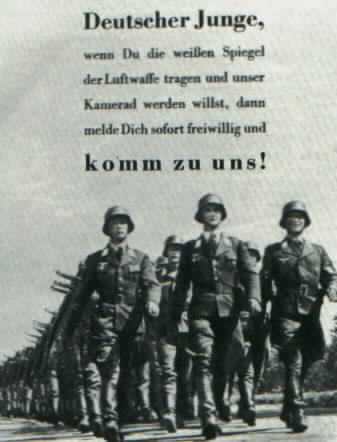
Translation: German boy, if you want to wear the white patches of the air force and be our comrade, volunteer right away and join us! -Recruitment poster, from the HG Panzer Division, by Alfred Otte.
At the same time that it was incorporated into the Luftwaffe, a battalion was ordered to be trained as a parachute battalion. This was meant to form the core of all future Fallschirmjager forces.
When this order was conveyed to the RGG, together with the request for volunteers, the numbers volunteered far outweighed the demand. The men were moved to the 1st Jager Battalion and to the 14th Pioneer Kompanie. Strenous physical and mental training followed before the men ever even set foot in a JU 52.
After 6 jumps, the young fallschirmjager received the parachute jumper's certificate, and was awarded the parachute jumper medal. This medal, was worn with pride by everyone who received it. At this time, these men jumped head forward, which demanded extreme self control. Only truly fearless men could do this, and lead, along with aggressive training, to the feeling that the parachute troops were truly elite.
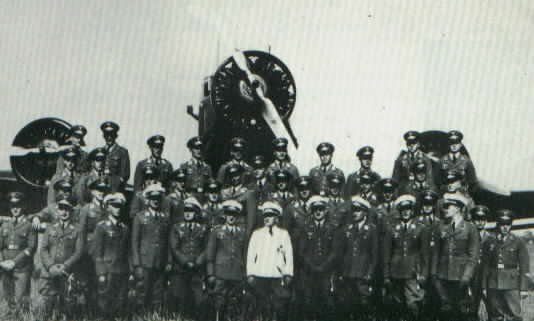
These men, selected exclusively from Regiment General Göring, were the first German parachute jumpers, who trained at Stendal airfield during May-June 1936, from the HG Panzer Division, by Alfred Otte.
From this first parachute battalion of the RGG, many prominent men originated. Many of the sergeants of the battalion were later promoted to officer, a great number of them for showing courage when facing the enemy. Of these first paratroops many achieved commands of their own. Many also won awards during the war for their bravery. Most, however, were killed while in service to their country
At the end of 1937, secrecy was no longer needed, and the 1. Jager-Battalion became the IV. Fallschirm-Schutzen-Battalion, unofficially called the Fallschirm-Jager-Battalion. It remained with the RGG until March 31, 1938. At this time it was renamed 1./Fallschirmjager Regiment 1, and received the yellow patches of the Fliegertruppe. It was moved to Stendal in the middle of 1938.
With reorganization over, a period of harsh training began for the men of the RGG. New weapons were trained on, and new recruits were instilled with the undying spirit of the old hands. After basic traning was through, field traning began north of Berlin. Large unit operations were also practiced in the Mark Brandenburg area.
In March, 1938, the RGG took part in the march into Austria, and remained until the middle of April, in Wiener Neustadt
During the Sudetan crisis in the late summer of 1938, the RGG deployed to positions west of Potsdam, to guard the headquarters of Göring. Portions of the guard battalion of the RGG and the Luftlande Battalion Sydow, saw action in the Sudetenland within the framework of the 7. Flieger Division near Jagerndorf-Freudenthal.
The RGG also took part in the occupation of Czechoslovakia with the march into Prague. The IV. Flak-Abteilung, however, was given to the 2. Panzer Division to secure its moves into action and marched with it through the Grafenwohr-Weiden and the Bohemian forest to the area of Pilsen. There, the Abteilung was charged with guarding the Skoda works. Here in the Skoda works, Germany found a new tank of advanced design, the Pz38t, and would use it in the upcoming lightning advances of 1939-40.
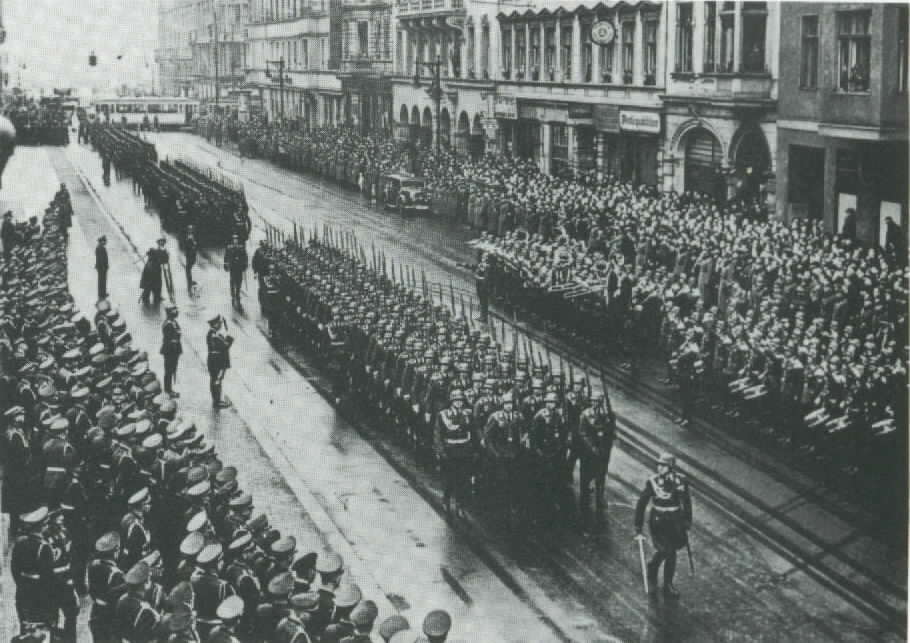
Commemorating the day in 1935 on which the newly created Luftwaffe was unveiled, RGG march past the Ministry of Aviation of the Reich on Wilhelmstreet, during the 'Day of the Air Force', on March 1, 1939, from the HG Panzer Division, by Alfred Otte.
In August 1936, Oberstleutnant von Axthelm took over the RGG from Oberstleutnant Jakoby. In October 1937, light and heavy Flak units were added to the RGG, since Axthelm wished the RGG to move the emphasis from infantry to air defense. Many changes within the RGG occured at this time as units were formed, and some departed (mentioned above, Battalion Sydow, and the Fallschirm-Schutzen Battalion Brauer).
In August 1939, the RGG went into its war formation. Added at this time were the 14. schwere Eisenbahn-Flak-Batterie(heavy railroad anti aircraft guns, 10.5cm) Lt. Arnold, Reserve Schweinwerfer-Abteilung, and the Reserve Abteilung, Major von Ludwig. A new Kradschutzen(motorcycle) Kompanie was formed from the old Reiter Schwadron as well.
During the Polish campaign the Flak units of the RGG were deployed in Berlin. A temporary renaming of the RGG, in 1939. to Flak Regiment 103, was just a smokescreen for the upcoming war with France. At this time I. and IV Flak Abteilung were integrated into the newly created II Flakkorps, and the III Flak Abteilung was integrated into the I Flakkorps. These were moved to the Westwall, to the areas of Aachen and Trier.
|

