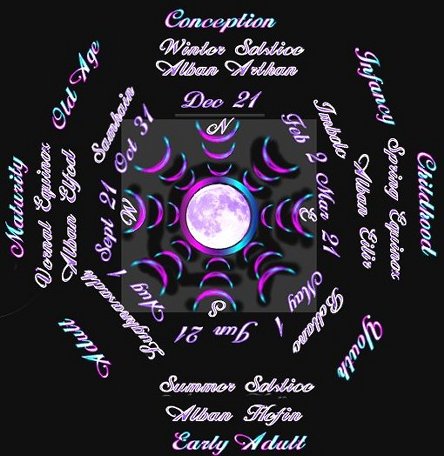
One of the major beliefs of the Celtic and Wiccan religions is the three-fold Goddess. Maiden. Mother. Crone. Going by the Cycle of the Seasons, the Goddess becomes the lover of the Horned God and becomes pregnant by him. And as the God dies, she gives birth to the Sun God, who is the Horned God reborn. As this occurs, so do the changing of the seasons. This life, death, and rebirth cycle shows the fertility of the earth in all its aspects. The earth has seasons to grow, and seasons to die, then once again it is reborn, like the God. If you take a look at the "Wheel of Life" above, then you can see how this is considered a continuous circle (or cycle, whichever you wish to call it.).
Today our main focus is the Goddess and as we all know the Goddess was pre-christian. She was worshipped for centuries before Christ ever emerged. The Upper-Paleolithic period is the hypothetical foundation of the religion of
the Goddess as it appeared in the later Neolithic Age of the Near
East. Many believe that the mother was perceived as the sole parent of children in this culture because the child was born from her body. Perhaps it was due to the fact that earlier cultures had no idea as to how life was created. They knew nothing of procreation except the act itself and so didn't relate the male to the child until much later.
Evidence that these earlier cultures worshipped the Goddess is shown through the multitude of sculptures made of women. These were found throughout most of Europe and the Near East, some dating as far back as 25,000 BC.
Many small female figurines have been identified, which appear to be pregnant. These have been found around the world in places such as Spain, France, Germany, Austria, and Russia. These figurines, including the places they were found, appear to span a period of at least 10,000 years.
The Goddess was worshipped under various names in various parts of the world. There was a temple dedicated to the Queen of Heaven of Erech that was erected about 3000 BC in the city-state of Uruk.
The great Babylonian Goddess, Ishtar, was said to have evolved from the sumerian Goddess, under the names Inanna, Eriskegan and Irnini.
In Neolithic Anatolia (Called Turkey today) the Great Goddess was worshiped in the shrines of Catal Huyuk around 6500 BC. The Sun Goddess Arinna was one of the most important female deities to survive the Hittite invasions. After the conquest she was given a husband who was said to be the storm god.
On the island of Crete, there is little doubt that the Goddess was the major deitiy and that the women acted as clergy. In prehistoric Egypt, the Goddess held sway in Upper Egypt as Nekhebt and was painted as a vulture, while in Lower Egypt, they worshipped the Goddess as Ua Zit (Great Serpent) and showed her as a cobra. Eventually she evolved and became known as Isis. From about 3000 BC onward the Goddess was said to have existed when nothing else had been created.
The land of Canaan (8000 - 63 BC) , also frequently called the 'land of milk and honey' was
an area about 90 miles wide running north and south along the
eastern coast of the Mediterranean. Today this region includes the states of Israel, Jordan, Lebanon, and part of Syria. This area is the area most revered as the home of Christianity, yet once again figurines of the Goddess, some dating as far back as 7000 BC, spread throughout the lands giving testimony to the fact that ancient civilizations worshipped the Queen of
Heaven prior to the purported coming of the Christ Child.
It is said that she was the principal deity of the cities of Tyre, Sidon, Ascalon, Beth Anath, Aphaca, Byblos, and
Ashtoreth Karnaim.
So as you can see the Craft is a religion which has an unbroken tradition that dates back approximately 35,000 years.
Unfortunately, invasions soon swept over Europe and nomadic tribes devoted
to war and conquest came in droves. The Goddess religions were soon changed to conform to the belief systems of the conquerors.
According to history, Yahweh fought a battle in Canaan, to guarantee that the people had "no other gods before me" according to His commandments, while the Goddess was given a masculine name and assigned the role of a false god. And although women had few rights back then compared to today, as this battle continued, women lost most of the rights that they had grown to enjoy.
And although the Goddess was losing favor due to forceful actions, the Celts in Gaul and the British Isles, incorporated the olde traditions including the Goddess into the Druidic Mysteries and kept them alive for awhile longer. Then somewhere around the late 1400's, the Catholic Church came in and tried to exterminate its competition, forcing the followers of the Old Religion to go into hiding.
Finally, in 1954, England repealed the Witchcraft Act, and
the Craft began to re-emerge and today is once again shining in its right place of honor among the worlds' religions.
If you would like to learn more about the deities of the Celtic Religion, you can find it here:
Celtic Deities