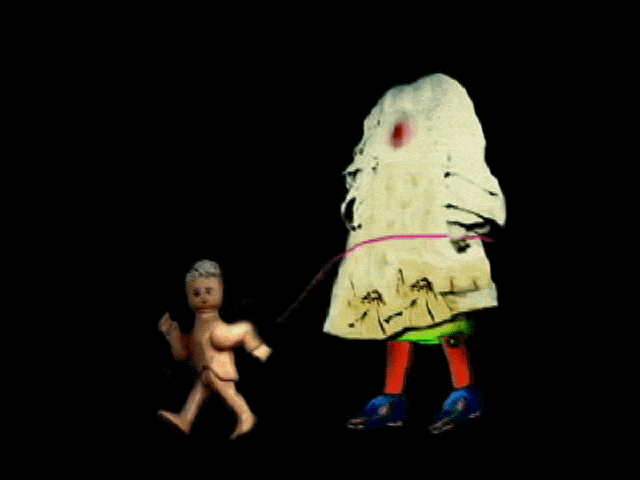
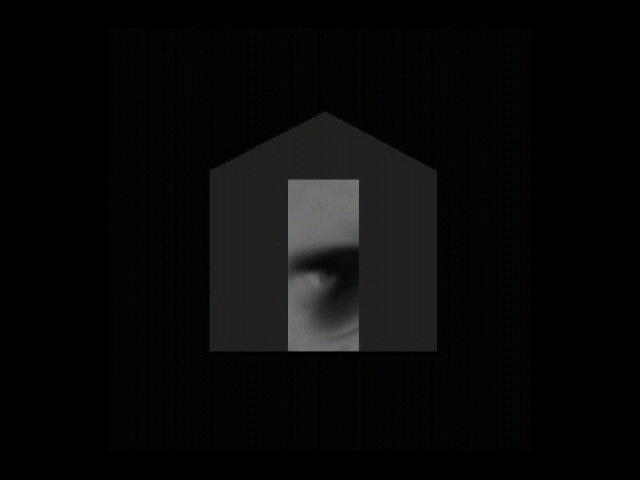
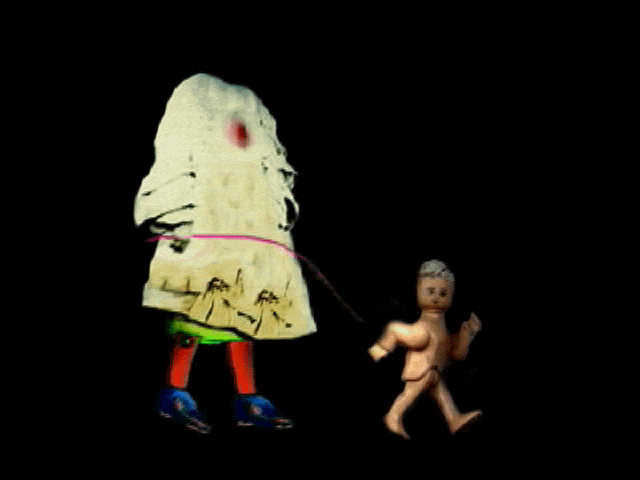
A transitional world made of fragments of the world we conventionally call "real"?
or
Broken crystal glass called "world", mended with fragments rearranged by chance or by inspiration?
Borgus Story: 00:03:59
All those movies were created from July 2001 and July 2002.
Watch out! (Little house): 00:03:23
Atlantida: 00:03:15
And if the Flood had been a dolls' rain?: 00:04:04
Can-Can Naguila: 00:05:00
Broken events: 00:04:19
Mosca de Moscœ: 00:02:59
In this exhibit, Ana Camusso and David Wapner, an immigrant artist couple, present an installation comprising seven computerized multimedia works. These artworks encapsulate synopses and materials from the two artists' common database. The data was processed and adapted to the physical setting of the museum. To understand the message of these works, the observer must decipher the encoded data. As the observer moves from station to station and repeatedly views the screens and the individual images, the casing enclosing the capsule is slowly cracked, releasing the odors and tastes of the artists' hidden personal worlds. We learn that Anna and David's world moves from one pole in their lives to another: from the colors, odors and endless open spaces of the pampean landscapes of Argentina, particularly of Buenos Aires where they were born and lived until just recently, to their current home of Beer Sheba in Israel's' Negev desert, which is dominated by blinding light, stifling heat, a sense of siege and a physical threat to survival. Their work also reveals the dichotomy between the Spanish language, mentality and culture through which they could express themselves well, and Hebrew, the local language, which is foreign and hard to pronounce, as well as showing the contraposition of man and woman and of individual and couple.
These artworks enable the couple to achieve a balance among these contrasting systems and provide them with an interpersonal channel for interacting with their new surroundings. Their chosen strategy is to combine forces and to synthesize these two worlds by means of a virtual world, where everything is permitted and everything is possible. One of the artists associatively selects the topics of the works. Each then contributes those components he or she deems important, while the other can intervene and make changes as appropriate. By using the computer as a creative tool, the artists are able to unite disciplines in which they worked in the past, such as drawing, sculpting, writing, music, animation and theater. This multidisciplinary approach suits the worldview of these two artists, who feel a need to express themselves through digital poetry that integrates words, music and images. The animation was produced using film-editing software. This software has a video channel for integrating digitized pictures and texts, as well as an audio channel for sound. These two channels, after editing, generate an animation sequence that runs in a loop. The shared experience of exposure, interaction and processing of personal materials is a therapeutic act that "repairs" the disconcerting and painful sets of contrasts, thus making existence in the current reality tolerable. The animation loop represents an infinite repetition of a mantra whose purpose is to repair reality.
The installation is composed of animations (capsules) that act to repair a variety of situations. By focusing on the screens, observers activate the mechanism and release its contents. Objects or sounds are first presented as a mantra releasing the observers' inhibitions and bringing them to a hypnotic state, much as during a therapeutic session with a psychologist. Vigilance and alertness give way to hallucination, to a blurring of the lines between reality and dreams or, according to Anna and David, to "siesta games." In Argentina, the siesta begins after lunch and continues through the hours of heat and daylight until dusk. In the Negev, this siesta time lasts much longer, for the intense heat prevails for most of the daylight hours. A lace curtain descends, separating between internal and external reality, and the moving fabric and the sounds make closing eyelids seem even heavier. In the emerging vision, messages come forth from the shared unconscious, among them family images of childhood, landscape postcards, nostalgic melodies, lace, fabric, doll, dog, butterfly, dragon and plastic toy, which after being joined together, distorted and moved, arouse nostalgia for another magical place. Viewers are enveloped by this virtual world until the film ends and they move on to another film.
The two artists' multidisciplinary background has an impact upon their artistic content, as for example in the manipulation of the image of their beloved dog, which is variously represented through drawing, photography, silhouette and animation and supplemented by the dog's barking and other processed noises. The distortion and duplication of the images of Anna, the doll and the dog contribute to the feeling of hallucination. The accompanying text tests the borders that define the concept of dog, along with its functions and its associations. The animations are an upgrade of the traditional puppet show, a medium in which the two artists worked in the past. The performance, with its puppet heroes and their human operators, has been transferred to virtual space, where the physical forces of gravity, space and time do not operate, leading to a new and different form of communication between the heroes and the viewers. The virtual nature of the performance enhances the hallucinatory feeling of the siesta, where the distinctions between the freedom of a social club and the imprisonment of a cage are blurred. The artists also have a personal interpretation of language: their use of non-standard Hebrew and double entendres adds to the irony and ambiguity of the work. The juxtaposition of recognizable music from the local scene, such as Hava Nagila, alongside foreign lyrics and tunes emphasizes the artists' sense of foreignness and their inability to communicate with their new surroundings, but it also represents their attempt to break through the isolation encircling them.
The works exist in virtual time and space, cut off from the material world. According to Baudrillard, each and every object, fact, and act in this space, whether political, historical or cultural, obtains its import by means of the media's kinetic energy. This energy perpetually casts everything outside its natural space, transferring it to hyperspace where it loses all significance, for it can never return to its natural venue.
The artwork is a collaborative effort on the part of the two artists, and it is impossible to discern what each individual contributed separately. This union reflects the nature of the work as existing in cyberspace, where it is cut off from the human body and where the dominance of brain and of thought find their new home. Body, sex, race, age and ethnicity lose their meaning. The artists' identities change as fast as they are able to type. They are transformed into data, into patterns of words and ideas divorced from time, space or body. The couple is related to as a pair of thinking entities that emit ideas, and not as a flesh and blood new immigrant couple. Their works in cyberspace become a branch of their virtual body, which is shared by all the users, and thus they are able to overcome the problems of material reality.
In this new reality, a virtual video camera has been "installed" in the head of each of us, transforming our lives into an act of observing recordings that have been edited in a variety of media channels. These recordings shape our personal consciousness and memories.
Avi Rosen, Curator|Back to the top|
|Back to the top|
* Admission
* Address
* Phone
*E-mail
Ana Camusso and David Wapner: Siesta Games
by Avi Rosen, curator
The works of Anna and David constitute personal digital messages, a pastiche of images, objects, sounds and languages intended for media consumers worldwide. Theirs is the world of the information society and of modern capitalism, a world in which communication and consumerism and art take place by means of images
Ana Camusso
Digital images, drawings, digital animation  Ana Gabriela Camusso was born in Buenos Aires, Argentina, in 1959. She is an artist and she has dedicated herself to painting, drawing and sculpture.
She studied art in the USA at the Corcoran School of Art in 1983 , in Mexico at the Esmeralda School in 1985; and in Argentina at the De La Carcova School of art in 1986. Camusso studied sculpture in ceramic in the studio of Leo Talvella, an outstanding Argentinian artist. She illustrated many books for publishing houses in Argentina, and, in 1999 she illustrated the book "Cama Tov Shebata" for the israeli Am Oved Publishing House. Since 1994, she has been intensively experimenting with digital instruments. In I995 she exhibited "Terminal Games", which is the forerunner of the current exhibition "Siesta Games". Since she came to Israel in 1998 she and David Wapner have run children's art workshop in primary schools and kinder-gardens. Ana publishes illustrations for the monthly fiction e-zine "CorreoExtremaficci—n", a magazine edited in Israel by David Wapner, with a worldwide circulation especially in the Spanish speaking countries. "Siesta Games" is a digital work that she has made in fully collaboration with David Wapner.
Ana Gabriela Camusso was born in Buenos Aires, Argentina, in 1959. She is an artist and she has dedicated herself to painting, drawing and sculpture.
She studied art in the USA at the Corcoran School of Art in 1983 , in Mexico at the Esmeralda School in 1985; and in Argentina at the De La Carcova School of art in 1986. Camusso studied sculpture in ceramic in the studio of Leo Talvella, an outstanding Argentinian artist. She illustrated many books for publishing houses in Argentina, and, in 1999 she illustrated the book "Cama Tov Shebata" for the israeli Am Oved Publishing House. Since 1994, she has been intensively experimenting with digital instruments. In I995 she exhibited "Terminal Games", which is the forerunner of the current exhibition "Siesta Games". Since she came to Israel in 1998 she and David Wapner have run children's art workshop in primary schools and kinder-gardens. Ana publishes illustrations for the monthly fiction e-zine "CorreoExtremaficci—n", a magazine edited in Israel by David Wapner, with a worldwide circulation especially in the Spanish speaking countries. "Siesta Games" is a digital work that she has made in fully collaboration with David Wapner.
|Back to the top|David Wapner
Original music and soundtrack, texts, digital images, digital animation
 Argentinian poet, narrator, playwright, musician, puppeteer and visual artist. David Wapner was born in Buenos Aires, Argentina, in 1957. He cofounded the music-theater band Gutural (1980-1990). His works were published in magazines and newspapers like Diario de Poes’a, La Naci—n and El Cronista Cultural. He founded and was in charge of Extremaficci—n (1996-1998) the Argentinian tabloid of non-conventional fiction, and since1999, he has edited the monthly e-zine CorreoExtremaficcion (ExtremefictionPost), featuring the rarest and uncommon Spanish-speaking poets and narrators. Wapner has published more than ten books (some of them for children), e.g. Bulu-Bulu (1987), Tragacomedias (1993), El ‡guila (1994), Violenta Parra (1999), Interland (1999) and soon in press "Algunos (no) son animales". In1996, he exhibited his graphic poems for the first time in Buenos Aires at the Liberarte Art Gallery. Since he came to Israel in 1998 Wapner and Ana Camusso have run children's art workshop at schools. Œ David Wapner has worked as a literary critic and has translated several works into Spanish, e.g the Old Possum's Book of Practical Cats by T. S. Eliot and Struwwelpeter by Heinrich Hoffmann. Since 1992 he has worked and experimented in a personal computer, exploring the visual and the sound possibilities of the medium."Siesta Games", which he has developed together with Ana Camusso since 2001, is his most recent art production.
* Opening hours
sun 09:30-17:00
mon 09:30-17:00
tue 09:30-17:00
wed 09:30-17:00
thu 09:30-17:00
fri 09:30-14:00
sat 09:30-15:00
Entrance fee
Ein - Hod, D.N. Hof Hacarmel 30890
972-4-9842350
dadamus@bezeqint.net
|Back to the top|