

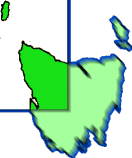
Introduction Tales and Trails of a Mining Past Rail Rides, Trail Rides and River Cruises Wild Fish in Wild Places On The Edge of Wilderness

Introduction
From 1822-1833 the Macquarie Harbour penal settlement was the man-made
hell of Van Diemen’s Land and the most feared and loathed penal settlement
in the British Empire. Today, the crumbling ruins of Sarah Island
evoke a powerful history of human deprivation and mark the original site
of white man’s settlement of ‘the west’. Top
Tales and Trails of a Mining Past
 In
1871, prospector-farmer James “Philosopher” Smith discovered the biggest
and richest lode of tin then known to man, near Waratah. In the boom
that followed, the west coast was proved to be one of the most bountiful
and diverse mineral provinces in the world. Prospectors who penetrated
the forbidding west coast wilderness found gold, silver, tin, copper, lead,
zinc and iron and built the foundations of the Tasmanian economy.
Allow time to visit the region’s mining towns and villages, which retain
the character of the boom days and many of the old mine workings; explore
south of Rosebery and follow the tramway which operated between 1898 and
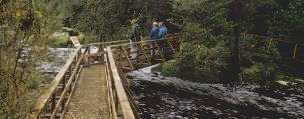
1932. Travel by foot or four-wheel-drive to Montezuma Falls, which
cascade 110 metres to the river below. Follow the course of the west
coast’s mining history on walks to Lake Cumberland in the Heemskirk Range,
to the Cornwall Range near Trial Harbour and along the abandoned Abt Railway
track between Strahan and Lynchford. Top
In
1871, prospector-farmer James “Philosopher” Smith discovered the biggest
and richest lode of tin then known to man, near Waratah. In the boom
that followed, the west coast was proved to be one of the most bountiful
and diverse mineral provinces in the world. Prospectors who penetrated
the forbidding west coast wilderness found gold, silver, tin, copper, lead,
zinc and iron and built the foundations of the Tasmanian economy.
Allow time to visit the region’s mining towns and villages, which retain
the character of the boom days and many of the old mine workings; explore
south of Rosebery and follow the tramway which operated between 1898 and
1932. Travel by foot or four-wheel-drive to Montezuma Falls, which
cascade 110 metres to the river below. Follow the course of the west
coast’s mining history on walks to Lake Cumberland in the Heemskirk Range,
to the Cornwall Range near Trial Harbour and along the abandoned Abt Railway
track between Strahan and Lynchford. Top
Rail Rides, Trail Rides and River Cruises
Settled in 1873 by tin miners, Waratah is set in a plateau surrounded
by small lakes which cascade into a deep forested gorge, right in the centre
of town. Take the winding road to Savage River and Corinna, where
Tasmania’s largest gold nugget was found. Cruise the majestic Pieman
River. Ride the Wee Georgie Wood, a small gauge steam railway near
Tullah or take a trail ride around the district. Watch the local
wood turner work with Tasmania’s famous Huon pine. Immerse yourself
in history at the West Coast Pioneers’ Memorial Museum at Zeehan, one Tasmania’s
third biggest town and now one of its smallest. The Zeehan museum
provides a vivid insight into the history of the west coast miners, with
mining memorabilia, a mineral collection and rolling stock from small gauge
railways which once serviced the western mines. Drive or walk through
Zeehan’s amazing Silver Spray Tunnel, the longest hand-built tunnel in
the southern hemisphere. The discovery of copper in 1882, on a ridge
near Mount Lyell, led to the establishment of the mining settlement of
Queenstown. Originally covered by dense rainforest, the famous Queenstown
hills, ravaged by bushfires, erosion and the fumes of the refinery are
showing signs of regrowth. The Galley Museum reflects the history
of the town which still mines its rich lode of copper. Top
Wild Fish in Wild Places
 Fish
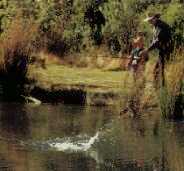
for trout in the lakes and streams of the west. Buy a licence and
take a guided tour to lesser-known spots, or cast a line at Lake Rosebery
or Lake Burbury or in one of the hundreds of rivers and streams in the
region. Take to the sea with a rod and reel for some of the best
saltwater fishing in the state, or dive for crayfish when in season.
Top
Fish
for trout in the lakes and streams of the west. Buy a licence and
take a guided tour to lesser-known spots, or cast a line at Lake Rosebery
or Lake Burbury or in one of the hundreds of rivers and streams in the
region. Take to the sea with a rod and reel for some of the best
saltwater fishing in the state, or dive for crayfish when in season.
Top
On The Edge of Wilderness
 Overlooking
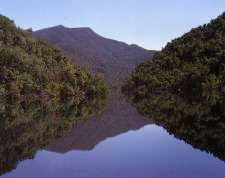
the second biggest harbour in Australia, the fishing village of Strahan
is the launching point for cruises on the magnificent Gordon River.
Visit the Strahan Wharf Centre for a closer view of the region’s early
history and an insight into the conflicts which led to the creation of
a magnificent national park.
Overlooking
the second biggest harbour in Australia, the fishing village of Strahan
is the launching point for cruises on the magnificent Gordon River.
Visit the Strahan Wharf Centre for a closer view of the region’s early
history and an insight into the conflicts which led to the creation of
a magnificent national park.  Watch
fishermen unload the catch of the day - crayfish, scale fish and abalone
- served as counter meals in pubs or at restaurants in the village.
Try fresh Atlantic salmon farmed at Macquarie Harbour. Ride along
Ocean Beach on horseback or take a guided tour of the Teepookana Plateau
to see Tasmania’s Huon pine history. Take to the air in a sea plane
for a spectacular wilderness flight. Follow the boardwalk to Nelson Falls,
just half an hour’s drive from Queenstown, into beautiful rainforest.
Stop at lookouts along the Lyell Highway on your way to Lake St Clair for
a less strenuous view of a World Heritage wilderness. Or push adventure
to the limit on the wild waters and rugged peaks of the Franklin-Gordon
Wild Rivers and South-West National Parks. Top
Watch
fishermen unload the catch of the day - crayfish, scale fish and abalone
- served as counter meals in pubs or at restaurants in the village.
Try fresh Atlantic salmon farmed at Macquarie Harbour. Ride along
Ocean Beach on horseback or take a guided tour of the Teepookana Plateau
to see Tasmania’s Huon pine history. Take to the air in a sea plane
for a spectacular wilderness flight. Follow the boardwalk to Nelson Falls,
just half an hour’s drive from Queenstown, into beautiful rainforest.
Stop at lookouts along the Lyell Highway on your way to Lake St Clair for
a less strenuous view of a World Heritage wilderness. Or push adventure
to the limit on the wild waters and rugged peaks of the Franklin-Gordon
Wild Rivers and South-West National Parks. Top
