HOME Click Here to Return to kennetheasley.com
Ecuador and the Galapagos Islands - May 10, 2002 to May 20, 2002
Note Place Cursor Over each Small Image When it is Towards the Top of the Page.

Galapagos Shark JW Stewart photo
Shark close-ups
- While photographing sharks the only problem was that they were
- so close-in that they would not fit within the frame.
- Many shots were passed up of just a partial-shark close up.

Green Sea Turtle JW Stewart photo
Endangered Green Sea Turtles
- While these turtles are endangered they are more abundant in the Galapagos
- than anywhere else on earth
- They were seen on most dives, sometimes in large numbers, and would often
- be curious enough to make a close pass.
- During the night dives we often encountered ten or more of them sleeping on the
- bottom or groggily swimming about after being awakened by our lights.

Hammerhead Shark approaching
- The Scalloped Hammerhead Sharks were most often seen when we were diving off
- Wolf and Darwin Islands. Although we did see them throughout the trip.

Hammerhead Shark in the Blue Water JW Stewart photo
- We began many dives begin by swimming along a wall but after a while
- we'd let the current take us straight off into the open "blue water".
- There we'd encounter Sharks, Mantas, and large schools of Jacks.

Hammerhead Shark JW Stewart photo

Hammerhead Shark profile
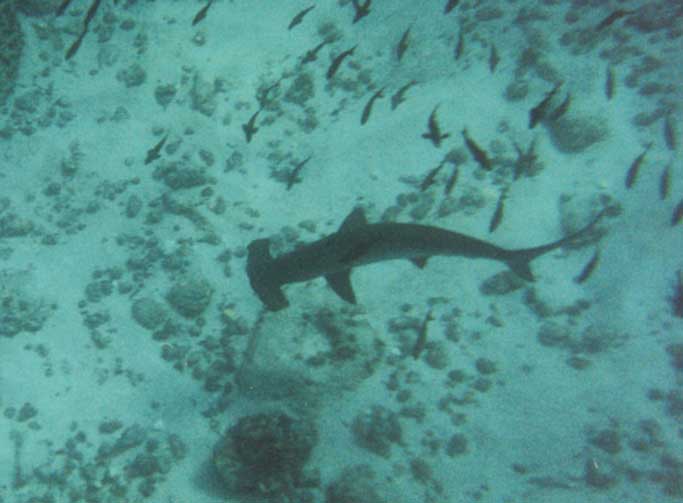
Hammerhead Shark below JW Stewart photo
Safety Stops
- At the end of every dive a "Safety Stop" is recommended.
- This is a 3 to 5 minute stop at 20 feet to allow one to decompress.
- In the Galapagos we'd often notice Hammerheads circling below us during these
- stops and while waiting for the Panga to come pick us up at the end of the dive.
- I'm sure they were only curious.

Hammerhead Sharks in school off Wolf Island
Too many to count
- While diving off Wolf Island we sometimes encountered Hammerheads in large numbers.
- Particularly in the early morning or late afternoon hours when they feed.

Moorish Idol JW Stewart photo
Tropical fish
- While not a tropical coral reef habitat the waters of the northern islands in
- the Galapagos are warm enough to host many strictly tropical fish.

Moray Eel JW Stewart photo
Daytime hunting
- In most parts of the world Moray Eels hide during the day and come out to hunt only at night.
- In the Galapagos they are out during the day, and like most of the animals there,
- move about without fear.