
 |
 |

|
|
| This is a beautiful Cichlid with a silver body and a dark lateral line from behind the eyes, into the caudal fin. The dorsal fin has a faint dark stripe at its base and is marked in yellow. The caudal fin is yellow with white trip, as is the anal fin. The pectoral fin is bright yellow. Agassiz's Dwarf Cichlid from the middle Amazon region are peaceful (except when spawning) and were suitable for a community aquarium. The average male grows to about three inches, his mate is only about two inches. They are not difficult to sex. The female's fins are somewhat shorter, rounder and more uniform color. The aquarium should be set up in a manner suitable for most dwarf cichlids. They will thrive on a variety freeze-dried foods, which can be alternated occasionally with frozen or live foods. Agassiz's Dwarf Cichlid is an Apistogramma spp. from the Amazon basin. The body is elongated and the fins are long-based and pointed. These cichlids are generally peaceful but will claim and defend territories. | Provide a well-planted aquarium with lots of caves and hiding places. Tank size is not much of a concern with such a small fish. Strong filtration and regular water changes are beneficial. Agassiz's Dwarf Cichlids are omnivorous and should be fed accordingly. Both live and prepared foods are relished. Vegetable matter much me supplied in their diet in order for the fish to thrive. Feed a varied diet. These Cichlids appreciate an acidic pH of around 6.5 and a dGH hardness of up to 10. Keep the temperature at a reasonable level between 75-82 degrees F. Male fishes are larger, with more brilliant colors and flashy fins. During spawning season, females will defend their territories against each other, but allow males to invade for breeding. One male may spawn with several females within a certain area. Apistogramma agassizi: Common name: Agassiz's dwarf cichlid. Requires a pH of 6.5, & a hardness around 102ppm. Reaches size of 8 cm, housing should be about 20 gallons. Half plants, half rocks & partly shaded. Temperature range of 76° F. Community/aggressive fish, eats live foods. Egglayer [Appearance 5] [Hardiness 3] [Temp. w/others 3] These fish are very colorful when they are adults, juveniles less colorful. | 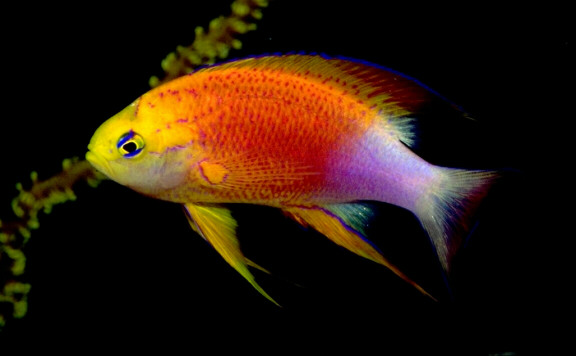 |
|
|
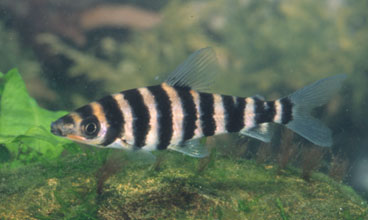
| Although a few members of this family are regularly seen for sale in the aquarium market, there is little information available in print about the various Leporinus species. Part of the larger group known collectively as Characins, all Leporinus are members of the smaller Anostomidae family. Anostomaide are predominately herbivores, originating in the swiftly moving rivers of South America. Also in this family are the headstanders, which bare a similar body shape and food preferences. The name Leporinus is of French origin, meaning "little hare". Close examination of the fish will explain why they were given this name, as they have two prominent front teeth much like a hare. Tolerant of other fish, most live in schools but are known to quarrel among themselves from time to time. This is particularly true when kept in small groups rather than large schools. Not all Leporinus carry the distinctive yellow and black stripes seen in the species most often carried in pet shops. However only the striped varieties Leporinus fasciatus and Leporinus affinis are usually offered for sale. Closely resembling each other, the primary difference is the shape of the caudal fin and the number of stripes. L. affinis has rounded caudal fins and displays nine stripes. L. fasciatus has pointed caudal fins and ten vertical stripes. Some specimens of L.Fasicatus will display a dusty red color on their throat, which is a specific to that species. |
In nature they live in rocky river beds, and are accustomed to strong currents. Because a strong current is important, the use of a power head is recommended. Like other Anostomidae they position themselves head down in rocky clefts and fissures, and should be provided with similar conditions when kept in an aquarium. Sand or fine gravel can be used for substrate. Care should be taken to use a tight fitting cover to prevent the fish from jumping out of the tank. Live plants will be eaten with zeal, so use plastic plants or keep to the sturdier live plants such as Java fern. The water should be kept on the soft and acidic side. Keep in mind that when fully grown this fish reaches a foot in length, which means it requires a large aquarium (55 gallon or larger).
|
 |
| Originating from South America, the Cardinal Tetras are peaceful and active and are best kept in a shoal of five or more. Mid-water feeders, they are related to the Piranha and has as many teeth! They can grow to about 2 inches (5cm) in length and are similar in appearance to the neon tetra but their red stripe extends the full length of their body. They thrive in acid water (pH between 6 and 6.8) with a temperature range of 24 to 28º C. Cardinal tetra has got a full red coloured lower body extending from below the eyes to the tail. Neon tetra has only got half its lower body in red. The maximum size of an adult C. Tetra is 5 cm whereas a Neon tetra is 4cm. There is an attractive blue-green iridescent stripe on the upper body. Females are generally more robust, males are smaller and slimmer. | C. Tetra is found in small rivers and pools in the Amazon, the basin of Negro river, which are soft water based. The fish is best kept in schools of six or more. Avoid fresh tap water as these fishes are more at home in a soft water environment, tap water usually contain "hard" trace elements. Filtered water through peat will yield the suitable composition and gives the tank a "tinted" look which highlights the fish fluorescent colour. C. Tetra will be most at home in a fully planted environment. These fishes occupies all levels of the tank and will feast on any kind of food, dried or live, especially small flying insects. C. Tetra are very particular about spawning conditions. It's recommended that the water to be very soft and slightly acidic (pH 6.5) with temperature at 23-24 degrees Celcius. When the female becomes swollen with roe, the breeding pair should be placed in a planted tank with lots of fine leaved plants. Spawning begins with an active chase through the plants. 100-130 non-adhesive eggs can be produced during one spawning session. The adult fish should be immediately removed and the spawning tank covered (sensitive to light) until the eggs hatched, which normally occur within a day. Increase the light exposure slowly in days and feed with sifted egg yolks, be careful not to foul the water. The same general care is applicable to Neon tetra. Be careful not to mix these fishes with other bigger fish which can swallow these poor midgets in one gulp. |  |
|
|
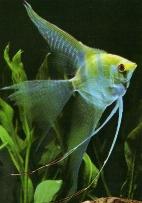
| The scientific name for the freshwater angelfish is quite descriptive. Pterophyllum is derived from the Greek word for "winged leaf" and scalare means "like a flight of stairs" in reference to the dorsal fin. It is a Latin word that can also mean "ladder". Angelfish are laterally compressed or look like a disc on edge with long fins coming out of the top and bottom and have 2 'feelers' in front of the anal or bottom fin. The tail is vertically oriented and may be ffrom scoop shovel shape to long and relatively narrow depending on the variety. Live plants should be included in all freshwater tanks. Water quality is monitored by live plants as they will look sickly before the fish die, they aid in keeping water clear, hinder growth of algae and add Oxygen to the water. Broadleaf aquatic plants are favorites of Angelfish for laying their eggs on. Amazon Sword Plants (Echinodorus) are in a genus that embraces more than fifty relatively hardy and adaptable species, most of which are native to the flood plains of South America. They prefer water that is neutral or slightly acid and not too hard making them perfect plants for your Angelfish tank. |
Angelfish can survive on flake food alone, but they will thrive and be much more apt to breed on a greatly varied diet. Live foods such as Adult Brine Shrimp, Black Worms, Mosquito larvae, finely chopped earthworms and Guppy fry are accepted with enthusiasm and should be included regularly. If live food is not available, frozen packages of Blood Worms (Midge Fly larvae), Brine Shrimp and others are available from your favorite pet supply store and are acceptable substitutions for the live food. There are many dried foods available that will suffice too. Raw beef heart, finely ground, mixed with unflavored gelatin and frozen immediately in small one serving size pieces is a good and economical addition to your Angelfish diet. Be absolutely sure there is no fat in the meat. The minimum size tank for a breeding pair of Angelfish is 15 gallons, but should be 25 gallons or larger if you plan on leaving the fry with the parents. As you can imagine, a fully grown pair of Angels with 200-300 fry to herd around would be pretty cramped in anything smaller. Another plus to having a larger tank is that there is a better feeling of security in a larger tank and the parents aren't as apt to eat their eggs or young. The best way of assuring yourself at least one young pair is to choose 6 perfect specimens from a large tankful of young angels. This method is less expensive than buying proven breeders that may be near the end of their breeding careers anyway. |
|
|
|
| When preparing to buy 6 Angelfish, take your time to study the fish and select only those with straight top and bottom fins and perfect 'feelers' without any bowing or bends in them. They should be strong, robust and active. Angelfish that are active feeders mean they will grow quickly, and have a high rate of egg production in the females. Do not buy fish from a tank with either dead fish in it, with fungus or parasite infestations. Resist the urge to 'come to the rescue of the little ugly duckling' because it will only grow up to be a big ugly duckling and will be totally unsuitable for breeding purposes. Be extremely picky with your breeder selection and you will be rewarded with beautiful fry. Once you have carefully selected your 6 potential breeders, they can be set up in a 20 gallon tank minimum to grow up in and to finally pair off. If they are fed well with a good selection of live foods, they will grow quickly and reach breeder size rapidly. One sure way to acquire a true breeding pair of Angelfish is to purchase a proven pair from a breeder. When you purchase a pair this way there is always the possibility that they are at the end of their breeding career. |

