
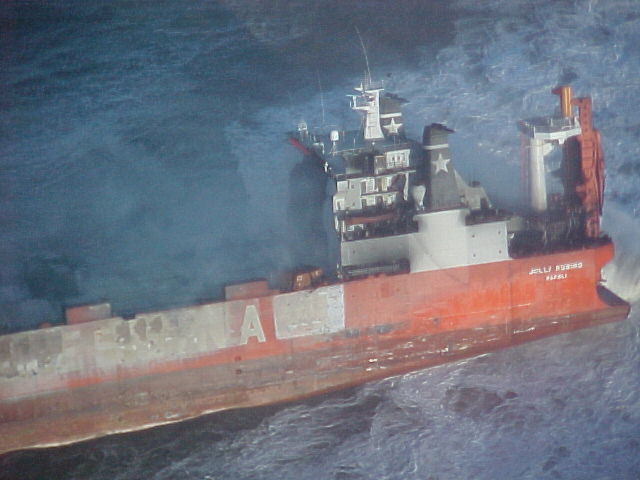
 Above : The stricken hazardous cargo ship The Jolly Rubino
The Definitive Resource For Junior Engineers
Chemical Engineering Project
Click here for Chemical Engineering Data, Notes, etc.
______________
TACKLING OIL SPILLS
Dispersion, Gelling, Biological Agents
TACKLING OIL SPILLS
(Compiled by K Naidoo, N Ramlutchman, D Pillay)
The following information was kindly supplied to the Project Team by Smit Salvage - a subsidary of Smit International, courtesy of Nick Sloane & Fred Burgmeije.
Visit them on the web : http://www.smit.com
The Jolly Rubino - An Overview
The "Jolly Rubino" caught fire on the evening of the 10th September in the engine room. The crew was forced to abandon the vessel and she was drifting approx. 20 NM offshore of Richards Bay in a severe SW storm. Within 2 days after two attempts to board her she grounded approx. 1 NM North of ST Lucia lighthouse and she was still on fire. After several attempts to board the vessel to do a refloat attempt the salvage team learned that the vessel was tidal. An oil removal operation was setup and at present the salvers are still struggling to get the HFO, DO, and Lub. Oil of the vessel. At this moment there were approx. 22 containers in a reasonable state and approx. 15 containers heavily burned and melted on the bow.
The containers on board identified :
- Voranate 2 160 drums
- Fungicide 2 1280 x 25 kg bales
- Methanol 2 160 drums
- Ethanol solutions 2 160 drums
- Ethyl acetate 1 80 drums
- Methyl Ethyl Keton etc. 80 drums
- Thinsol 5 400 drums
- Acetone 4 360 drums
- Vinyl Acetate Monomer 3 240 drums
- Hides 1
- Calcium Tartrate 1
A lot of the barrels in the container and on deck were damaged, burned or empty. In the containers, barrels were spotted which seemed to be in a reasonable condition. It was hard to say about the amount of liquid or intact barrels. The heavily damage containers close to the bow had some general cargo inside such as Nissan Hard body's, Cotton and Wax. On the port side of the deck were containers stowed loaded with Phenol drums. The containers are overboard and a number of unidentified barrels are present on the deck.
THE FOLLOWING WAS THE ACTUAL CARGO REMOVAL PLAN AS SUPPLIED BY NICK SLOANE OF SMIT INTERNATIONAL
Cargo Removal Plan
Phases of work
The work will be executed in four phases:
- Recovery of hazardous cargo from casualty deck;
- Air transportation of hazardous cargo to destination transfer facility;
- Road transportation to designated temporary storage facility;
- Transportation and Safe Disposal of all waste products. Phase 1: Recovery of hazardous cargo from casualty deck. A 15 man team will start working as soon as all permits are received, and the reception area located, and precautions taken. The precautions that will be taken consist:
- Suitable PPE for the chemical expected to be present; § Doctor and Hospital on stand-by;
- Chemist present;
- Safety officer present;
- The work will be done in a 3 shift cycle (work, rest and stand-by);
- In case of spillage we can transfer drum's contents to new drums or isolate the spillage by absorbents;
- After the actual "work" cycle proper decontamination will be done.
The removal of the barrels will be done in the following steps:
a) First the empty barrels in front of the containers will be roved from this area and the barrels on the starboard side in front of the containers. These barrels have to be removed first because no one can tell which chemical was in these containers. All though that most of these drums are empty they will be checked if there is any residue left inside. If a residue is found our chemist will take LEL readings and samples of the chemical and determine which chemical this is.
b) All the barrels on deck will be handled as a PHENOL due the fact that this was the most dangerous chemical in that area. If a residue is found the barrel will be loaded into an oversized drum and closed down. After this the barrel will be decontaminated with seawater and the barrel will be loaded into a drum carrier. As soon the drum carrier is loaded MI 8 helicopter will arrive above the drum carrier and will be hooked on.
c) The drums with contents, which are in a reasonable state will, handled with care loaded with a small lifting device into the drum carrier. If the barrels are too damaged they will be lifted in a oversized drum or pumped empty with chemical pumps.
Phase 2: Air transportation of hazardous cargo to designated transfer facility. The chopper will arrived above the pre-slung (certified) and lift the drum carrier from deck. Then she will follow her approved safe flying path to the reception area, approx. 9 miles South from the casualty. Then the drum carrier will be landed onto a prepared safe "hot spot" area.
Phase 3: Road Transportation to designated temporary storage facility. The safe area will be prepared at Stockpile 12 for the handling of the drum carriers. An area of approx. 50 x 100 meter will be bulldozed to create the safe area for handling and landing the chopper.The GPS position of the receptions area is ………. At the location where the drum carrier will be landed two protected chemical sheets will be buried under the sand. The safe area approx. 25 square meter consists of a layer off sand, plastic, sand plastic and sand, to prevent that any spillage will enter the soil. The barrel carrier will softly lowered down onto that area and rechecked for drum emptiness and/or tightness, before it will be loaded onto a truck. If no traces of chemicals were found the truck will depart to a dedicated receiving area from HAZMAT. From there they will be transport either to the chemical plants or a dumping area. The road transport from the reception area to the receiving area will have an escort.
Phase 4: Transportation and Safe Disposal of all waste products: The transportation and disposal of hazardous cargo will be undertaken at the earliest possible opportunity. This will, comply with all relevant legislation with regards to the road transportation of disposal hazardous waste. Communication: Prior to the hazardous waste removal process, the Richards Bay Fire and Emergency Services will be informed in writing of the salvage team's operational plan, in order to find their approval and assistance in the event of emergency beyond the control of the team in place. All relevant authorities and the Fire Department will be informed when the process is complete.

