^/\^ PeaK /\^/\
What's new... is old again
October News
Oct 31, 1998
Guillaumes' of PHS has a image of the day generated by different
3.5/4 generation cards on his
main page.
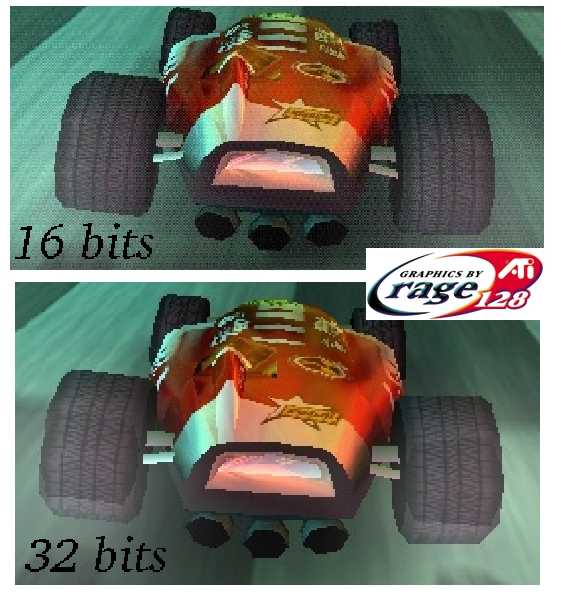
Here are direct links to graphics dumps in 16 bit mode
and in 32 bit mode
that are about 260K and 400K, respectively. To save you time,
I have magnified and merged identical sections from each 16 bit and
32 bit "Dethkarz" image into
one 42K image
and used JPEG compression of 50% to
reduce the file size to 42K.
Before looking at these images you should put you machine
into 32 bit mode. Linux users can do this by invoking X11
using the following sequence: startx -- -bpp 32 .
Note the detail in the shadows around the muffler and the lack of pixelation
in the gray colour tones used in the texutred map. There is less banding/lumping
of colours as they transition from dark to light regions of the car painted
with the same colour. In actual game play with typically sized monitors,
the differences probably do not matter much but the Rage 128 is architect
so that no performance penalty will result when going to 32 bit mode under
OpenGL Workstation class apllications.
Thanks in
advance, Guillaume.
This last week I have a level of energy within me return that I have
not had in three years. I have been one of those lucky
people with the good fortune of never had a headache in school or work
until about 1994 (35 years).
People talk about sudden alergies developing and possible links to that
"new" carpet in the office.... I have no rational explanation for
my malaise but it also coincided with an overall drop in "energy".
The reason: a good night's rest. In fact, make that three in a row.
I am still comparing notes with my wife to see what it is exactly but
I have been trying different forms of relaxation/meditation strategies in
various combinations over the last little while so I'll give you the dissected
Western scientific "view" after running a few more human guneau pig experiments
on myself. May I wish you God's sleep John Glen.
For me lack of "sleep/stress/worrying/lack of productivity/
mid life crisis/right of passage" are all words to describe the same thing.
It been a focal point of discussion between
me and my older brother but the essence is the inability to concentrate
and to feel energize. I like to thank him for lending more
than a ready ear. The experience has had its good points
(yes it seemed to get worse before better) and I can now understand
better why people get "grumpy". I'll keep you up to date on the experiment
and will open up a new "hidden" page for those are going through a
similar "time warp". Yes it is embarassing when close friends detect
a difference in the person they thought they knew. I have said it
before "it is easier sometimes to tell total strangers on a bus your deepest
darkest secrets" ...so to all my acquaintences reading this stuff...SCRAM!
The first Direct Broadcast HDTV transmission will be in
November. This format has
equivalent resolution to that of a 35mm slide projected on to a screen.
As someone (Gordon) at ATI pointed out, HDTV necessitates an architectural
decision to support it via high bandwidth DVS port and a 1440 wide overlay
(vs 800). Currently only the Rage 128 chip can make this claim. HDTV has been
around for the last decade but North American standardization deviated from
the proposal initiated in Japan for legacy issues and to buy development time
for them. An RGB monitor, though small, is an output device capable of displaying
the enhanced image quality.
The Rage Theatre decode (input) provide and extract the signal
from your Cable, Camcorder, Digital camera NTSC output and whatever
it misses will be digitally filtered and outputted for viewing or stored
for archival/editorial purposes. On a really good TV, images generated from
a Camcorder will have an almost HDTV-like quality due to higher bandwidth and
lower noise capability of the video-in path.
A lot of OEMs are still including the Rage Pro in their premium
450 MHz BX based systems...Why? The Rage Pro has always had great 2D performance
and greater than VooDoo 3D performance with P2-233 Mhz processors. This level
of 3D performance is not too shabby but the silver lining lies in the
added performance increases that OEMs will see in soon to be release
final performance drivers (i.e. Lonsdale). It is a cost effective and
stable design and
the architecture continues to be able to scale with CPU speed increases.
A recent comparison of all existing 3.5/4 generation chipsets
shows one interesting fact....all of the chips required a heat sink and also
ran hot. The ATI Rage 128 was the only chip to run "naked". Take a
look at EndUser's 3D comparison ,
as well. For user's who cannot wait for the Mondo col features of the
Rage 128, go out and buy a BX motherboard (Some popular Socket 7
boards will not work...or will
be crippled to limit current draw in the driver/bios), a TNT board and a
big FAN...but you may have to wait for some of the software like
Quake 3/Arena to appear before you can sort of justify your impulse buy.
Wouldn't it be easier justifying business OpenGL apps, HDTV, DVD
and AC-3 compatability to your home theatre instead
of just a framerate number of greater than 25 to your better 1/2 ?
It also keeps the coffee warm :)
GL-Quake code has recently been recoded/redefined
to support multitexture as an
extention in a more robust and general fashion in 3.19 as
compared to the 3Dfx targeted implementation found in earlier code.
The effort for OpenGL has been on CAD/ICD and away from Quake but expect
to see ATI react to this Quake OpenGL release. Perhaps for 5.3 ?
ATI software engineers have working
with UnReal to sort out advanced 3D support issues like multi-texture support.
ATI now has a mature OpenGL team sorting out the Worstation
CAD application program problems with acknowleged
bugs in the newly minted SGI/Micorosoft OpenGL codebase. The turnaround
from Microsoft is not surprisingly...wanting/trying and even
driver developers have to fit into their release scheduels.
3Dfx may continue to have
the fastest subset/mini-GL/games-only/ OpenGL for Quake
due to early participation/co-development but you will never see
a mainstream Workstation OpenGL based program run on their hardware. The Rage
128 has already caused more that a few dropped jaws as OEMs continue to drop
their favourite OpenGL programs in and run them with barely a hitch.
Oct 24, 1998
Rage Theatre was demonstrated on a large 26" Gateway monitor and the bandwidth
and low noise level blew every other NTSC decoder out of the water. It was
outstanding at picking out very weak signals and attenuating very strong signals.
This companion chip is 2nd generation material.
I have re-installed the link to Guillaume's article on the Rage 128
preview. Since then he has posted a number of screenshots
of Quake at 1600x1200/1280x1024, Motorhead and Flight Sim at 1280x1024,
Incoming at 1024x768 and a Professional OpenGL CAD package called
LightScape at 1280x1024 at
the following site
Ask a Ferrari owner if he like a bit more room in the back seat and he
probably respond "Take away a few horses and give me higher ground clearance,
more trunk space and for your information...I do not have a back seat".
I have been reading reviews of competing graphics products around the net
would have to say that some of thoughts/threads that I have subscribed to
are more in evidence. I never would have thought that Thomas Pabst would
argue that 25 fps is
more that adequate
but it happened.
Alan Cole
has enough inquisitiveness in him to have tested every graphics card
under the sun but not to an extent that his eyes
have become bloodshot and glazed to the framerate counter. He brings
a clarity of thought to the review process
that allows him to be just slightly
"ahead of our time". He has me convinced on the merits of DVD. The hardware
assist ATI put into RagePro chips over a year ago now allows it to run under
a Pentium II 233 CPU at 30 fps without a dropped frame.
Pentium 166/200 MMX units lack "write combining" which is used extensively
to speed up Operations. Their are plans to have write combining added to
the AMD operation set in the future, so a socket 7 solution will be available.
Logistically, even a high end processor will have about 1/2 of its CPU usage
gobbled up by this DVD processing so it probably makes sense in the future to
offload the processor using dedicated hardware. The size of a heatsink on
a 450 Mhz Pentium CPU is getting ungainly.
The visual
quality of DVD is a quantum leap above TV output and a CRT image gives us
a glimpse of what HDTV TV is all about....think 35mm slide quality.
It is easy to overmargin a chip for
just 3D performance (by adding extra pipeline stages to meet timing)
but the tradeoff is extra heat
and lack of silicon area for other useful features.
The
production driver development is ready and when all is said and done,
the "3D FerrariGauge" will be part of the overall excellence of the Rage128.
I leave it to the media to educate themselves about why "two Voodoos w'ont do"
if one is sufficient to play and to delve a bit more into broader
implications and uses of video and graphics information.
The silver lining for those who stick with ATI
will be Workstation business-solid OpenGL drivers, Broadcast TV support via Genlocking,
Hardware DVD decode assist, HDTV companion products, and performance
OpenGL via hardware direct walk of OpenGL vertext lists.
What you will not see in the reviews for a while "RealWorldGauge" which in
my book puts ATI in a select class on its own. Expect similar promises at Comdex
as competitors re-think their video chipset offerings, alound.
ATI has already shown all of the above in action in September and the polish
at COMDEX should be impressive.
Expect to see the generation of computers that IBM, Sony, Fujitsu, Compaq
HP, and Dell want to release in the near future pass a bit on the
"FerrariGague" and wait for ATI on the "4x4Gauge"...I got my fingers crossed...just
in case. You should be seeing independent benchmark testing very soon from
major PC magazines.
Here is a Rage 128 Preview
translated to english of an article originally from
http://france.gagames.com/tech/rage128.html. Quake 2 startup screens
and screenshots together with a morphing sequence from "Rage Dawning" illustrate
the better realism (this is what it is all about...not frame rate) show
a morphing sequence already coded to take advantage of the second rendering engine
and speed of Rage128. Solid fourth generation 3D hardware and software and the only chip to have
next generation multimedia hardware part. Refinements in the HDTV and hardware
assisted DVD decode take a bit longer to debug/refine but this should be your
last hardware upgrade
for a "longer while" than even the Rage Pro longevity that
continues to be driver-refined and have legs. ATI should be releasing an updated view
of when products will be hitting the shelfs.
The acquisition of Chromatics
puts ATI in a rare group of companies that will be able to selectively merge the
inherent programming flexibility of DSP approaches into audio, video,
and graphics. It will be a killer combination. The hardware architects are already
wispering to each other on how to ease the programming
model of existing Chromatics's hardware . ATI should be able to put Chromatics over the hump
of their "close but no cigar" architecture which captured the mindset of
the computer industry in the early years. This is a significant acquistion...make
no mistake about it.
A couple of new ATI/Rage centric sites now exist at 3DRage and
3DXTC .
Oct 17, 1998
Today marks the one year anniversary of my mom's
passing away.
The past year for
me has been one of four day work weeks to partly sort out the
dimishing internal rage I felt against the timing of life's
events. Just like others in her circle, I wished we could have laughed,
eat, cry, talk, travel....more, or in short, "live" more with her.
Her legacy will always be that giant heart that was born
in an era that stood her well till that fateful day last year when
she went in for her "routine" surgery. In hindsight,
my penance took the form of a step back from
life's day to day battles, a lack of caring, and a lack of passion...for
I did take her for granted.
I have come to rely and in some cases fully depend on individuals at my work
place to steer and define work which I used to be responsible. Their growth
and development is my reward and I would like to thank them.
I still need to rekindled old friendships,
to build new ones, and to experience it in its infancy. Thanks for the
memories Mom and I do hope you have an especially great day today...remember to
give me one of your smiles any time you think I'm feeling sorry for
myself and I promise you a better report card for next October...at
least a "C" :)
See the November 1998 article on the Rage 128 by Greame Bennet on
A closer look at the world's "fastest" graphics chip
Here are two pictures from Rage Dawning showing
complex highlights rendered by the Rage128 chip.
The mountain scene
shows a lot of detail. I added three more links for new Rage 128 articles.
More reports about TNT running extremely hot.
Oct 11, 1998
I have made some simple adjustments costing about $2.00 that have
cleaned up the sound of the Radio Shack Optimus LX-5 speakers.
Take two straws and cut them into four 1.5" sections and place them in
the smaller right hand port and flush with the baffle.
This seems to clean up the lower midrage and tighten the bass.
Lepage's now sells something called FUN-TAK which is a cross between
plasticene and glue. Cut off four 1/2 inch squares and place on the bottom
corners of the speaker to attach it to a stool/speaker stand. This seems
to get rid of any interface resonance. The result is greater dynamics and cleaner
sound at higher volume levels. I put on Loreena McKennit's "Arnachie Gordon"
cut from her "Parallel Dreams" album and there were shivers everywhere.
The speakers do need to be run in and seem to become sweeter as I
play them more and more. Still no low bass but what is left now very
coherent and interesting to listen to. Amazing !
Read Tom's breakdown on Intel's roadmap and things are confusing in
processor land. It seems as if the different system architects
at Intel have had different views
about which way Intel should be heading.
Klamath was their 0.35 micron core used on P2(233 to 300).
Deschutes was their 0.25 micron core used on P2(333 to 400) that is also
used as the Celeron core minus the L2 cache.
The result of having cache run at 1/2 the CPU clock frequency has resulted
in a overall throughput hit in cache operations such that the ranking
(from fastest throughput to lowest) is p2-300, p2-333, and p2-400.
The new Celeron 300A and 333
seem to be units which would be perfect for Socket7 deployment
with built in cache that would avoid the severe board layout requirements
inherent in older designs that used external cache integrated into the
Slot-1 board.
Remember the PentiumPro ? It was just a chip that was ahead of its time.
It seems like some of the new chip cores used in Celeron will be punted
into the Pentium II and Xeon(next generation PentiumPro) chips to
get around the multi-chip modules comprising a Pentium Pro.
It is very confusing that Intel introduced yet another slot for the
Celeron that will prevent it from being used with LX or BX chipsets.
I'll put down my thoughts on this whole situation some time in the future
but for now I still like the way-cool compactness and efficiency of
the Socket-7 design.
About a month ago (Sept 12 news) , I mentioned long term reliability of
video chipsets and the new trend amongst manufacturers of overclocking
chips at the expense of
reliability/heat. Intel pioneered this
trend with the advent of the i740 and others have followed suit.
Since then I have been contacted about G200 been too hot to touch
(can you leave your finger on the chip for 5 seconds without removing it)
and failing in systems that do not have the system fan blowing towards it.
The Nvidia TNT is supposedly so "current" hungry that ASUS AGP motherboards
fail
to power it up. Because there are current limitations specified for
cards running in AGP slots and in PCI slots, you might say that the card
is borderline non AGP compliant and non PCI compliant .
Currently guidelines exist about powering up and down when a card
consumes more than 10 watts in the PCI specification. Apparently,
the TNT chip consumes on the order of 15 watts (5A)
reported in some
of the newsgroup threads along with reports of
overheating.
The Rage 128 is already successfully running
on the P2L97 platform that has highlighted this issue.
A great stride was taken up by ATI last week in the area of hardware
multimedia
development in the prototyping labs at ATI. You will have to wait
until further comment from ATI on this development.
Oct 1, 1998
Bought a pair of Radio Shack LX-5 speakers with the much raved about
"Linaem" tweeter just before going to a dinner engagement last night.
It was worst than waiting for a Santa Claus to come down the chimney.
I fired them up this morning and the upper-mid to treble region is
about as good as I have heard. The problem is that the critical midrage
is a bit off. A quick look at the crossover and it seems to be of
good build (film capacitors and air core inductors) so simple mods
are probably not needed and will not get you up another grade.
The prior generation units (LX-4...now discontinued :( ) got rave reviews
but they also had a Kevlar bass unit which is now replaced by a less
expensive unit that does not quite match the tweeter. More later.
They are on sale until the end of October for $80, Canadian, each.
Not bad but I hear that the PSB Alphas go for about $50 more for the pair.
They beat the Minimus 7's that I bought over a decade ago hands down.
After having played through all my relevant CD music, I'm going to keep
these little babies. I could live with them for the next 3 months without
touching them but I'm getting itching just reading what others have to say
and have done to these LX-5 units:
- LX-4 predecessor and modifications that started all this
- Image of LX-5 at this site
- LX-5 reviews
- Crossover/speaker
mods
Septermber 98 News
~
Sept 30, 1998
In Germany, Helmut Kohl woulld have less purchasing power
that the average North American even if he was re-elected.
The All-in-Wonder Pro is routinely sold out. The recent release
of DirectX 6 has revealed bottlenecks in the 3D processing to be primarily
in the DirectX side of things (50% increases in frame rate). With Multi-texture support now offered in
DirectX, expect patches for games to gain another 30% or so.
With 3D performance at this level, over 50% of of the leading laptop manufacturers
have been opting to put in low power versions of the Rage Pro (LT Pro) in
their portables taken advantage of built-in low EMI panel interface
called LVDS and taking advantage of the built-in TV-out.
Current graphic card reviews are pretty much the same except for the
CPU dependence (Quake fps, Forsaken fps, screenshots) due to the relative
inexperience of reviewers concerning Intercast, Web TV capture, camcorder
capture. For a taste of why OEMs are choosing Rage Pro as multimedia ready
technology of choice in the era of DirectX 6...take a look at this "all media"
All-in-Wonder Pro review
running under a Super 7 board with a AMD K6-2 CPU.
Foraken at 1024x768 plays near 30 fps....this means that if games are optimized
appropriately for DirectX 6 and written for multi-texture support, next
generation visual improvements in visual quality (1024x768 playback,
multi-texture coding) are here today in the Rage Pro. Xpert@Play users can
upgrade to a All-in-Wonder Pro by purchasing the ATI-TV tuner. If only
all of Germany could be so lucky.
Sept 27, 1998
Despite what anyone out there will tell you, the transition from
0.35um to 0.25um is a difficult one for anyone wishing to come up
with a high speed and low cost solution that fits in
a variety of platforms with high reliability.
There is no such thing as a direct shrink.
Some chip manufacturers are having difficulty already with
smaller designs at 0.35um and deal with it by
either dropping
5V PCI support, handling only single data rate interfaces, or
by sacrificing memory footprint.
Alliances with developers to date have already shown how
quickly the power and maturity of
the new architecture can be harnessed in process-taxing demos
"Rage Dawning" and "Any World" which have real-time
morphing and walk-thrus. These demos look like logical
successors to "Final Reality" demo/benchmark.
Virtual hardware in the form software emulators and register specs
now enable software developement for Rage 128 ahead
of sample silicon. Developers are already busy as
it is trying/learning to take advantage of the multi-texturing abilities
in the Rage Pro that will offer a "bump" in performance.
Click here for a small picture of a prototype Rage 128 board. Where do
these guys get GIFs of these prototype cards from , anyways?
In the course of gathering this information and comparing this
lastest chipset, one cannot help but be whelmed by the progress
in 3D chipsets. The Rage 128 is definitely a lot more than just
about 3D graphics and games but you can be sure that TuroK, Quake2,
Forsaken, and Incoming are up and running today.
Expect to see maturation in the application game code on Unreal's part
as they learn to take advantage of multi-texturing. No longer will
VooDoo enjoy the advantage of being solely able to exploit
multi-texture hardware as graphics drivers/DirectX 6/game code are jointly
co-developed on drivers now sporting beta implementations of
advanced hardware features: Stencil buffers and multi-texture
to name a few.
It is an exciting time at ATI to see long term
efforts converge simultaneously into 8 million transistors and to then
have some of the details laid out...what is even more amazing is
the yet to be disclosed capabilities enabled by this chip
in the realm of Digital Broadcast TV and HDTV. DVD will be a highly
exploited media(data, images, mpeg, sound) that will tax video
chips and software development....the Rage 128 hardware awaits it deployment.
I'll apologize upfront for my biased enthusiasm but I hope it is
contagious for your long term benefit by having you
wait long enough (how about no later than
a month prior Xmas :) ) for its release.
In the meantime have a look at the possible
uses of TV-in/TV-out/multimedia
ports features for security monitoring, feeding goldfish, to producing
a CD-ROM multimedia high school graduation "flashback" via the
All-in-Wonder Pro. For those who persist on gaming, take a look at
Alan Dang's early impressions/review of Unreal
running under
ATI hardware with D3D, not yet optimized for extended DirectX 6 features.
Later.
A bit more about a little known feature on the Rage 128
called Genlocking.
This is a very difficult requirement to accomplish despite whatever Bill Gate's
and the PC98 specification have to say about it. The issue is one primarily
of perception. If you were to see a funny "tear" during a analog television
broadcast of say a basketball game over 45 minutes, it has been determined
that most people think there is something wrong with the television unit, just
because our broadcast standards are so high. All TVs derive their timing from signals embedded in
the TV broadcast signal. For digitally braodcasted signals
sent to computer display, the previous synchronization does not exist. Instead,
a TV signal signal consists
of a signal with a base timing slightly different from that on your
video graphics card. Over time it as if a bucket of water is entering
a bucket(broadcast signal) at one rate and leaving(VGA display) at another.
At some point they need to re-align. One inexpensive technique is to
"drop frames", This might happen once every five minutes in a well aligned
system but most people would expect better quality from a $2,000 computer
than that of a $250 TV. The Rage 128 has a unique and fully digital technique
that provides for alignment without incurring any drift in the time
base that is essential for stable monitor display. No other graphics card/chip
has it or will be fully PC98 compliant unless it does.
Here are a few more links covering the Rage 128 unveiling two weeks ago:
- PC World....Grace Aquino covers the product line.
- Electronic Buyer's News....Mark Hachman...remember Cable set-top
boxes ? Rage Pro technology will merge Internet and TV singals in
separate windows using a nice compact OS via Windows CE. ATI's
display solutions up through Rage 128 GL are discussed.
- Gamasutra...A Game developer magazine
mentions the ultra-thin driver layers and
the OnNow power down technology that allowed for a heatsink-less
and fan-less chip design. SGI has seen prototypes and offers
comments on ATI's fourth generation chip.
- RageOn 128 comeents...
Cybertitan has a 3D centric description of the Rage128 features.
I have an animated GIF of various Rage 128 prototype boards but
need to clear this with ATI for release first...in
the mean time go to the above site for a preview of a small
low res GIF image of a prototype Rage 128 board. It is green
with the standard black patches and the dreaded
heatsink are nowhere to be seen :<)
- Computer Retail Week...
Kristen Kennedy discusses the 8 million transistors with
Phil Eisler of ATI and quotes Jon Peddie on the performance
positioning of the Rage 128 relative to VooDoo2 technology.
Sept 25, 1998
The Rage 128 genus lay back many years ago during the conception of
the 3D feature set for the Rage Pro. There were individuals who championed a Workstation class
product at that time but the quick time frames led to compromises in
ultimate 3D performance due to a desire to have a better balanced product
with multimedia (TV-out, MPEG decode, motion compensation).
In addition the technology, architecture and market were not yet
in alignment to make this a cost effective volume chip.
The Rage 128
has targetted OpenGL performance supporting hardware acceleration
of common OpenGL operations such as "direct walk of Vertex Lists".
One common benchmark for OpenGL is expressed in frames/second based upon
a geometric mean of 7 tests that make up the
Viewperf CRDS metric. It is a composite of complex
image transformations submitted by independent software vendors
designed to gauge real work performance of workstations designed for
professional applications using the OpenGL 3D transform engine.
Current CRDS composite frame frame rate is on the order of
65 .
This is quite an achievement when you look at Permedia 2 ( 35 fps).
To see how this compares to workstations, click on the
following
link.
I expect a TNT to hover around the 40 fps mark but do not quote me on
this number. See also the OpenGL.org site, here.
Remember the situaion with SDRAM being overclocked and the problems
with memories running in one computer but not another. The AGP 2x version
of the Rage Pro has become one of the defacto standards used
by motherboard manufacturers in the testing and verfication
of the their side of the AGP interface implementation by virtue of
the Rage Pro having garnered the distinction of being the number one distributed
card and the number one distributed chip for 1998.
During prototyping and testing
of the Rage128, many of the motherboards were found to generate glitches on AGP lines
that could induce a variety of problems.
The fault seems to be mostly layout related as there are boards that do
not exhibit these symptoms but have the same chipset.
By the time Rage 128 boards
hit the shelf in late October with updated silicon,
you can be assured of having an interface that
is will be more tolerant of glitching than that
designed for the Rage Pro. Bottom line is that
many of the $100 boards using chipsets (LX, ALI, VIA, and SIS...BX
I think that makes up all of them)
have a lot of noise that can be cleaned up with better engineering
of traces.
The following reviews show that many of the recently reviewed and
released video chipsets/boards from
S3,
Intel-i740
and
Nvidia-TNT show
that they only work with a few select motherboards
during their benchmarking.
It is not the fault of the video card, per se,
but what do you do with the millions of motherboards out there with empty
AGP slots just waiting to be filled. In the case of ATI, add SIS
to the growing list of chipsets/boards tested. Stay tuned.
Sept 12, 1998
Just to keep up appearances with the rest of the "Rage" X sites.
Here is an
excerpt quoted
from 4th Wave, Inc on the
Rage 128. The link has been added to the Rage 128
reviews/links page. A new proposal being pushded around at VESA meetings for
Monitor Display is the VSIS standard. It comes down to tightening the
output specifications coming out of graphics cards. Much of the
push is coming from analog LCD Monitor manufacturers who need to perform
an A/D conversion on the analog VGA/XGA/UGA signal coming out.
A signals may look fine on an analog CRT monitor but new issues exists
when trying to put perform an A/D conversion in the area of output signal
range and hsync to front porch alignment. One of the ideas is to do away
with the separate digital sync and to then encode the signal into the overscan
region of the signal.
There have been recent enquiries as to what computer system I
am presently running. My system has been evolving since 1993. The case
is not made of the thin stamped/painted metal you find in todays cases but
a heavier gauge plated case that I am reluctant to change. It has a
ATI logo that I ripped of a ATI installation floppy that uses their
old byline of "Perfecting the PC". The motherboard is an Acer AP5T that
still gets the knod from me when people ask me about upgrading their
Baby AT motherboards. If they could come up with something with
Super 7 support (AGP 2X support, PCI 100 support)
instead of the ATX form factor(AX59Pro) ....I be sold.
The CPU is run off ball bearing heatsink with a series resistor to
reduce the speed and noise. It is noiseless and runs fast enough
to cool my CPU for stability. Similarly the power supply has been treated
with the series resistor treatment. The unit sits on my desk with the
case cover permenently removed. I am running a SB16 board with a 2x
CD-ROM drive that suits me perfectly fine.
(See my thoughts on upgrading) The hard drive is a Western Digital
1.2 MB Caviar that can dual boot to either Linux or Win95, with Linux
being the default....of course :). The graphics card is an early Rage Pro
card with 4MB of memory. Current projects are setting up a network to a
386 unit with a minimal install so that a client session can be run off
my current unit via X11. I am currently looking for a digital camera but have
not see any designs that are low powered enough to be interesting.
They seem to run through batteries faster than the auto-wind, auto-focus,
auto-rewind...auto-do-everything Lithium powered units....it just doesn't
click. There is currently a very good article at
ct'd.
The Rage 128 reference design has had very good success getting
a hoard of motherboards with AGP
chipsets based on Acer ALI ,
Intel LX/BX and the Via MPV3 to work. A prototype PCI
version of the card has already been tested. Stay tuned.
After examining the new high resolution modes on a prototype
Rage 128 GL card, I have to say the image quality targets and improvements
require to image at resolutions of 1920x1440 have been met, readily.
Yes, than means that the cards run your favourite benchmarks/games at insane
rates :) will be sharp and stable...
wait for the benchmark numbers on near release silicon when they come out.
What is my biased and indiosyncric take of where this chip
sits relative to the others ? Read On:
If you look at the
DirectX5
and DirectX6
Winbench benchmarks at Mercury, it is easy to see
roughly where 3rd generation chips stood. As DirectX 6 will be the standard
bearer, 3rd generation chips (Riva128, Rage Pro, Permedia2, Rendition) generatlly
hover around the 1000 mark and below. Interim chips released in the
April time frame (Riva ZX, G200, i740, etc) give a Winbench numbers boost
greater than 1000 but less than 1500. The fourth generation chips
(in terms of performance) give greater than 1500 Winbench scores and this
select company includes the Rage 128 and Riva TNT. Before I get to the comparisons,
I like to discuss an issue I'll call zero margin overlocking.
This may be a carryover of mine from the Apple Mac days when the earliest
McIntosh computers were absolutely quiet due to the fan-free design.
- Environment Margining
The best case solution for a volume chip solution is to offer
a heatsink-free design meeting performance targets at
extreme voltage/ambient conditions. CPU's must typically
meet environmental marging because computers can be found
on the loading docks of a cold Minnesota meat packer or beside
a warn blast furnace of some steel factory.
- Zero Margin Overclocking
CPU's are easily overclocked due to proper "environmental marginging".
The average consumer typically runs regulated supplies at room temperature
operation which allow for users to tradeoff and tradeoff the margin
(possible operation at extended conditions) by overclocking the chips beyond manufacturer
settings for room-only operation. The tradeoff is that the system may
become unstable when a brownout happens or if the air conditioner shuts down.
Looking at the sheer number of overclocking pages, forums, postings leads
me to believe that North Americal has either a very good power distribution grid
and/or most homes have air conditioning.
Zero Margining Overclocking is indicated in two ways typically.
Instability during normal operation (Think Riva). Hot case temperatures even
in the case of heatsinks (Think VooDoo).
Be especially suspicicious if "clock adjustment utilities" exists when a
new chip is released.
ATI products run stable and cool to the
touch and have never used heatsinks. Distirbution of clock adjustment
utilities is strictly forbiddien.
- Rage Pro: Fully competitive with i740 (what
I call a generation 3.5 technology. These are chips release in
the interim April 98 time frame). with the latest release "Lonsdale" driver.
It has gotten so good that the "Turbo" designation (nee 3.5)
might be justified. Most of the games
(Forsaken@800x600, X-demo@1024x768, Turok@640x480) run at 40 fps.
Worst result(Incoming) runs better than the minimum "24 fps" to eliminate choppiness.
Quake needs some co-development to take advantage of the multi-texture
support offered in both DirectX 6, Lonsdale and in the OpenGL ICD.
- i740 Good chip features and quality. Chip absolutely needs
a heat sink to reach design performance targets while meeting
environmnetal margining.
I wonder where the performance would have stood without heatsinking
in an Apples to Apples comparison with other non-heat sunk
products. Question of where
driver support will come from for Windows NT and Win 98 if not Express or
Starfighter card product. PCI solution requires expensive bridge chip solution.
Already eclipsed by later and better 3.5 generation chips from Matrox and S3.
- G200 They are back and have good visual quality. Good example
of what can be achieved in 0.35um technology. 64 bit external memory bus
does not support new double data rate memories limiting memory bandwidth.
Zero margin overclocking issues exist but a
heatsink is
required in the design.
- Savage 3D Top of the class 3.5 generation due to use of 0.25 um
technology. 128 bit internal architecture only. 64 bit external interface does
not support external double data rate memories. No idea
zero margin issues but a
heat sink is required in
their prototype design.
Near the release prototype stage. Main disadvantages are maximum
8 MB memory footprint limit and single texture unit. Reports of Lossy
texture compression. Key OpenGL features not in hardware.
- Banshee DirectX 5 Winbench 98 numbers about 10% better than
the Savage 3D based upon card based upon early prototype card
putting it in the 3.5 generation classification. Based upon VooDoo1 and
VooDoo2 products and user reports regarding hangs and hot heatsinks/fast
memories, I would expect the
recent Banshee numbers to come from "zero margined"
0.35 um technology. Just got a JPEG image of the
Banshee and
it not only has a heatsink but a fan...beware.
Main disadvantages is pseudo AGP 1X scheme that behaves like faster
PCI bus only. No direct execute mode. Limited to 16 bit rendering and
one pipeline. Key OpenGL features not in hardware.
- Riva TNT 4th generation performance in 0.35um technology but
hampered by speed/heat issues
(ref1-anand,
ref2-stb).
No DDR memory support. My guess is that "Zero margining"
hangs in the Riva 128 are no longer acceptable due to
desire to more mainstream chip instead of a just being a 3D optimized gamer chip that
hung under 2D applications. ATI chips are margined across all applications
including MPEG-2, TV-out, 2D and 3D applications for stability first.
Here is a link to a JPEG image of the just released Canopus
TNT card. Note the combination fan/heatsink on at least a
heatsink". I hope it will be a ball
bearing unit cause the combination of the power supply/CPU/TNT fan
should be quite an earful. Without a fan, you might expect TNT to explo...!!!
;) . Key OpenGL features not in hardware.
- Rage 128 4th generation chip in 0.25um technology than runs
cool to the touch. The GL version comes with a 128 external bus for twice
the memory bandwidth of 64 bit wide generation designs. 64 bit interface
supports new DDR memories for equivalent memory bandwidth by two bits of
information per clock cycle. Greater than 1500 Winbench performance today
on prototype silicon. 4th generation muti-media extentions include
hardware DVD/MPEG-2 decode. Expect robust "enviromental margining" that
you have come to expect without a heat sink. Direct Walk of OpenGL vertex
lists implemented in hardware.
Other than obviously putting on my hype hat for ATI, remember that this is the same
page that says a 486 system running Linux makes for a great performing system
for those who wish to more balanced computer usage in terms of 2D applications
and software development. In this regard, I still think the Rage Pro chip makes
for one of the best supported, applicaton stable, and cost effective quality video cards on the
market with, currently, the best multi-media hardware support and quality.
The Rage 128
evolves upon it and offers OpenGL hardware features
(eg.
direct walk
of OpenGL Vertext Lists) to run Workstation OpenGL class
applications which should make all those HP/SUN/SGI power users
smile.
No word yet if the XFree86 organization has got their developmental shipment
of Rage128 cards to generate an accelerated 2D driver for X11.
In case you missed it, here is the
official word
on multimedia hardware
support for operating systems such as OS/2 and Linux.
ATI has written a pretty good
FAQ regarding Rage 128 product/chip questions
covering Xpert 128/Fury differences, GL/VR differences, hardware/architecture
advances, and integrated DVD/MPEG-2 deocde.
Sept 8, 1998
Just tested out the alcohol stove. It runs for about 15 minutes
on 1.5 oz (45 ml) of methyl hydrate or gas line antifreeze. The flame was hot
and blue and boiled a quart (4 cups) in about 9 minutes. Impressive!
I am currently looking at ways of getting it to burn slower and longer.
I found
that the end of frozen orange containers make a perfect lid. ATI apparently
has a bunch of adult "pyromaniacs" who informally make up the "firestarter club".
They are currently checking out a technique to create a spark using
a compression wave force down a narrowing tube.
I think the offeer of a flick of my butane lighter or a match may
ignite more than a pile of twigs.
This stove may knock them over... I did notice being overcome by a certain calm
looking into that nice blue flame...burn methyl burn.
Beta release
page announces 2nd version of Lonsdale Driver (version
b37x )
released supporting
DirectX 6. Release
notes do not indicate reasons for quick update.
Do you prefer a release quickly and release often schedule which seems to
be the temporary course or would you rather upgrade/download (15 minutes) based upon
information. I'll wait for others to report their findings/comparisons
in FPS ATI forum. The FPS ATI discussion Forum has changed their links, but,
the link on the ATI page is broken and not correct....
click here.
Sept 6, 1998
Want a compact and cheap camping stove ? The following site uses
two pop can bottoms to fashion a useful
homemade camp stove
similar to the MSR/Trangia alcohol unit I bought recently. Neat !
There have been concerns about the
possibility of explosions
if gasoline derivatives (white gas or naptha or Coleman fuel) is mistakenly
added to an alchohol stove. Just for your information, an explosion can
only occur when gas/air can propogate a flame. This can only happen when
gas molecules exists at a particular ratio to air which is on the
very low side. When gas is burning in your car engine, you are burning mostly
air via small controlled explosions within the cylinders of your car.
I have began the process of centralizing informaton related to water filter
and stoves in a
camping link.
When demand does not equal supply, what happens ? That depends. The market
for graphics
chip, even a pretty good one, is even more fickled than the CPU arena.
The hardware is just one part, some say minor, of a larger complex
hardware/software product that has a incredibly large (BIOS/driver) software content
in today's graphic video card.
A commodity is something
that has evolved to a level that the only distinguishing feature is price. Items
like toilet paper, light bulbs, etc are examples. It used to
be that commodities were low tech items, but complicated TVs/Stereos/Cell Phones
fall into this category due to "combined" price(volume),
selection/choice (popularity), and demand.
The combination of 30 graphics companies, even in a hot market segment,
does not bode well if one company elects to over produce and sell at a lost as it
diminishes the true value of all competing products.
This does not happen very
often as only large cash rich companies can weather the storm
of recovering engineering/marketing/operations costs for very long and because
they must be responsible to their share holders.
Small companies have it very tough.
Dumping has been a term used
to descibe this practice that use to exist in the book publising business
whereby a large publisher in one country could undermine the profits
of a smaller publisher in another country by cutting losses on overproduced
items, produced in one country in another country (with demand), at below
production costs to cut losses.
The North American Free Trade Act is well aware of the possibility of
dumping when trading between nations.
Of course this can viewed
as a tactic for cutting your losses but this can only be ascertained in hindsight.
Many in the graphics industry realized that a chip vendor can only service
so many premium card manufacturers to sort out joint BIOS, driver,
and hardware issues. Reference designs and drivers go only so far in terms of
base functionality and required driver support for evolving operating systems.
The price of supporting chip/cards must be absorbed somewhere and when
the margins are small at the card level (due to fierce competition), the
end result is that driver support and card quality will suffer.
The i740 has
flooded
the Taiwan market, much like the PCI chipsets. The main
difference is that BIOS issues are normally sorted out by either AWARD or
AMI and the PC is a standard. Bottom line is to not to expect driver
support under DirectX 6 from your $49 no-name i740 card manufacturer
and hopefully the bios/driver are generically upgradeable. But, hey, what
do I do about getting 3DNow code support in the driver.
September 1, 1998
I'll let a veteran of the "card" wars (Alan Cole)
co-hype
the Rage 128 for a change. The ATI review page now has a subsection
pertaining specifically to news items and hopefully, reviews, in
the non too distant future on the Rage 128.

Rage128, Casa Loma, Cape Breton, Cavendish, Digby, Tiverton....Lonsdale. Theses are
the names that lend convenience to the description of majestic images and in
the case of ATI....the heart and soul of their latest creation. The release
of details (CNET,
TCP )
surrounding the Rage128 chip was held at at
Casa Loma, a real castle
finished in 1914 at a cost of 3.5 million dollars, complete with secret
passage way. I live down the street only two blocks away and was away
in the greener pastures of the Atlantic provinces of P.E.I, New Brunswick and
Nova Scotia visiting the sites of
Cape Breton (spectacular Mountains
created along a Fault line) ,
Cavendish (monstrous and endless pictureque
beaches made famous by Anne of Green Gables), Digby (a romantic 3 hour
ferry ride from Nova Scotia to New Brunswick). Hurricane Danielle ended
up with us at the same time in Cape Breton and we were unable to get a
view of Bald Eagles or of whales swimming in the Atlantic.
Lonsdaleis the full Win95/98
driver set providing traditional 2D and 3D primitives
(code that maps DirectX output to ATI hardware)
for Rage Pro hardware interfacing to DirectX. DirectX must support older
3D applications calls but is free alter/improve/enlarge/re-architect
the the interface to the ATI driver interface for improved speed and capability.
It is all transparent to user providing he/she updates both
DirectX and the compatable Win95/98 driver set from your card vendor.
This basically means an avenue for the supporting the following initiatives:
- New 3D features such as multi-texture support or texture compression.
- Extentions mechanism for D3D as in OpenGL to cover those features not
anticipated to be handled by today's graphics chips....lighting and transformation,
anyone.
- Provisions for easier integration of new SGI/Microsoft OpenGL
codebase and SGI/Microsoft initiatives.
The Lonsdale(neighbour in Toronto for those curious)
driver has already seen tremendous
efficiency gains in games
(Forsaken, Turok,
X-demo).
My feeling from reading the responses of those who have tried it (ICD) is
that concept of a general subset OpenGL was fine when the application
developers and driver teams (i.e. 3Dfx) were working together with
relatively stable interfaces to figure out
what part of the application/driver fence to change for best efficiency via
code archtiecture and design.
Many of the Direct3D games, have seen a sizeable increase
in framerate but it is unclear whether these were due to pending developmental
releases
in application or just due to improvements in
the MS code, ATI code or all three (?).
I have seen ATI's multi-texturing described
as robust, but can tweaky/kludgy hardware specific code
developments (ie. 3Dfx centric Quake/Opengl code optimiazations) have
have a negative impact on different hardware implementations of
similar features such as multi-texture support ?
This is similar to the question of why a game, written to
a device independent standard (such as OpenGL), needs a specific code
release to support AMD 3DNow initiatives. Are the present transformation/lighting
operations in Quake accomplished by OpenGL calls that are subsequently
software/CPU computed or is it accomplished internally via the Quake engine,
thus necessitating a AMD specific version of Quake ?
Finally, I have come to realize that much of gathering and dissemination of
information around the "internet" is now handled by a number of ATI/Rage
centric web sites that will allow the reader to hopefully make better
comparisons and to pose pertinent questions.
I will leave the bulk of this reporting to sister Rage Pro
sites.
When I started my this site, it was in response about the
lack of central repository regarding Linux video card configuration and setup
for 2D Rage hardware. This evolved to helping support extentions to
2D Mach64 architecture bought on by non "watermark" based display update.
I am sure similar issues will arise once again for the Rage128 chip
and I will help focus there.
Answers to questions about TV-out support, 3D support
and DVD support can be found
here.
Questions about protecting
hardware design might best be addressed by having individuals within ATI
getting familarized with Linux internals and writing thin interfacing layers, such
as Glide.
I tested out my new
alcohol camp stove burner on my recent trip and
can definitely give it the thumbs up. These stoves have been in use for
the last half-century in Euroupe and are distributed by
MSR
under the Trangia label.
The web pags at MSR have re-organized recently and have a lot of
broken links pointing to an "/msr" directory that no longer exisits: Just,
remove the /msr reference from the link to see the page for the time
being.
I bought the Westwind
unit last year for about $25. I had been using a Coleman Peak Stove for about
the last ten years that bols faster (7 minutes/quart vs 12 minutes), but the
alcohol stove is noiseless and requires no priming or pumping and is
completely matienance free. For bicyle camping, the weight savings
(6 ox vs 24 oz) and
compactness are a definite plus. What is even more interesting is that
the alcohol burner has been integrated into the cooksets that should allow for
better efficiency through a combination of trapping heat and integrated
windscreening. Here are a few more reveiws:
Review1,
Review 2 ,
and Review 3,
Whether water boils in 10 minutes or
7 minutes sort of gets back to the decision to take a ferry as opposed
to a hydrofoil, it is the journey that really matters...even in the case of
making 3D chipsets :)