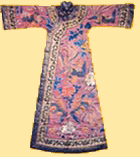
|
According to archeological
evidence, silk and silk fabric emerged in China at
least 5,500 years ago. The cultivation of the
silkworm can be traced back to the third century
B.C. It was said that the demigod Leizu, a legendary
figure of prehistoric China, started the planting of
mulberries and the raising of silkworms.
During the Zhou Dynasty, a special administration
was set up to manage sericulture and silk
production. The famous Silk Road to the Middle East
and Europe started under Zhang Qian. Under imperial
order, he started his diplomatic mission to the west
from 138 B.C. to 126 B.C. Gradually, sericulture and
silk production techniques spread to other
countries. Chinese silk was high prized among the
wealthy of ancient Rome. Chinese silk still enjoys
its reputation for high quality through the world.
Embroidery
Once the cloth had been weaved, embroidery was used
to give the cloth its delicate, often brilliant
patterns. The Four Renowned Embroideries of China
were regional in their origin. Su embroidery
originated from Jiangsu. Yue embroidery originated
from Guangdong. Xiang embroidery originated from
Hunan. Shu embroidery originated from Sichuan.
Su Embroidery
Short for Suzhou, Su embroidery originated during
the Northern Song Dynasty. According to historical
records, Su embroidery became so popular during the
Song Dynasty that people even named roads using
words associated with silk and its embroidery.
Nearly every family raised silkworms and
embroidered. Su embroidery reached its peak during
the Qing Dynasty.
Su embroidery has a wide range of themes. Its
techniques include both single faced embroidery and
unique double-faced embroidery that looks the same
from either side. Basic features of Su embroidery
are simple composition, clear theme, vivid image,
and gentle color. In recent times, Su embroidery
design has absorbed some western painting
techniques.
Yue Embroidery
Yue embroidery is also called Cantonese because it
is produced in Guangdong province. It is said that
Yue embroidery originated among a minority people
during the middle to end of the Ming Dynasty. A
variety of threat materials is used, including
twisted peacock quill and hair from horse tails.
Gold thread is used to establish contours for
embroidering complicated patterns. Bright in color,
Yue embroidery usually displays such themes as A
Hundred Birds Displaying Homage, the Chinese
phoenix, marine products, or melons.
Xiang Embroidery
Hunan's local embroidery had a long history before
the development of Xiang embroidery. Archeologists
have discovered finely embroidered silk items in
tombs of the Chu and Han dynasties, which were both
more than 2,000 years ago. The embroidery that we
now call Xiang came into being during the latter
part of the Qing Dynasty. Xiang embroidery combined
the styles of both Su and Yue embroidery with the
local embroidery style.
Xiang embroidery is famous for its tiger patterns.
Xiang embroidery's unique techniques are generally
based on Chinese painting, although it also includes
techniques of engraving, calligraphy, and
embroidery. This combination of techniques produced
a new and unique embroidery product, double-faced
and with different images and colors on each side of
a transparent chiffon.
Shu Embroidery
Shu embroidery is also called Chuan embroidery
because it is mostly produced around Chengdu,
Sichuan province. Sichuan embroidery had a long
history that developed into today's Shu style during
the middle of the Qing Dynasty. The main themes of
Shu embroidery are those of auspicious happiness.
Embroidered products include mirror curtains,
wedding dresses, hats, and shoes. The themes are
usually the animals and plants of nature. Shu
embroiderers are especially adept at embroidering
pandas and fish.
The materials used for Shu embroidery are
locally-produced soft satin and colorful threads.
Shu embroidery is characterized by even stitches,
bright threads, closeness and softness of texture,
and delicate needling. The threads are neatly and
thickly used. Colors are elaborately arranged.
Silk Goods
Silkworm cultivation, silk weaving, and embroidery
skills have been one of China's great contributions
to world development. More than 2,000 years ago,
Chinese silk products were traded over vast
distances. Although the ancient Romans knew
virtually nothing about China, they did know of
ancient China's brilliant civilization. The
wealthiest Romans could often be seen wearing
Chinese silk items.
Historically, most of China's silk products were
made for either expensive clothing or decoration.
Silk goods are divided into many types, such as
brocades and satins, based upon differences in
weaving techniques and embroideries. It was the
common people who developed China's excellent silk
skills. Unfortunately, poverty deprived the common
Chinese of this expensive material that their
ancestors had developed.
Chinese Embroidery Pouch
Hebao was the name of an ancient food. Although
named after this food, the Hebao, the Chinese
embroidery pouch, was really a bag for items other
than food. Hebao have several different uses and
cultural meanings.
In China, it was a custom that girls began to learn
embroidery around age seven. When she married, she
would give pouches she had made to relatives and
friends as gifts. Her gifts demonstrated the
deftness of her handiwork. Before marriage, young
girls might give Hebao to young boys as symbols of
love.
During the Dragon Boat Festival, Chinese people
often insert Chinese mugwort into Hebao. Mugwort is
used to exorcise the five poisonous creatures. When
young girls made pouches, they often filled them
with mugwort and perfumed grasses.
In daily life, hebao can be used to hold items such
as watches, wallets, mirrors, tobacco, and fans.
Hebao were popular with people, both as souvenirs
and as gifts of friendship. The outside of the pouch
is embroidered, while the inside has a thick layer
to protect the embroidery.
Cloud Brocade
This kind of brocade looks like colorful clouds,
hence the name cloud brocade. Producing this effect
required both high quality silk and exquisite
skills. From the Yuan Dynasty to the Ming Dynasty,
cloud brocade was used mostly for imperial clothing.
Dai Brocade
Made of either cotton or silk, Dai brocade is a
product of the Dai minority. Since early in the Han
Dynasty, the Dai have produced muslin, a kind of
cotton cloth. Cotton brocade uses an undyed yarn of
natural color to make a smooth cloth. When making
silk brocade, the Dai usually dye the silk red or
black before it is woven by the weft.
Dong Brocade
This is the brocade of the Dong minority. Like Dai
brocade, it can be made of either cotton yarn or
silk, or a combination of the two materials. Dong
brocade is distinguished by its patterns, which are
mainly of flora, fauna, and Chinese characters. Dong
brocade is commonly used to make children's
sleeveless garments, quilt facings, or scarves.
Li Brocade
Produced by the Li minority living on Hainan Island,
this brocade is mainly used to make women's
tube-shaped skirts, bags, etc. Woven of cotton yarn
and silk thread, Li brocade was called "Li
cloth" or "Li curtain" during the
Song Dynasty.
Lu Brocade
Mainly produced by people in the south and the north
of Shandong province, Lu brocade is distinguished by
its bright colors and strong textures. In the 1980s,
Lu brocade experienced a strong revival as it became
adapted to the needs of modern life.
Miao Brocade
Produced by the Miao minority, this kind of brocade
is popular in Guiding, Guizhou province. As
decoration, it is used to ornament the collars,
fronts, and sleeves of women's garments. It is also
used as a material for everyday costumes and quilts.
Sichuan Brocade
Sichuan brocade was first produced in Chengdu,
Sichuan province, during the Han Dynasty. It became
the primary kind of traditional silk brocade. After
Sichuan became linked to middle China, its
brocade-making skills were spread throughout China.
Sichuan brocade flourished during the Tang, Song,
and Yuan dynasties, with more designs, patterns, and
colors being used. Especially during the Tang
Dynasty, Sichuan produced a large quantity of very
high quality silken goods. The magnum opus of this
period included patterns of bundles of flowers, red
lions, and the Chinese phoenix.
Yao Brocade
The history of Xiangzhou records that the Yao
minority originated Yao brocade. Yao brocade is
widely used by Han people as dowry when young women
are married. The main patterns of Yao brocade are of
flora, fauna, and geometry. This brocade is woven of
dyed yarn or silk thread.
Marriage is obviously a festive occasion. Not all
brocades are suitable for festive occasions. In some
places, brocades of different colors suggest
different emotions. In Quanxiu, Guangxi province,
red brocades suggest happiness and are propitious,
orange or green brocades suggest mourning and
sadness.
Suzhou Brocade
Produced in Suzhou, Jiangsu province, this was once
the most famous brocade in China. The art of making
Suzhou brocade was lost at the end of the Ming
Dynasty, but was soon revived at the beginning of
the Qing Dynasty. Suzhou brocade is characterized by
harmonious colors and geometrical patterns. It is
divided according to size. Big brocade, also called
heavy brocade, is mainly used as a mounted picture
or for large decorations. Small brocade is used to
decorate small articles.
Zhuang Brocade
Produced in Guangxi province, this is the brocade of
the Zhuang minority. Zhuang brocade is produced on a
weaving machine operated by one woman. It uses silk
down and locally produced silk threads to make
articles such as quilt facings, tablecloths, and
scarves. The patterns of Zhuang brocade are mainly
of figures, flora, fauna, and geometry.
|