| Holland
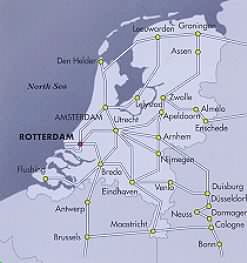
Map |
|
|
|
Around the world the name "Holland" is much better known than "the Netherlands". The Republic ofth the Netherlands, which has beena kingdom since 1815, was formed in 1648 following the Peace treaty of Munster. The word "Holland" has a much older sound to it. It is derived from the word
Holtland, which means Houtland (woodland). Forests and marshes covered the land.
Until about the year 1000 squirrels could jump from tretop to treetop form Antwerp to Groningen and from Maastricht to Alkmaar without ever touching the ground. But the Hol(t)landers burned the wood for cooking and fireplaces. Or used it to build houses or ships or to make clogs. A nan wasenforced against cutting down trees on what measly little was left of the forests. Timber could onloy be imported. Using wood as a fuel was not affordable. Luckily Holland had a good supply of moor-peat and bog-peat. The peat was used for
fuel
|
From an aeroplane you can clearly see peat areas that have not been reclaimed and lakes. These have been made into natural areas. Some areas, such as "De Weerribben" in northwest Overijssel became National Parks.
Another phenomenon in holland is the control over water, much of the polderland liers up to 6 metres under sea-level. the inland waterways are kept level artificially with the aid of dykes, pumping-stations and sysmem of reservoirs for superluous polderwater. These are mostly computer enerated so that during periods of rain of drought the water level remains the same.
of course we do not want to avoidthe big cities.Den Haag is the town where the government is situated, not in the capital -- Amsterdam. Amsterdam is the capital of the Netherland. Rotterdam is still the largest trade and trans-shipping harbour in the world.
Utrecht, situated in the centre of the country is sometimes called " Bishops town", until the reformation, around 1568, the Bishops of Utrecht reigned over a large part of the northern provinces. In Utrecht you can still find traces rich Roman life. Maastricht, the oldest city in the Netherlands and Eindhoven is the largest city in the south. Its size is mainly due to the Philips company.
The islands in Zeeland are also special with their pretty towns and villages. Vlissigen lies prodly at the mough of the Schelde. A visit to the Delta Works is recommended as the Dutch knowledge of water control can be observed, such as the closing of the two slides across the Nieuwe
Waterweg.
The Wadden islands are a very popular holiday destination. Netherlands has the image of "the land of windmills, tulips, nationa costumes and clogs", windmills do often dominate the countryside, for example, at Kinderdijk where nineteen windmills on a row keep the polder dry. A selection of "industrial" windmills can be found at the Zaanse Schans. These include wood sawing mills, paint-and oil windmills, mustard and peeling mills.
The most famous regional costume is worn in Staphorst, just north of Zwolle. The costumesin Marken and Volendam are more for tourists. In Bounschoten, spakenburg, Urk and Zeeland you can still find people wearing the costme as their daily dress. The younger generation does not consider it fit to wear to a disco though.
The Bulb-field are si a line behind the dunes from Deen Haag till Den Helder. The most well known places are Lisse and hillegom (home to the Keukenhof), Limmen and Breezand. This is where the "Tulips from Amsterdam" come from. In the JIsselmeer polders more and more bulb-fields can be seen. A surplus of cows(milk) and pigs made the farmers search for alternative sources of income. Many now run eel and sheath-fish hatchery or have redeveloped regional products that are grown eco- and biologically friendly.
The Dutch farmer is used to adapting to the need of the soil. The people of the Netherlands are proud and hospitable. they cherish their ocuntryside and monumental heritae, and are fully supported by the government.
You can not lump all Dutch people together, people living in the west are pretty open. The people in Friesland and Groningen will only open up after they get to know you. The population in the south really know how to enjoy a party.
It is remarkable that English and other languages are spoken by most people in the Netherlands. An ex-minister once said: " It is because we have so many foreign
neighbours".
|
|