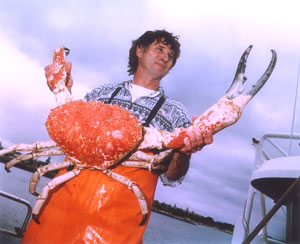
Sea Monster?
December 7, 2006 - 9:40am
It's big, ponderous and ugly, and dwells in the frigid, sunless depths between 300-400 meters on the margins of south-eastern Australia's continental shelf. The giant crab Pseudocarcinus gigas remains an enigma. Scientists are trying to obtain crucial data on its lifestyle, behavior, growth and reproduction. Scientists believe that the megalopa grow rapidly in there environment, where there tends to be a large aggregation of nutrients and food. Not much else is known about this strange sea monster.
More.
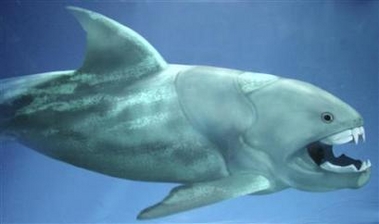
Giant Prehistoric Fish Packed Quite a Bite
December 1, 2006 - 12:30pm
This undated artist's rendition shows the armor-plated fish Dunkleosteus, a 33-foot-long (10 meters), four-ton (3,600kg) monster that terrorized other marine life in the Devonian Period, which spanned 415 million to 360 million years ago. It was the first super predator of the ancient seas and its fearsome, jagged jaws still inspire awe 400 million years later.
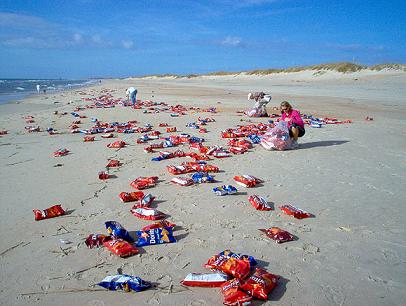
Doritos Wash Up in North Carolina
December 1, 2006 - 8:00am
A cargo container that apparently fell from a ship washed up on the Outer Banks of North Carolina and spilled thousands of bags of Doritos brand tortilla chips on the beach. Scavengers collected the chips, which were apparently still fresh due to their airtight packaging. It is unknown which ship has lost the cargo.
More.
Hawaii Marine Survey Yields Many New Species
November 29, 2006 - 11:01am
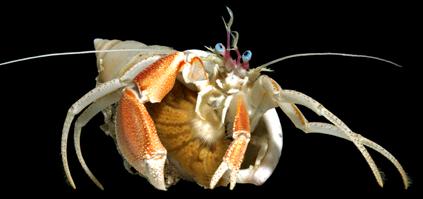
With its conspicuous blue eyes and shiny orange claws, this colorful crab seems hard to miss. But it's one of many species that had likely never been seen until scientists went exploring in the Northwestern Hawaiian Islands Marine National Monument this fall. The finds highlight the diversity of life in the new national monument, which was established by presidential decree in June, creating the world's largest marine sanctuary.
More.
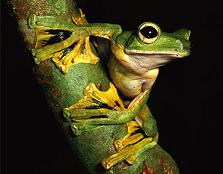
Wallace's Flying Frog
November 17, 2006 - 10:40am
Also known as parachute frogs, Wallace's flying frogs inhabit the dense tropical jungles of Malaysia and Borneo. When threatened or in search of prey, they will leap from a branch and splay their four webbed feet. The membranes between their toes and loose skin flaps on their sides catch the air as they fall, helping them to glide, sometimes 50 feet (15 meters) or more, to a neighboring tree branch or even all the way to the ground. Wallace's flying frogs are not the only frogs who have developed this ability, but they are among the largest.
More.
How Are Planets Created?
October 10, 2006 - 3:00pm
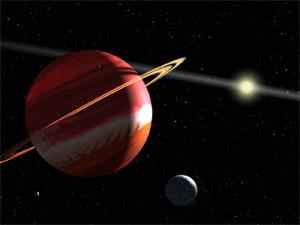
It's official: planets are formed from the debris swirling around a young star, astronomers have confirmed, more than 250 years after the idea was first proposed. "Because of Hubble, we know for sure that it is a planet and not a failed star," project leader, Barbara McArthur of the University of Texas, said.
More.
Try
This!
September 22, 2006 - 9:15am
Read the
following paragraph.
FINISHED
FILES ARE THE RE-
SULT OF YEARS OF SCIENTIF-
IC STUDY COMBINED WITH
THE EXPERIENCE OF YEARS.

Sudoku
Makes Your Brain
Ache
September 13, 2006 - 10:05am
No wonder
Sudoku puzzles give your brain a good workout.
Scientists say solving them depends on neural pathways that even the
most powerful computers can't replicate. To crack Sudoku our brains use
a unique set of neural pathways known as associative memory, which
enables us to discover a pattern from a partial clue. More.

Pluto
is Now Just a Number
September 13, 2006 - 8:45am
Pluto has
been given a new name to reflect its new status as a dwarf
planet. On Sept. 7, the former 9th planet was assigned the asteroid
number 134340 by the Minor Planet Center (MPC), the official
organization responsible for collecting data about asteroids and comets
in our solar system. More.

Golden
Age of Discovery Ahead
September 11, 2006 - 1:15pm
The next
several decades could prove to be a golden age for dinosaur hunters
looking to discover new species of the ancient reptiles. A new
statistical analysis predicts that more than 1,300 unique dinosaur
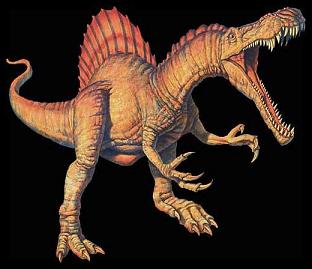
genera await discovery by paleontologists. Below is a picture of the
Spinosaurus. It is the newly crowned biggest land carnivore, at 55 feet
long and 8 tons. The T. rex was once considered the largest carnivore
in history. More.
Another
iPod Accessory
September 8, 2006 - 9:20amm
The iWear
connects to your iPod video. Inside the goggles are two tiny LCD
screens made up of 230,000 pixels. The resulting view looks like a
35-inch TV. The iWear is able to play both 2-D and 3-D movies. More.

Welcome Back to School
September 6, 2006 - 8:02am

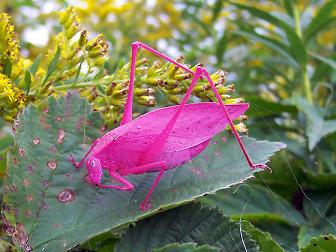
Strange Bug Found in Michigan
September 5, 2006 - 8:00amThis strange bug was found in Michigan. It is not the first one ever found in the world, but it is strange. It is called a carinate katydid. This unusual insect is actually a rare variety of one of our common katydids that are normally green all over. The bright pink condition is caused by a genetically determined condition called erythrism. More.