

Topic: Anecdotes
I thought you might like to see an authentic legal process up close, so I am putting this here.
I got a ticket for running a red light in Beverly Hills in December 2005. I was on my way to a job interview with N. (The famous pink rabbit English school in Japan.)
I was really angry about it. The ticket was for $350!! But the real reason I was so angry was because I hadn't committed the infraction. The motorcycle cop must have been asleep at the time because it wasn't even close. .
I decided to fight the case, but because I was going to return to Japan soon after, I had to submit my case in writing. First, I had to pay the court $350. Then I had to send in my argument with some photos. The case was resolved in April 2006. I WON! I just got a $350 check from the Court this week!
This is my case including the important photos, but I can't include the diagram. It was hand-drawn, and I don't have a copy here.The following is an exact copy of the letter I sent to the Beverly Hills Courthouse in late winter 2006:
I declare under penalty of perjury that this statement is true and correct.
This statement is eight pages long, including form TR-205, four typed pages, and three pages of evidence. Included are two pages of photos that I have labeled "Page 5" and "Page 6," and a street diagram I have labeled "Page 7."
Re: (My Name here)
Citation: R458409
Issue date: 12/01/05
Bail amount of $350 paid on January 30, 2006
I was given a ticket for allegedly running a red light at the intersection of Fountain and La Cienega. I was driving a light blue, 1992 Toyota Camry (a family sedan), and was traveling westbound on Fountain and turned left (southbound) onto La Cienega. I made the turn from the inner of the two lanes that are permitted to make left turns onto La Cienega. (See diagram on Page 7.)
Your Honor there is no doubt in my mind that I did not go through a red light. The light was just turning yellow when I entered the intersection. I am extremely confident of that because I had seen the solid "Don't walk" signal (see G on Page 6) a second or two before. (Indicating that the light would change to yellow soon.) In response I slowed and then slowed some more due to some traffic just ahead of me. (I was going about 5 mph.) I was prepared to stop and easily could have if I had wanted to. But there was no need to stop. The light finally turned yellow, and I eased into the intersection less than a second later. About midway through the intersection (20 feet or so), I came to a complete stop. (See photo D on Page 5 and diagram on Page 7.) There were vehicles in both lanes ahead of me and a car alongside of me. After we had been stopped for a second or so, the light finally turned red, and all the cars proceeded through the intersection. Soon afterward, the officer turned on his siren, and I pulled over to let him go by. I was baffled and angry when he stopped behind me.
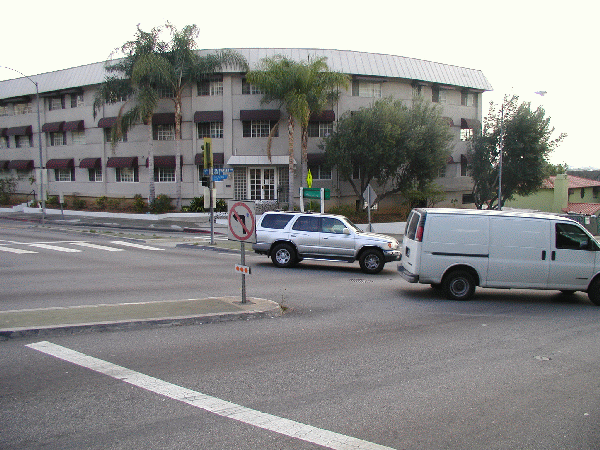
Photo D: My car was roughly in the position of the rear car in this photo when the light changed to red. I was stopped in the intersection at the time. This view is from the officer's side about 20-30 meters north of where he was parked.
Prior to that the officer had been parked opposite me on his motorcycle near the mouth of the driveway ramp. He was facing the oncoming, westbound Fountain traffic. (See Page 6 photo G and diagram on Page 7.)
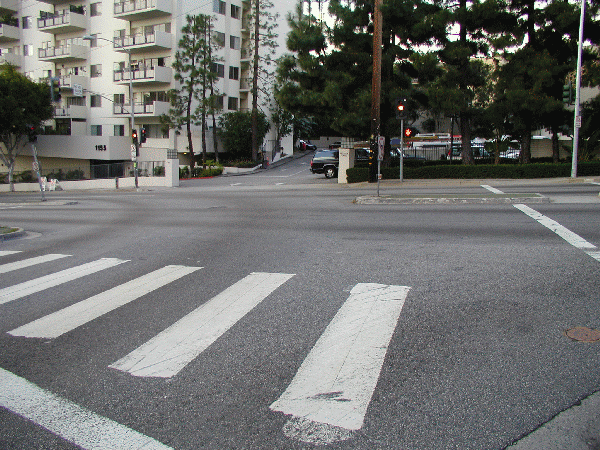
Photo G: The officer was parked in that apartment building driveway. This photo shows my view of the intersection, although I was in the left most lane, and this view is from the right most of the three lanes. The yellow light here lasts about 3 seconds.
There are several facts that should raise some doubts of my guilt. In brief, the location itself is extremely ill-suited to observing red light violations, particularly in consideration of where the officer was parked. There are two left turn lanes and the outer lane vehicles (when present) block the view of cars in the left most (inner) lane (where my car was). Even without an outer lane, the officer couldn't have seen my car and the traffic signal at the same time due to the position of his motorcycle and that of the traffic signals. Indeed he couldn't see my signal at all! Also, the problem of depth perception increased the difficulty even more. I was headed directly towards the officer, so there must have been difficulty in judging distances and positions. Finally, also because of traffic, it must have been difficult to see the intersection markings by themselves or in relation to my car.
The main hinderance is the second left turn lane. When there is traffic in the outer lane throughout the intersection, as was the case that morning, the cars in the inner lane can be completely obscured, especially by large vehicles. From a position facing the westbound Fountain traffic (where the officer was), it would have been very difficult to see cars in the inner lane at all. (Note the blocking effect of the small bus and van in photos B and D, respectively, on Page 5.)
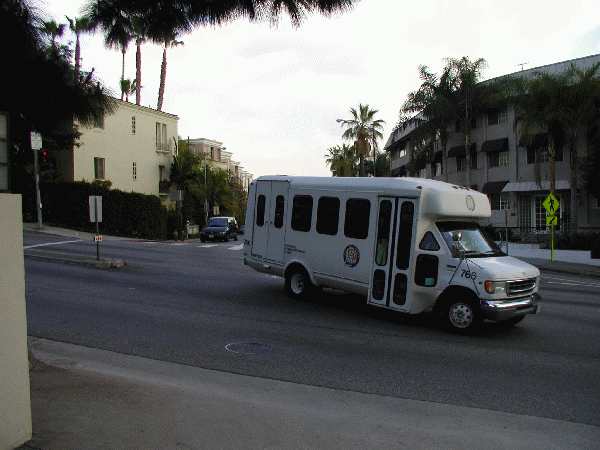
Photo B: The bus is in the outer lane. This is the view the officer had. He obviously could not have seen my car in the inner lane. Also note that there are no traffic signals present except for northbound and southbound traffic.
During the incident, all traffic came to a halt briefly in the intersection. Vehicles in the outer lane were not going wide enough before turning and, therefore, crowding the inner lane. This brought all cars to a halt and constricted the gaps between vehicles, making it bumper to bumper and increasing the blocking effect of vehicles in the outer lane.
Another significant issue is the design of the intersection. La Cienega and Fountain is a 3-way intersection. Westbound Fountain traffic must turn left or right onto La Cienega. This design means there are no traffic signals that the officer could see above my car. The only traffic signals for westbound Fountain traffic were above, behind, and on either side of the officer's position. (No signals can be seen in the photo taken from the officer's position. See picture G on Page 6.) There is no signal above Fountain (see B and D on Page 5 and F on Page 6), as would be the case in a normal 4-way intersection. As such, Officer P. (the issuing officer) was in poor position to see red light infractions by cars going westbound on Fountain. He was parked almost even with or slightly in front of the signals for Fountain. The only way he could have seen them would have been to turn completely behind and look directly up. Even if he did so, he was too far directly under them to be able to see the lights themselves. It was early morning (8:30 am and the sun was low in the East, shining directly into the signals near him (and his eyes).
Therefore, the officer must have looked at the signals to his right on La Cienega. (See photo C on Page 5 and the diagram on Page 7.) But those signals are for southbound La Cienega-not Fountain. Even if he used the La Cienega signals, Officer P. could not see any of the three of them and my car at the same time. (Assuming he could see my car at all due to the traffic in the outer turn lane.) And if he did see the light and me at the same time, then I must have been far into the intersection! The signals for southbound La Cienega were approximately 90 degrees to the right of his field of vision if he was looking at Fountain.
Since it was the La Cienega southbound traffic signal he was looking at, there are some powerful arguments that I didn't run a red light. Maybe he was looking at my car and then glanced to see the green light. (Remember he was looking at the La Cienega signal, so it would have been green not red.) If so, he couldn't be sure the light hadn't changed in the interval between seeing my car and seeing the green light. I doubt this happened.
More likely he would say he saw the green light first and then he turned to see me enter the intersection. This seems to be the only possible scenario. If so, he is implying that I entered the intersection very late! (Of course, I concede that people do do such things, but it would be extremely dangerous and therefore unlikely.)
If Officer P. claimed that I entered the intersection after the La Cienega signal turned green, he would probably state that he was looking at a southbound La Cienega light and saw it turn green. Even the furthest of those lights were approximately 90 degrees away from his view of my car. After seeing the La Cienega green, the officer might say that he then turned to face Fountain and saw my car cross the white line delineating the intersection. That would mean that I entered the intersection a moment after he turned his head-all the while there had been a green light for La Cienega!
First of all, the signal for an intersecting street does not turn green simultaneously with the red of its compliment street. There is a lag of a second or so to safely allow people who run red lights to clear the intersection. (I would imagine that most people who run red lights go through before the compliment street light turns green.) Also there would be extra time necessary for the officer to process the information and turn his head to face Fountain. As a result, any car just starting to enter the intersection from Fountain after the officer turned his head would be doing something very dangerous indeed!
To take it further, since the officer's head would necessarily be turned 90 degrees away from my car; he wouldn't be able to see me enter the intersection at the same time. And at that point, he certainly wouldn't have had any expectation that a car would enter the intersection from Fountain that late, so he would have turned his head in a leisurely way. In such a situation, the split seconds would add up to a point where in order for this scenario to work, I would have had to have entered the intersection as much as two seconds after the light changed red-ridiculous! That would have been suicidal.
I am not a lawyer, so I will concede a couple of points. I was the last car through the intersection in the left most lane. It was not because cars behind me stopped for the red light. There were simply none behind me in either lane for a block or so.
Also, I didn't see the officer until he turned on his siren after I exited the intersection. While in the intersection, my view of him was blocked by a vehicle or vehicles ahead of me and alongside me in the outer left turn lane. This indicates that his view of me was obscured, as well.
Since the officer's position during the alleged infraction is significant, let me elaborate a little on it. At the time I saw him, it was through the rear view mirror and I could clearly see him attempting to start his motorcycle. I pulled over to let him pass, and he still hadn't moved much. I note this to show why I am sure that he was parked at the time.
I believe he was trying to start his bike because of the motions of his right arm and his right leg. Since he was facing Fountain, I could see him in profile. He seemed to be pressing the starter button and twisting the handgrip accelerator. Also, I saw him stand the bike up and disengage its kickstand. (One doesn't have a motorcycle on its kickstand when the engine is on unless it has just been started.) Because of that I am quite sure that he was parked with his engine off when he turned on his siren. (I have a motorcycle license and I've been riding for more than 25 years, so I am quite sure.)
It is impossible for me to know exactly where he was parked, though. I marked him in the photos and the diagram as being at the northern area of the ramp, which is what I remember. But he may have been 5-10 feet away from where I thought he was because of the problem of judging depth. Of course, that is largely irrelevant because even if he had been much farther away, he couldn't have seen any of my signals. I am certain that he was along the curb, so the signals still would have been behind him no matter where he was along the driveway or curb.
I think there is probably only one good position from which the officer could have properly judged a red light infraction by my car. If he had been going in the same direction, alongside, in front of, or just behind me on Fountain, he would have been able to see the signal, my car, and the white lines clearly at nearly the same time.
Facing northbound or southbound on La Cienega wouldn't have been much better. He would have been able to see my signal, but would have had to turn up to 180 degrees away from the intersection to do so.
The absolute worst position must be facing East, which the officer was. From just about any viewpoint, it's a tough place to observe Fountain traffic. The blocking outer lane and the lack of a signal in clear sight make it impossible to judge.
At this point, I would like to state that I don't think the officer lied. He was simply mistaken. I think my car must have been obscured by traffic in the outer lane, and so may have appeared (to Officer P.) to have come out of nowhere into the middle of the intersection. He may have been passively observing and not really been focused on the situation. Of course, this is all pure speculation. I have no idea what he saw.
To summarize, there is no doubt in my mind that I entered the intersection less than one second after the light turned yellow. (The yellow light at that intersection lasts about three seconds-like most yellows.) Also, the officer was parked facing me where he could not possibly see my car and my signal (or the La Cienega signals) at the same time.
Accordingly, I argue that Officer P. was in extremely poor position to have seen any red light infraction for the Fountain traffic.
I also repeat my sincere and confident belief that I am innocent. I was stopped and waiting in the middle of the intersection when the light changed red. It wasn't even close.
I know I have been long-winded. Thank you for your time.
My Name
Tokyo, Japan
(That's the end of the letter.)
Updated: Sunday, 18 June 2006 1:57 AM KDT
Post Comment | Permalink | Share This Post