Descriptions and Reviews are from Amazon.com
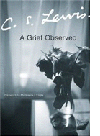 A Grief Observed
In April 1956, C.S. Lewis, a confirmed bachelor, married Joy Davidman, an American poet with two small children. After four brief, intensely happy years, Lewis found himself alone again, and inconsolable. To defend himself against the loss of belief in God, Lewis wrote this journal, an eloquent statement of rediscovered faith. In it he freely confesses his doubts, his rage, and his awareness of human frailty. In it he finds again the way back to life.
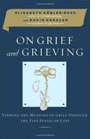 On Grief and Grieving
Shortly before her death in 2004, Elisabeth Kübler-Ross and David Kessler, her collaborator, completed the manuscript for this, her final book. On Grief and Grieving is a fitting completion to her work. Thirty-six years and sixteen books ago, Kübler-Ross's groundbreaking On Death and Dying changed the way we talk about the end of life. Now On Grief and Grieving will profoundly influence the way we experience the process of grief.
On Death and Dying began as a theoretical book, an interdisciplinary study of our fear of death and our inevitable acceptance of it. It introduced the world to the now-famous five stages: denial, anger, bargaining, depression, and acceptance. On Grief and Grieving applies these stages to the process of grieving and weaves together theory, inspiration, and practical advice, all based on Kübler-Ross's and Kessler's professional and personal experiences, and is filled with brief, topic-driven stories. It includes sections on sadness, hauntings, dreams, coping, children, healing, isolation, and even the subject of sex during grief.
On Grief and Grieving is Elisabeth Kübler-Ross's final legacy, one that brings her life's work profoundly full circle.
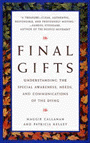 Final Gifts : Understanding the Special Awareness, Needs, and Communications of the Dying
Five years after its first publication, with more than 150,000 copies in print, Final Gifts has become a classic. In this moving and compassionate book, hospice nurses Maggie Callanan and Patricia Kelley share their intimate experiences with patients at the end of life, drawn from more than twenty years experience tending the terminally ill.
Through their stories we come to appreciate the near-miraculous ways in which the dying communicate their needs, reveal their feelings, and even choreograph their own final moments; we also discover the gifts--of wisdom, faith, and love--that the dying leave for the living to share.
Filled with practical advice on responding to the requests of the dying and helping them prepare emotionally and spiritually for death, Final Gifts shows how we can help the dying person live fully to the very end
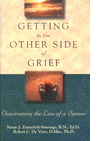 Getting to the Other Side of Grief: Overcoming the Loss of a Spouse
It's something no married person wants to imagine. Yet each year, eight hundred thousand individuals mourn the passing of a husband or wife.
Coming alongside the grieving spouse, psychologist Susan Zonnebelt-Smeenge and pastor/professor Robert De Vries provide much-needed support from a unique perspective--empathy. They each suffered the loss of their spouse at a relatively young age. Throughout Getting to the Other Side of Grief, the authors share their stories as living proof that if worked through properly, grief will lead the way to a fresh new life.
Beginning with the premise that a full resolution to grief is possible, the authors extend this lifeline to readers: Complete healing doesn't happen without intentional effort (time alone doesn't heal), and this intentional effort, for complete success, must combine Christian faith and sound mental health practices. In offering these interwoven disciplines, the authors give readers the benefit of both the male and female perspective.
Readers will find getting to the other side of grief less lonely and more promising in the empathetic company of these two authors. Those who assist grieving persons on their journeys--pastors, counselors, family members, friends--will find this a useful supplement to the support they offer.
 How To Go On Living When Someone You Love Dies
Mourning the death of a loved one is a process all of us will go through at one time or another. But wherever the death is sudden or anticipated, few of us are prepared for it or for the grief it brings. There is no right or wrong way to grieve; each person's response to loss will be different. Now, in this compassionate, comprehensive guide, Therese A. Rando, Ph.D., bereavement specialist and author of Loss And Anticipatory Grief, leads you gently through the painful but necessary process of grieving and helps you find the best way for yourself.
 The Grief Recovery Handbook
Incomplete recovery from grief can have a lifelong negative effect on your capacity for happiness. Drawing from their own histories, as well as from others, the authors illustrate what grief is and how it is possible to recover and regain energy and spontaneity. Based on a proven program, now extensively revised, The Grief Recovery Handbook offers grievers the specific actions needed to complete the grieving process and accept loss. For those ready to regain a sense of aliveness, the principles outlined here make this a life-changing handbook.
 I Wasn't Ready to Say Goodbye: Surviving, Coping and Healing After the Sudden Death of a Loved One
Each year about eight million Americans suffer the death of a close family member. The list of high visibility disasters, human suffering and sudden loss is long and will continue to grow. From TWA Flight 800 to Egypt Air, from Oklahoma City to Columbine, daily we face incomprehensible loss. Outside the publicized tragedies there are many families and individuals that are suffering behind closed doors in our neighborhoods, in our own homes, in hospital waiting rooms. Now for those who face the challenges of sudden death, there is a hand to hold. Both authors lost a loved one tragically. Noel's brother was stung by a bee and died instantly at age 27. Blair's husband died of a brain aneurysm. As they struggled to rebuild they found little printed material. I Wasn't Ready to Say Good-bye is the first book to devote all its pages to the unique challenges of sudden loss, written by two women who have walked the path. They cover such difficult topics as the first few weeks, suicide, death of a child, when a body isn't found, children and grief, funerals and rituals, physical effects, homicide, depression and many others.
 How We Die
Attempting to demythologize the process of dying, Nuland explores how we shall die, each of us in a way that will be unique. Through particular stories of dying--of patients, and of his own family--he examines the seven most common roads to death: old age, cancer, AIDS, Alzheimer's, accidents, heart disease, and strokes, revealing the facets of death's multiplicity.
"It's impossible to read How We Die without realizing how earnestly we have avoided this most unavoidable of subjects, how we have protected ourselves by building a cultural wall of myths and lies. I don't know of any writer or scientist who has shown us the face of death as clearly, honestly and compassionately as Sherwin Nuland does here."--James Gleick
|