|
by: Mr. Rodelio P. Barcenas
Faculty Computer
Engineering Department
Don Bosco Technical College
Another Example:
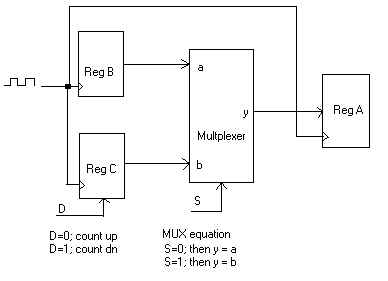
Register C is an up/down counter register,
while A and B are plain registers.
The above circuit can now be translated into an RTL. First we need
to identify the control signals. It can be easily seen that S and
D are control elements. Therefore we can now write;
S'D': A <-- B ; C <-- C
+ 1 {two operations exists}
S'D : A <-- B ; C <-- C - 1 {two operations exists}
S D': A <-- C + 1
S D : A <-- C - 1
Since now that we have two bit
variables for the control elements, we have four possible combinations
which will in turn give us four different RTLs. The more control
elements, the more microoperations or RTLs that would represent
the circuit.
At this point I suppose you are getting more curious about the relation
of RTLs in microprocessors... I still need one more example and
I will call this the punch line.

Home

|


