

The Critical Success Factors
In this chapter and throughout this book, we have explored the challenges and strategies of the third wave of e-Commerce. From working with the pioneers of e-Commerce on large-scale initiatives such as GE's TPN Register, we have seen some common patterns and gained valuable insight through observing traits common to those who have developed sustainable and flexible initiatives. We can now recap and summarize the critical business and technology factors of success.
Inter-enterprise Architecture.
We have stressed the need for an inter-enterprise architecture to provide an underlying structure that is consistent, easily understood and comprehensive (it includes both business and technology elements). In his column, "Peopleware, Re: Architecture" Larry Constantine writes, "Architecture, whether in the organization of the internal functionality or in the structure of the user interface, is often among the first victims felled by today's time-boxed software projects, short release cycles, and rapid applications development. There seems to be no time to think through the consequences of architectural decisions. Often there is barely time to think. Full stop." The facts, however, remain. The development of a strong architectural vision and the adoption of incremental development cycles are keys to sustainable e-Commerce success. In turn, success in e-Commerce architecture will be determined largely by five key business imperatives: adopting the customer paradigm, optimizing the value-chain, achieving time-to-market, governance, and measuring progress and effectiveness.
In the "old days" producers would determine what consumers could have. They would take their products and push them on their customers. Now, the shoe is on the other foot, subordinating production to the demands of the customer.
With the new production-consumption equation, customers must be provided complete self-service access to a company's business processes and those of the company's value-chain. The customer-centric company of the 21st century changes the customer relationship by engineering customer-facing processes from the outside-in, creating the "open" corporation where the customer initiates and conducts his or her own business using the open (yet secure and auditable) resources of the corporation.
Value-chain Optimization: business-to-business.com
With the customer in control, a business must realign its value-chain around the customer, from end-to-end, squeezing out inefficiencies - and customizing information, products and services. The open corporation is extended to suppliers and trading partners so that when customers touch the resources of a corporation they also touch the resources of the value-chain.
The customer drives the entire value-chain, determining what is to be produced, when and at what price. Pricing will ultimately behave as is does in the stock market, changing in real-time. As in the stock market, pricing will fluctuate with overall perceived value which, in turn, will be influenced by cyberbranding. The customer will interact with the whole ecosystem, not just the individual company, making general systems theory a core business competency. Companies must directly participate in building the new business ecosystem, or competitors will do it for them. Inter-enterprise architecture provides the framework for customer-driven, value-chain optimization.
Time-to-Software, Time-to-Market
In the domain of e-Commerce, time-to-market is governed by time-to-software. Component-based development is the next logical step in modular software development, a trend that has been underway since the advent of "structured" programming, then structured analysis and design, and then on to object-oriented development. By packaging software constructs and implementations into components, software can be removed from the critical path in time-to-market. Component-based development is the current best practice in software development because it combines strong architectural notions with rapid applications development.
Governance: Put the CEO In Charge of e-Commerce
The question of e-Commerce governance summons a short and simple answer. Business users of information systems are the most thorough source of business and market knowledge, and the most accountable for business success. E-Commerce is, therefore, a business unit responsibility - with IT playing a role of enablement and support.
Looking at the chain-of-command in Fortune 1000 corporations, and considering that e-Commerce will form a completely new platform for operating a business, it is logical to conclude that, ultimately, the CEO must also become the CECO, Chief Electronic Commerce Officer. As a company transitions to a fully digital business, the CEO will assume bottom-line responsibility for e-Commerce - to wit, Jeff Bezos, CEO at Amazon.com where e-Commerce is the business.
What's good for the CEO is good for the board of directors. In his provocative article, "Directors' Boards are Clueless About the Internet," Thorton Mays, Vice President of Research and Education at Cambridge Technology Partners, reflects on Emerson, "Ralph Waldo Emerson once observed that 'we learn geology the morning after the earthquake.' The emerging digital economy, and how it's affecting boards of directors, is being studied post-Web-quake by some top business scholars. Their conclusion: The directors of most mainstream companies don't understand the implications of the Internet, aren't aware of their ignorance and are taking no steps to remedy their dangerous strategic blind spot." For one, existing boards are too grounded in vision limiting experience in their industries, the very industries they need to transform. In addition, the ability to unlearn or forget entrenched mental models is a very difficult learning proposition. Boards need to learn new things and forget many of the ways they operated in the past. To overcome this behavioral inertia, Mays contends that boards of directors need to "add new tech-savvy DNA to the board, hire a technology coach for each board member and collectively educate the entire board on the competitive implications of IT."
Balanced Scorecard ROI
Measurement is a critical element in any system of management. As a new platform for conducting business, e-Commerce is a long-term business proposition - a company cannot go out and buy e-Commerce, it must make it a way of business and grow it. Measures of e-Commerce's value should include the long-term value of the business infrastructure it provides as well as the individual return-on-investment (ROI) of specific e-Commerce initiatives.
Because e-Commerce changes the way a company operates, it calls for new measures of business performance. While financial (ROI) measures have dominated Industrial Age corporations, the business reengineering movement of the early 1990s gave birth to Information Age measures of performance. It follows that if companies were reengineering to do new things, they needed new, consummate, measures of business-critical performance. How else could they measure their progress in translating vision and strategy into day-to-day business reality?
A modern jet airliner requires many more instruments to measure flight-critical performance than an automobile needs for its simpler operating environment. Business-critical performance in the e-Commerce environment requires measuring the right things, those things that create competitive advantage in digital age competition.
Robert S. Kaplan and David P. Norton, developers of the Balanced Scorecard method, write, "The emergence of the information era in the last decades of the twentieth century made obsolete many of the fundamental assumptions of Industrial Age competition. The balanced scorecard retains traditional financial measures. But financial measures tell the story of past events, an adequate story for industrial age companies for which investments in long-term capabilities and customer relationships were not critical for success. These financial measures are inadequate, however, for guiding and evaluating the journey that Information Age companies must make to create future value through investment in customers, suppliers, employees, processes, technology, and innovation." More than a financial measurement system, the Balanced Scorecard, is a strategic management system for achieving long-term goals. Kaplan and Norton show how to use measures in four categories - financial performance, customer knowledge, internal business processes, and learning and growth - to align individual, organizational and cross-departmental initiatives and to identify entirely new processes for meeting customer and shareholder objectives. These measures are portrayed in Figure .
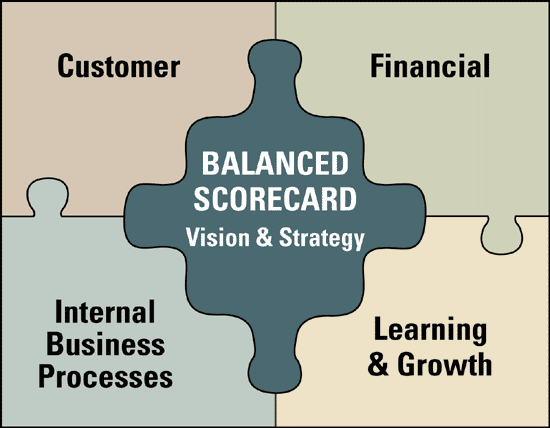
Kaplan and Norton's Balanced Scorecard
The Balanced Scorecard serves as a learning system for testing, gaining feedback and updating an organization's strategy. The four perspectives provide a balance between short-term and long-term performance, and include subjective as well as objective measures. When applied to e-Commerce initiatives, measures may include process cycle-time, transaction per employee ratios, cost per transaction, volume of transactions, percent of customers supported by e-Commerce, time to fulfill service requests, and inventory costs. Kaplan's recent research initiatives have extended activity-based analysis to technology and product development and interorganizational measurement systems between manufacturers and retailers that capture supplier and customer profitability.
Whether it is the Balanced Scorecard or another equally robust system of measurement, measuring "the right things," in addition to financial ROI is crucial to successful e-Commerce. The following anecdote tells the story of measuring the right things, "The concept is interesting and well-formed, but in order to earn better than a 'C,' the idea must be feasible," wrote a Yale University management professor in response to Fred Smith's (founder of Federal Express Corporation) paper proposing reliable overnight delivery service. Is "well-formed" or "competitive breakthrough" the right thing to measure? We can wonder what grade the professor would have given Amazon.com's Jeff Bezos.
A company deliberating its future in the brave new world of e-Commerce may seek out lessons learned from past experiences with disruptive technologies. "Dear Mr. President: The canal system of this country is being threatened by a new form of transportation known as "railroads." ... As you may well know, Mr. President, "railroad" carriages are pulled at the enormous speed of 15 miles per hour by "engines" which, in addition to endangering life and limb of passengers, roar and snort their way through the countryside, setting fire to crops, scaring the livestock and frightening women and children. The Almighty certainly never intended that people should travel at such breakneck speed," wrote Martin Van Buren, Governor of New York (1828). Like it or not, e-Commerce, along with its many side-effects, is quietly roaring and snorting its way through the business landscape, scaring investors and frightening Industrial Age thinkers and leaders. Whether by evolution or revolution, e-Commerce will create winners and losers in every industry. Who will they be? Who knows? In uncharted territories and in uncertain times, prediction is of dubious value. Through a stream of assimilation, individuals, departments, companies, industries, and markets must learn as they go. They must learn a little, do a little, learn a little, do a little. At each step in the journey, more information will become available and knowledge will grow from experience.
Rather than being overwhelmed by rapid, discontinuous change, the winners will look back and learn that it was their total commitment to the underlying factors of success that enabled them to arrive at the future first. An inter-enterprise architecture allowed them to build learning organizations that used the first principles of general systems thinking to transform their companies into customer-centric businesses. With this architectural approach, they were able to rationalize, arrange and connect business and technology components to produce the desired results. For them, e-Commerce mastery provided the bridge to the Customer Age.


