

Ontology.org, sponsored by Computer Science Corporation (CSC), was founded by Howard Smith and Kevin Poulter in 1998. Ontology.org is working with CommerceNet to develop ontologies for e-Commerce and XML vocabularies. Smith and Poulter elaborate on the goals of Ontology.org, "Although taxonomy contributes to the semantics of a term in a vocabulary, ontologies include richer relationships between terms. It is these rich relationships that enable the expression of domain-specific knowledge, without the need to include domain-specific terms." The adoption of a shared ontology allows e-Commerce software (especially software agents) to simultaneously "interoperate without misunderstanding, and retain a high degree of autonomy, flexibility and agility." Without ontologies, the tasks of integrating, or in any way unifying the rapidly growing list of XML vocabularies will be as monumental as building the Tower of Babel.
A neutral, non-profit organization makes the most sense for governance of XML repositories and registries. CommerceNet, the non-profit electronic commerce consortium, has announced that it is developing an e-Commerce Registry service. Another organization, OASIS, the Organization for the Advancement of Structured Information Standards, is a non-profit, international consortium dedicated to accelerating the adoption of product-independent formats based on public standards, including SGML, XML and HTML. XML.ORG is an industry Web portal operated by OASIS. The most important function of XML.ORG is to serve as a trusted, secure, persistent repository and registry for DTDs, namespaces, schemas, and other specifications that must be globally accessible in order to make possible the use of XML for data exchange within particular industries.
Owning and governing XML repository portals means power and influence with software developers, so commercial companies including Microsoft have made moves into this space. Using the ".org" top-level domain name, Microsoft rushed in to fill the registry gap by establishing BizTalk.org. The web site is "free," and Microsoft will be happy to store companies' private XML schema in secure areas on the site as well as public vocabularies.
In summary, XML by itself is little more than a markup language. When XML is used as a meta language to define industry vocabularies so that trading partners can interoperate, then it will be those very vocabularies that thrust XML center stage as the language of e-Commerce. Reaching this goal will not be as easy as it may sound and many requirements must be met. The XML/EDI Group amply describes these requirements. "What does it take for a document/format to meet the challenges of delivering on the concept of enabling the "Electronic Enterprise" of the future? One can foresee that the requirements would include:
1. Message objects containing all the information (rules and data) necessary to process them without reference to the originator for clarification. [self-describing and introspective business objects]
2. A self-validating and authenticating message.
3. Displayed as requested by the author or reader, including local styles, and also tailoring itself automatically to the particular device or media available.
4. Dynamic links from various sources/servers and object components from around the world.
5. A web presence with common tagged elements.
6. A legacy interface with the new system without having to redesign expensive business processes.
7. Extended EDI messages with multimedia-based objects and content.
8. Searchable via today's and enhanced object-based engines of the future.
9. Encapsulated internal routing and security elements.
10. An easily assimilated protocol via today's software.
11. Manipulated and viewed with your Web browser, word processor or spreadsheet program.
12. Dynamically updateable industry codes cross-linked to reflect the local language.
13. Compatible with internal workflow subsystems and external business-to-business pipelines.
14. Automated on-line E-business.
15. Intranet access to local databases without the use of complex middleware."
As industry vocabularies mature, XML will bring the benefits of traditional EDI to the masses, ease the legacy and ERP interoperability problems, and level the playing field for small and medium-sized enterprises (SMEs). Although adapting to the new XML-enabled world of e-Commerce will require a lot of transition planning and work (no technology introduction is trivial), XML is in every company's e-Commerce future.
Issue 8: Open Markets: Standards-based Rules of Engagement
The telephone was the first universal, fully interactive information highway. Standards made it possible for any phone company's proprietary system to interoperate with any other phone company's proprietary systems. As a result, today anyone can phone anyone anywhere at anytime. Without global standards, however, the telephone would not be universal and would not have its impact on society and the economy.
In the third wave, e-Commerce transforms closed, isolated markets to dynamic open markets. Standards are prerequisite to such dynamic markets and market interoperation. We have discussed the Tower of Babel problem of the growing XML industry vocabularies. Creating standards, open standards, between and among these semantic towers of e-Commerce Babels is essential to digital commerce. Open e-Commerce standards (tying together the XML Towers of Babel) to watch for in include CommerceNet's eCo system architecture and the Object Management Group's Electronic Commerce Reference Architecture Model.
A January 1999 report from CommerceNet documents the status of the eCo system framework and the problem it aims to solve. "Using XML and Objects to construct an Electronic Commerce Framework - CommerceNet announced its eCo Framework workgroup in August 1998. Its purpose is to select and integrate various existing technologies into a framework for all commerce. Many efforts, proprietary, industrial and international in nature, are working to establish electronic commerce standards. Efforts such as OFX (Open Financial Exchange), ICE (Information Content Exchange), or OTP (Open Trading Protocol), while well done, focus on only part of the whole Electronic Commerce process and do not offer a total solution. The eCo Framework Workgroup hopes to solve this problem through the use of new and existing object-oriented technologies, XML, Object-Oriented XML, Agents, EDI and other existing semantic and syntactical technologies. This is a formable undertaking - to accomplish this goal, expertise from many related standards groups is required for constructing the final framework. The work group has two efforts underway. One effort is to establish the architecture of services and how they interact and fit together. The other effort is to research existing technologies and recommend those that should be used to construct the framework."
"Marketware" is the generic name for a class of eCo applications and services that would bring together buyers and sellers. The services are based on a common platform that would be customized by plugging in different application modules. Depending on the modules used, a variety of value-added market services could be implemented CommerceNet's eCo framework is centered on advanced semantic models and technique derived from the world of artificial intelligence such as ontologies developed by the European Enterprise Project."
"The primary focus of CommerceNet's eCo framework project is to
demonstrate the value of the integration of three common component-based
electronic commerce services. These services are semantic integration of
multiple database types with multiple data constructs and data libraries;
trusted open registries; and agent-mediated buying. It is our belief that
these three core services will serve as the foundation for next
generation, component-based commerce applications and services. These core
services will provide interoperability between many commerce services and
serve as a foundation to operate Web-based trading communities." The eCo
Architecture is presented in Figure .
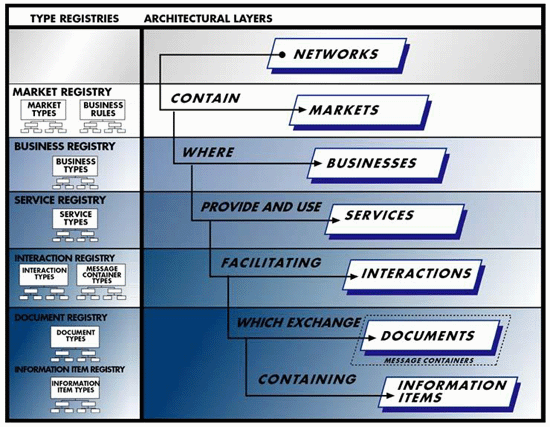
CommerceNet's eCo Architecture for Open e-Commerce
To help put the eCo Framework in perspective, Figure shows an instance of the eCo framework at work. Using the eCo Architecture specification, the figure illustrates the following e-Commerce scenario, "two companies are represented as eCo Businesses (implementations of the eCo Business Layer.) These Businesses exist together in an eCo Market that provides a venue for the type of e-Commerce that they are conducting. The eCo Market is indexed within a Network of Markets so that it can be located on the Internet. Each of these Businesses offers a set of e-commerce "Services" to each other. Each Service represents an interface to a business process. Example Services might be "Become a VAR", "Order some product", or "Review a catalogue of products." At the highest level, Businesses interact by using the Services of each other."
"A Service is composed of a set of document exchanges. We call these exchanges 'Interactions'. An Interaction occurs when a request (consisting of one or more Documents) is sent from one Business to another and a response (again consisting of one or more documents) is received."
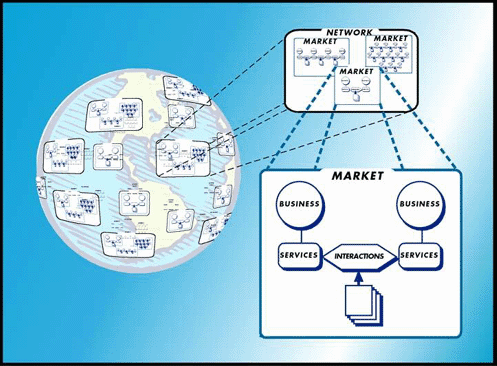
CommerceNet's eCo Framework at Work
Distributed object computing sets the foundation for both enterprise computing and the inter-enterprise computing that is essential to open e-Commerce. In fact, it is the distributed component paradigm that has made it possible for e-Commerce to aspire to open digital markets.
Like business objects in general, the interoperation of open market processes must rise above technology interoperation ("above the ORB") to a level of abstraction where business information models can interoperate using the vocabulary of e-Commerce. In other words, common business semantics must be available to all participants in an open digital market.
Yet common business semantics are not enough. Interoperation at the e-Commerce semantic level is the focus of CommerceNet. Interoperation at the information systems level is the focus of the Object Management Group's (Common Object Request Broker Architecture) CORBA specification. In addition to CORBA middleware, and rising above the "orb," the OMG's Electronic Commerce Domain Taskforce (ECDTF) combines e-Commerce interoperation with distributed, heterogeneous systems interoperation. The greater business world will benefit if these two organizations closely collaborate with each other, W3C and DISA.
The OMG EC Domain Task Force is developing standards for open markets: Negotiation, PKI, Payments, and Brokerage specifications, with more to come within the framework of OMG's overall reference architecture. The Electronic Commerce Reference Model sets the stage for open market standards backed by a robust distributed computing infrastructure. No organization has contributed more to creating open, standard "middleware that's everywhere" - an OMG slogan. We can understand the OMG's Electronic Commerce Reference Model and the goals of the ECDTF by reading from its draft mission statement:
"The Electronic Commerce Domain Task Force (ECDTF) exists to define and promote the specification of OMG distributed object technologies for the development and use of Electronic Commerce applications by: (1) developing an object-oriented framework for open commerce that promotes the interoperation and reuse of applications and services, and (2) supporting an ongoing process for achieving broad consensus on issues of interoperability and reuse.
The ECDTF will focus on defining and influencing OMG specifications for technology areas related to EC, including:
 Security
Certificates (e.g., Authentication)
Asynchronous (e.g., queued) Communications
Information Transfer Protocols
Transactions
Quality of Service
The ECDTF will work with other OMG elements to leverage existing activities and specifications. As new requirements are identified, the ECDTF will collaborate with other OMG elements to develop new OMG specifications. Finally, the Electronic Commerce TF will work with outside organizations (such as, CommerceNet, ANSI X12, EDIFACT, CEFACT, TINA-C) through the OMG Liaison committee to leverage and influence related activities and specifications." In recognition of the requirement for knowledge representation in e-Commerce, the OMG ECDTF includes an Agent Technology Work Group that has participants with world-class experience in the commercial intelligent agent community.
The OMG's initial draft service architecture for open electronic
markets, the Electronic Commerce Reference Model, is shown in Figure
8.8. The model is of sufficient depth to address such issues as "policy
management" which affects market participant behavior and enterprise
system rule enforcement. The architecture reaches deeply into the
interactive relationship between participants such as customer and
supplier (and their respective agents). Negotiation may equally occur over
agreement on policy in order to establish a common, temporary domain. This
concept of "dynamic policy domains" built using sophisticated policy
management tools opens up new markets in third-party policies, used for
the duration of a transaction and then discarded.
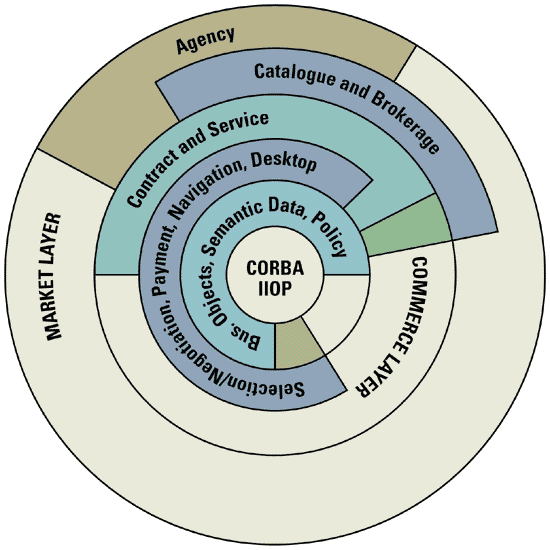
OMG's Electronic Commerce Reference Model Architecture
The e-Commerce related standards being evolved by OMG and CommerceNet, as well as the Workflow Management Coalition (WfMC), DISA (EDI) and the World Wide Web Consortium (W3C) are works-in-progress. Corporations wanting to excel in emerging, open markets should participate directly in the work of these organizations. Participation will help a company keep abreast of developments and offers the opportunity to help shape the standards that will serve as the rules of engagement.


