METACOGNITION AND CRITICAL THINKING
FOR EFFECTIVE LEARNING
D.F Lockwood
I. INTRODUCTION:
The information flow in todayˇ¦s education has shown a steep increase.
Students and teachers need a scheme to intelligently deal with extra
information. The scheme can center around raising studentsˇ¦ cognition above the
recall level. If students can reach the level of true HOW and WHY understanding,
the gateway is open to all other levels of knowledge. Then knowledge can
actually be applied for future success in learning.
II.
Critical Thinking Skills (CTS) and Metacognition can be strongly linked to
develop active participation and all the levels of knowledge. CTS is logical and
reflective thinking. It involves the processes of actively questioning and
analyzing information to gain knowledge. Metacognition is looking at your
results along the way. It is being aware of what you know and donˇ¦t know at
various levels of cognition. Metacognition also involves being aware of
strategies to control and improve learning. CTS helps students to truly come to
grips with a subject. This becomes apparent for example, if HOW and WHY
questions are asked during an interactive lesson. Students then realize if they
understand the material. They are now in a better position to make valid
decisions for what learning strategies they will need to answer higher level
exam questions.
(ex. Deciding how to produce cause and effect relationships on exam guides)
**See the first poster on the relationships among CTS, Metacongnition and
Cognition
.
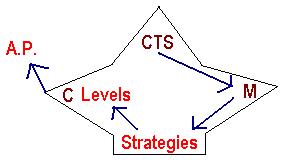
(Click here for emblem explanation)
Metacognition in general, includes the major elements of Planning,
Integrating, Monitoring, and Evaluating for various levels of knowledge. In
second poster these major elements are mapped out. Under each element are
several strategies to achieve that element. For example, student exam guides are
listed under planning. Daily ten minute self-checks and keyword booklets are
listed under monitoring. Mind-mapping for relationships is listed under
Integration. These metacognitive measures show students what they need to
understand a course.
**See the second poster on the Metacognition Mind Map.

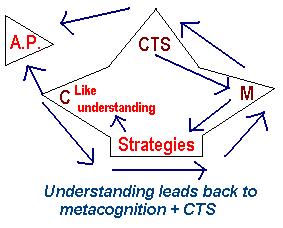
Teaching for understanding can play a big role in achieving CTS and proper
Metacognition. Understanding also leads to long term memory. This in turn allows
for future applications of knowledge and even more CTS and Metacognition. All
these processes are recursive! For understanding to take place, which I have
focused on in planning a course. These topics or themes link all the course
material together. They also provide an unlimited number of interconnecting
questions for Metacognition. The principles of understanding also include
interactive explanations and modelling by the teacher. Teaching for
understanding can also lead to Active Participation by students. Students ask
more, perform more actively on class projects, and achieve better on higher
order exam questions.
**See the third poster and look at the first poster again!
.
III. CONCLUSION:
There is a whole group of teacher and student behaviors that can be combined
together to produce Metacognition and Critical Thinking. When these behaviors
are pursued, the Metacognition and CTS can lead to high levels of cognition.
Core Thinking skills like basic reasoning and remembering respectively become
logical reasoning and long term remembering. The core abilities of analyzing and
relating facts are sharpened. They therefore can lead to greater success in idea
formation, decision making and problem solving. These functional brain skills
will be needed to operate within our complex society. Therefore, we should
promote both Metacognition and Critical Thinking to help our students attian
full cognition and the functional brain skills.
** See the teacher/student behaviors in poster #4 and the flow chart in poster #5. These posters provide an overview of how Metacognition and Critical thinking
can lead to high levels of functional thinking and knowledge for future student
success.