
Noseart Page 1
The seal says it all! Pratt and Whitney powered many of the aircraft, both fighters and bombers, in WWII.

Obviously the Wright Choice of engines was a Wright engine. The Wright Aircraft Company produced many of the engines that powered both fighters and bombers in WWII. They also developed the very successful R-3350 which in the turbo compound version produced almost 200hp per cylinder and was the height of technology in radial engine development
W.A.S.P. stands for the Women's Airforce Service Pilots. During WWII these women were were trained to fly fighters, transports, and bombers. In the 1940's women weren't allowed to fly combat missions on the front line. These brave women were willing to risk their lives for their country and 1078 earned their wings. The silver wings that were worn by these pilots had a diamond shaped shield in the center to represent the shield carried by Athena, the Goddess of War. During WWII they flew over 60 million miles ferrying aircraft. They also flew missions towing targets, as instructor pilots, cargo, and as test pilots. Thirty-eight would loose their lives in service to their country.
Thomas Hamilton began manufacturing propellers in the 1920's. Later it merged with the Standard Steel Adjustable Propeller Company to form Hamilton Standard. During WWII Hamilton Standard would produce over 500,000 aircraft propellers!
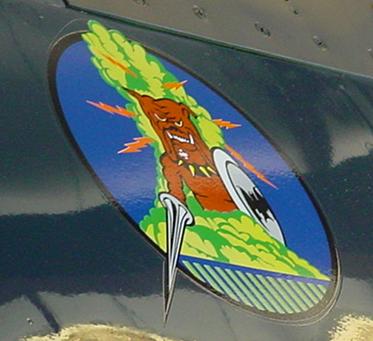
Squadron decal on Chance Vought F4U-5 Corsair. This emblem represents the Navy composite squadron VC-3 "Detachment Dog." VC-3 flew F4U Corsairs off the U.S.S. Princeton during the Korean War including Commander Guy Bordelon, a Navy Ace during that era. VC-3 was a squadron of night hunters. These Corsairs would fly very dangerous low level night missions against North Korean targets.
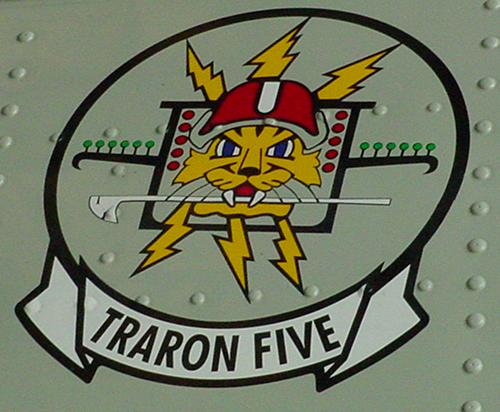
This emblem belongs to a T-28C and is marked in the colors of the Navy Training Squadron VT-5. The symbol in this picture is the emblem of TRARON 5, the "Tailhook Tigers". TRARON is the term given for Top Training Squadron. The squadron was based out of Naval Auxiliary Air Station, Saufley Field, Pensacola, Florida. The tail bears the markings of the U.S.S. Lexington.

This P-51C proudly wears the colors of "Ina the Macon Belle." The original Belle was flown by Tuskegee Airman Lt. Colonel Lee Archer of the 302nd fighter squadron. This squadron is most noted for the remarkable achievement of never loosing a bomber on an escort mission.
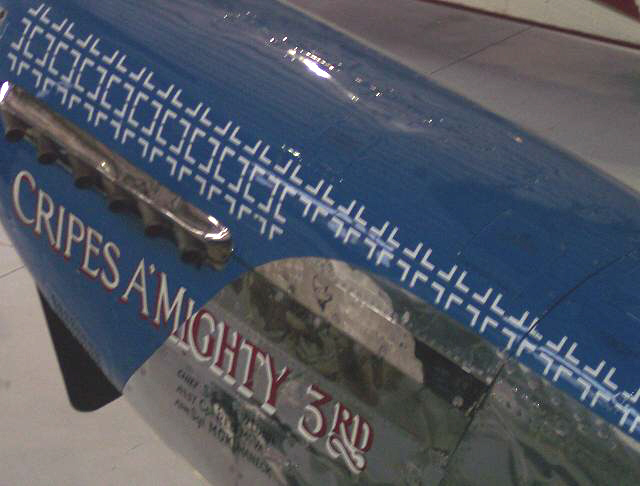
This P-51D is painted up as Major George Preddy's "Cripes A'Mighty 3rd. Preddy is the highest scoring American ace in a P-51 credited with 24 kills in Mustangs and 3 in other aircraft. He also had 5 confirmed ground victories. On December 25th, 1944 Preddy was shot down by friendly anti-aircraft fire. At the time of his death he was the highest scoring American ace of the war.
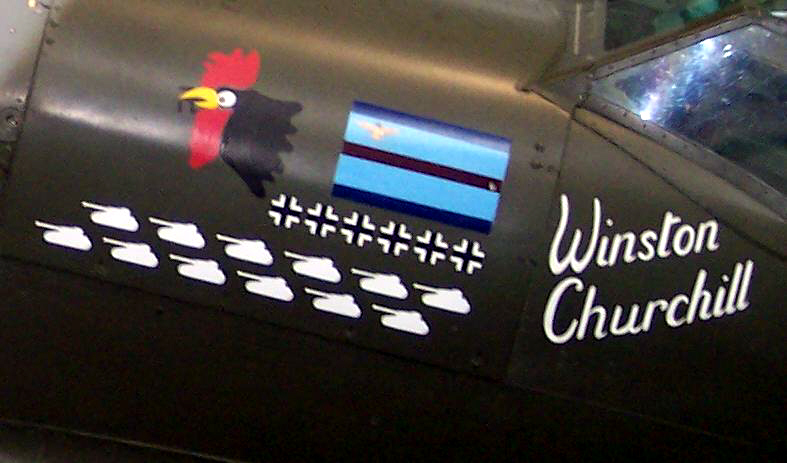
This Spitfire Mk XVI is painted in the markings of Sqaudron Commander Ramond Lallemand, the top scoring Belgian Ace of WWII. His aircraft was named in honor of Winston Churchill the Prime Minister and Minister of Defense of Great Britain from 1940 until 1945. Although the markings are correct, the noseart is fictitious. In WWII the British aviators, unlike the American's, could not paint artwork on their planes.
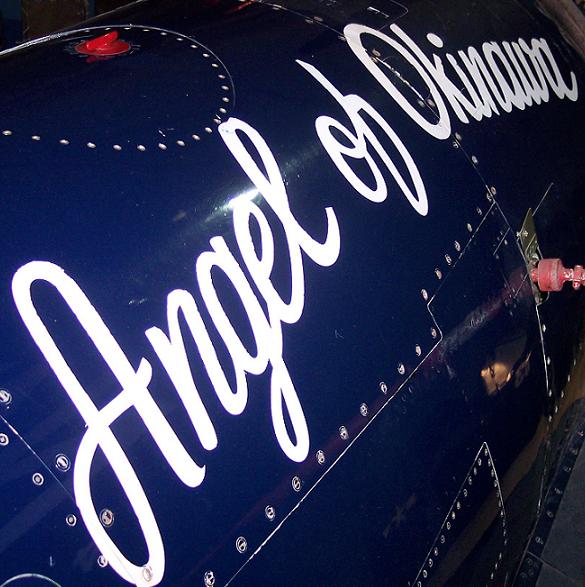
"Angel of Okinawa" displayed on the nose of this Chance Vought F4U-4 Corsair build number 97286. The name was given by a previous owner, Merle Gustafson, in honor of it's wartime history in the battle of Okinawa. This particular aircraft was also featured in the hit TV series "Ba Ba Black Sheep."



Legal Disclaimer - Please Read
© Brian Whittingham 2004
