
Fantasy of Flight Page 1
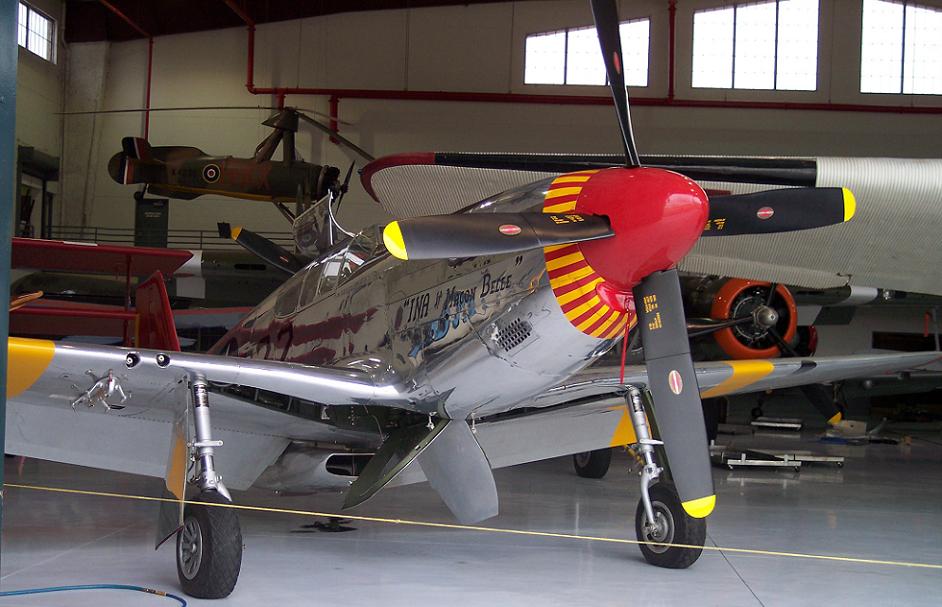
This P-51C proudly wears the colors of "Ina the Macon Belle." The original Macon Belle was the stead of WWII Fighter Ace Lt. Colonel Lee Archer of the 302nd fighter squadron 332nd fighter group. He was one of the "Tuskegee Airman" which was composed entirely of African American pilots. On October 12, 1944 Lt. Col. Archer shot down three Me-109's in a single day! He flew 169 combat missions in WWII and went on to fly missions in the Korean War. In his 29 years of service to his country he would recieve three Presidential Unit Citations, the Air Medal with twelve oak leaf clusters, and the distinguished flying cross. The original Belle was actually a P-51B model and can be seen pictured here: http://www.ebonywings.com/ewpages/ewabouttheartist/pages_leearcher.html
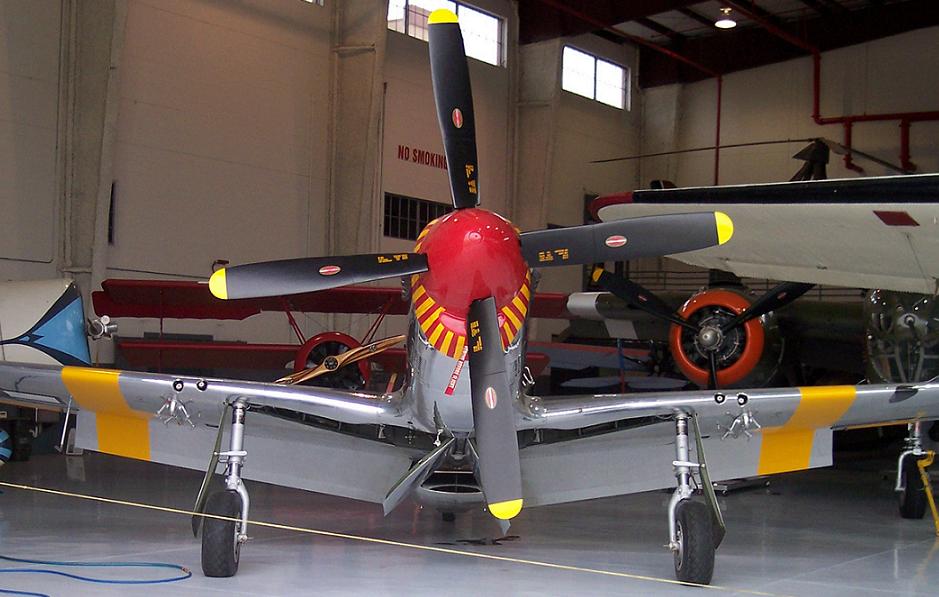
The Tuskegee pilots initially had to prove that they could fly as good as their white counterparts. In time the respect and admiration of the other pilots would be gained and through their reputation they became requested by the bomber groups. The 302nd never lost a single bomber during it's escorting missions. These men helped end segregation in the U.S. Armed forces. The aircraft pictured above was once owned and raced by Paul Mantz, a Hollywood stunt pilot, as race #46 and #60. It is only fitting that this extremely rare P-51C was painted in the colors of the Tuskegee Airmen. The restoration took place over 13 years to become the most original P-51's restored. It is indeed the finest restoration of a P-51 ever!

This F4U-4 Corsair was flown in the Battle of Okinawa. In 1989 it was acquired from the estate sale of Merle Gustafson. Maintenance and Inspection were done by Nelson Ezell to make this aircraft flyable. It was also used in the TV series "Ba Ba Black Sheep" which was a show based on the "Black Sheep Squadron." The VMF-214 Black Sheep were the most famous Marine Corp Squadron in WWII. They were led by commanding officer Gregory "Pappy" Boyington. The Black Sheep flew from August of 1943 until January of 1944. They fought in the northern Solomons and in Rabaul where they were credited with shooting down 94 Japanese aircraft and destroying another 103 on the ground. The squadron had either other aces besides Boyington. Boyington initially had a hard time in flight training having to go through a number of rechecks. Boyington was given a dishonorable discharge from Claire Chenault after flying for a time with the AVG. While with the AVG he managed 6 kills. He would go on to total 28 claimed kills in WWII. Eventually he was shot down and did a year and a half in a Japanese prison camp. An interesting fact is that Boyington was referred to as "Gramps" not "Pappy." Pappy was the nickname that the press gave him after he was shot down.
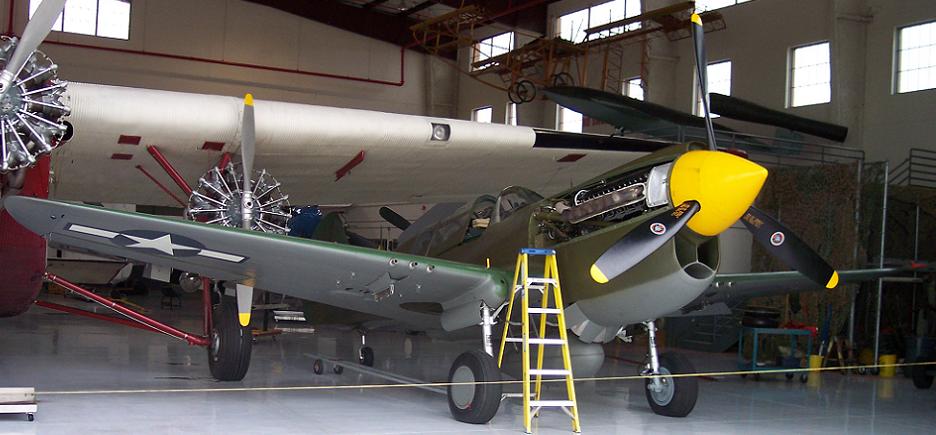
This is an Army Air Corp TP-40N variant. This variant was a conversion done by Curtiss in Buffalo, New York to turn a standard P-40N into a dual seat, dual control Warhawk. Only 30 of these aircraft were ever converted for training purposes. The Warhawk at Fantasy of Flight is one of the rarest warbirds still airworthy.

The Grumman F3F Flying Barrel was the last of the Grumman biplane fighters. It first flew in 1936 but was out of service by the end of 1941. It was powered by a Wright R-1820 rated at 850hp. During it's day it was the fastest and most maneuverable biplane carried aboard a ship. The aircraft pictured above was restored by "Planes of Fame" and first test flown by former race pilot Steve Hinton. In the 1970's none of this type aircraft remained in airworthy condition. Raising the landing gear on this aircraft was achieved by a manual crank, 26 turns to the up position!

The first Supermarine Spitfire was delivered in 1938. The designer Reginald Mitchell took the experience gained from his Schneider Seaplane Racers. The S.4 would set a new world speed record in 1925 of 226.75mph. The new fighter was powered by a Rolls Royce Merlin engine. During the Battle of Britain in 1940 the Spitfire gained worldwide fame. Spitfires served in all theaters during the war and were flown by every allied country. Before the United States officially entered into the war a group of American Volunteers called the Eagle Squadron. Only once before had this happened with a squadron called the Lafayette Escadrille. They went to Europe to fly for the RAF. Their first mission was flown on August 5, 1941. They flew Hurricanes and Spitfires. The Eagle Squadron was composed of approximately 240 men, but after the official entry into the war by the U.S. was disbanded. Over 20,000 Spitfires were produced and played a major part in the outcome of WWII. The aircraft pictured is a Mk16 with clipped wings and a streamlined cockpit. In the 1960's it was used in taxi scenes for the movie "Battle of Britain." Then in the 70's it served as a static display and gate guard for RAF Norholt in London.

This unusual aircraft is a Cierva C-30A Autogyro. The autogyro has no conventional wings, but instead it has a rotating wing like a helicopter. The engine attached to the front of the fuselage was a 140 hp Armstrong Siddeley Genet seven cylinder radial engine. This propelled the aircraft forward which provided the momentum to turn the rotor blades. This is known as autorotation. The rotor blades aren't powered by an engine which makes it impossible to hover like a helicopter. To control the aircraft's bank and roll the rotor heads were movable. Yaw was accomplished by a rudder like a typical airplane. The aircraft pictured above was built in 1934 and served with the RAF's 529th squadron in WWII.
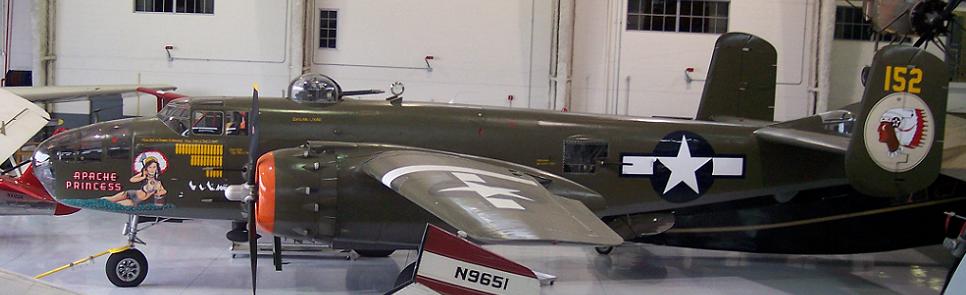
This B-25J is painted to replicate the real "Apache Princess" of the 345th bomb group.
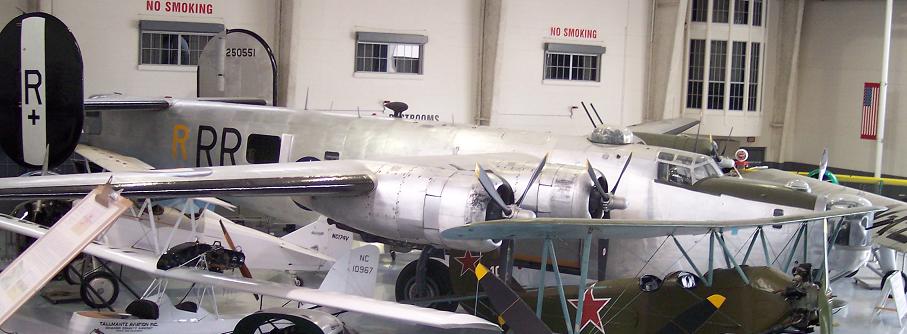
The Consolidated B-24 Liberator is the most mass produced American military aircraft ever. There were 18,481 of this type to be built. It was powered by four P&W R- 1830's producing 1,200hp a piece. It was designed in 1939 and although it went on to serve on all fronts during WWII but it's long range made it the bomber of choice for the Pacific theater. It was also used to carry cargo, as a transport, photo reconnaissance, and in mine laying. During the war they were produced by the Consolidate company in Fort Worth and San Diego and by the Douglas Corp of Tulsa. This B-24D "Joe" ,pictured above, served in WWII with the RAF and after with the Indian Air Force. It was used during WWII during the Battle of Burma to destroy the Siam- Burma Railway Bridges! It is one of only three B-24's left in the world that still fly. The other two are the B-24 "Dragon & His Tail" operated by the Colling's Foundation and the B-24 "Diamond Lil" operated by the CAF.
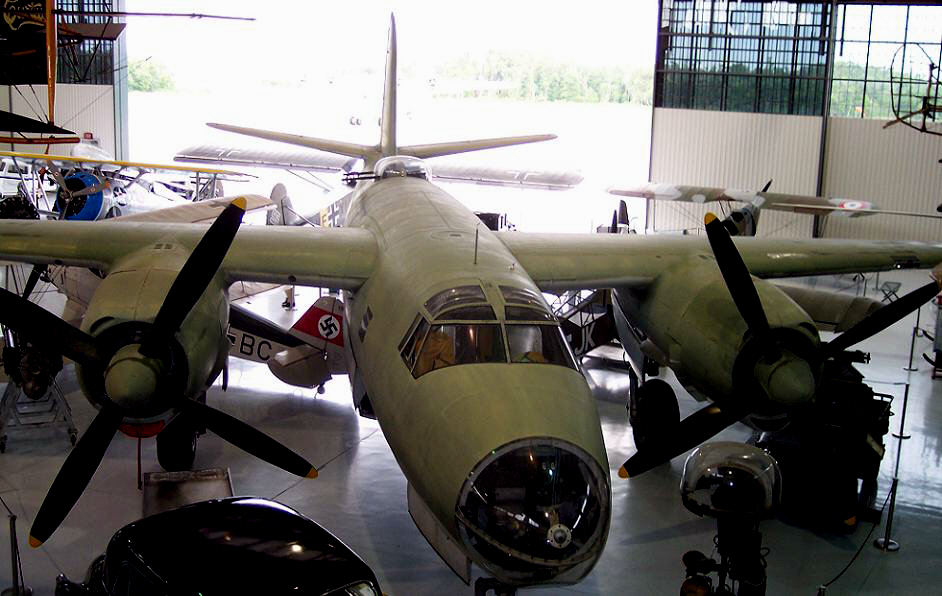
The Martin B-26 was officially named the "Marauder." It was designed in January of 1939 to be a mid-sized bomber capable of 320mph. It was certainly fast, but had poor handling at lower speeds due to it's short wings. By 1943 the Marauder was phased out of the Pacific theater in favor of the B-25 Mitchell. It would go on to be used as tactical support in early 1944 during D-Day. The British also used the aircraft very successfully as a torpedo bomber.

By the crews it was known as the "Widowmaker", "Baltimore Whore", and "Flying Prostitute." It is slightly ironic that the B-26 would have the lowest attrition rate of the 9th Air Force Bombing Group by the end of WWII. It was because of the stubby wings and poor handling at lower speeds that a series of accidents occurred during training at the Naval Air Station in Tampa Florida that originated the saying, "One a day in Tampa Bay." Even the famous aviator, now Colonel Jimmy Doolittle, said that the aircraft was unforgiving. The "B" model would incorporate slotted flaps and a longer nose wheel to increase the wings angle of incidence. This allowed a shorter takeoff run and lowered landing speeds.



Legal Disclaimer - Please Read
© Brian Whittingham 2004
