You have to deserve your father's.
He is more particular."
-Robert Frost

| FAVORITE HAUNTS |
Book Search
W. P. Kinsella's writing is a welcome respite from the profuse sensationalism that plagues much of today's bestselling fiction. He writes with a nuanced eye, placing characterization above high-octane plot twists. The results are deeply textured, heartfelt stories embedded with characters that are to be believed, even in their eccentricities.
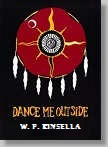
Dance Me Outside is a short story collection. Set on the Ermineskin Reserve in northern Alberta, it follows eighteen-year old Silas Ermineskin and his friend Frank Fence-post through a series of stories written through Silas in the first-person. Frank and Silas are enrolled in a mechanics class at the technical school in Wetaskiwin, but to complete it they must each write an essay. The stories that emerge in Dance are the result of Silas' pursuit of this goal, finding his voice along the way.
Kinsella writes with respect for the First Peoples featured in his stories. Embedded with humor, it's not the native nations he pokes fun of so much as it is the idiosyncrasies of the dominant white culture that Silas and his pals keep running afoul of. The Royal Canadian Mounted Police are a recurring target of jokes, as are the bloated and bigotted politicians and financiers who control the flow of what little commerce there is to the communities outlying the rez.
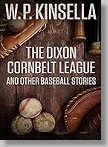
Unlike W. P. Kinsella's Dance Me Outside with its intertwined stories that focus on a handful of recurring characters, the stories in The Dixon Cornbelt League have nothing in common, save for one singular theme: baseball.
The nine stories that comprise Dixon Cornbelt all feature baseball players who are on the far side of their careers. They're either playing for minor leagues with dreams of making a comeback, or languishing in retirement, wishing they were playing in the minors. Like the past champions of horse racing, these boys of summer have been put out to pasture.
While ball players past their prime may sound like a sure yawn, in Kinsella's hands they're anything but. He's a master craftsman of plot, presenting the unexpected, breathing new life into otherwise tried and tired subject matter. In the case of The Baseball Wolf, Kinsella slips in a bit of mystic fun, giving two players the supernatural gift of shape-shifting, while Eggs presents the inner conflict that arises when a ball player is pressured to retire, but wants to exit on his own terms: "I'm only somebody
when the ball smashes into the catcher's mitt and the batter twists into a corkscrew. I need one more season . . ." But, at thirty-one, he's past his prime, and his fastball, impotent.
Kinsella's fans will find themselves in a familiar landscape in the title story of the collection when the civic leaders of a small Iowa town threatening to go bust take a gamble on retiring ball players. By actively recruiting washed-up players for the local farm league, they hope to stabilize the town's population. With recruitment comes a small stipend, and the opportunity to marry and settle down with one of the many available local girls. It's Grand Mound, Iowa's answer to keeping the outflow of residents lower than the influx of ball players. Theirs is a plan for maintaining an idyllic lifestyle of baseball, hotdogs and apple pie. A numbers game they appear to be winning, even though their ball league is a thing of fiction. For a retired ball player past his prime, that makes no difference. For a retired ball player, Grand Mound - its days filled with practice games that will never count toward official statistics - offers a familiar routine playing the game he loves. For a retired ball player, Grand
Mound is tantamount to heaven on earth. For a reader, Dixon Cornbelt is too.
posted 08/04/25
|