
 |
CICHLIDS By: Gatekeeper |
|
|
It is obvious that in a
giant body of water like Lake Malawi there are a number of different If one reads the
aquaristic travel reports about Lake Malawi one gains the impression
that the coast of this lake is mainly made up of cliffs. In contrast,
although the majority of ornamental fish come from the rocky regions of
the coast, most of the coastline (ca. 70%) is formed by gradually
inclining sandy zones. While Mbunas are only rarely found in these
regions, the various îsand cichlids” from the group of the Non-Mbunas
are at home here. Especially the Lethrinops spp. (Lethrinops,
Taeniolethrinops and Tramitichromis), and the numerous Nyassachromis
occur in large numbers over the sandy bottom. At some places so-called
spawning colonies can be seen in which hundreds
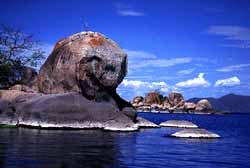
of males are found living side by side The rocky coast is not only crassly different optically but also the number of species living here varies greatly from the aforementioned sandy zone. This is the main habitat of the majority of the species caught for the ornamental fish trade. Nevertheless when one takes into consideration the total area covered by rocky or stony regions in Lake Malawi, this habitat only takes into account less than 5% of the potential area available for the fish to settle. Despite this, virtually all the Mbunas are to be found in the rocky regions. Various Non-Mbuna genera are also to be found in these zones. The aufwuchs growing on the rocks is the main source of nutrients for the majority of these cichlids. The intermediate
zone is a habitat that can only be poorly demarcated. At many places the
sand and stone regions run into each other. Here both aufwuchs and
free-lying sediment with ground-living organisms are available as food
sources. These areas belong to the most species-rich biotopes as their
position as îjunctions” between the sand and The remaining four habitats are only of minor importance to the aquarist. Open water should be differentiated in the open water close to the shore and the pelagic environment (the open water far away from the shore). Strictly speaking the latter zone is only inhabited by a single species which does not belong to the cichlids but to the anchovies (Engraulicypris sardella, the Lake Malawi anchovy). The so-called Utaka (Copadichromis) are indeed inhabitants of open water but these species always remain in the open water close to the shore. The reproduction of this habitat in captivity for the keeping of the Copadichromis spp. would be simple if its dimensions were not so huge. The largest possible aquarium (both in height and floor area) with lots of swimming room and a rocky back wall would be sufficient. Despite this, the majority of the imported Copadichromis can be permanently maintained and bred in a standard aquarium. A very special habitat is formed by the deep water zone. This is normally considered as the depths below 30 m and in Lake Malawi this extends down to 200-250 m. Further down in the lake, the water is contaminated by poisonous hydrogen sulphide making the survival of higher organisms impossible. In the deep water zones live chiefly representatives of the genera Diplotaxodon, Alticorpus, Pallidochromis and some large Rhamphochromis spp. Especially the tasty Rhamphochromis and Diplotaxodon spp. are often caught by fishermen, so that these deep water inhabitants now and again are seen on the lake. Alticorpus spp. have been caught at depths of almost 160 m. None of the typical deep water dwellers are of interest for the aquaristic. The final habitat which will be introduced here is formed by the river mouths and the reed-covered shore line. In these regions there can be found not only those species which also live in the rivers that flow into Lake Malawi (Tilapia, Astatotilapia, Serranochromis), but also representatives of the Non-Mbunas. The exporters of ornamental fish tend to shun these areas as they are usually unproductive. Site designed by Gatekeeper. Best viewed under Internet Explorer 5.0 or above. All
text files provided here are copyrighted by their respective author. |

 habitats present. The human tendency for classification may appear often
artificial, nevertheless the following division into seven habitats
initially published at the beginning of the 1960s, provides the best
overview. The knowledge of the individual habitats enables the aquarist
to set up his aquarium as naturally as possible.
habitats present. The human tendency for classification may appear often
artificial, nevertheless the following division into seven habitats
initially published at the beginning of the 1960s, provides the best
overview. The knowledge of the individual habitats enables the aquarist
to set up his aquarium as naturally as possible.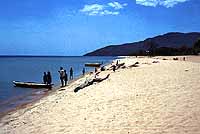 in their territories or sand nests, all trying to court the attention of
the females. Most of the sand dwellers are not so colourful as the
species found in the rocky or intermediate zones.
in their territories or sand nests, all trying to court the attention of
the females. Most of the sand dwellers are not so colourful as the
species found in the rocky or intermediate zones. rock zones offer a suitable habitat to a large number of species. A
miniature intermediate zone can only be built in a very large aquarium
as the Lake Malawi cichlids when they have first begun to feel secure in
an aquarium do not feel themselves bound to one particular area and
settle higgledy-piggledy throughout the zones present in the tank. The
next sheltering stone is indeed not so far away, so that a Mbuna,
without experiencing any reservations will be able to venture into the
adjacent area of sand in order to quickly scare off a Nyassachromis
male from his sand nest.
rock zones offer a suitable habitat to a large number of species. A
miniature intermediate zone can only be built in a very large aquarium
as the Lake Malawi cichlids when they have first begun to feel secure in
an aquarium do not feel themselves bound to one particular area and
settle higgledy-piggledy throughout the zones present in the tank. The
next sheltering stone is indeed not so far away, so that a Mbuna,
without experiencing any reservations will be able to venture into the
adjacent area of sand in order to quickly scare off a Nyassachromis
male from his sand nest.