


Group Members
Click on me to know
more 
Mostafa I was born on
the 10th of Novembre 1982.I Study Computer Programming In Dar
attarbieh School . I Live In Tripoli ( Lebanon ) Al Kobeh ,
Univercity Street Tel : 06 384 553 Email :
m_raad@hotmail.com
Back
to top
Bassam I was born on
the 20th of January 1983. I am in secondary school in Dar Attarbieh
School .I Live In Tripoli (Lebanon ) Abou Samra Tel : 06 436 187
. Email : b_allaf@yahoo.com
Back
to top
Hassan I was born on
the 13th of June 1984. I am in secondary school in Al Yazigi School . I Live
In Tripoli ( Lebanon ) Abou Samra Tel : 06 447 982 . Back to top
OUR COUNTRY LEBANON OUR BELOVED COUNTRY IS THE LOVELIEST
PLACE IN THE WORLD, ONCE YOU ARE IN IT YOU DON'T WANT TO LEAVE IT....
WE WILL DO ALL OF OUR BEST TO REGAIN ITS STOLEN GLORY
UNDER
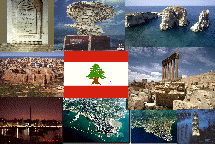
THE BEAUTIFUL COUNTRY IN THE WORLD
(Arabic
Lubnan), republic on the eastern coast of the Mediterranean Sea
in Southwest Asia. Lebanon is a small country of only 10,400 sq
km (4015 sq mi); from north to south it extends 217 km (135 mi)
and from east to west it spans 80 km (50 mi) at its widest point.
The country is bounded by Syria on both the north and east and by
Palestine on the south. Lebanon's landforms fall into four
parallel belts that run from northeast to southwest: a narrow
coastal plain along the Mediterranean shore; the massive Lebanon
Mountains (often referred to locally as Mount Lebanon) that rise
steeply from the plain to dominate the entire country before
dropping eastward; a fertile intermontane (between-mountain)
basin called the Beka Valley (Al Biqa'); and the ridges of the
Anti-Lebanon Mountains, shared with Syria. Lebanon's highest
peaks are Qurnat as Sawda' (3,083 m/10,115 ft) in the country's
north, and volcanic Mount Hermon (2814 m/9232 ft) at the southern
end of the Anti-Lebanons. The country's name comes from the old
Semitic word laban, meaning "white," which refers to
the heavy snow in the mountainsBack to top
Most of Lebanon has a Mediterranean climate,
with warm, dry summers, and cool, wet winters, although the
climate varies somewhat across the landform belts. The coastal
plain is subtropical, with 900 mm (35 in) of annual rainfall and
a mean temperature in Beirut of 27° C (80° F) in summer and
14° C (57° F) in winter. In the Lebanon Mountains, temperatures
decrease and precipitation increases with elevation: Heavy winter
snows linger well into summer, making the Lebanon Mountains more
pleasant in the summer than the humid coast; higher altitudes
receive as much as 1275 mm (50 in) of annual precipitation. The
Bekaa Valley and the Anti-Lebanon Mountains are situated in the
rain shadow of the Lebanon Mountains and as a result have hot,
dry summers and cold winters with occasional rain.Rivers and
Lakes Although Lebanon has no navigable rivers or major natural
lakes, springs in the Bekلa feed two small noteworthy rivers:
the Lىtanى flows south, where it is used for irrigation and
hydroelectric-power generation, and then west through a gorge
into the Mediterranean; the Orontes flows north and across Syria
into Turkey. Many major springs can be found along the western
slopes of the Lebanon Moutains. Throughout the country, many
streams flow only during the winter rainy season. Combined with
runoff from melting snow, these sources provide Lebanon with a
plentiful supply of water, unique in the dry Middle East.Back to top
Lebanon's coastal plain is divided into
several isolated sections by gorges, which are cut by streams
that pour down the mountains in winter and spring. In ancient
times, north-south movement along the plain was nearly impossible.
Villages developed on larger sections of the plain, and those
with good harbors and better agricultural areas evolved into the
city-states of Phoenicia. These cities then used the
Mediterranean Sea to communicate and trade with one another and
beyond the coastal plain. Due to geographical and other barriers,
however, Phoenicia never unified politically. Later, mountainous
areas provided protection for groups seeking refuge, but these
groups, too, were isolated and did not form a unified nation. The
modern nation of Lebanon was formed after World War I (1914-1918),
when the defeated Ottoman Empire, which had controlled the area,
was divided. When France received a mandate from the League of
Nations to rule Lebanon after the war, the region's people were
aligned along religious and cultural lines, but felt little unity
based on a Lebanese nationality. Lebanon still lacks unity today,
which has led both to a diverse culture and extreme conflicts.Prehistory
and Ancient History Early peoples occupied the coastal plain and
the Bekaa Valley during the Old Stone Age, or Paleolithic. Much
later, numerous villages thrived in both areas during the New
Stone Age, or Neolithic, roughly 7000 to 9000 years ago. Still
later, several waves of people, mostly Semites, surged into the
region from the interior, likely the Arabian Peninsula. Ancient
records show that by 2800 BC, cedar timber from Byblos was being
traded for metals and ivory from Egypt. About 2200 BC, Semitic
Amorites arrived from Arabia and Syria, and from the western
Amorites the Canaanites evolved along the full length of the
Levant, the region along the eastern shore of the Mediterranean
Sea. During succeeding centuries the Canaanites developed the
most favored coastal villages into celebrated city-states:
Tripoli, Byblos, Beirut, Sidon, and Tyre. By about 1100 BC the
northern Canaanites became known as Phoenicians (from the Greek
word phoinos, meaning "red," a reference to the unique
purple dye the Phoenicians produced from murex seashells). Having
already developed the first alphabet and mastered the art of
navigation, they dominated the Mediterranean Sea trade for the
next 400 to 450 years. Phoenicians adjusted easily to successive
conquerors: Assyrians in 867 BC; Babylonians in the 590s BC;
Persians in 538 BC; and Greeks under Alexander the Great in 333
BC. However, Phoenician trade declined with Greek competition
after the 5th century BC.
Back
to top
Muslims respect and
revere Jesus (upon him be peace). They consider him one of the
greatest of God's prophets and messengers to humankind. A Muslim
never refers to him simply as "Jesus", but always adds
the phrase "upon him be peace." The Qur'an confirms his
virgin birth, and a special surah (chapter) of the Qur'an is
entitled "Mary." The Qur'an describes the Annunciation
as follows: "'Behold (O Mary!)' The Angel said, 'God has
chosen you, and purified you, and chosen you above the women of
all nations. O Mary, God gives you good news of a word from Him,
whose name shall be the Anointed (Masih or Messiah), Jesus son of
Mary, honored in this world and in the hereafter, and one of
those brought near to God. He shall speak to the people from his
cradle and in maturity, and shall be of the righteous.' "She
said: 'O my Lord! How shall I have a son when no man has touched
me?' He said: 'Even so; God creates what He wills. When He
decrees a thing, He says to it, "Be!" and it is.'"
(Qur'an 3:42-7) Jesus (upon him be peace) was born miraculously
through the same power that had brought Adam into being without a
father: "Truly the likeness of Jesus with God is as the
likeness of Adam. He created him of dust and then said to him,
'Be!' and he was." (Qur'an 3:59) During his prophetic
mission, Jesus performed many miracles. The Qur'an tells us that
he said: "I have come to you with a sign from your Lord: I
make for you out of clay, as it were, a figure of a bird, and
breathe into it and it becomes a bird by God's leave. And I heal
the blind, and the lepers, and I raise the dead by God's leave."
(Qur'an 3:49) Neither Muhammad nor Jesus (upon them be peace)
came to change the basic doctrine of the belief in One God,
brought by earlier prophets, but to confirm and renew it. In the
Qur'an, Jesus (upon him be peace) is reported as saying that he
came: "To attest the law which was before me. And to make
lawful to you part of what was forbidden to you; I have come to
you with a sign from your Lord, so fear God and obey me." (Qur'an
3:50) The Prophet Muhammad (upon him be peace) said: "Whoever
believes that there is none worthy of worship but God, alone
without partner, that Muhammad is His messenger, that Jesus is
the servant and messenger of God, His word which He bestowed on
Mary and a spirit proceeding from Him, and that Paradise and Hell
are true, shall be received by God into Heaven." (A Hadith (saying)
from the collections of al Bukhari)
Back
to top
Cool Sites .http://www.fares.net......... .http://www.jannah.org .https://www.angelfire.com/pa/farra.. http://www.ayna.com .https://www.angelfire.com/ga/gazakh........................... .http://www.al-mokhtar.com.lb Back to top
 .
.
E-mail
Us m_raad@hotmail.com We are very happy for visiting our page......
keep in touch https://www.angelfire.com/ar/alislam https://www.angelfire.com/ar/alislam/mostafa.html https://www.angelfire.com/ar/alislam/alislam.html
Back
to top
Biographical
Information We
are a group of close friends that aims to spread and share our
thoughts with all people all over the world and to show our deep willing in dealing
peacefully with the whole world regardless the color, religion or
nationality We live in our dear country Lebanon the land
of Love and Islam. You will find specific information
about every member under his name. Back to top
Personal Interests
- Friendships
- Sports
- Computer Games
- Studying
https://www.angelfire.com/ar/alislam Back to top
THIS ROSE IS DEDICATED TO MY DEAREST ( Mr.ATFAT
)


GOODBYE DEAR
RYMA

Together
Forever
Dedicated To My
Dear Friend Ryma Serhan
"together
forever we shall be, never apart, A part of you has grown in me,
maybe in distance, but not in heart"
YOUR
FRIEND FOREVER... Mostafa Raad


( مع
تحيات شباب فجر الإسلام القريب Maa
Tahiat chabab Fajr Al islam Al Qarib)

Lebanon MR1999