   
       
 |
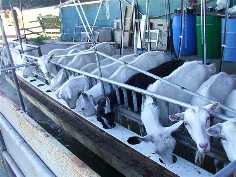
MIDAS DAIRY GOATSGOATS MILKThe main reason for keeping dairy goats as opposed to other forms of goat is to produce milk. Therefore, it makes sense to only keep those goats that produce large quantities of milk. When milking by machine it isn't possible to see clearly who is producing what quantity and therefore herd testing becomes very important.In the past I have herd tested using the New Zealand Dairy Goat Breeders Association's Herd Production Recording scheme. However, as I am no longer a member of that Association I do not do official milk testing at present.
Herd Testing 2001
For generations now, cows have been regarded as the major source of milk in our diets, not only in the liquid form but in the multitude of other foodstuffs containing milk or its by-products. However, with increasing evidence, studies show that as many as 7.5% of all babies born develop a hypersensitivity to cows' milk, generally known as Cows' Milk Allergy (CMA). Although CMA is more easily detected in young babies (before weaning) it is not confined to this age group. Many children do not grow out of their allergies and are therefore afflicted all their lives. For a large number of adults everyday problems relating to skin disorders, respiratory problems, gastric upsets and migraine are generally not considered to be related to cows' milk but are later diagnosed to be symptons of CMA. As a result, alternative sources of milk must be found - thus the increasing interest in and demand for goats' milk and related products.
Eczema Recurrent diaorrhea Recurrent rhinorrhea Repeated vomiting Persistent cholic Recurrent bronchitis Asthma Studies have proven that when all sources of cows' milk are removed from diet of babies suffering CMA the sympton(s) are relieved. Further tests have also shown that twenty per cent (20%) of babies suffering from CMA are also allergic to soya milk replacement formulae. Although it is evident that any children outgrow their allergies it is not yet certain which children will and at what time
MINERAL COMPOSITION OF GOAT'S MILKmg/100ml
Sodium 35.2 - 41.9
VITAMIN CONTENT OF GOAT'S MILKmg/100ml unless otherwise stated
Vitamin A (1U/100ml) 191
Cheese
Cottage Cheese
Cottage Cheese 2 The keeping of a dairy goat or two can bring one pleasure and joy, as well as providing milk, cream, cheese, and ice-cream for the family. What can be more satisfying than sitting down to a meal in which fresh wholesome goat milk and goat milk products are a part of the menu? |