|
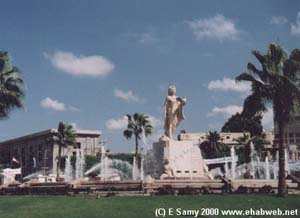
Visit Alexandria The second largest city and the main port of
Egypt, Alexandria was built by the
Greek architect Dinocrates
(332-331 BC) on the site of an old village, Rhakotis, at the orders of
Alexander the Great.
The city, immortalizing Alexander's name, quickly flourished into a prominent
cultural,
intellectual,
political, and economic metropolis, the remains of which are still evident to
this day. Alexandria lies
north-west of the Nile delta and stretches
along a narrow land strip between the Mediterranean Sea and
Lake Mariut (Mareotis). It is linked to
Cairo by two major highways and a railroad
line. It is one of the most notable summer resorts in the
Middle East, for, in addition to its temperate
winters, its beaches, with white sands and magnificent scenery, stretch for 140
km along the
Mediterranean Sea, from
Abu Qir, in the east to
Al-Alamein and Sidi Abdul Rahman, in the west.
CLICK BELOW FOR MORE INFORMATION
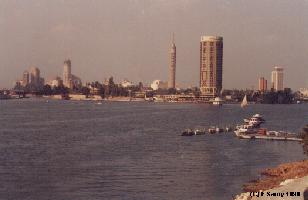
Visit Cairo Cairo - the Triumphant City - is the glorious
capital of
Egypt, the cradle of civilization and the
beacon of religion. It is the largest city in the
Middle East and
Africa and lies at the centre of all routes
leading to, and from the three continents:
Asia,
Africa and
Europe. CLICK BELOW FOR MORE INFORMATION
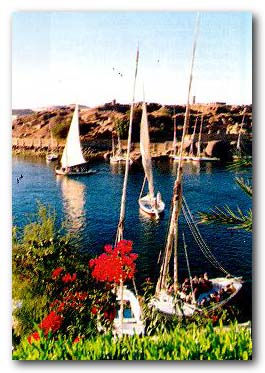
Visit Aswan Aswan, Egypt's sunniest southern city and ancient frontier town located about 81 miles south of Luxor, has a distinctively African atmosphere. Its ancient Egyptian name was Syene. Small enough to walk around and graced with the most beautiful setting on the Nile, the pace of life is slow and relaxing. Days can be spent strolling up and down the broad Corniche watching the sailboats etch the sky with their tall masts or sitting in floating restaurants listening to Nubian music and eating freshly caught fish. In Aswan the Nile is at its most beautiful, flowing through amber desert and granite rocks, round emerald islands covered in palm groves and tropical plants. Explore the souk, full of the scent and color of spices, perfumes, scarves and baskets. View the spectacular sunsets while having tea on the terrace of the Old Cataract Hotel (Named due to the location of the Nile's first cataract located here). Aswan has been a favorite winter resort since the beginning of the nineteenth century, and it's still a perfect place to get away from it all. CLICK BELOW FOR MORE INFORMATION
Visit Luxor
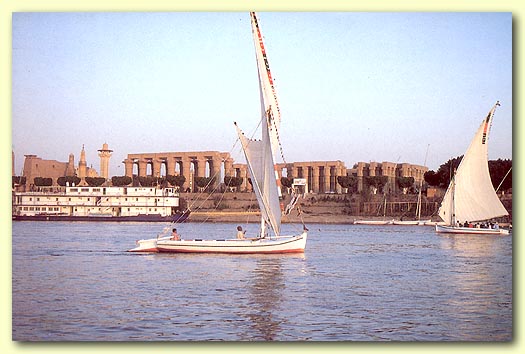
This is the place to be seen if you're a Pharaoh. Luxor was
once the centre of Egyptian power, and has been described as the world's
greatest open air museum. Here you will find the impressive Luxor
Temple, started by Amenophis III in c1350BC but added to after his lifetime.
The grand entranceway to the temple is guarded by majestic statues of Ramses
II, and was originally flanked by a pair of obelisks. Only one remains. The
other was presented to France by Mohammed Ali (no not that one!) in 1831 and
is now in the Place de la Concorde in Paris. From Luxor Temple, the Avenue of
Ram-Headed Sphinxes will take you in the direction of the Karnak Temple. At
that point you will understand why Luxor was considered a 'minor' temple.
The Karnak Temple is the largest ancient temple complex in Egypt. The Great Temple at the heart of the Karnak complex is so enormous, it has been estimated that St Peter’s, Milan and Notre Dame Cathedrals could be lost within its walls. The Hypostyle Hall is a massive 54,000 square feet and is reported to be the largest room in any religious building in the world. In addition to the temples, Luxor is home to Tutankhamun’s burial chamber in the Valley of the Kings on the west bank of Luxor at Thebes, but if visiting the site, beware of Tutankhamun’s curse! CLICK BELOW FOR MORE INFORMATION
Visit Port Said Port Said is the fourth largest city in Egypt and and is the second most important port after Alexandria. It is located on the Mediterranean Sea, to the north of the Suez Canal. Port Said has many places to visit. Its pretty beaches attract both Egyptians and tourists who come to enjoy the sea and the views, especially the ships passing by. Interesting ways to enjoy Port Said are either to take a cruise on the canal or to take a tour around the city on a "Hantour" (a horse-drawn carriage). Shopping is another option in this tax free city. CLICK BELOW FOR MORE INFORMATION
|
|
© 2003 All Rights Reserved by VisitEgypt.com |