
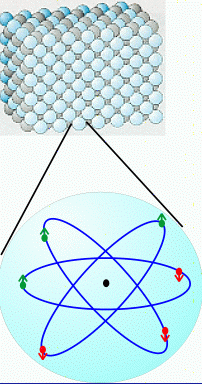
Matter is anything that has mass and volume. Mass is the quantity of matter in an object. Volume is the amount of space an object occupies. Matter can come in all forms. Stars, your brain, air, peanut butter sandwhich, and a plastic soda bottle are all examples of matter. Matter is made out of atoms. Atom is the basic unit of matter. Atoms combine to form clusters, sometimes molecules.
Matter can be described by their characters or properties. Properties can be color, mass, volume, texture, transparency, flammability, electrical conductivity, heat conductivity, density, melting point, boiling point, index of refraction, malleability, ductility, etc. Matter can have physical properties, which can be observed or measured without changing the composition of matter, and chemical properties, which can be observed only when substances interact with one another. Example of physical properties are color, texture, shape, mass, volume, density, state, etc. Examples of chemical properties are reactivity with acid, melting point, boiling point, electrical conductivity, head conductivity, etc. Matter also has intensive properties, which result from the way matter is structured. All chemical properties and many physical properties, such as melting point, color, density, texture, etc. are intensive properties. Extensive properties are volume, length, mass, etc., and they depend on the quantity of matter present.
Energy is the capacity to do work. Two forms of energy where matter and energy interact are kinetic energy and potential energy.
Kinetic energy is a type of energy which only moving objects have. An example of kinetic energy is a bowling ball rolling, and it knocks down the bowling pins in the way. The equation for kinetic energy is:
Potential energy is energy an object posesses because of its position. The reason it is called potential energy is because it has the potential, or ability, to make matter move and change once the energy is released. The amount of potential energy an object needs corresponds to the amount of force needed to keep it in position. An example of potential energy is an apple hanging from a tree and the apple is waiting to fall down. Potential energy also affectes atoms and molecules, as strong forces hold these particles together, giving the particles potential energy.
Mass can be a form of energy. In 1905,Albert Einstein discovered a third inportant type of energy, which was mass. He made the equation E=mc2. In this equation, E stands for energy, m for mass, and c the speed of light. Mass energy is due to the very fact of an object's mass. Mass can be transformed into other types of energy. For example, in nuclear reactors, the masses of particles convert to kinetic energy which turns into electric energy. Matter goes through changes such as a physical change, endothermic change, exothermic change, and chemical change. A physical change is a change that affects the physical properties of an object only, where as chemical properties are not changed. An endothermic change is a physical or chemical change in which a system absorbs energy from its surroundings. An exothermic change is when an energy is given off instead of being absorbed. A chemical change is when one or more substances are changed into new ones.
Matter can be classified as either a pure substance or a mixture. A pure substance is matter composed of only one kind of atom or molecule. A mixture is a collection of two or more pure substances physically mixed together. The properties of mixtures vary because the proportions of different substances vary. A pure substance has specific chemical and physical properties. For example, water is clean, odorless, will produce bubbles of hydrogen gas if placed in contact with calcium, and has a boiling point of 100 degrees Celcius at standard pressure. If a given substance is mixed with tiny amounts of an impurity as where the impurity is not noticeable, then it is a pure substance.
Mixtures can be homogenous and heterogenous. Homogenous mixtures contain substances that are uniformly distributed. Examples of homogenous substances are gasoline, syrup, saltwater, etc. All regions of a homogenous mixtures are identical in their composition and properties. A heterogenous mixture contains substances that are not evenly distributed. Some regions have different properties from other regions, and heterogenous mixtures can take many different forms. Sometimes, chemists use the term phase, which is any part of a system that has uniform composition and properties. Mixtures may contain more than one phase. For example, oil-and-vinegar is a two-phase, heterogenous mixtures.
Elements are the 109 or more simplest pure substances from which more complex materials are made of. Aluminum, copper, oxygen, and silicon are a few examples of elements. Elements contain only one kind of atom, and each element has its own unique set of physical and chemical properties. Only a dozen of 109 different elements compose common items we see everyday. Some elements may be allotropes, which means they are different molecular forms in the same physical state.
Compounds are pure substances that are composed of two or more different elements that are chemically combined. They are created when atoms of different elements join together in chemical reactions. Since compounds are pure substances, they should have unique sets of chemical and physical properties, but the properties are often very different from the elements that made up the compound.
Main menu
Topic 2: Atomic Structure
Credits and Links
