
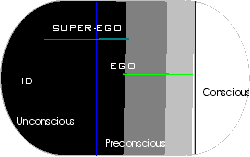
Freud contended that the mind is also made up of three elements that rule a person’s thinking. They are the id, ego, and superego. Freud called this his structural model of the mind. The id is powered by the innate desires a person has. The id wants whatever is pleasing at any particular time. The desires are the similar to those that even an animal has, such as thirst, hunger, and sexual desires. Humans are born with id. Babies cry when they need to be fed, changed, put to sleep, or simply want attention. The id is oblivious to the practicality of its needs. The ego is the considerate part of the mind, knowing that desires can only be met when the time is appropriate and if the person wishing to fulfill the desire is capable of performing his or her task. After taking these aspects into account, the mind has to understand if the desire right or wrong. The superego is in charge of this area of the mind. The superego begins to identify with what is taught by parents and society. According to the rules it has learned, the superego strives to create an archetypical person (Kaplan and Sadock, Synopsis of Psychiatry 217). This part of the superego is also known as the ego ideal. The ego ideal consists of a person’s aims and goals. The ego ideal tries to emulate someone with whom it has identified. The ego ideal also helps a person decide what he or she should and should not do. Hence, the superego is also the conscience; determining whether it would be morally correct to carry out certain desires (Hales and Yudofsky 150-1). Freud also believed that the ego plays the role of a judge. The ego decides if the desire from the id should be carried through according what information about the ethics of the decision the superego has provided (Goldman 5). The ego must maintain the delicate balance between the id and superego to ensure that the person does not become too impulsive or too rigid (Kaplan and Sadock, Synopsis of Psychiatry).
