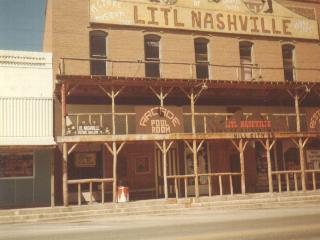
Little Nashville
Main Street Pictures
A Tour Bus
It has been a significant legal, mercantile, entertainment, railroad, and financial center in the Black Hills region since the beginning of white settlement.
In the mid 1800s, a steady westward movement of settlers skirted both north and south of the Black Hills. That area of the Dakota Territory was part of the Sioux Indian Reservation established in the 1968 Treaty of Fort Laramie. The treaty prevented white settlers from entering the region and was enforced by the U. S. military. As long as gold fields farther west were profitable, rumors of gold in the Black Hills were left uninvestigated.
All of this changed when Lieutenant Colonel George Custer arrived in the Black Hills in the summer of 1874. Custer was establishing a new military post and his company included at least two experienced miners who panned gold as they forded the region's creeks. Custer reported the presence of gold on August 3, 1874. Coinciding with the financial Panic of 1873 causing high unemployment in the East, Custer's report suddenly attracted hundreds of people to the Black Hills region.
Throughout most of the twentieth century, mining and tourism have been important economic factors for Deadwood. The Homestake Mining Company remains in operation as the world's largest producer of gold, and the city exists as a National Historic Landmark, designated in 1961. More recently, the citizens of South Dakota voted to allow legalized limited-stakes gaming in Deadwood with the proceeds dedicated to preserving city's heritage. Gaming has produced the latest in a series of booms that have characterized Deadwood's history since 1875.
Other great places to visit are Spearfish,Lead and Sturgis where they hold Bike Week and just about every motorcycle in the country is there.
Black Hills CavesOf all the caves in the United States, none contain the vast variety of rare formations found in Black Hills caves. These caves display more boxwork than any other in the world. They also form some of the largest concentrations of passageways in the world. Eight Black Hills caves are open to the public. Two are part of the National Park Service: Jewel Cave National Monument and Wind Cave National Park.
Jewel Cave is the third-longest cave in the world. More than 120 miles of passages have been surveyed. Calcite crystals that glitter when illuminated give the cave its name. The cave's most common crystals are dogtooth and nailhead spar. The cave is located about 13 miles west of Custer.
Wind Cavewith more than 82 miles of mapped passages,Wind Cave is one of the longest caves in the world. It contains the world's largest display of a rare formation called boxwork. Above ground, the park is comprised 28,000 acres of mixed-grass prairie and ponderosa pine forest.
A FEW MORE PICTURES ALONG THE WAY
CusterState Park in the Black Hills encompasses 73,000 acres of spectacular terrain and an abundance of wildlife.
Within the park, you'll discover a world of adventure!
Favorite outdoor activities include hiking 7,242-foot Harney Peak, mountain biking, horseback riding, rock climbing, fishing, chuckwagon suppers and jeep rides to see the bison.
The park boasts scenic drives such as the Needles Highway (SD 87), which twists and turns its way past towering rock formations and through narrow tunnels. At the end of one tunnel stands the Needles Eye, a granite spire with a slit only 3 to 4 feet wide but reaching 30 to 40 feet in the air.
History and culture also abound. Walk the banks of French Creek, where Custer's expedition first discovered gold in 1874. Take in a theater performance at the Black Hills Playhouse or visit the log-cabin thatn was home to Badger Clark,South Dakota`s first Poet.
We took the tour that went thru here & after seeing the twists & turns we were glad we didn`t try to drive thru here.
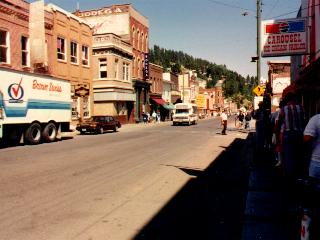
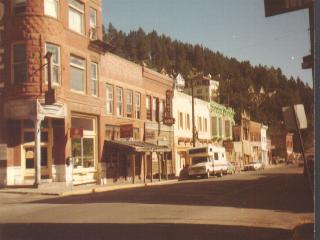
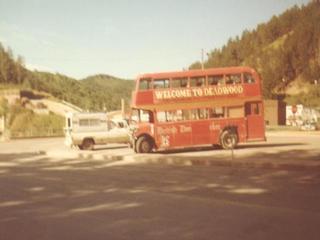
These are picture on the main street in Deadwood. It is a historic gold mining area.The City of Deadwood, South Dakota represents the history and heritage of the American West in the nineteenth and twentieth centuries. The gulches of South Dakota's Black Hills region were the sites of the American West's last great gold strikes, and Deadwood was the focal point for the region's gold rushes and subsequent hard rock mining booms.