|
The ecorun qualifications (Saturday)
Saturday morning, 5h:00, departure for Suzuka with the two cars in a rental truck. Hiratsuka and Uozaki have left already in order to get a good spot inside the pit station. This will turns out to be the most important decision. The forecast announced a day like hell: 36 degrees Celsius on October 3rd!

The ride takes approximately 1 hour and half from Kariya in the Aichi prefecture to Suzuka in the Mie prefecture. Everybody is sleepy because of the previous week's efforts. However, the most difficult is still to come. The qualifications are today, and although, the cars have proven themselves in and around the laboratory, anything can happen on the circuit of Suzuka famous for its steep hills and long descents.
As soon as we arrive, we move the cars carefully to their respective pit stations reserved by Hiratsuka. Under the roof of the pit, it is cooler both for the cars and us. Teams that have arrived later have to manage with the torrid sun. The day is scheduled as follows: cars check-up and first part of the trials in the morning and second part in the afternoon.
|
During the trials, each car must wait in line until the start gate where officials (wearing yellow jacket) will fill the gasoline tank (standard 100 mL made of glass, everybody has the same of course) up to the "full" line. Two other officials will place the car at the start line and hold the rear wheel until the departure. It is quite strict because whenever a car cannot start, it is out of the race immediately. Once the car leaves the start gate, it must complete three tours of the circuit. However, the cars are allowed to stop on the sides for tune-ups by the team mechanics. This helps each team to correct new problems and adapt the engine to the present conditions.
|

|
|
Above picture: On the sides of the road during the morning trials. Yamamoto, Sakai and myself are discussing with Hiratsuka. I was a little bit surprised by the size of the road. In fact, it looks much bigger on TV. Now, I understand why it is the scariest of all sports.
Aiming 2 driven by Hiratsuka finds early problems with the secret part (see Ecoran introduction) and decides to go without it first. After the morning trials, the front tires, not perfectly aligned, are burned out. They must be changed during the lunch. Service course Michelin tires cost 90$CAN each! A magnet placed around the income of gas, supposed to help reducing gas consumption, is found to interfere with the sensible electronic device and is thus removed. Problems fixed up; the afternoon trials will go without any major problems. Top speed: 70 km/h. Not bad for a scooter engine!
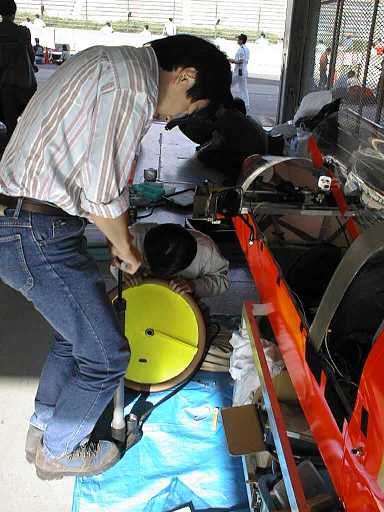
To the left: Inside the pit station, everybody works hard for the afternoon qualifications. Uozaki is pumping while Hiratsuka is checking the new tires. In the background, we can see the "pit sign men" who are the only people allowed nearby the road recording lap times, etc. must wear the red banner displayed at the top of this page.
|
|
Aiming 3 was assembled on Thursday during the week before the race. We are still lucky that it can move by itself. Even if it is based on the same pattern than Aiming 2 with the same secret parts and electronic circuits, we are not so sure how little it will consume gasoline though. Enya has not practiced much and Hiratsuka is constantly warning him that engaging the clutch and the engine together is not that easy. Particularly if the car is very compact, the arm movements are very tedious.
As predicted, Aiming 3 driven by Enya will have more technical problems and must be tuned-up fairly often. Poor guy! However, he is not the only one... Motor noise and smell really make the pit stations not a good place to sleep. Because of danger of explosion, smoking is, of course, strictly prohibited.

To the right: Enya inside Aiming 3. Because of race regulations, the drivers must wear long sleeve shirts and pants, gloves and a motor bike helmet. At 36*?, they are litteraly melting as soon as the hood is in place.
|

|
|
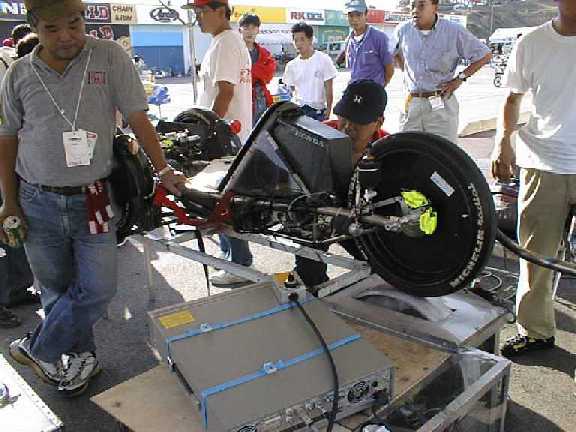
It is impossible to talk about the mileage marathon without talking about the Honda team, winner of the two previous races at Suzuka. Kings of Suzuka, there are interviewed constantly by the press and the media. They have a special stand for themselves only where "fans" and curious can go take a look at the highest technology.
To the left: The yellow blocks are "go-cart" breaks. It is possible to tell the quality of a car just by looking at the money spent on tires. School and Universities use cheap bike tires. However, Honda team and top teams will use much wider tires but certainly lighter. Electronic devices are the rule and the road to the supremacy. The box on the table is a electronic recorder that enable the mechanics to observe the gas consumption during testing. Finally, communications between the driver and the mechanics during the race with talk-i-walkee is more and more important.
|
|
However, although some companies may spend 50 000 dollars to send a team to Suzuka every years, high school and University students must build innovative cars with very tight budgets. I came across a "bamboo" car on the way to the pit station. It stunned me. Wow! Other than the engine, the frame is made of bamboo only. We have to remember that prices are given to originality! This one is sure to be a winner...
It is 7 o'clock. After some attempts around and in the pit stations,
the cars seem to perform well and ready for the race tomorrow. Return to Kariya and everybody needs a really good night sleep...


|

|
|