|
Space | Civil War | Home | Star Treck | Links | ||||||
| Universe | Solar System | Space | Galaxies | Space Flight | Carl Sagan |
| Articles by Cat Castle |
|
| Earth | |
| Meteorites | |
| TODAYS HEADLINES | |
| Top Stories | |
| Science | |
| Off Beat | |
| GUEST BOOK | |
| Sign Guest Book | |
| View Guest Book | |
| Addiction | |
| Hazelden | |
 Today‘s Gift |
|
 Today‘s Gift |
|
| My Addiction | |
| Tools | |
| Color Chart |
| GAMES | |
 Grab your snow board and start shredden! |
|
 In deep space it’s blam or be be blamed. |
|
 get revenge on the formerly famous! |
|
 Frosty wants to dress cool will you help? |
|
| Moon Images Page 2 | ||
|
Image 2 of 10 |
||
|
|
||
|
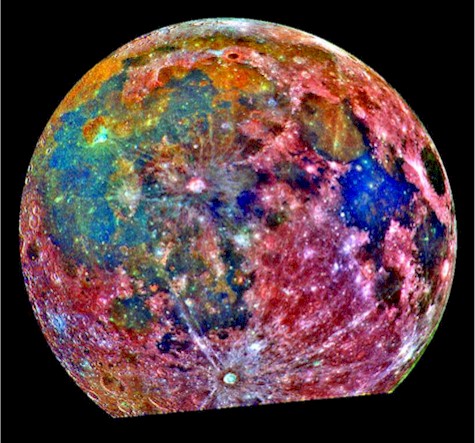
Moon in Full Color This false-color photograph of the Moon was taken by the Galileo spacecraft on December 8, 1992. The false-color processing used to create this lunar image is helpful for interpreting the surface soil composition. Areas appearing red generally correspond to the lunar highlands, while blue to orange shades indicate the ancient volcanic lava flow of a mare, or lunar sea. Bluer mare areas contain more titanium than do the orange regions. Mare Tranquillitatis, seen as a deep blue patch on the right, is richer in titanium than Mare Serenitatis, a slightly smaller circular area immediately adjacent to the upper left of Mare Tranquillitatis. Blue and orange areas covering much of the left side of the Moon in this view represent many separate lava flows in Oceanus Procellarum. The small purple areas found near the center are pyroclastic deposits formed by explosive volcanic eruptions. The fresh crater Tycho, with a diameter of 85 kilometers (53 miles), is prominent at the bottom of the photograph. 1 * 2 *
3
* 4
* 5
* 6
* 7
* 8
* 9
* 10 |
||
|
Webmaster: Cat Castle Revised: 1/19/02/ |
||