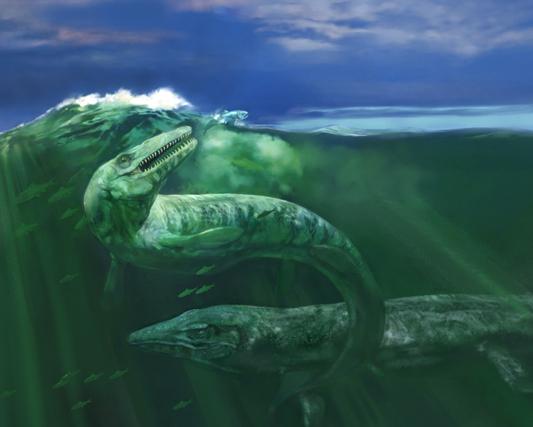
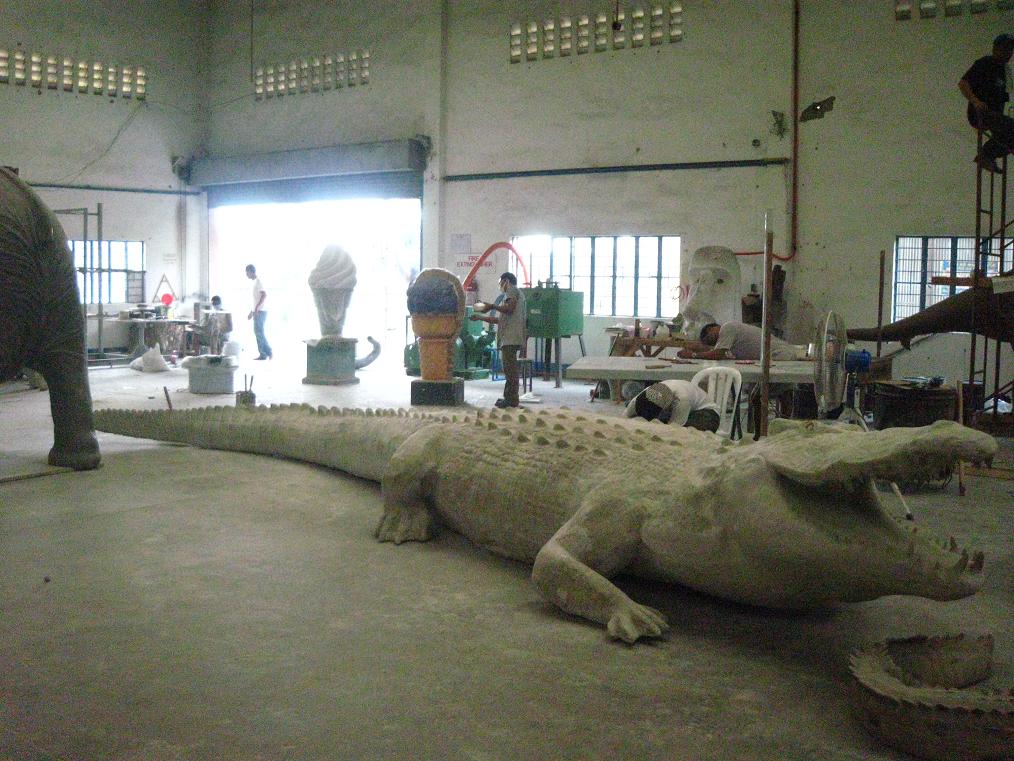
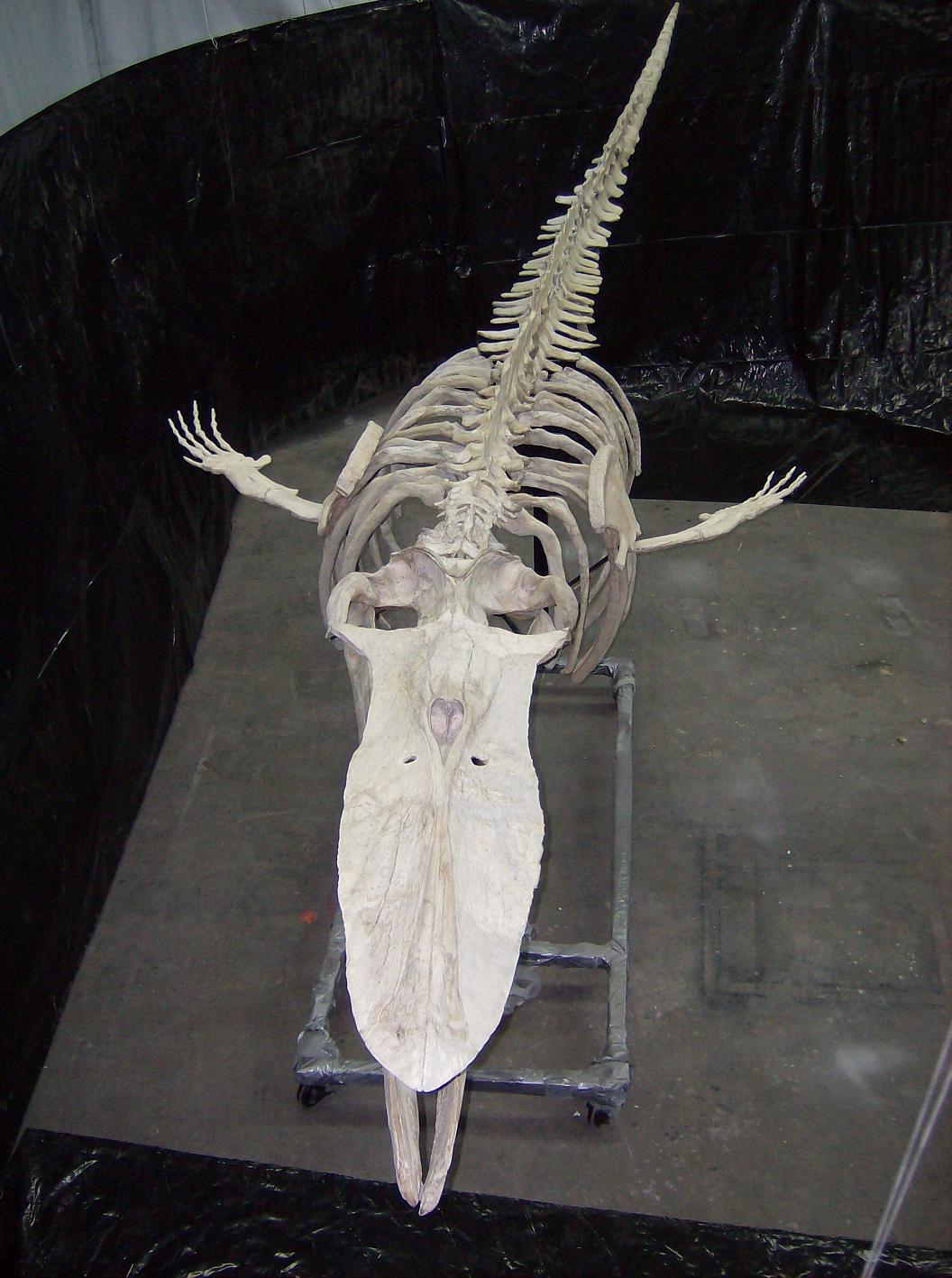
Plesiosaurs, Ichtyosaurs, Mosasaurs, Titanichthys agassizi, sharks, fish and other aquatic reptiles (fossils and cast replicas) from Taylor Made Fossils

TaylorMadeFossils.com

All Fossils are listed alphabetically. To Jump to a Fossil, click on the corresponding letter below. For example, Click on the "M" for "Mammoth"
Fossils beginning with the letter:
A
B
C
D
E
F
G
H
I
J
K
L
M
N
O
P
Q
R
S
T
U
V
W
X
Y
Z
Fossils starting with "A" (Return to Top of page)
| Alligator skeleton in matrix cast replica | | Alligator skeleton in matrix cast replica Eocene, The original was discovered in the Green River Formation
| 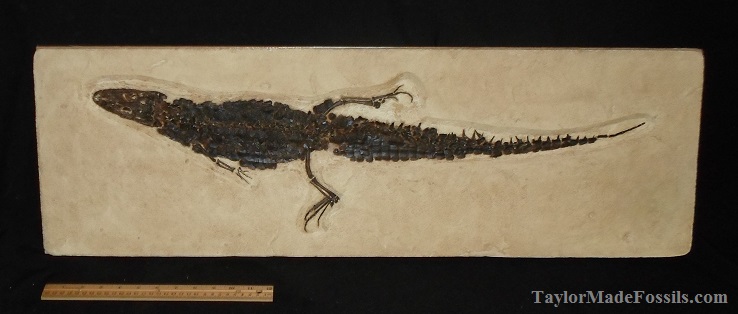 Cast measures 30 inches long. Was $425.00 NOW $300 (plus shipping)
Please call (314) 556-0650 or email us for more pictures or information.
| |
 |
Pendant Ammonites Fossil Beautiful and Rare Fossil Ammonite
Finished with Stainless Steel frame.
Ammonite Pendant $15 (plus $4.95 shipping) Please call (314) 556-0650 or email us for more photos or information.
| |
| Ammonites giganteus cast replica | | 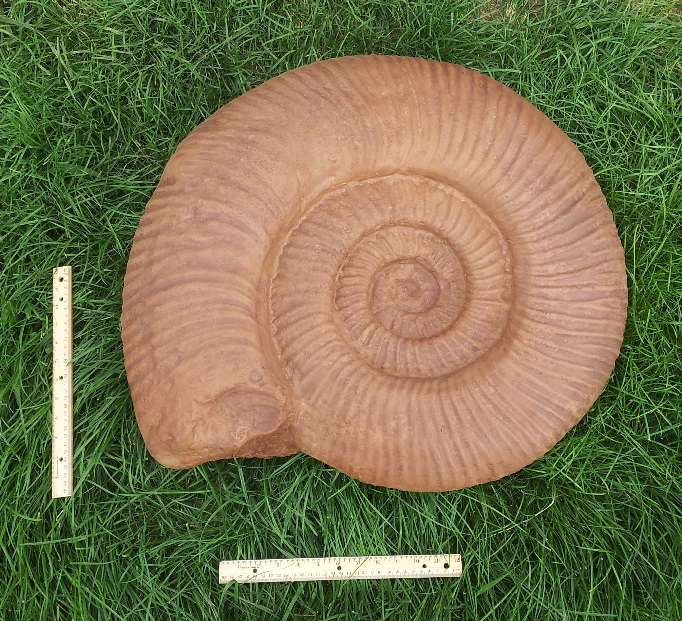 Ammonites giganteus cast replica One of the largest Ammonite casts available on the web. From The Jurassic Of The United Kingdom. This cast is from the Henry Ward collection. Cast measures 28 inches in diameter.
$160.00 (plus $60 Oversized US shipping)
Ammonites, as they pertain specifically to the order Ammonitida, are an extinct group of marine animals belonging to the cephalopod subclass Ammonoidea. They are excellent index fossils.
The closest living relative of the Ammonitida, is not the modern Nautilus they somewhat outwardly resemble, but rather the subclass Coleoidea (octopus, squid, and cuttlefish).
Their fossil shells usually take the form of planispirals, although there were some helically-spiraled and non-spiraled forms (known as "heteromorphs"). Their name came from their spiral shape as their fossilized shells somewhat resemble tightly coiled rams' horns. Pliny the Elder (d. 79 A.D. near Pompeii) called fossils of these animals ammonis cornua ("horns of Ammon") because the Egyptian god Ammon (Amun) was typically depicted wearing ram's horns. Often the name of an ammonite genus ends in -ceras, Greek for "horn" (for instance, Pleuroceras). |
Kingdom: Animalia, Phylum: Mollusca, Class: Cephalopoda, Subclass: Ammonoidea, Order: Ammonitida
Suborders: Ammonitina, Ancyloceratina, Phylloceratina, Lytoceratina.
Please call (314) 556-0650 or email us for more pictures or information.
| |
Fossils starting with "B" (Return to Top of page)
Basilosaurus (Basilosaurus Cetoides (Zeuglodon)) skeleton and skull cast replica. Mammalia - Cetacea , Late Eocene
$48,000 plus crating and shipping
Please get in touch with us for photos and more information.
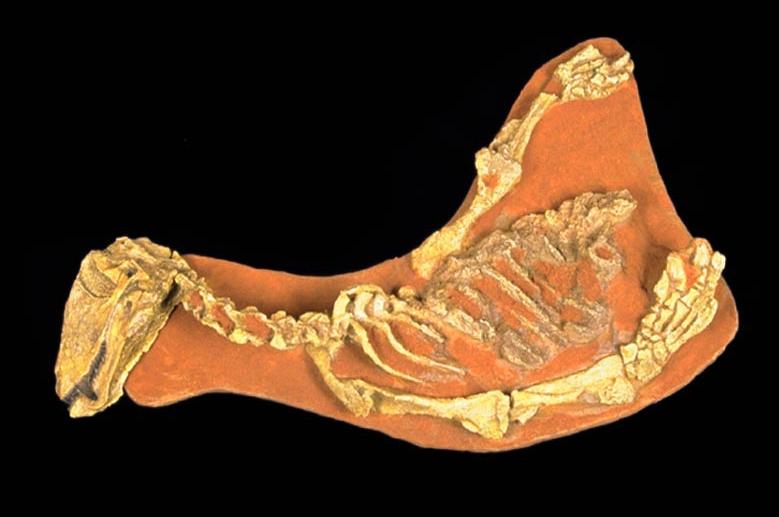
|  Biarmosuchus tener
Meaning of Name: Crocodile from Biarmia, an ancient country in the Perm region.
Pronunciation: Bi-arm-moh-SUE-kus Classification: Therapsida; Eotheriodontia; Family Biarmosuchidae
Late Permian, Zone I
Locality: Ocher, Perm Region
Size: 75cm in length
This cast replica was molded from a half skeleton encased in sediment, as found in the field. Locality: The original was discovered in Ocher, Perm Region. Russia
Biarmosuchus tener was the size of a large dog. | 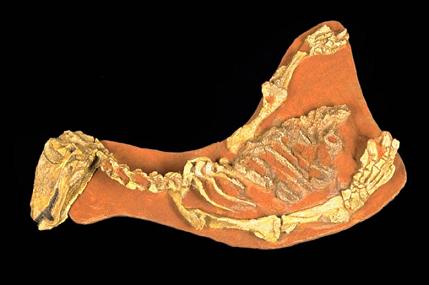 This mammal-like reptile had canines, incisors and cheek teeth of different shape m as well as teeth on the palate. Represented is the skeleton of a small predator in the Eotheriodontia, the most primitive of the mammal-like reptiles. The specimen was preserved in flood channel sandstone that was deposited it in a river flowing off the young and growing Ural Mountains. The slender nature of the limbs of this mammal-like reptile suggests that it was a very a pie animal. Like Eotitanosuchus olsoni, its skull shows the small, primitive temporal opening behind the eye that is characteristic of the most ancient of therapsid (mammal-like) reptiles. $985 (plus shipping)
Please call (314) 556-0650 or email us for more pictures or information.
| |
|
Bothriolepis Armored Fish |
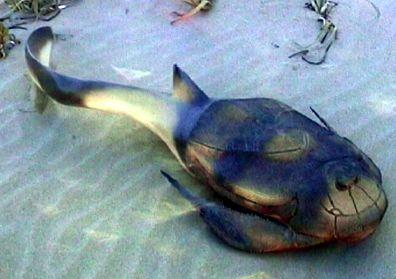 Bothriolepis ("pitted scale" or "trench scale") was the most successful genus of antiarch placoderms, if not the most successful genus of any placoderm, with over 100 species found on every continent. It was a small benthic freshwater detrivore that lived in the Middle and Late Devonian Scientific name: Bothriolepis panderi. This specimen was discovered in Morocco.
|

Bothriolepis Armored Fish cast replica. Resin cast with base measures 11" $195 (plus shipping)
Please call (314) 556-0650 or email us for more pictures or information.
| |
| Bothriolepis Armored Fish #2 |
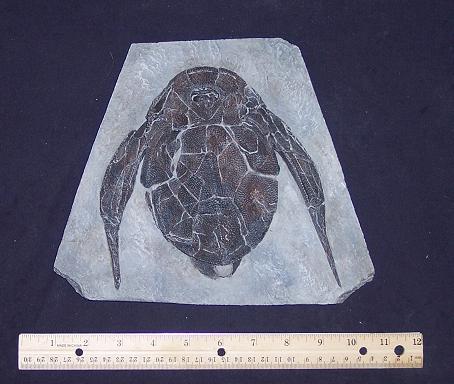 |
Bothriolepis canadensis, armored fish This bottom-feeding armored fish lived in brackish water and seas, in the middle of the Late Devonia. Measures 10x10 inches Bothriolepis Resin cast replica $195 (plus shipping) Shipping weight: 4.00 Lbs
Please call (314) 556-0650 or email us for more pictures or information.
| |
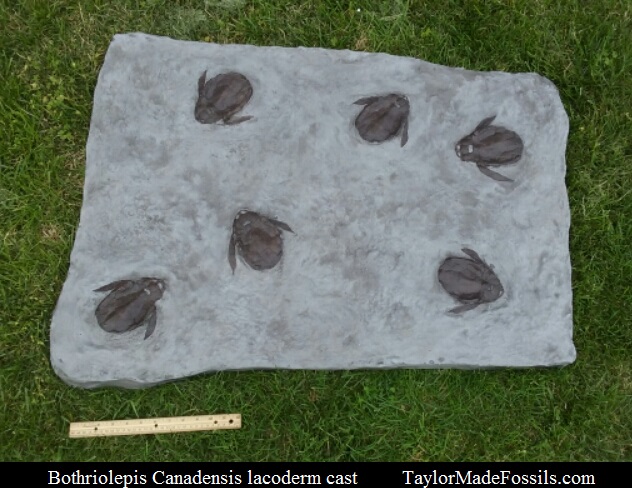
| Bothriolepis Canadensis placoderm panel cast replica (item #REP062) |
|
Bothriolepis Canadensis Placoderm Panel cast replica
Molded from original fossils this Upper Devonian cast measures 37 x 27 inches. Scaumenac Formation Scaumenec Bay, Quebec
Price: $250.00 (shipping not included and can not be calculated in shopping cart)
Please call (314) 556-0650 or email us for more photos or information.
|
 | |
Brachychampsa alligator Fossils (Click Here to Return to Top of page)
|
Brachychampsa Montana alligator skull |
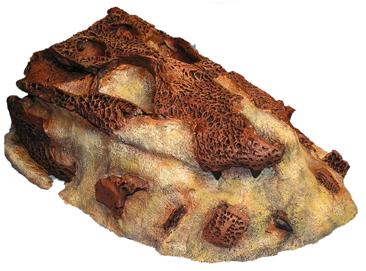 Brachychampsa montana, alligator skull
solid resin Measures 10" x 7.5" x 3.5" Cast replica: $120 (plus shipping)
Please call (314) 556-0650 or email us for more pictures or information.
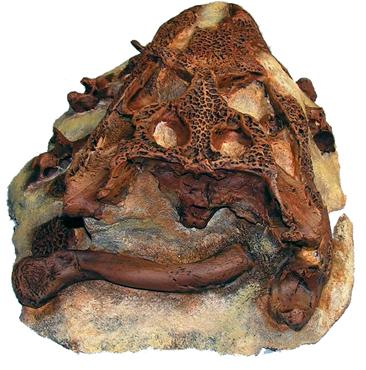 |
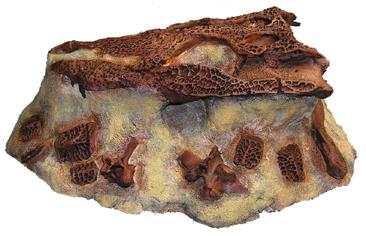 This is a great Alligator skull with some postcranial elements. We decided to cast the elements and skull in situ. The original specimen was found in a block of mudstone and the pieces were a bit jumbled. The skull was mostly intact, which is rare. This is a great replica for anyone into the reptiles of the dinosaur age. There are some teeth still in the dentition also. All elements seen are directly cast from the original specimen; there has been no cosmetic restoration. All elements painted fossil brown are directly from the original fossil. We prepared this specimen and a younger skull of the same species (available soon). This is poured in solid resin so it is very stable. Hell Creek Formation, Later Cretaceous 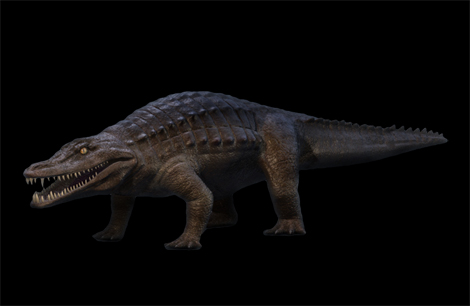 | |

Complete line of alligator and crocodile skull casts and fossils here
Fossils starting with "C" (Return to Top of page)
|
Clidastes (Mosasaur) Skeleton panel cast replica |
|
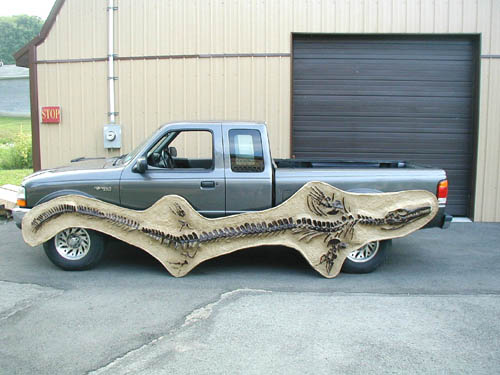
Clidastes liodontus (Mosasaur)Skeleton cast replica.
Discovery location: Gove County, Kansas
Formation: Niobrara Chalk Length: 15 feet long by 4 feet wide A virtually complete Cladastes, Mososaur, skeleton discovered in 2001. It was discovered in the Pierre Shale Formation, late Cretaceous (74-83 million years) near Chadron, Nebraska.
This specimen is missing only three to four vertebrae from the distal portion of the tail and three phalanges from one paddle. It is otherwise a very rare complete specimen. The original specimen was donated to and is on exhibit at the Elachee Nature Center, Gainesville, GA.
$3,000 plus $250 crating. Shipping cost varies based on location and is not included. Average shipping
cost in the US: $300 This item can also be picked up from our Saint Louis location.
Please call (314) 556-0650 or email us for more pictures or information.
|
| |
Coelacanth Fossils (Click Here to Return to Top of page)
| Coelacanth: TMF Coelacanth life cast replica | |
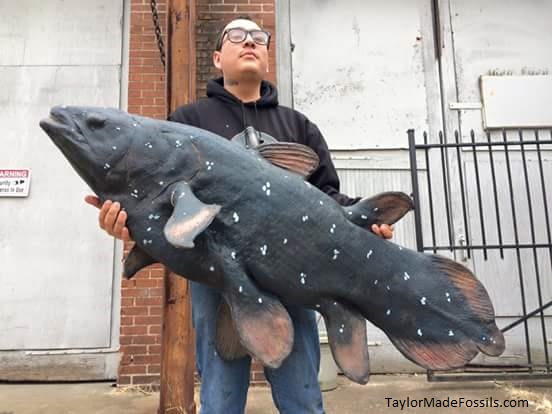
Coelacanth: TMF Coelacanth life cast replica. This beautiful Coelacanth was modeled from a real specimen. This resin and fiberglass
cast measures: 50 inches long (127cm)
$1,500 (plus shipping). Shipping cost within the US is $150 for oversized freight. For shipping costs
outside the US please contact us.
Please call (314) 556-0650 or email us for more photos or information.
|
Custom painting available. | |
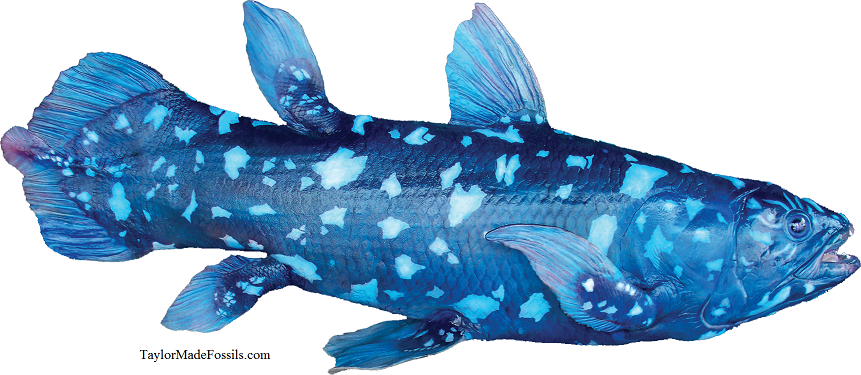
Latimeria chalumnae (Coelacanth)
Locality: West Indian Ocean
Formation: recent non-fossil
Length: 1.2 m (4 feet)
Price: Contact Us
This reconstruction is a cast taken directly from a freshly-captured coelacanth. This is not only spectacular to view, but has important historical significance as the “living fossil” discovered by Hendrik Goosen and identified by Margorie Courtenay-Latimer in 1938. Before their discovery, all species of coelacanth were only known from fossils. Shown here you can see the bright blue natural color and pattern of this large lobe-finned fish species.
| Coelacanth fish cast replica |
|
The Coelacanth (pronounced SEE-la-canth) is a primitive lobe-finned fish, (Crossopterygii). The largest Coelacanth (meaning "hollow spine") is about 5 feet (1.5 m) long. This carnivore (meat-eater) was thought to be extinct, but a living Coelacanth was caught in the Indian Ocean off the coast of South Africa in 1938. |
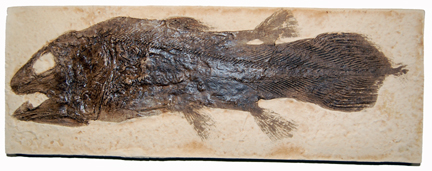
Coelacanth, fish Measures: Approximately 11.5 x 4.25 inches
$40 painted
_________ $20 unpainted
Please call (314) 556-0650 or email us for more pictures or information.
| |
|
Crab: Horseshoe Crab cast replica (item #REP029)
|
|
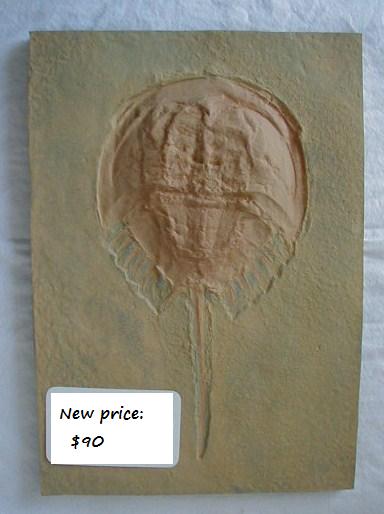
Horseshoe Crab cast replica Pfeilschwanz Jurassic Solnhofen, Germany
Measures: 30 cm X 21.5 cm
(11.81 inches x 8.46 inches) Price: $90.00 (plus shipping)
Please call (314) 556-0650 or email us for more photos or information.
| |
| Crinoid Dizygocrinus Hisforcrinus Plaque
| 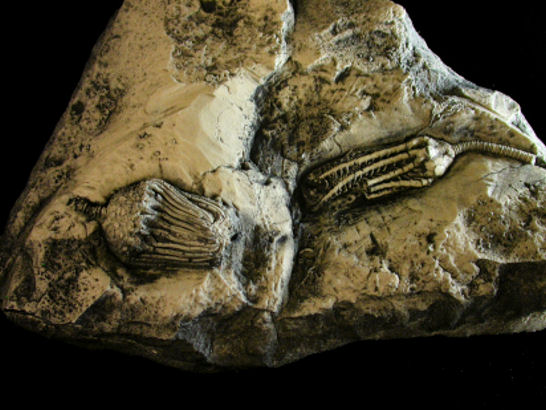 | Crinoid Dizygocrinus Hisforcrinus Plaque This crinoid cast replica was molded from an original fossil found in Montgomery County, Indiana. Lower Mississippian Muldraugh Group. Resin cast measures 7.0x5.5in (177x140mm) $35 plus shipping.
Please call (314) 556-0650 or email us for more pictures or information.
| |
| Crocodile skull and skeleton (Jurassic crocodile cast replica) | 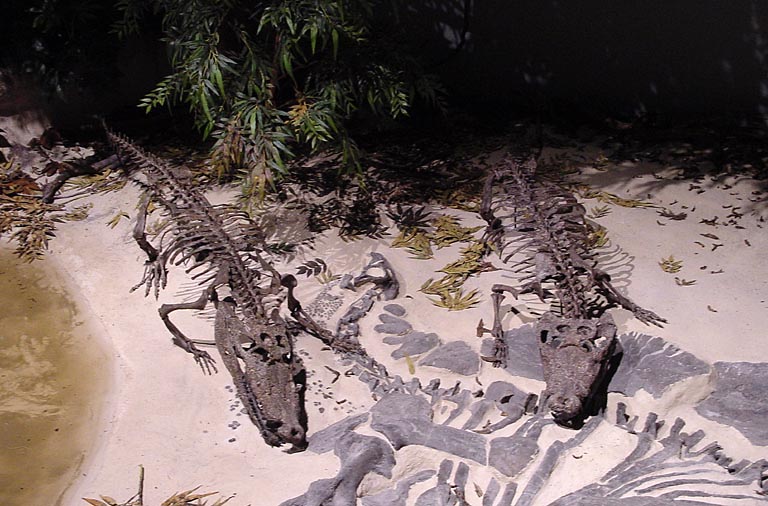
Goniopholis Crocodile skeleton cast Jurassic; Cast replica measures 9 feet (106 inches). Mounted crocodile skeleton cast replica $13,000 Goniopholis is an extinct genus of crocodyliform that lived in Europe and Asia during the Late Jurassic and Early Cretaceous, and North America (Late Jurassic). Being semi-aquatic it is very similar to modern crocodiles. It ranged from 2–4 metres in length, and would have had a very similar lifestyle to the American alligator or Nile crocodile. Goniopholis was closely related to the ancestor of extant crocodilians. Complete line of alligator and crocodile skull casts and fossils here
| 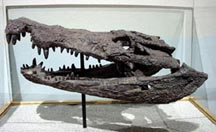
Crocodile skull cast (the finest known from the Jurassic)
Goniopholis Skull cast replica
This specimen was discovered at Bone Cabin Quarry in 1993.
Skull measures: 19.5 inches (49.5 cm) long, 10 inches (25.4 cm) wide, 6 inches (15.2 cm) high.
$545.00
Please call (314) 556-0650 or email us for more pictures or information.
| |
| Crocodile fossil cast replica | |
Fossils starting with "D" (Return to Top of page)
| Deinosuchus skull cast replica. |
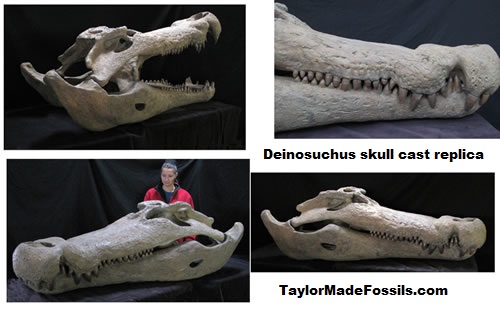 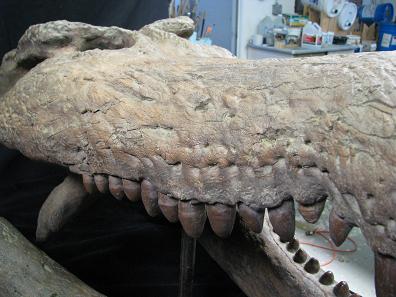 Deinosuchus skull cast replica.
 This newly molded and cast specimen o Deinosuchus measures 5.5' long and 29" wide. $5,800 plus crating ($300) and shipping (based on your location). Please contact us for shipping cost
Deinosuchus (pronounced DYE-no-SOO-kəs) is an extinct relative of the alligator. Late Cretaceous. The name translates as "terrible crocodile" and is derived from the Greek deinos ("terrible") and soukhos ("crocodile"). The first remains were discovered in North Carolina in the 1850s.
Deinosuchus was far larger than any modern crocodile or alligator measuring up to 12 m (40 ft) and weighing up to 8.5 metric tons (9.4 short tons) its overall appearance was fairly similar to its smaller relatives. It had large, robust teeth that were built for crushing, and its back was covered with thick semispherical osteoderms. One study indicates that Deinosuchus may have lived for up to 50 years, growing at a similar rate to that of modern crocodilians, but maintaining this growth over a much longer period.
| 

Deinosuchus fossils have been found in ten U.S. states, as well as northern Mexico. It lived on both sides of the Western Interior Seaway, and was an opportunistic apex predator in the coastal regions of eastern North America.
Kingdom: Animalia, Phylum: Chordata, Class: Sauropsida, Order: Crocodilia, Suborder: Eusuchia, Superfamily: Alligatoroidea, Genus: Deinosuchus rugosus
Please call (314) 556-0650 or email us for more pictures or information.
| |
| Deinosuchus skeleton cast replica. |

|
Deinosuchus Skeleton cast replica Deinosuchus sp Location: SE Utah USA Formation: Kaiparowits Cretaceous Skeleton cast measures: 30' L x 5.5' W. Utah Museum of Natural History specimen $59,000.00 (plus crating and shipping)
Please call (314) 556-0650 or email us for more pictures or information.
| |
Dunkleosteus Fossils (Click Here to Return to Top of page)
|
Dunkleosteus marsaisi skull |

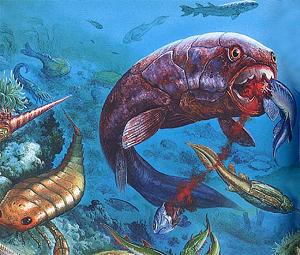 Dunkleosteus Skull Dunkleosteus marsaisi Dunkleosteus is one of the largest arthrodire placoderms to have ever lived. This carnivorous predatory prehistoric fish lived in the late Devonian period
From a private collection, this cast was molded from an original fossil from Morocco, North Africa The assembled skull measures: 41" long, 25" high, 20 inches wide. Weight 55 Lbs |


This resin cast can be purchased assembled or unassembled. It is cast in 13 pieces (The Jaw is cast in 2 pieces, The Skull in 11 (There is 1 bottom plate plus 9 large and 4 small pieces). Resin cast: Assembled Mount, with trunk armor and base, $3,495 (plus crating and shipping)
"The Dunkleosteus is fantastic!!! I am very pleased with the quality" Please call (314) 556-0650 or email us for more pictures or information.
| |
|
Dunkleosteus (Dinichthys) jaw cast replica (item #M304) |
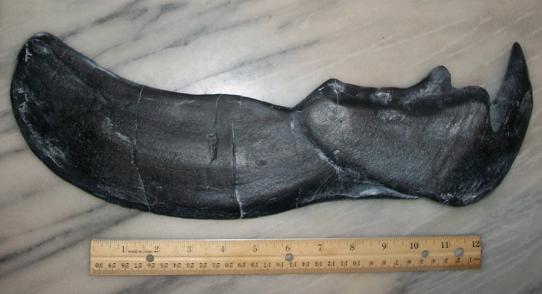
Dunkleosteus (Dinichthys) jaw (inferognathal). From the heavily armored skull of the giant Devonian Placoderm fish. Jaw measures 16.7 in (423mm). This jaw is from a different specimen than the one above. $55.00
Please call (314) 556-0650 or email us for more pictures or information.
|
 Customer review: "It's arrived. It looks really good, nice work!" | |
| Dyrosaurus Phosphaticua skull cast replica (item # REP025)
|
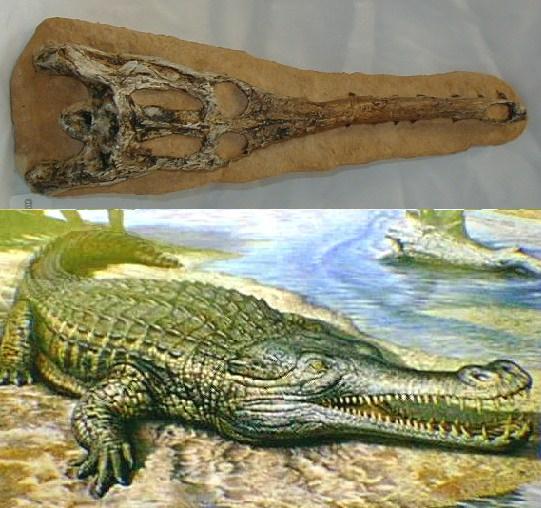 |
Dyrosaurus Phosphaticua skull cast replica
Late Cretaceous Kew-Kew, Morocco Skull cast measures: 56 cm X 18 cm
$180.00 (plus shipping)
Please call (314) 556-0650 or email us for more photos or information.
| |
Fossils starting with "E" (Return to Top of page)
Enchodus is an extinct genus of bony fish. It flourished during the Upper Cretaceous and was small to medium in size. One of the genus' most notable attributes are the large "fangs" at the front of the upper and lower jaws and on the palatine bones, leading to its misleading nickname among fossil hunters and paleoichthyologists, "the saber-toothed herring". These fangs, along with a long sleek body and large eyes, suggest Enchodus was a predatory species.
Large individuals of this species had fangs measuring over 6 centimetres (2.4 in) in length, though the total body length was only about 1.5 meters (4 ft 11 in), giving its skull an appearance somewhat reminiscent of modern deep-sea fishes, such as anglerfish and viperfish. Other species were smaller, some like E. parvus were only some cm (a few inches) long.
Enchodus original fossil skull in matrix $4,400.
|
Eocyclotosaurus Skull cast replica (Item #S012)
|

|
 Please call (314) 556-0650 or email us for more photos or information.
| |
|
Elasmosaurus skeleton cast replica (Item #S012)
|

|
Elasmosaurus sp. Skeleton - Fossil Replica
The long-necked Elasmosaurus cast replica mounted skeleton.
Elasmosaurus is the perfect addition to any Cretaceous marine exhibit.
Late Cretaceous
Measures approx: 32' l x 7' w (9.75 x 2.14 m)
$68,000.00
Please call (314) 556-0650 or email us for more photos or information.
| |
Eryops Fossils (Click Here to Return to Top of page)
|
Eryops skull and skeleton cast replica |
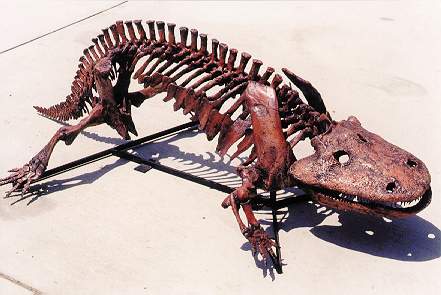 Eryops skeleton cast replica. This large amphibious tetrapod measures 5.5 feet (1.68 meters). Mounted and crated: $10,048.00
__________ Unmounted Eryops Skeleton cast $8,000.00
Please call (314) 556-0650 or email us for more pictures or information.
|
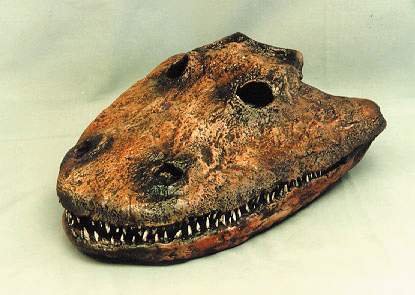 You can also buy the Eryops skull cast alone for $508
Eryops (pronounced EAR-ee-ops). Eryops meaning "drawn-out face" because most of its skull was in front of its eyes (Greek eryein = drawn-out + ops = face) is a genus of extinct, semi-aquatic amphibian found primarily in the Lower Permian-aged Admiral Formation. Kingdom: Animalia, Phylum: Chordata, Class: Amphibia,
Order: Temnospondyli, Family: Eryopidae, Genus: Eryops, Species: Eryops megacephalus | |
| Eurypterid cast replica 1 (item #1453) | | Eurypterid cast replica Eurypterids (sea scorpions) are an extinct group of arthropods related to arachnids, which include the largest known arthropods that ever lived. They are members of the extinct class Eurypterida (Chelicerata). The word Eurypterid comes from the Greek word eury meaning "broad" or "wide" and the Greek word pteron meaning "wing". The largest, such as Jaekelopterus, reached 2 meters (6 ft 7 in) or more in length, but most species were less than 20 centimeters (8 in). They were formidable predators that thrived in warm shallow water in the Ordovician to Permian. Although informally called "sea scorpions", only the earliest ones were marine (later ones lived in brackish or freshwater), and they were not true scorpions. According to theory, the move from the sea to freshwater probably occurred by the Pennsylvanian period.
Domain: Eukarya, Kingdom: Animalia, Phylum: Arthropoda, Subphylum: Chelicerata, Class: Merostomata, Order: Eurypterida,
| 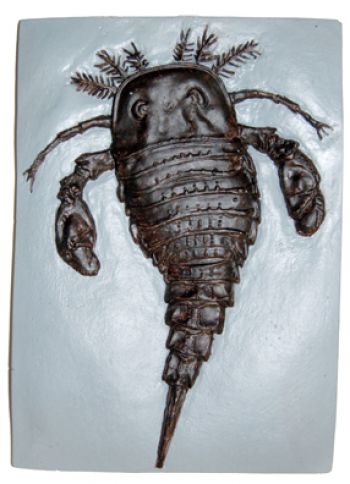 This specimen of Eurypterid is from the Bertie Group, Silurian Age of New York.
Cast measures 8.25 x 6 inches
$50.00 (plus shipping)
Please call (314) 556-0650 or email us for more pictures or information.
| |
| Eurypterid cast #2 - Mixopterus giant Eurypterid | | Eurypterid cast replica Eurypterids (sea scorpions) are an extinct group of arthropods related to arachnids, which include the largest known arthropods that ever lived. They are members of the extinct class Eurypterida (Chelicerata). |  The word Eurypterid comes from the Greek word eury meaning "broad" or "wide" and the Greek word pteron meaning "wing". The largest, such as Jaekelopterus, reached 2 meters (6 ft 7 in) or more in length, but most species were less than 20 centimeters (8 in). They were formidable predators that thrived in warm shallow water in the Ordovician to Permian. Although informally called "sea scorpions", only the earliest ones were marine (later ones lived in brackish or freshwater), and they were not true scorpions. According to theory, the move from the sea to freshwater probably occurred by the Pennsylvanian period.
Domain: Eukarya, Kingdom: Animalia, Phylum: Arthropoda, Subphylum: Chelicerata, Class: Merostomata, Order: Eurypterida
Cast measures 33 x 12 inches
$300.00 (plus shipping)
Please call (314) 556-0650 or email us for more pictures or information.
| |
Fossils starting with "F" (Return to Top of page)
| Fish Plaque This is a solid resin plaque of an ancient fish. The plaque measures 27" wide by 16.5" high. It comes hand-painted and antiqued. $195.00 (out of stock)
Please call (314) 556-0650 or email us for more pictures or information.
Weight 9.5 lbs | 
| |
Fossils starting with "G" (Return to Top of page)
Gar Fish Fossils (Click Here to Return to Top of page)
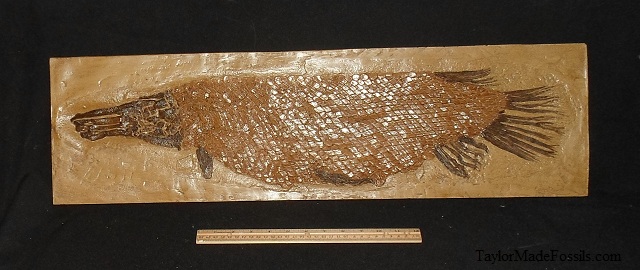
Original Lepisosteus fossils from this locality are sold for $7,000- $15,000. This is a chance to own a museum quality collectors piece for much, much less. It would be the centerpiece and focal point of any collection. This huge plate measures 30.5 x 8.5 inches.
Lepisosteus was found in the Green River Formation of southwest Wyoming and parts of Colorado and Utah. Some of the world's most outstanding specimens of fossil fish are found in the Green River Formation. The Green River system was composed of three lakes: Lake Ulinta, Lake Gosiute and Fossil Lake. These Eocene Lakes lay in a series of intermountain basins formed by geological events that uplifted the Rocky Mountains during the early Tertiary time. The Climate was much different from the desert-like climate of this area today. Both the fauna (crocodiles, alligators, boa constrictors and some subtropical fish families) and the flora (such as large palm trees) indicate a climate much like that found along the Gulf Coast today. Large amounts of ash found in the sediments indicate that volcanoes were particularly active at this time.
The most common fish found in the formation is the Knightia, a herring-like fish. They are found singularly or in large groupings. These groupings are referred to as "Mortality Layers" and are believed to have been caused by extensive ash fallout after volcanic eruptions. Some of the other species of fish found in the Green River Formation are: Phareodus, a carnivorous fish often found up to 2 feet in length and having many sharp teeth, Mioplosus, a true perch, and Priscacara, a sunfish-like fish with stout dorsal and anal spines. There are also turtles, stingrays, crocodiles and alligator garfish.
The fossils of the Green River Formation each one unique - are some of nature's finest and are highly valued by collectors the world over.
Lepisosteus. Eocene. Green River Formation, Wyoming
| 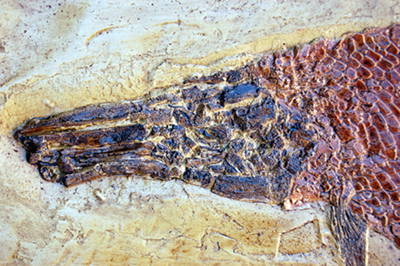 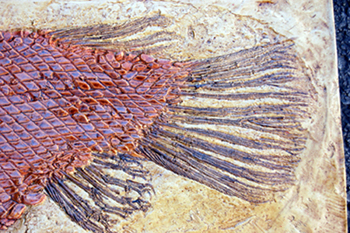 Lepisosteus (Garfish Skeleton) Lepisosteus (Garfish Skeleton)
Measures: 30.5" long x 8.5" wide Resin cast: $350 (plus shipping)
Please call (314) 556-0650 or email us for more pictures or information.
| |
Fossils starting with "H" (Return to Top of page)
Fossils starting with "I" (Return to Top of page)
Ichthyodectes ctenodon ("Fish Biter (with) Comb Teeth") was a 4-metre long ichthyodectid. It lived in the late Cretaceous. It was closely related to the 4 to 6 metre long Xiphactinus audax, and the 2-metre long Gillicus arcuatus, and like other ichthyodectids, I. ctenodon is presumed to have been a swift predator of smaller fish. As its species name suggests, I. ctenodon had small, uniformly sized teeth, as did its smaller relative, G. arcuatus, and may have simply sucked suitably sized prey into its mouth.
Ichtyosaur Fossils (Click Here to Return to Top of page)
| Ichthyosaur Fossil Casting | | 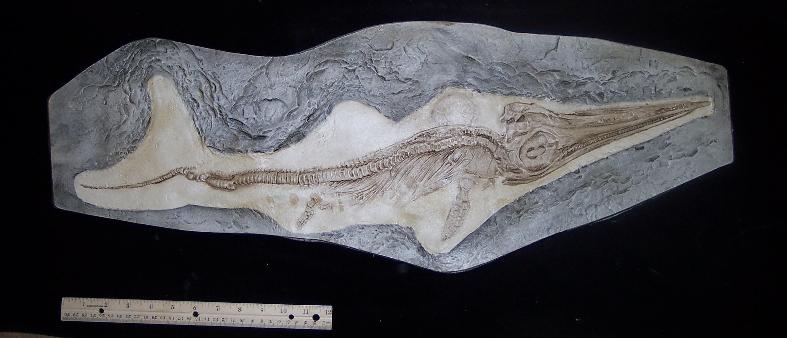
| Ichthyosaur Fossil Casting Ichthyosaur fossil casting- 2 1/2 feet long, has 2 sturdy hangers in the back. Ichthyosaurs cast replica $250.00 (sale: $195) Click Here to purchase
Please call (314) 556-0650 or email us for more pictures or information. Customer review: "Cast is very impressive! Already up on my wall."
| |
|
Ichthyosaur skeleton cast replica (item # REP030)
|
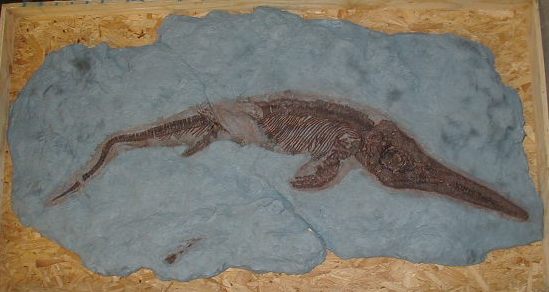
Over 6 feet long! |
Ichthyosaur skeleton cast replica. This Icthyosaur cast measures 198 cm X 101 cm
(6 feet and 5.95 inches x 3 feet and 3.76 inches)
Price: $800.00 (plus shipping)
Please call (314) 556-0650 or email us for more photos or information.
| |
|
Ichthyosaurus intermedius cast replica |
 
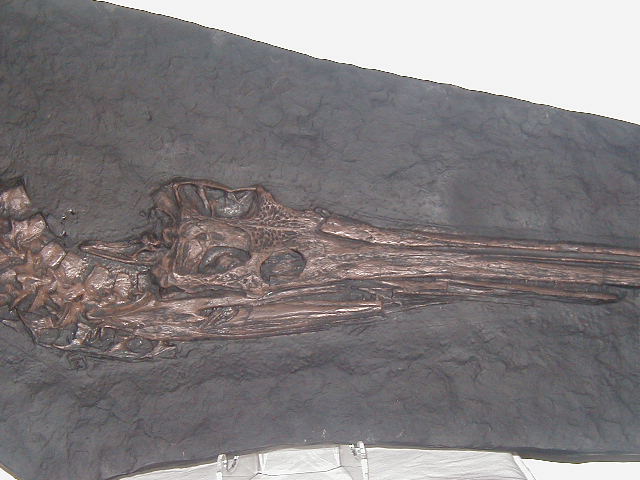
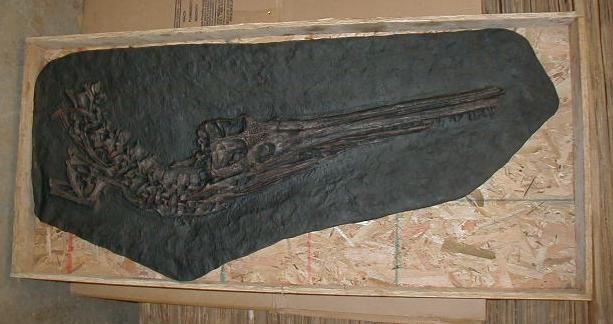
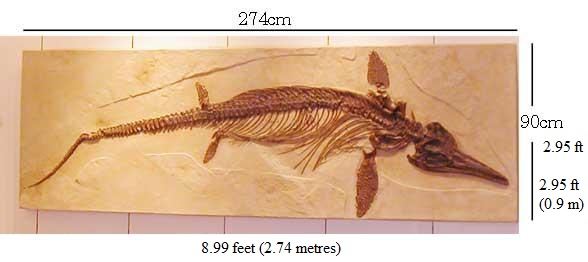 Ichthyosaurus intermedius, marine reptile Resin & Fiberglass 9 ft by 3 ft $2,500 (plus crating/shipping)
This piece was first produced in the 1860s by Henry Ward, of Ward's Scientific. 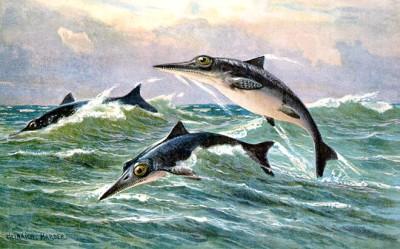 This is the first time in 140 years that this piece has been available for purchase.
 Please call (314) 556-0650 or email us for more pictures or information.
|
Pronounced (IK-thee-oh-SAWR-us) Ichthyosaurus was, a dolphin-like reptile up to 75 feet long. It could swim at 25 mph (40 kph). Ichthyosaurs had a tall dorsal fin, a half-moon-shaped tail, paddle-like flippers and smooth skin. The nostrils were near the eyes on the top of the head. It had massive ear bones and large eyes, probably giving it acute hearing and sight. These marine reptiles gave birth to live young. Their diet was mostly fish but also included cephalopods (like belemnites). Hundreds of Ichthyosaurus fossils have been found in England, Germany, Greenland, and Alberta, Canada. They lived during the early Jurassic to the early Cretaceous periods. It was not a dinosaur, but another type of extinct reptile. Ichthyosaurus, which means "fish lizard," was named by Charles Koenig in 1818. The six mile stretch of coastline to either side of the town Lyme Regis is world famous for its fossils. People have been collecting fossils for at least the last two hundred and fifty years, the most famous being Mary Anning who was born in Lyme in 1799. When she was twelve years old, she discovered the first Ichthyosaur ever to be found in England. During her lifetime, she extracted the first complete ichthyosaur, plesiosaur and the finest flying reptile among many other significant finds. Lyme Regis lies at the point where the Triassic rocks disappear below the sea and the oldest Jurassic rocks, thick clays and thin limestone of the 'Lias', form the cliffs. These rocks were deposited in a moderately deep tropical sea that was packed with marine life and as a result, fossils are very common. Some, such as pencil-shaped belemnites and coiled ammonites, are easy to find but others, like ichthyosaurs are far rarer.
Specs: From the Jurassic Period of Glastonbury, England. | |
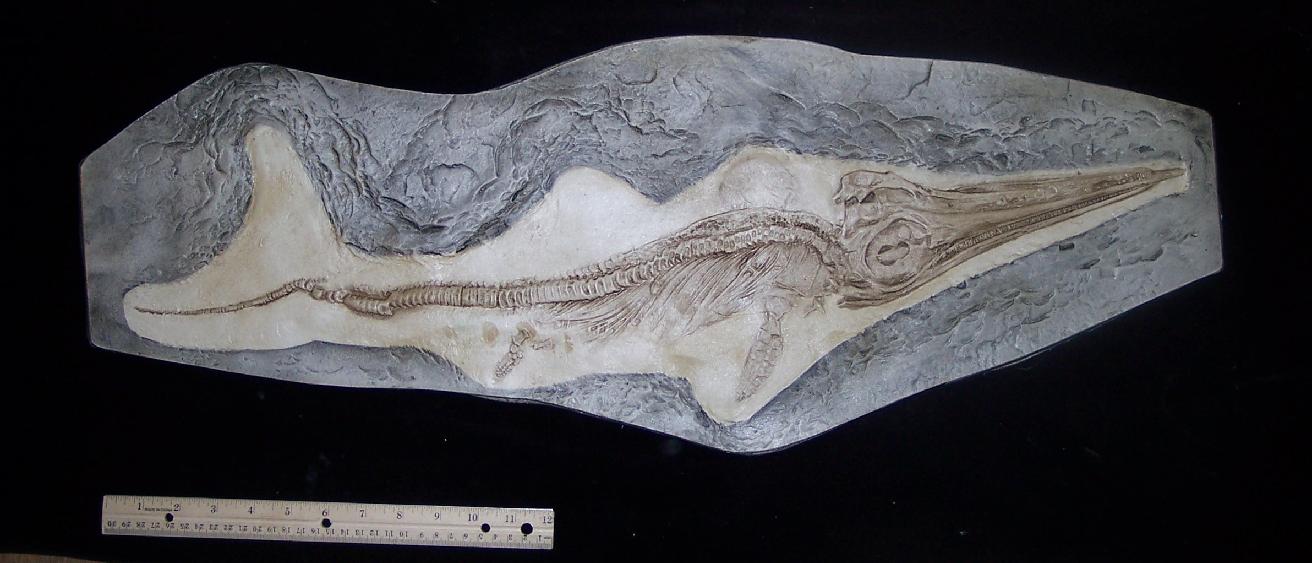
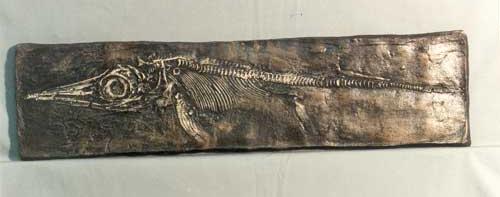
| Icthyosaur Skeleton Plaque (item #P24) | | Icthyosaur Skeleton Plaque cast Marine reptile. This cast is of an infant Ichthyosaur from European waters. Fossils have also been found in both North and South America.
Measures 23x6in (58x15cm). $35 (plus shipping)
|  Please call (314) 556-0650 or email us for more pictures or information.
| |
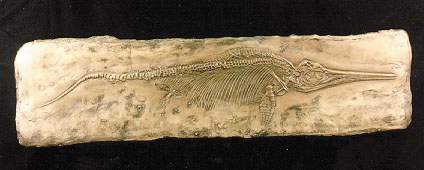
| Icthyosaur Fossil Panel cast replica (item #P20)
| |  Please call (314) 556-0650 or email us for more pictures or information.
|
Panel cast of Icthyosaur. Marine Reptile of the Triassic and Jurassic. Fossils discovered in North America and Europe. Don't let the picture fool you. This cast is huge and measures 5 ft long! (152cm) $635 (plus crating/shipping)
| |
Fossils starting with "J" (Return to Top of page)
| Jellyfish fossil cast replica
| | 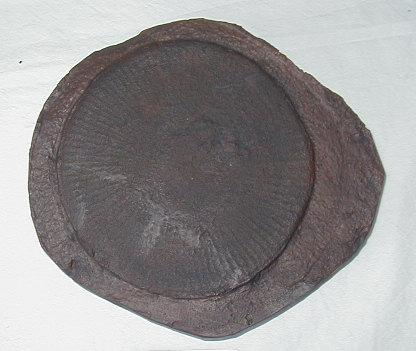 |
Here is a fossil cast of a jellyfish: Eldonia berbera . It measures: 17 cm X 20 cm
Price: $60.00 (plus shipping)
Please call (314) 556-0650 or email us for more pictures or information.
| |
Fossils starting with "K" (Return to Top of page)
| 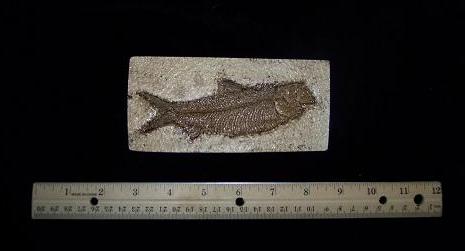
Knightia is the state fossil of the state of Wyoming. Cast replica $5 (plus shipping)
Please call (314) 556-0650 or email us for more pictures or information.
| Knightia Humilis Fish cast They were double scuted, having rows of dorsal and ventral scutes running from the posterior end of the head back to the median fins. Knightia is an extinct genus of fish well-known from abundant fossils found in the Green River Formation of Wyoming, United States. They rarely exceed 25 cm in length and are found throughout the formation. Knightia was a slender fish and seems to have been a secondary consumer, feeding mainly on ostracods, algal forms and diatoms, as well as some smaller fish. They were schooling fish, and because of this they are frequently found together in mass mortality layers. | |
Fossils starting with "L" (Return to Top of page)
|
Lanthanosuchus skull cast ("Forgotten Crocodile") replica |
|
Lanthanosuchus watsoniLocality:
Isheevo, Tatarstan Late Permian, Zone II
Size: About 250 to 750 centimeters in total length in life. This skull cast measures l9cm in length Meaning of name:
'Forgotten crocodile' Pronunciation: Lan-than-oh-SUE-kus
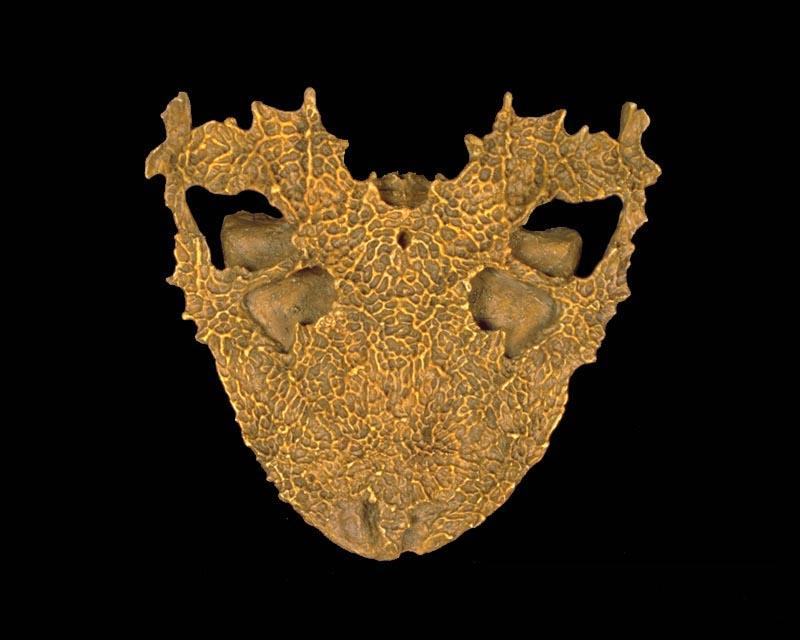
Classification: Parareptlilia: Lanthanosuchidae Skull of a primitive reptilian in a group that may have given rise to turtles.
When scientists first described this fossil, it was thought to be a labyrinthodont amphibian. Further analysis, however, now has led to the view that although in its flattened nature it did bear a strong resemblance to the labyrinthodonts, it was a reptile and a close ally of turtles. Certainly, advanced labyrinthodonts and primitive reptiles show many similarities for indeed some labyrinthodonts were the ancestors of reptiles.
Lanthanosuchus was adapted to life in warm saline pools, which were abundant in parts of Tatarstan in the Late Permian. There it may have fed on organisms including crabs and insects. It probably was an ambush predator that fed off the bottom of lakes and streams. Notches in the skull below the eye sockets may have housed special saline-excretory glands that dumped excess amounts of salts built up in Lanthanosuchus as a result of its surroundings. Complete line of alligator and crocodile skull casts and fossils here | 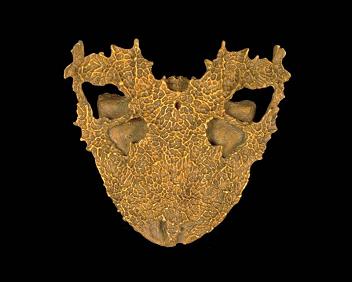 Please call (314) 556-0650 or email us for more pictures or information.
| |
Megalodon Teeth Fossils (Click Here to Return to Top of page)
Fossils starting with "M" (Return to Top of page)
|
Megalodon Jaw cast Museum quality (Item# REP033) |
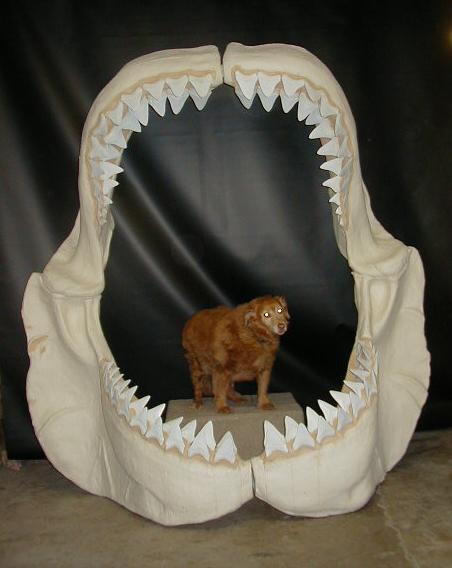 |
This amazing Megalodon jaw cast replica has 184 teeth!
Measures: 195.5 cm X 185.5 cm This makes a great show piece and instant exhibit. Kids love it! Price: $10,000.00 (plus crating/shipping) Please call (314) 556-0650 or email us for more pictures or information.
| |
|
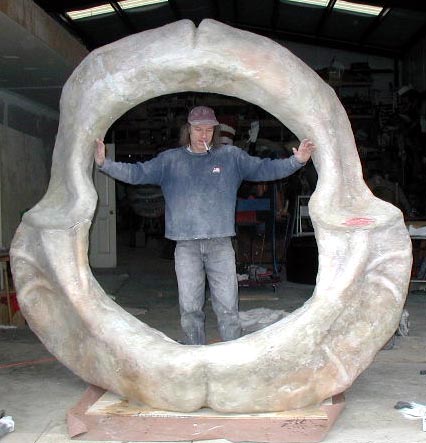
Megalodon Shark jaw with teeth. This is a great Megalodon shark jaw cast replica. While it does not show the teeth in this photo, we will fill the mouth with as many rows of teeth as you'd like. Give us a call and lets talk about this great display. Cast is in two pieces that bolt together. Outside measurement is approx 8 feet. Available for rent or purchase. Please call (314) 556-0650 or email us for more pictures or information.
|  | |
|
Megalodon: Carcharocles megalodon |
|
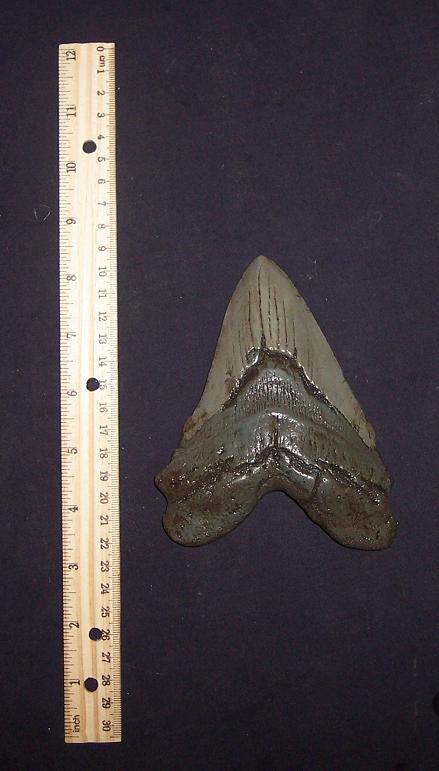
Megalodon Shark Tooth with removable base.
Scientific Name: Carcharocles megalodon This megalodon tooth was discovered in Aurora, North Carolina, USA It comes from the Yorktown Formation. Pliocene Measures 5.5" Resin cast: $36 (plus shipping)
Please call (314) 556-0650 or email us for more pictures or information.
|  | |
| Megalodon Tooth (item #FP MEG) | |
Megalodon Tooth with stand Megalodons teeth were up to 6.5" long. Like most sharks, Megalodon teeth were probably located in rows which rotated into use as they were needed. Most sharks have about 5 rows of teeth at any time. The front set does most of the work. The 1st 2 rows are used for obtaining prey; the other rows rotate into place as needed. As teeth are lost, broken, or worn down, they are replaced by new teeth. Megalodon may have had hundreds of teeth at one time. They did not chew their food like we do, but gulped it down whole in very large chunks. Cast is in solid resin $35.00 (Weight 1.75lb) Out of stock Please call (314) 556-0650 or email us for more pictures or information.
|  | |
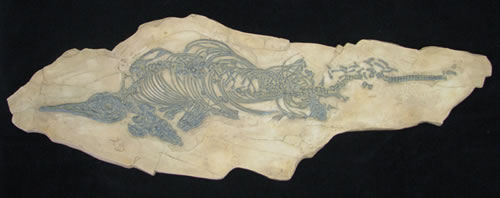
| Mixosaurus cast replica #1 |
|
Mixosaurus cast replica Scientific Name: Mixosaurus sp. Triassic
Molded from an original fossil discovered in Germany This cast measures 46" long $495 (plus shipping)
|
 Please call (314) 556-0650 or email us for more photos or information.
| |
Mosasaur Fossils (Click Here to Return to Top of page)
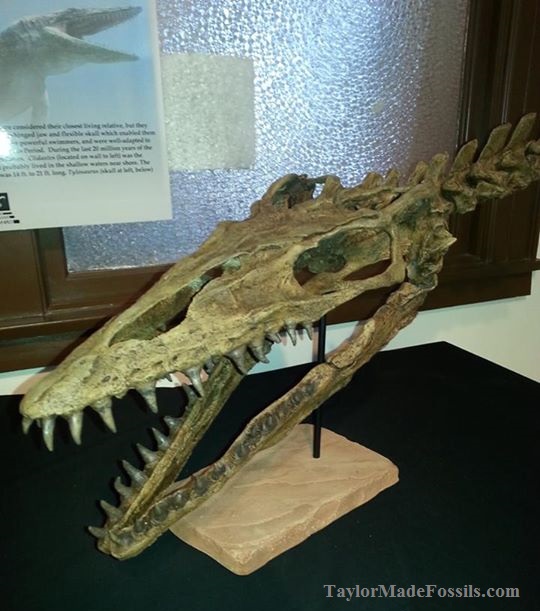
| Mosasaur skull: Platecarpus tympaniticus |
|
Mosasaur skull cast
Mosasaur skull with stand Scientific name: Platecarpus tympaniticus
Molded from an original fossil discovered in Kansas, USA
Cretaceous Skull cast measures 22"
This item is available for rent only.
|
 Please call (314) 556-0650 or email us for more photos or information.
| |
|
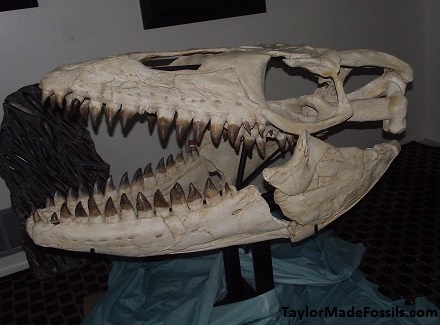
TMF Mosasaur skull cast replica | |
Huge and amazing 5 foot long Mosasaur Prognathodon skull.
Molded from the original fossil which itself sold for $50,000.
The skull cast measures 5 feet long X 45 wide X 51 inches high.
Comes with a custom stand that conforms to fit the upper cranium and a back
to hold the lower jaw.
This an amazing show-stopper.
This would be great for any museum or permmanet exhibit great for traveling shows.
Incredible attention to detail is this rare find.
TMF Mosasaur skull cast: $2,500 (plus shipping
Please call (314) 556-0650 or email us for more pictures or information.
|

| |
|
Mosasaur Skeleton cast replica | | Mosasaur (Prognathodon stadtmani) Skull and skeleton cast replica. Here is a cast of an entire Mosasaur skeleton (skull can also be purchased alone). The original is housed in Brigham Young University This skeleton is from the Late Cretaceous, and was discovered in the Mancos Shale Formation of Colorado (USA). Resin cast: The Assembled skeleton Mount measures 36 feet long, $ You can also purchase the skeleton unassembled, unpainted for $ Mosasaur paddle cast replicas:
Paddle size is approximately 32in. long by 19in. wide. The price for a front or rear paddle is $195.00 Please call (314) 556-0650 or email us for more pictures or information.
|
 | |
| Mosasaur skull cast replica (45 inch) | |
 | Mosasaur skull cast replica. Molded from an original fossil discovered in Kansas. This skull measures 45in (114cm) long. This item will be shipped by freight truck only. Shipping within the US is $200 (please inquire about shipping costs to other countries).
$1,095.00 (plus shipping)
Please call (314) 556-0650 or email us for more pictures or information.
| |
| Mosasaur skull cast replica (45 inch) |
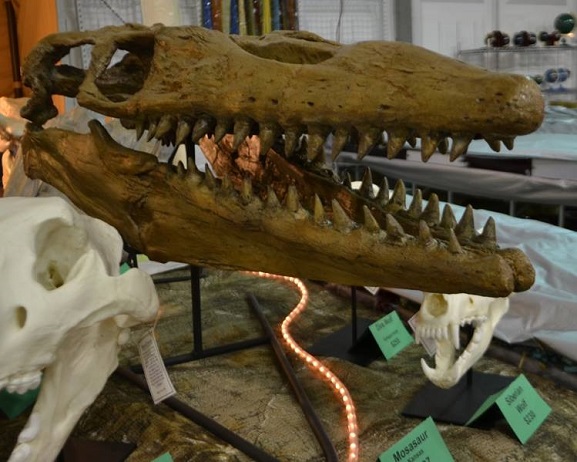 | 
Mosasaur skull cast replica. Molded from an original fossil discovered in Kansas. This beautiful Mosasaur skull measures 45 inches (114cm) long. This item will be shipped by freight truck. Shipping cost is $2
within
the US. $1,495.00 (plus shipping)
Please call (314) 556-0650 or email us for more pictures or information.
| |
|
Mosasaur skeleton (98% complete) Actual Fossil |
 Mosasaurs (from Latin Mosa meaning the "Meuse river" in the Netherlands, and Greek sauros meaning "lizard") were serpentine marine reptiles. The first fossil remains were discovered in a limestone quarry at Maastricht on the Meuse in 1764
With the extinction of the ichthyosaurs and pliosaurs, mosasaurs became the dominant marine predators. |
 Real Fossil Mosasaur skeletonThis amazing Mosasaur fossil is 98% complete. A great chance to own an actual Mosasaur skeleton. The skeleton is mounted on a 7ft fiberglass disk. Weight before crating is approx. 125 pounds Please contact us for price Please call (314) 556-0650 or email us for more pictures or information.
| |
Fossils starting with "N" (Return to Top of page)
Nothosaur Fossils (Click Here to Return to Top of page)
|
Nothosaur: Keichousaurus hui |
|
Articulated Nothosaur Keichousaurus hui Discovered in the Guanling Formation Triassic Location: China Measures 6 x 9.5" Resin cast replica $125 (plus shipping)
Please call (314) 556-0650 or email us for more pictures or information.
| 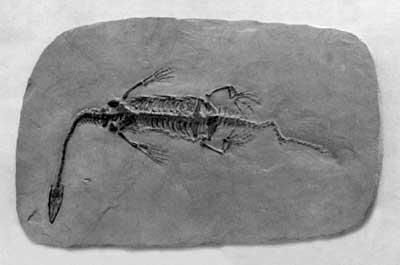 | |
Nothosaurus is an extinct genus of sauropterygian reptile from the Triassic. It's fossils being distributed from North Africa and Europe to China. It was about 4 m (13ft) long and is the best known member of the nothosaur order. Its name means "False lizard".
Nothosaurus was a semi-oceanic animal which probably had a lifestyle similar to that of today's seals. It had long, webbed toes and possibly a fin on its tail. When swimming, Nothosaurus would use its tail, legs, and webbed feet to propel and steer it through the water. The skull was broad and flat,with long jaws, lined with needle teeth, it probably caught fish and other marine creatures. Nothosaurus likely hunted by sneaking up slowly on prey, such as shoals of small fish, then putting on a last-minute burst of speed. Once caught, few animals would be able to shake themselves free from the mouth of Nothosaurus.
Fossils starting with "O" (Return to Top of page)
Fossils starting with "P" (Return to Top of page)
| Pharodus testis fish (item #P53)
|
|
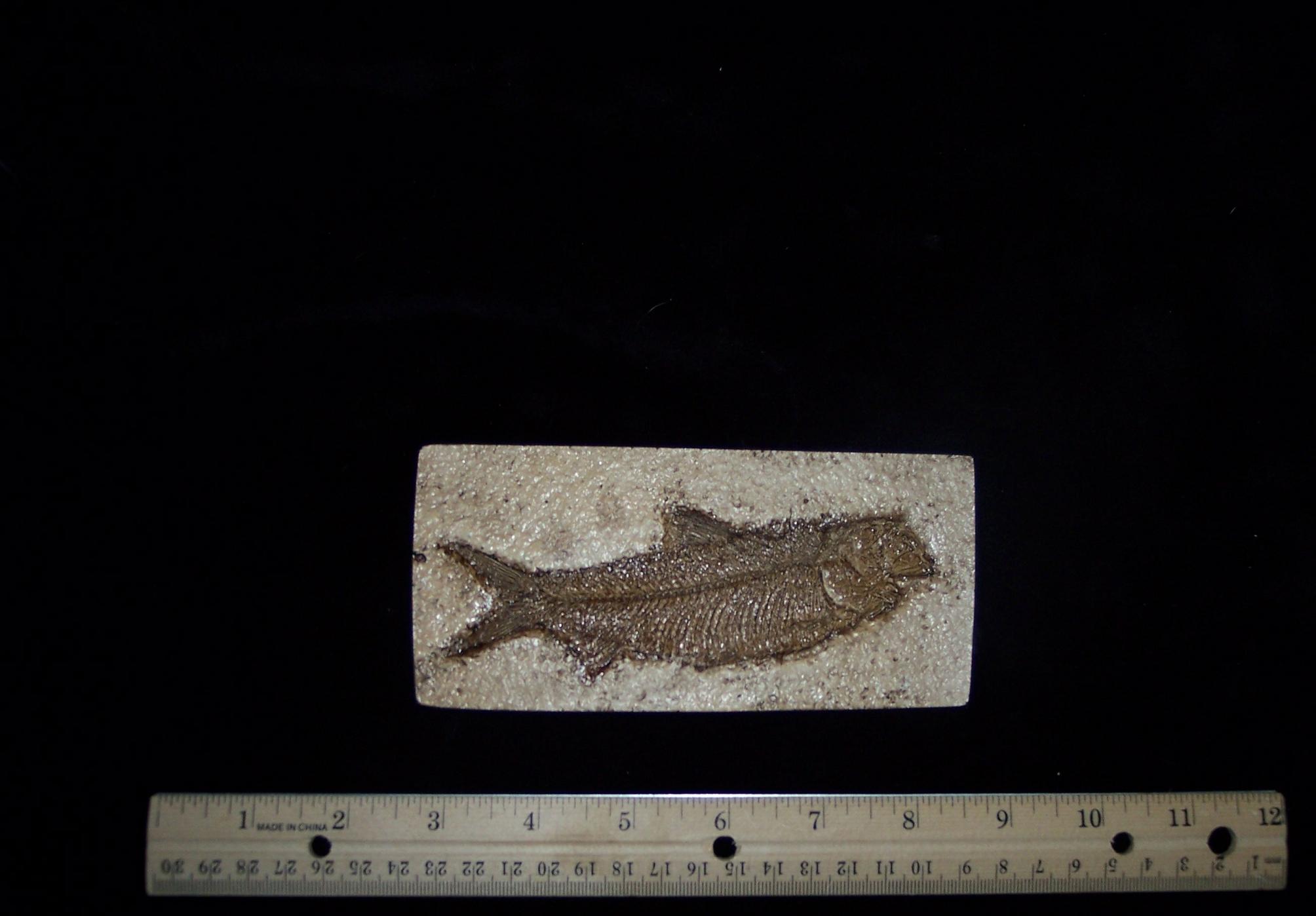
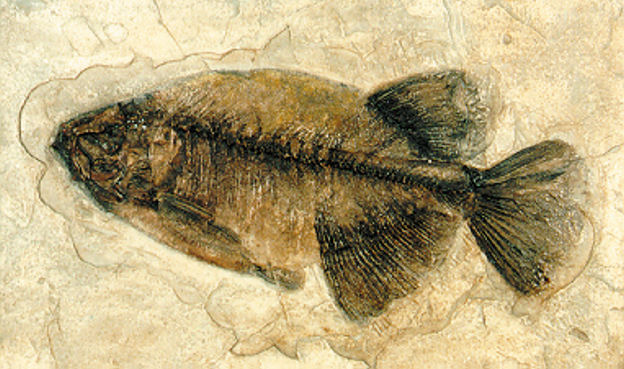
Pharodus testis fish cast replica Pharodus testis. Size. 438mm/17.2in. Location: Green River Wyoming. Age: Eocene $58 (plus shipping)
Please call (314) 556-0650 or email us for more photos or information.
|
| |
|
Pharodus testis, Green River Fish resin cast replica. (Item #144) |
|
Pharodus testis, Green River Fish
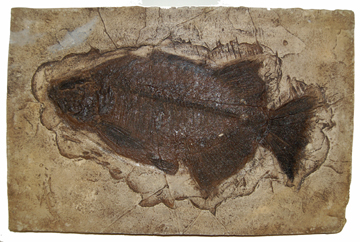
resin cast replica. Measures: 17 x 11 inches $70.00 (out of stock) Please call (314) 556-0650 or email us for more pictures or information.
|
| |
|
Phareodus testis cast fish fossil for sale |
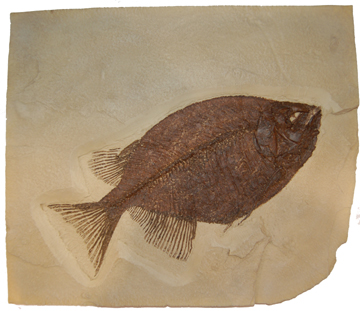 |
Phareodus testis, Green River Fish cast replica. Made of poly-resin Measures: 15x12.5x inches
$125.00
Please call (314) 556-0650 or email us for more pictures or information.
| |
|
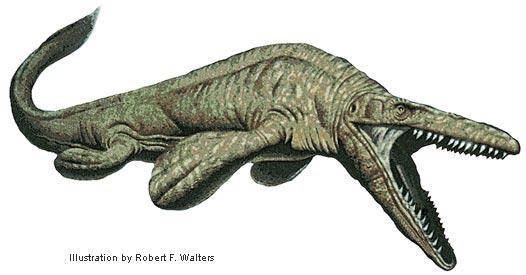 |
Platecarpus planifrons complete articulated skeletons and skulls are also available Please call (314) 556-0650 or email us for more photos or information.
| |
|
Phytosaur skeleton fossil cast replica |
|
Phytosaurs - family Phytosauridae or Parasuchidae - were a group of large (2 to 12 meters long - average size 3 to 4 meters) semi-aquatic predatory archosaurs that flourished during the Late Triassic period. These long-snouted and heavily armoured archosaurs bore a remarkable resemblance to modern crocodiles in size, appearance, and (clearly) lifestyle. The name "phytosaur" (plant reptile) is very misleading, and their snapping jaws clearly show that phytosaurs were predators. The person who first described them mistakenly thought the specimens he was working with were plant-eaters.
Phytosaur skeleton cast measures 15 feet (4.5 meters) long.
The price is $39,900 for the whole skeleton.
Phytosaur skull cast replica. The skull is approx 22 inches wide and 15 inches high depending on how wide the mouth is open.
Price for the skull only is $3,300 (plus shipping)
Kingdom: Animalia, Phylum: Chordata,
Class: Sauropsida, Infraclass: Archosauromorpha, (unranked): Crurotarsi,
Order: Phytosauria (von Meyer, 1861), Family: Phytosauridae (Jaeger, 1828)
|  Phytosaur skeleton fossil cast replica.
$42,500 Please call (314) 556-0650 or email us for more pictures or information.
| |
Plesiosaurus Fossils (Click Here to Return to Top of page)
|
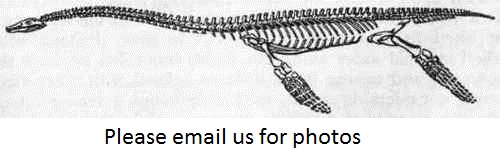
Plesiosaurus dolichodeirus skeleton cast replica | | Plesiosaurus cf. dolichodeirus Skeleton - Fossil Replica
Fully articulated mounted plesiosaur cast replica skeleton.
Skeleton measures approx 9' l (2.75 m)
$28,000 (plus crating and shipping)
Please email us for photos
Please call (314) 556-0650 or email us for more pictures or information.
|
 | |
|
Plesiosaurus dolichodeirus | | Plesiosaurus dolichodeirus skeleton cast replica panel. A cast of a young but almost complete plesiosaur, seen from the underside. It shows well how the skeleton of a plesiosaur is made up, the long neck, the four outstretched paddles which it used to ‘fly’ underwater and the strong barrel-shaped body.
This plesiosaur shows why Rev. William Conybeare, the Bristol man who invented the name ‘Plesiosaurus’, described these animals as ‘like a snake threaded through the body of a turtle’.
The original specimen, now in the Natural History Museum, London, came from the lower Lias rocks of Street, Somerset in the early part of the C19th. It was found by Thomas Hawkins (1810-1889) of nearby Glastonbury, the great collector who introduced the name ‘the Great Sea Dragons’ in 1840.
The cast was made in the Geology Laboratory of the City Museum & Art Gallery. A previous cast was destroyed by bombing in 1940.
Cast of a Thalassiodracon hawkinsi skeleton (known as Hawkin's Plesiosaur)
This skeleton cast is made of resin/fiberglass and measures 72x30 inches.
$900 (plus crating and shipping TBD)
Shown here black, it can be painted any color you wish. Please call (314) 556-0650 or email us for more pictures or information.
|
 Plesiosaurus (pronounced: plee-zee-oh-SAWR-us). It's name comes from the Greek: plesios, which means "near to" + sauros, meaning: "lizard"). Plesiosaurus was a large (about 3 to 5 meters long), marine Sauropterygian reptile that lived during the early part of the Jurassic Period, and is known by nearly complete skeletons from the Lias of England and Germany. It was distinguished by its small head, long and slender neck, broad turtle like body, a short tail, and two pairs of large, elongated paddles. It lends its name to the order Plesiosauria, of which it is an early but fairly typical member. Plesiosaurus was one of the first of the "antediluvian reptiles" to be discovered (by Mary Anning), and excited great interest in Victorian England. It was so-named ("near lizard") by William Conybeare, to indicate that it was more like a normal reptile than Ichthyosaurus, which had been found in the same rock strata just a few years previously. | |
|
Plesiosaur / Plesiosaurus (Elasmosaurid) Thalassomedon fossil skeleton cast replica | |
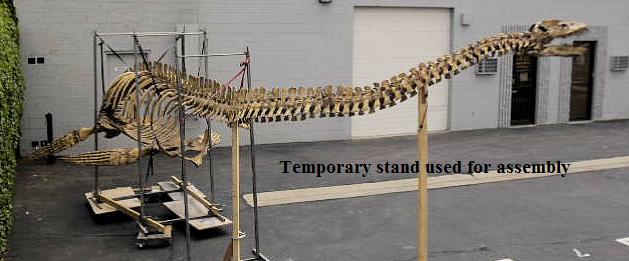 Plesiosaur / Plesiosaurus (Elasmosaurid) Thalassomedon skeleton cast replica. Giant marine reptile of the N American Jurassic seas. Upper Cretaceous Colorado. DMNH# This Giant Plesiosaur skeleton cast measures 42ft (13m) long. The width of the skeleton varies depending on the pose.
The rib cage is 48 inches wide. Each flipper is 52 inches long. You can manipulate the width by changing the
flipper position. If you had both flippers straight
out (plus the width of the rib cage) you would have 152 inches wide.
| 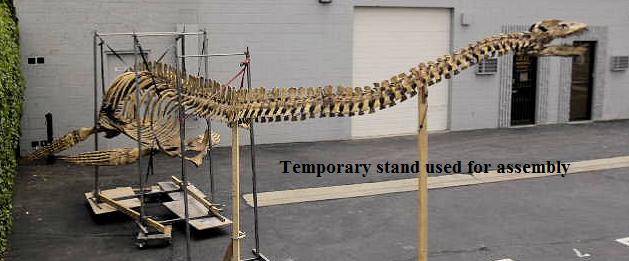 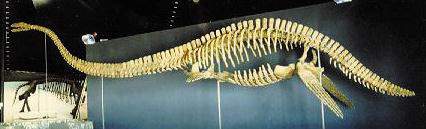 Plesiosaur skeleton cast Mounted and crated: $45,000 Unmounted: $35,000.00 Please call (314) 556-0650 or email us for more pictures or information.
|
Fossils starting with "R" (Return to Top of page)
Fossils starting with "S" (Return to Top of page)
| Sarcosuchus imperator Supercroc skull cast replica | | Sarcosuchus imperator Supercroc Sarcosuchus imperator (flesh eating crocodile), nicknamed Supercroc, (Cretaceous). Sarcosuchus imperator skull cast measures: 57" Long, 33" Wide, 18" High Please call (314) 556-0650 or email us for more pictures or information.
|  With an estimated body length of 40 feet, and a skull over 5 1/2 feet long, Supercroc is one of the largest crocodiles that ever walked the Earth. The Sarcosuchus's jaws are lined with over 100 teeth. Unlike modern crocodilians whose teeth interlock, Supercroc's lower teeth fit inside its uppers, leading scientists to the conclusion that Sarcosuchus imperator did not limit its diet to fish. It is believed that Sarcosuchus was an ambush predator capable of killing large dinosaurs that wandered too close to the water's edge. The Sarcosuchus's unusual bulbous snout is thought to have given it a greater ability to smell prey and make louder sounds. This gigantic crocodilian was first discovered in the Sahara desert by Albert-Felix de Lapparent (1964) and named by France de Broin / Phillipe Taquet (1966). | |
Seymouria Fossils (Click Here to Return to Top of page)
|
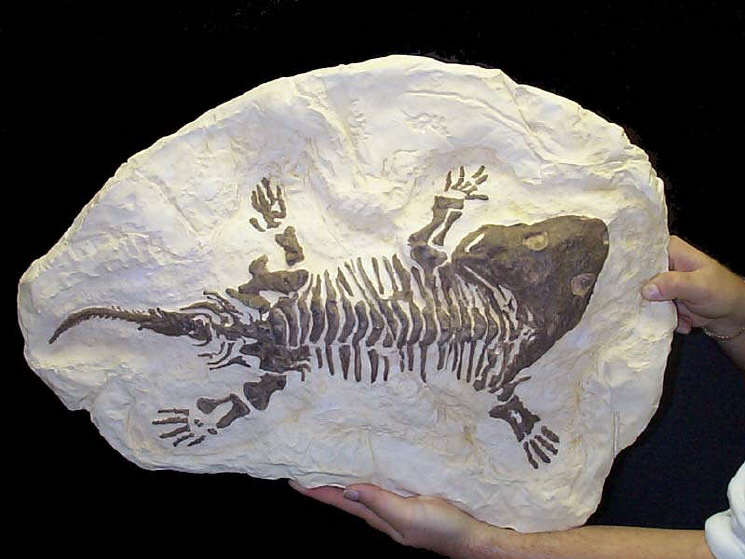 | 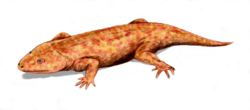 Seymouria skeleton cast A casting of a Permian Texas amphibian Seymouria was a reptile-like tetrapod from the early Permian of North America and Europe. Seymouria was well adapted to life on land, with many reptilian features - so many that it was first thought to be a primitive reptile. Cast replica measures: 25" x 19". Texas, USA. Seymouria skeleton cast replica $275 (plus shipping)
>
Please call (314) 556-0650 or email us for more pictures or information.
| |
|
Steller's Sea Cow Skull cast(Hydrodamalis gigas)replica
(item #AA309) |
|
Steller's sea cow (Hydrodamalis gigas) is a large extinct sirenian mammal. Formerly abundant throughout the North Pacific, its range was limited to a single, isolated population on the uninhabited Commander Islands by 1741 when it was first described by Georg Wilhelm Steller, chief naturalist on an expedition led by explorer Vitus Bering. Within 27 years of discovery by Europeans, the slow-moving and easily captured Steller's sea cow was hunted to extinction. Molded from a UCB specimen skull cast measures 24 in.
$650.00
| 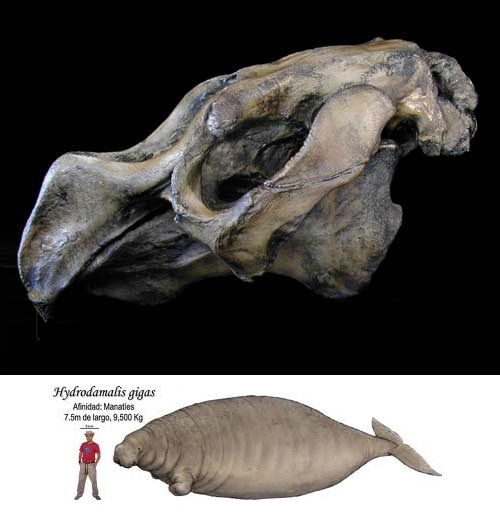 Stellers Sea Cow
Kingdom: Animalia, Phylum: Chordata, Class: Mammalia, Order: Sirenia, Family: Dugongidae, Subfamily: Hydrodamalinae (Palmer, 1895), Genus: Hydrodamalis (Retzius, 1794), Species Binomial name: Hydrodamalis gigas (Zimmermann, 1780)
Please call (314) 556-0650 or email us for more pictures or information.
| |
  |
 Giant Super Croc! This giant supercroc statue is painted to your specifications. Gross Wt. (kg) : 86 (189 lbs)
CBM : 1.5732 Super Croc statue measures: (LxWxH, in) : 185 x 55.75 x 15 (15.41 feet long x 4.58 feet x 15 inches)
$5,900 plus shipping. 
Buy 2 or more statues (your choice) and recieve a special discount price.
More Dinosaur and animal statues HERE email us.
| |
Fossils starting with "T" (Return to Top of page)
| Titanichthys Skull cast replica | |
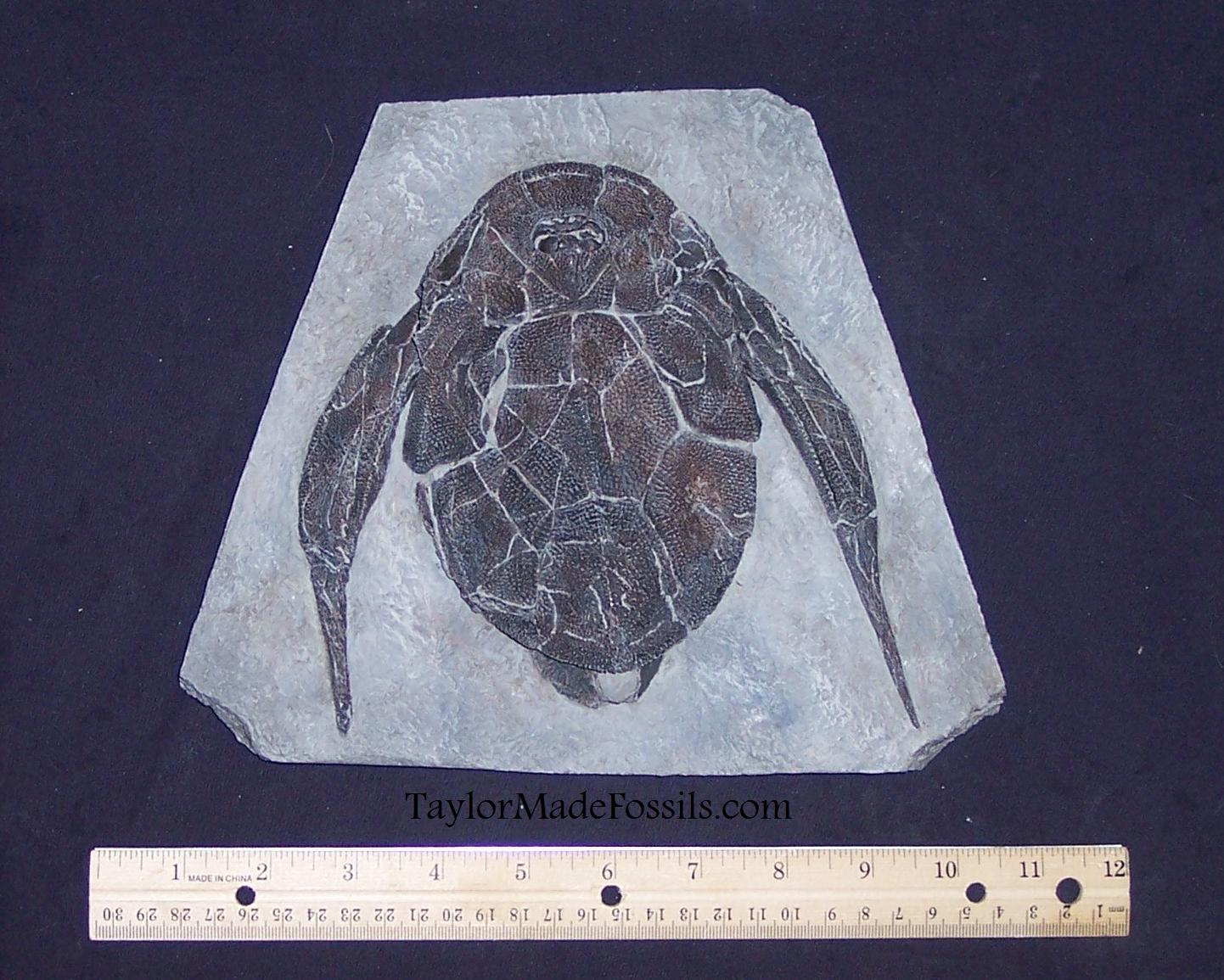
Titanichthys agassizi was a giant, aberrant marine placoderm from the Late Devonian. It approached Dunkleosteus in size and build. Unlike its relative, however, T. agassizi had small, ineffective-looking mouth-plates that lacked a sharp cutting edge. It is presumed that the beast used its capacious mouth to swallow or inhale schools of small, anchovy-like fish, or possibly krill-like zooplankton, and that the mouth-plates retained the prey while allowing the water to escape as it closed its mouth. When the first specimens were found in Morocco by geologist Henri Termier, Titanichthys was originally placed within the genus Gorgonichthys - that is, after Termier was able to convince his colleagues that the bone scraps were of a placoderm, and not a . A junior synonym is Brontichthys, which should not be confused with another arthrodire, Bruntonicthys (Dinichthyidae). Late Devonian
Locality Morocco
Measures approx. 91.5 cm x 119.4 cm x 139.7 cm (36 in x 47 in x 55 in)
Resin cast: $8,500.00 | Please call (314) 556-0650 or email us for more pictures or information.
| |
| Trilobite Fossils and cast replicas | |
| Turtle (Chisternon undatum cast replica) | 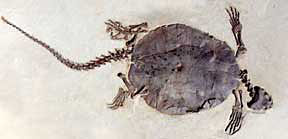 | Turtle (Chisternon undatum); Eocene, Green River Formation; This turtle is a massive 50 inches long; Resin cast: $725 (plus shipping)
More turtle skulls and skeletons | |
Fossils starting with "U" (Return to Top of page)
Fossils starting with "V" (Return to Top of page)
Fossils starting with "W" (Return to Top of page)
|
Walrus: Ice age Walrus skull cast replica
|
|
Ice Age Walrus skull cast replica. Location of discovery: Alaska USA Pleistocene Molded from a privately owned specimen
Measures: 24"H x 10"W $475 (plus $50 oversize shipping)
Please call (314) 556-0650 or email us for more photos or information.
|
 | |
Whale Fossils (Click Here to Return to Top of page)
|
Whale skeleton - new unnamed species |
 Unassembed Whale skeleton kit $16,000 Please call (314) 556-0650 or email us for more pictures or information.
|
 This is an as yet unnamed species of intermediate whale from the late Oligocene. It was discovered in South Carolina by Steve Faust. This is an as yet unnamed species of intermediate whale from the late Oligocene. It was discovered in South Carolina by Steve Faust. The skull is 6' in length, the complete skeleton is 22' in length. Assembled Resin Whale skeleton cast $48,000 Resin Skull with mandibles and cervicals $7,800 | |
|
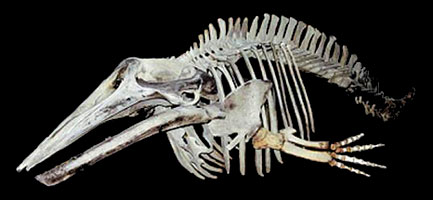
Whale: Balanoptera acutorostrata (Minke Whale) Skeleton cast replica
|
|
Balanoptera acutorostrata (Marine Mammal)
Skeleton cast replica.
Commonly referred to as the Minke Whale, they are the smallest of the modern baleen whales. This individual is one of the largest at 8.3 meters (30 feet) long, with a skull that is 2.1 meters (7 feet) long. $45,000 (plus shipping)
Please call (314) 556-0650 or email us for more pictures or information.
|
| |
| Whale: Beluga Whale Skeleton cast | | 
 | Delphinapterus leucas; Single species. Monodontidea. The original skeleton was found in the Arctic Ocean and adjoining seas. Made of polyurethane, this is a cast of an original San Diego Museum of Natural History specimen. Measures: 3.2m. / 125.in. Size;125.in Long. 44.5in Wide from flipper to flipper Beluga Whale Disarticulated Skeleton $3,675.00 Or Assembled $6,037.00 Beluga Whale Skull cast(530mm. / 20.9in.) $495.00
| |
Fossils starting with "X" (Click Here to Return to Top of page)
|
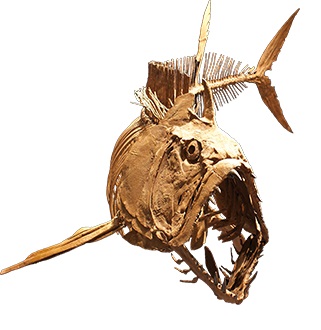
Xiphactinus audax skeleton cast |
Please call (314) 556-0650 or email us for more pictures or information.
|
Xiphactinus is the largest known bony fish, and was a voracious predator of the Western Interior Seaway. A number of specimens have been recovered with the intact remains of smaller fish preserved as stomach contents. We offer three-dimensional replicas of this amazing fossil, with every bone detailed and articulated as in life.
We also offer panel mounted Xiphactinus specimens with a reconstructed fish-within-a-fish as well as a panel with isolated Xiphactinus stomach contents.
A 3.8 meter (12.5 feet) life reconstruction is also available
| |
|
Xiphactinus (Xiphanctinus) audax |
 Xiphactinus audax (from Latin and Greek for "audacious sword-ray") was a large, 4.5 to 5 m (15 to 20 feet) long predatory bony fish that lived in the Niobraran Sea, in what is now North America, during the Late Cretaceous. A junior synonym of the species is Portheus molossus.
Xiphactinus fish, Scientific Name: Xiphanctinus audax This specimen was discovered in Kansas, USA in the Niobrara Formation. From the Late Cretaceous, Resin cast measures 29.5 x 27," Xiphactinus cast #1: $495
Please call (314) 556-0650 or email us for more pictures or information.
| Skeletal remains of Xiphactinus have come from Kansas, Alabama, and Georgia. Xiphactinus Head Plaque Mount #2 Resin cast $___
 | |
|
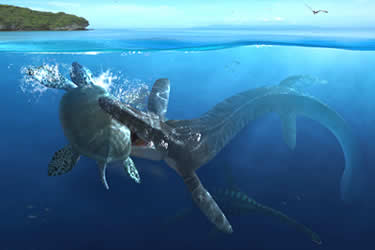
Arcelon & Tylosaurus Poster |
|
Arcelon & Tylosaurus Poster Printed on 100 pounded coated paper Poster measures: 24x36 inches $15 plus shipping More Posters Here
|  | |
Fossils starting with "X" (Return to Top of page)
Fossils starting with "Y" (Return to Top of page)
Fossils starting with "Z" (Return to Top of page)
| Zygorhiza Eocene Whale Skull & Skeleton cast replica | | 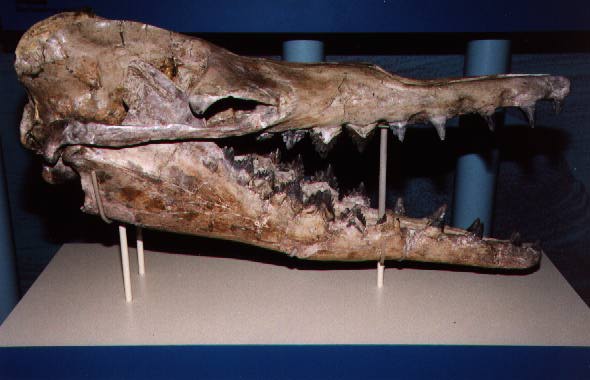

Please call (314) 556-0650 or email us for more pictures or information.
|
Zygorhiza, skull Zygorhiza kochii ("Koch's Yoke-Root") is an extinct species of cetacean. A Eocene Whale Skull & The Mississippi State Fossil Zygorhiza was a smaller, less elongated, 6 m (20 foot) long relative of the famous Basilosaurus. Zygorhiza had flippers that could, unlike in modern cetaceans, be moved at the elbow. Its hind limbs were rudimentary. Zygorhiza's one-metre (3-foot) skull had fearsome jaws with deadly teeth. Unlike modern cetaceans, Zygorhiza had a neck consisting of seven vertebrae. Kingdom: Animalia, Phylum: Chordata, Class: Mammalia, Order: Cetacea, Suborder: Archaeoceti, Family: Basilosauridae, Genus: Zygorhiza True, 1908 Species: Zygorhiza kochii Resin cast measures: 32x13x12 inches high Zygorhiza cast $650 (plus shipping)
Complete skeleton also available. | |
TaylorMadeFossils.com
Taylor Made Fossils's Profile

Create Your Badge
For ordering information please contact:
Taylor Made Fossils
1546 #R Irving Avenue
Saint Louis, Missouri 63133 USA
(314) 556-0650
email us
We are open 24 hours.
|
..........
|
--------- Please call (314) 556-0650 or email us for more photos or information.
| |