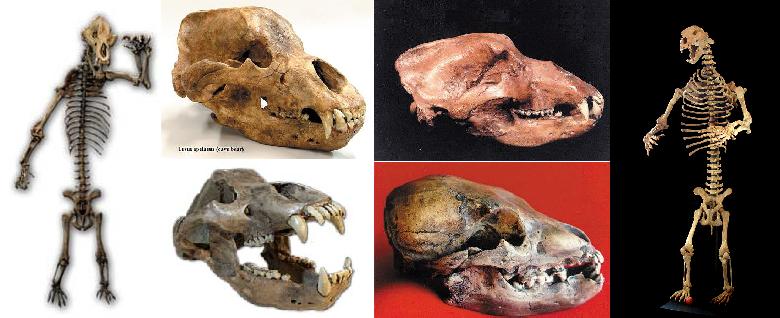
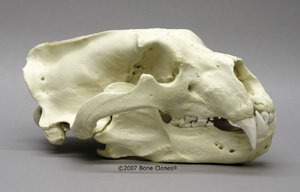
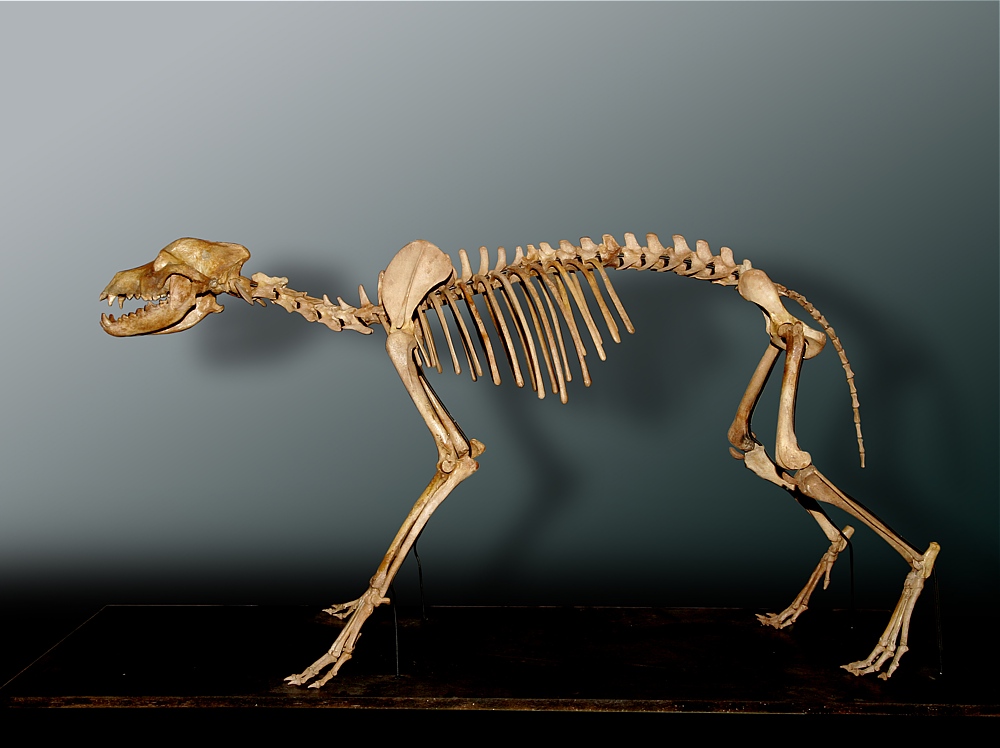
Arctodus simus Short-Faced Bear Skull
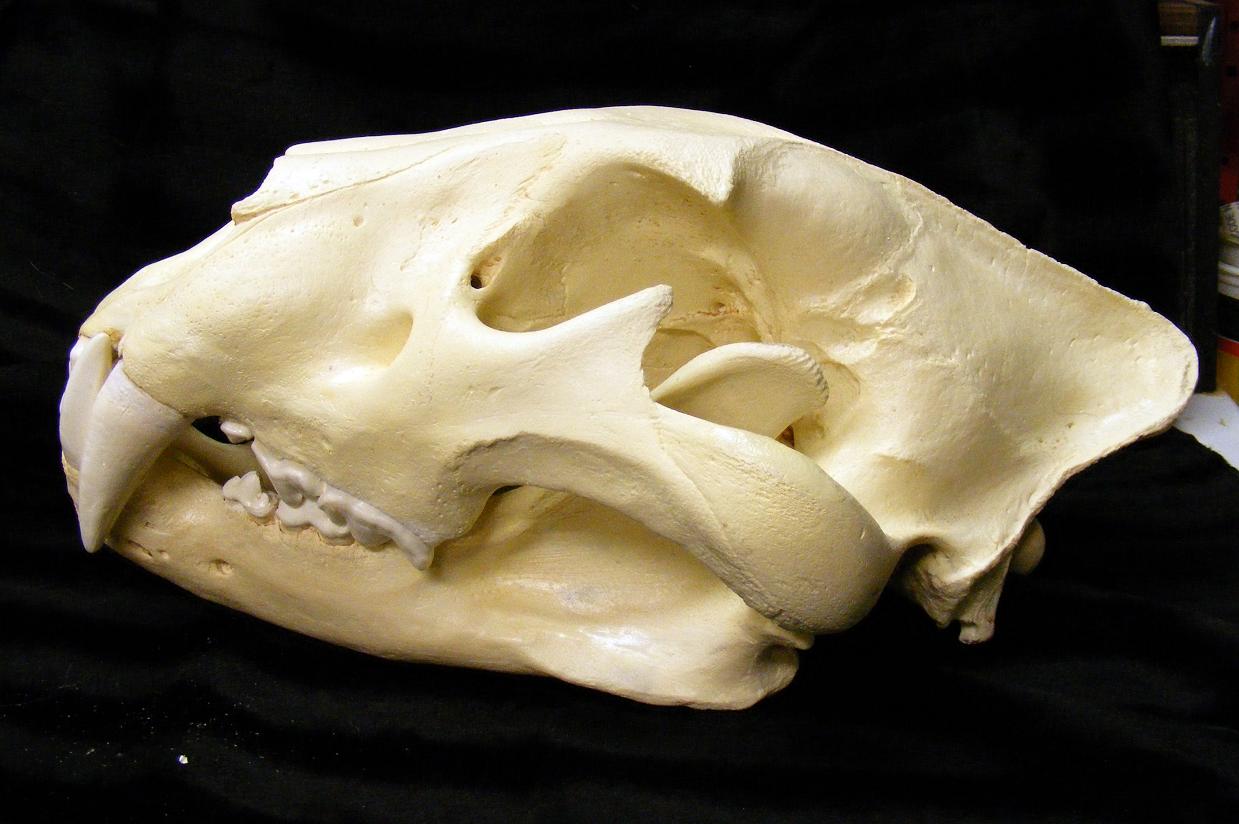
Arctodus simus (Cope-1897), which is more closely related to the Andean Bears, Tremarctos than to Ursus, have been found in several locations from Mexico to Alaska. Those specimens from Alaska, known as Arctodus simus yukonensis, are typically more robust than those specimens found in more southern latitudes.
These bears were extremely large and weight estimates have been in excess of 1300 lbs. Notably, their limbs were very long and would have dwarfed both the modern Kodiak bear along with the Pleistocene European cave bear.
This specimen was approximately five feet at the hip and stood about 12 feet tall. Arctodus simus has been extinct for thousands of years. The upper canines of this skull are removable, as shown in the insert.
Arctodus simus Short-Faced Bear Skull $__
_________
A stand shown here with the skull, is available for an additional fee.
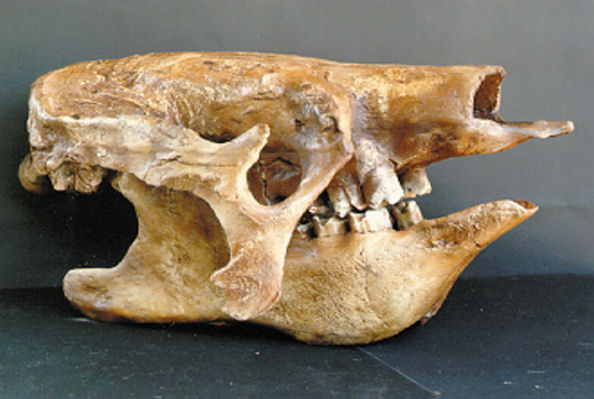
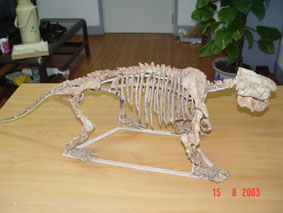
Holmesina is a genus of pampathere, an extinct group of armadillo-like creatures that were distantly related to extant armadillos. Like armadillos, and unlike the other extinct branch of Cingulata, the glyptodonts, the shell was made up of flexible plates which allowed the animal to move more easily.
Holmesina individuals were much larger than any modern armadillo. They traveled north in the faunal interchange, and adapted well to North America, like the ground sloths, glyptodonts, armadillos, capybaras, and other South American immigrants. Their fossils are mostly found in Texas and Florida.
Skull cast measures 9 ¾" L x 5 ¼" W x 3 ½" H 25L x 13.5W X 9H (cm)
Giant Fossil Armadillo Skull cast
$__
Giant Armadillo Skull with base.
Holmesina septentrionalis skull cast replica
This skull is from the Pleistocene.
It was discovered in Florida.
Holmesina species were herbivores; armadillos are mostly insectivorous.
Age: 12,000 years (late Pleistocene). Discovered at Ayer Pond, Orcas Island, in the Pacific Northwest in 2003. The skull of this specimen is considered to be one of the finest and largest found to date. With a horn spread of 31 inches, Bone Clones captured all the incredible detail of the original, including the intact nasals. Significantly, the bones suggest human activity in this region about 800 years before the Clovis era. The evidence supplied by the bones is consistent with butchering by humans and inconsistent with carnivore activity (e.g., wolves would have typically damaged the nasals, bears would not typically have broken the humerus at its thickest point, and there would have been far more surface damage to the bones).
Brontotheriidae, also called Titanotheriidae, is a family of extinct mammals belonging to the order Perissodactyla, the order that includes horses, rhinoceroses, and tapirs. Superficially they looked rather like rhinos, although they were not true rhinos and are probably most closely related to horses. They lived until the very close of the Eocene.
The skull and lowers are from Custer County, SD. The skull (upper) was collected on a cattle ranch in 1992 and the lowers found in the same area but, later in 1999.
Brontops sp. (robustus?)
Crazy Johnson Member
Chadron Formation
Custer County, SD
Molded from a privately owned specimen.
Dimensions of the fossil skull replica: 26" long x 13" wide x 24" tall.
$795 (plus shipping)
Crate size: 34" long, 20" wide, 25" tall. Weight of skull and crate: 82 lbs.
Customer review: "The skull cast arrived in great shape. Your packing job was excellent and the paint is spot on for our preservation here. It will make a fine display"
Brontotheres have teeth adapted to shearing (cutting) relatively nonabrasive vegetation. Their molars have a characteristic W-shaped ectoloph (outer shearing blade).
The history of this group is well known, due to an excellent fossil record in North America. The earliest brontotheres, such as Eotitanops, were rather small, no more than a meter in height, and were hornless.
Brontotheres had massive body sizes, although some small species, such as Nanotitanops did persist through the Eocene. Some genera, such as Dolichorhinus, evolved highly elongated skulls. Later brontotheres were massive in size, up to 2.5 m (8.2 feet) in height with bizarre hornlike skull appendages. For instance the North American brontothere Megacerops had large sexually dimorphic paired horns above their noses. The sexually dimorphic horns suggest that brontotheres were highly gregarious (social) and males may have performed some sort of head clashing behavior in competition for mates. However, unlike rhinos, the horns of brontotheres are composed of bone, the frontal bone and nasal bone, and were placed side-to-side rather than front-to-back.
Brontotheres probably became extinct due to an inability to adapt to drier conditions and tougher vegetation (such as grasses) that spread during the Oligocene.
Caenopus occidentalis skull cast replica (please contact us)
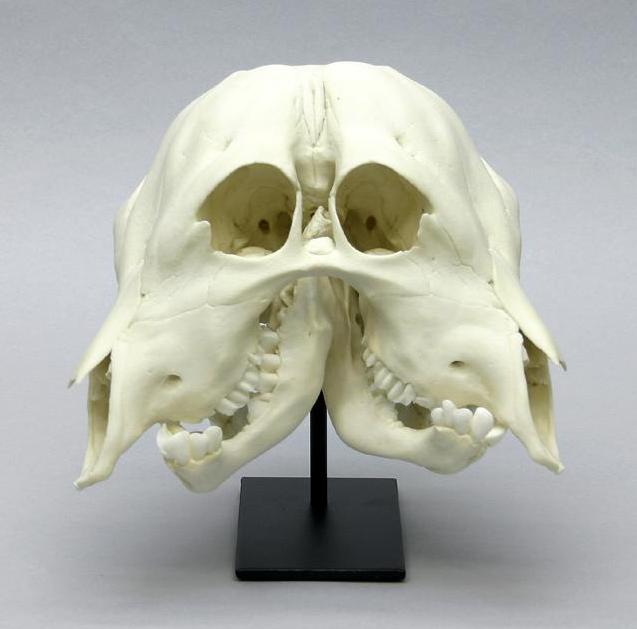
Calf: Bos Taurus with Craniofacial duplication
Two heads, fused, but one endocranium and one foramen magnum that connected to a single neck and body. A very rare and beautiful specimen considering that the skulls are literally mirror images of one another. It appears to have been artistically created but really was molded and cast from a real skull. Custom Stand included.
This calf exhibits the rarest form of conjoined twinning known as Diprosopic Parapagus. This bizarre congenital defect results from the complete fusion of the bodies, limbs, necks and rear portions of the skulls of identical twins, with only their "faces" remaining to reveal their individual origins.
We had to show the underside of this unique specimen. Both mandibles were cast separately and attached to the skull in the correct anatomical position to match the original skull.
Belonging to the Pleistocene era, Rancholabrean epoch, the Giant Beaver became extinct about 10,000 years ago. Although it ranged from Alaska to Florida, there have been very few specimens found. This particular one is considered to be among the largest and most complete. Compared to a modern Beaver, its size was remarkable.
Castoroides ohioensis (item #BC-071T "Tarpit)
Measures 13" Long, 9" Wide, 10" High
Resin cast: $__ (plus shipping)
Castoroides, or giant beaver, is an extinct genus of enormous beavers that lived in North America during the Pleistocene. C. leiseyorum and its northern sister species Castoroides ohioensis, were the largest beavers to ever exist.
Castoroides ohioensis (item #BC-071A "Antique")
Measures 13" Long, 9" Wide, 10" High
Resin cast:$__ (plus shipping)
We also have real fossil Giant Beaver skulls and skeletons for sale.
Cast replica Giant Beaver skeleton: $8,500 (plus shipping).
The measurements for the castoroides skeleton are;
skull length: 10.5 inches long
occipital condyle length is: 2.5 inches wide,
femur length: 6.75 inches long
humerus length: 5 inches long.
Please contact us for photos and more information.
Cave Bear (Ursus spelaeus) Fossils and casts / replicas
The Stag-moose or Stag moose (Cervalces scotti) was a large moose-like deer of North America of the Pleistocene epoch.
It was slightly larger than the moose, with an elk-like head, long legs, and complex palmate antlers. The species went extinct approximately 11,500 years ago, toward the end of the most recent
ice age, as part of a mass extinction of large North American mammals.
Cervalces scotti, Stag Moose, Skull & Antlers
Measures: 183 cm X 122 cm
$__(plus $300 shipping - US, outside US please contact us for price)
Original fossil Cervalces skeleton and Cast replica skeleton also available.
Contact us for more information.
Please call (314) 556-0650 or email us for more photos or information.
The Stag-moose or Stag moose (Cervalces scotti) was a large moose-like deer of North America of the Pleistocene epoch.
It was slightly larger than the moose, with an elk-like head, long legs, and complex palmate antlers. The species went extinct approximately 11,500 years ago, toward the end of the most recent
ice age, as part of a mass extinction of large North American mammals.
We have real fossil skeletons of both male and female Cervalces. Mounted to your specifications.
$ please contact us for prices
Cervalces skeleton Cast replica skeleton also available.
Contact us for more information.
Please call (314) 556-0650 or email us for more photos or information.
Chalicotheres (from Greek chalix, "gravel" + therion, "beast") were a group of herbivorous, odd-toed ungulate (perissodactyl) mammals spread throughout North America, Europe, Asia, and Africa during the Early Eocene to Early Pleistocene subepochs.
Anisodon grande, formerly Chalicotherium grande.
Chilotherium Skull
Chilotherium is an extinct genus of rhinoceros from the Miocene to the Pliocene of Asia and Europe.
Scientific Name: Chilotherium sp. Discovered in Gansu Province, China. Late Miocene
Dire Wolf Skull Canis dirus fossil skulls and skeleton cast replicas
Thriving during the Pleistocene, the Dire Wolf is not a direct ancestor of any of today's known species of canine. They once co-existed in North America with Grey Wolves. Dire Wolves had short, thick legs, a larger, broader skull and more massive teeth than the modern wolves. Their brain case is also notably smaller than their remaining canine cousins. Current belief is that they were likely scavengers rather than hunters. Remains of over 3,600 individuals have been recovered from the La Brea tar pits - more than any other species of mammal. This may also be an indication of their preying in packs on dead or incapacitated animals that were themselves trapped in the mire.
Thriving during the Pleistocene, the Dire Wolf is not a direct ancestor of any of today's known species of canine. They once co-existed in North America with Grey Wolves. Dire Wolves had short, thick legs, a larger, broader skull and more massive teeth than the modern wolves. Their brain case is also notably smaller than their remaining canine cousins. Current belief is that they were likely scavengers rather than hunters. Remains of over 3,600 individuals have been recovered from the La Brea tar pits - more than any other species of mammal. This may also be an indication of their preying in packs on dead or incapacitated animals that were themselves trapped in the mire.
Skull cast measures:
We also offer a Dire Wolf Skeleton cast cast replica $9,500 assembled / $6,695 unassembled.
The skeleton will require a crate for shipping. Crate cost $150 for unassembled or $275 if assembled. Shipping cost is not included.
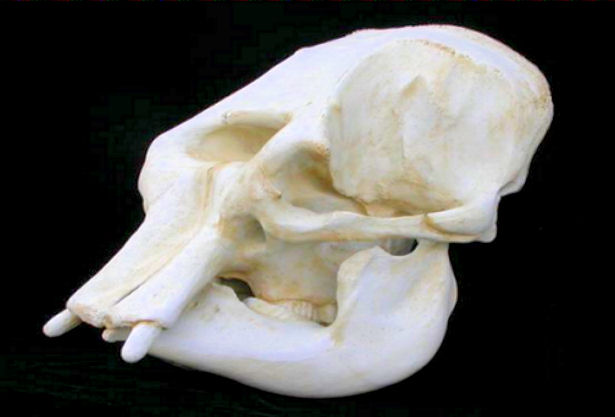
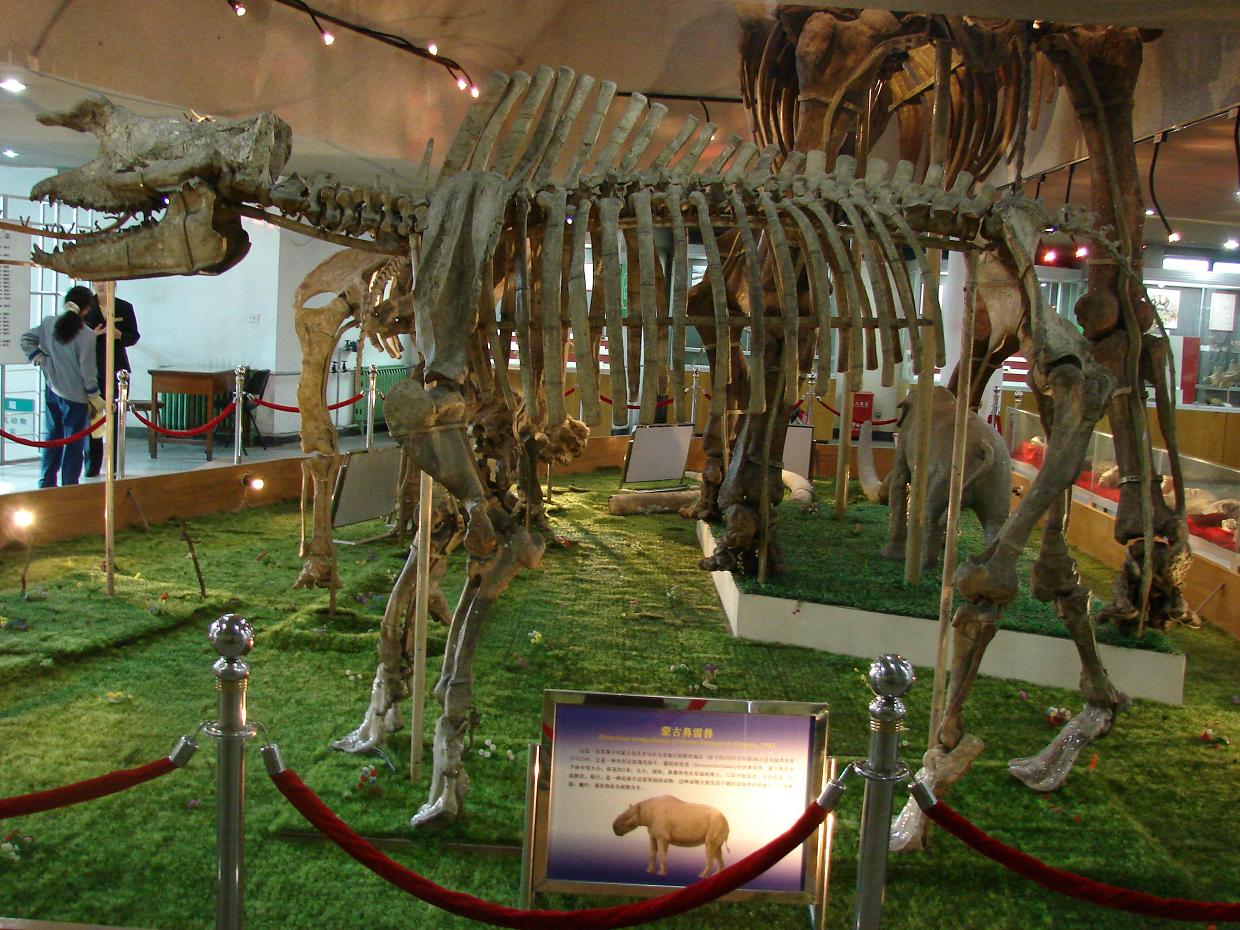
This skull belongs to a now extinct relative of elephants called
Platybelodon grangeri. Platybelodon (meaning "flat-tusk") lived during the Miocene Epoch. It may have gone extinct from overspecialization and inability to adapt to changing environmental conditions.
The shape of the two lower teeth have led Platybelodon to be known as a "shovel tusker". It may have used it's teeth to strip bark from trees. This specimen was discovered in Gansu Province, China and measures 53" long. Late Miocene.
Resin cast:$____ Price does not include crating or shipping.
Crate and shipping costs are not included.
This skull would make a great comparison piece to my mammoth skulls (lower this page)
Eremotherium: Giant Ground Sloth.Edentate of the late Pleistocene.
The original bones were found in Florida, Segment of AA101.
Polyurathane cast of an original from Royal Ontario Museum.
Eremotherium is an extinct genus of ground sloth. The species, E. laurillardi, had a wide distribution spanning both South and North America and is often referred to as the Panamerican Ground Sloth.
The Glossotherium" chapadmalensis Ground Sloth (Mylodon) can be mounted in several ways. On all four feet the skeleton would be 9ft long, 4 1/2ft tall, and approx 3 1/2ft wide.
Mounted in an upright position the skeleton is approx 7ft tall, 9ft long 3 1/2ft wide.
Panochthus is an extinct genus of glyptodont, which lived in Argentina during the Pleistocene epoch.
It could reach 3 m in length and a weigh up to 1500 kg; the upper skull and the body were protected by hemispherical armor composed of hundred of rounded scales called "scutes". The tail, short and wedge-shaped, consisted of small bony bands with small spikes used for defense.
Glyptodont Skeleton cast replica Pleistocene, Rio Lujan Formation
Once this item has sold, it will be removed from the web site.
Hippopotamus Skull (Natural Bone) Hippopotamus Skull Natural Bone
Product: Hippopotamus Skull
Quality: Natural Bone
The hippopotamus is found in the river systems throughout much of central Africa. Hippos spend much of the day socializing in the water, but come ashore to feed at night. This large aquatic herbivore can be aggressive when protecting its territory. The hippopotamus contributes to more human deaths in Africa than lions, crocodiles and venomous snakes combined.
Hippopotamus Skull
This hippo skull exhibits no tusks, and a small hole under the right zygomatic arch.
Typical of early carnivorous mammals, individuals of Hyaenodon had a very massive skull but only a small brain. The skull is long with a narrow snout - much larger in relation to the length of the skull than in canine carnivores, for instance. The neck was shorter than the skull, while the body was long and robust and terminated in a long tail. Despite the name, these creatures are not related to hyenas.
Hyaenodon Skull cast replica
Scientific Name: Hyaenodon sp
Location: Nebraska USA
Formation: White River
Oligocene
Molded from a privately owned fossil specimen
Measures: _
$ (plus shipping)
Please call (314) 556-0650 or email us for more photos or information.
Hyaenodon ("hyaena-toothed") is the type genus of Hyaenodontidae, a group of extinct carnivorous creodonts of the family Hyaenodontidae endemic to all continents except South America, Australia and Antarctica. The various species of Hyaenodon competed with each other and with other hyaenodont genera (including Sinopa, Dissopsalis and Hyainailouros), and played important roles as predators in ecological communities as late as the Miocene in Africa and Asia. Species of Hyaenodon have been shown to have successfully preyed on other large carnivores of their time, including a Dinictis nimravid "false saber-tooth cat" by analysis of tooth puncture marks on a fossil Dinictis skull in North Dakota
Hyaenodon Skull cast replica
Oliogocene creodont.
Skull cast measures: 11x7x4.5in (28x18x11cm).
$125 (plus shipping)
Please call (314) 556-0650 or email us for more photos or information.
Hipparion (Greek, "pony") is an extinct genus of horse.
It resembled the modern horse, but had outer toes (in addition to its hoof). These did not touch the ground. Hipparion was about 1.4 metres (14 h) tall at the shoulder. They were apparently very successful, as they spread from their origins in North America, to Asia, Europe, and Africa,
This skull comes from the Gansu Providence Red Clay China. It is currently in a museum in China. The original is not for sale.
Leptomeryx evansi was a small hornless ruminant that resembled a miniature antelope or deer; their closest living relatives are the Tragulidae. Unlike the Tragulidae of today, they probably lived in social groups as indicated by mass mortality deposits containing as many as 26 skeletons. They had short forelimbs with tiny four toed feet that would have enabled them to dart like rabbits in the shady undergrowth of their forested habitat. They most likely dieted on tender shoots, fruits, and insects. It was a very successful animal dominating the fossil record in some localities, and would have been a tempting snack for the forest dwelling predators of its day.
Our panel mount skeleton replica is molded from a nearly complete skeleton. It is "positioned" in a walking pose, on matrix.
This is a really interesting animal. Great for any badlands exhibit!
Details
Age Oligocene Epoch (About 33 MYA)
Locality Brule Formation - Orellan Member - White River Group, Nebraska
Source Original collected and prepared by Black Hills Institute of Geological Research, Inc.
Notes May take approximately four weeks for delivery. Check with us to see if an earlier delivery is possible.
Size ~ 22" l x 16" h (56 x 41 cm)
Extras Crating and packing fees apply. Please contact us with your questions.
Price: $475.00
Lion: White lion of Timbavati skull cast replica
White lion of Timbavati skull cast replica
This skull comes from a 550lb male lion from South Africa taken in the early 1980's.
It is said to be from one of the famous "white lions of Timbivati" before they were all extinct in the wild.
The white lions of Timbavati Game Preserve in South Africa are extinct in the wild. The Cincinnati Zoo, Siegfried and Roy's compound in Las Vegas, 4 in S. Africa, 2 in Germany and 4 in other zoos are in existance.
The Timbavati Lions are the only white lions in existance. Roy Horn of Siegfried and Roy, presented the Cincinnati Zoo and Botanical Garden with a rare, 7 month old female white lion of Timbavati in 1998.
They named her "Prosperity", and will join her with "Sunshine and Future", 10 month old white male lions also from Siegfried and Roy.
Their hopes for offspring are aimed at mid-1999. This pride of Timbavati lions has been named, "Pride of the Millennium".
White lions are extinct in the wild, and there are only 25 in existance in captivity.
Thanks to an alliance with the Johannesburg Zoological Gardens, Siegrfried and Roy were given 7 white lions to continue this unique line of species in their breeding program.
Legend has it that the white lions once every year would emerge from the bush, and show their pure white coats, which represents the good in all creatures.
The white lion is not an albino, it carrys the recessive white gene.
One of the most unique aspects of the Woolly Mammoth (with its large size, shaggy coat, and giant tusks), but its teeth.
The Mammoth only had a single tooth in each jaw—four total—with six sets of replacements over its lifetime. If and when the last set wore out, the animal starved to death.
Species: Mammuthus primigenius
Tooth cast replica measures: 8 inches across the surface and 3.5 inches wide with an 8 inch long root.
Item location: Chaldron, Nebraska
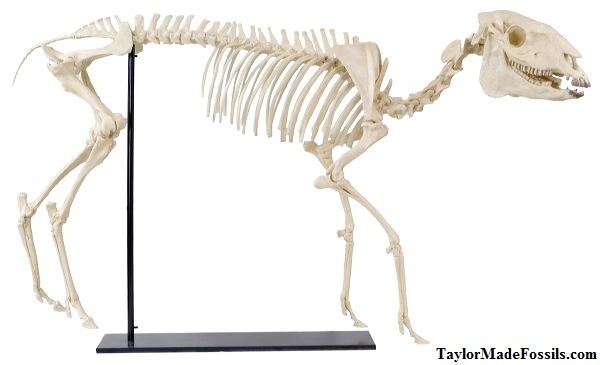
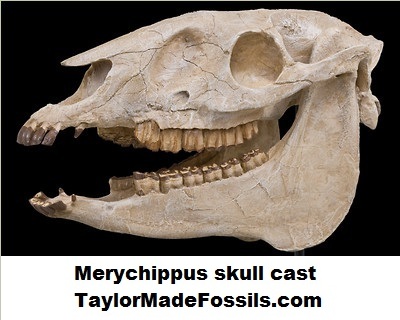
This offering is one-of-a kind. It may be the most complete skull of a Mesohippus that you will ever find. It is 8" long and has some neck vertebrae attached. Except for a couple small areas it has all bone and was prepped my friend and the finder. This was found in the 1950's and hasn't been bought or sold to anyone until now.
The color is perfect, the bone exceptional and the form ideal. This is a fantastic representation of the species. I've seen these animals in poor condition go for $4,000 at auction so grab this one up before it's gone. This comes with beautiful case for display or transportation. On sale now for $2,099 plus shipping/insurance.
Merycoidodon ("ruminating teeth") is an extinct genus of terrestrial herbivore of the family Merycoidodontidae, subfamily Merycoidodontinae (oreodont), more popularly known by the name Oreodon ("hillock teeth") endemic to North America during the Late Eocene-Early Miocene subepochs
The skulls of Merycoidodon have a pit in front of the eyes. Similar pits are found in the skulls of modern deer, where they contain a scent gland used for marking territory. Although Merycoidodon was not directly related to deer, it seems likely that it possessed a similar gland, which may imply that it, too, was territorial
Mesohippus skull cast replica.
(RF031)
Mesohippus bairdii. skull cast replica.
This little horse skull measures 8 inches (202mm).
A very nice Oliogocene horse. Molded from an original fossil discovered in the White River Formation, Nebraska.
$65 (plus shipping)
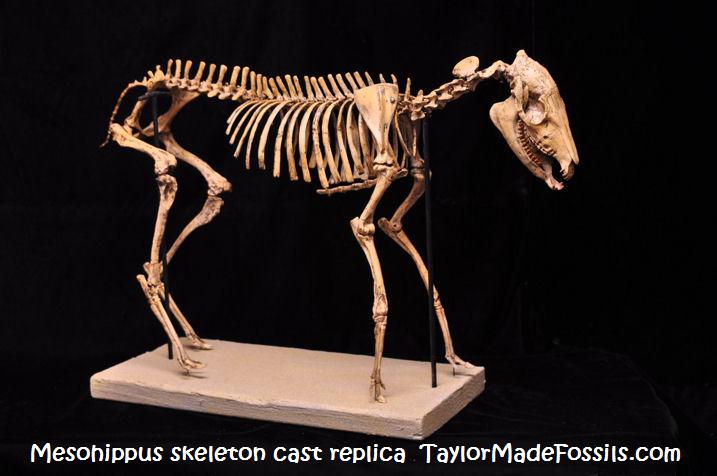
Mesohippus bairdii skeleton cast replica also available. Please email us for photos, prices and more info.
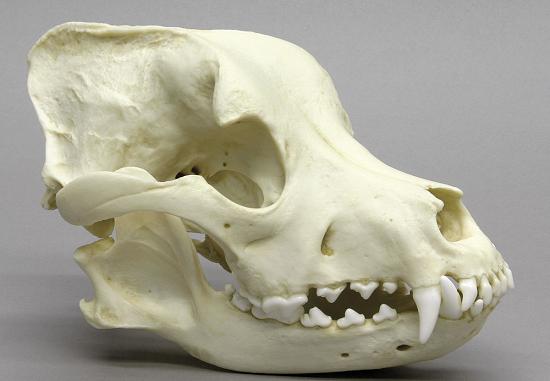
This skull was beautifully molded and cast from our original skull (which came from a natural death - the original skull is being donated to a local vet). We hope this skull will help educate veterinarians and the public alike. By providing high quality cast replicas the sale and trade of real skulls is no longer necessary.
Our profits from the sale of this cast replica will go to Pit Bull rescues and BARC of Saint Louis which helps low income families spay and neuter dogs and cats of all breeds.
Are you looking for a cast replica dog skull of another breed? We have them. DogSkulls.com
Pit Bull Dog skull
Pit Bull is the shortened name for the American Pit Bull Terrier, although it is often used to refer to other terrier mixes (for example, the Staffordshire Bull Terrier). Bred and valued for its tenacious grip, the Pit Bull is a powerfully built dog, with strong jaws (no breed of dog has a so called "lock jaw"), a thick, muscled neck, and impressive chest. Today, if raised with care, the Pit Bull is a loyal guardian and good-natured family pet. Its height ranges from 18-22 inches, and its weight most commonly falls between 35 to 55 pounds.
Platygonus is an extinct genus of peccary from North America. Platygonus was larger than modern peccaries, at around 1 metre (3.3 ft) in body length, and had long legs, allowing it to run well. It also had a pig-like snout and long, carnivore-like tusks which were probably used to fend off predators. It had a complex digestive system, similar to that of a modern ruminant.
Platygonus was a gregarious animal and, like modern peccaries, traveled in packs. It ranged from southern Canada to Mexico and from California to Pennsylvania. Stratigraphically, it occurs throughout the Pleistocene (Calabrian), and as early as the Blancan in the Gelasian of the Pliocene.
Polar Bears are extremely large predators and dangerous to humans. These bears are often found on ice flows and lead a very nomadic life. This particular specimen (which measures 18" long, 11 3/16" wide, 8 1/2" high) is considered to be the second largest skull ever found.
Stegodon are one of the largest of extinct elephants species (Proboscidean) with adults being 13 feet high at the shoulder, 26 feet long, not including 10 foot long nearly straight tusks. The genus Stegodon, (from Greek stegos: meaning roof, and odon: meaning tooth, referring to the step ridges on the molar tooth) has its origins in the late Miocene of Asia and belongs to the family Stegodontidae. There are 6 recognized species. Stegodons probably originated from Gomphothierium, and developed into a new direction with increase molar size and ridge-like dental features. The tusks were so close together that the trunk probably did not lye between them but instead draped over. Stegodon moved into Africa in the Pliocene and is regarded as the ancestor to present day elephants, as well as the extinct mammoths. The oldest finds of Stegodon are found in Asia. Stegodon diet consists of branches and foliage of trees.
Please call (314) 556-0650 or Email for crating & shipping estimates.
Teleoceras is an extinct genus of grazing rhinoceros that lived in North America during the Miocene all the way to the early Pliocene epoch
Teleoceras is the most common fossil in the Ashfall Fossil Beds of Nebraska. In fact, its remains were so numerous and concentrated that the building housing the greatest concentraion of Ashfall fossils is dubbed the "Rhino Barn". Most of the skeletons are preserved in a nearly-complete state. One extraordinary specimen includes the remains of a Teleocerascalf trying to suckle from its mother.
Uintatherium Skeleton Rare and exotic dinocerta mammal of Eocene Uinta Colorado. Gunma MNH (Japan).
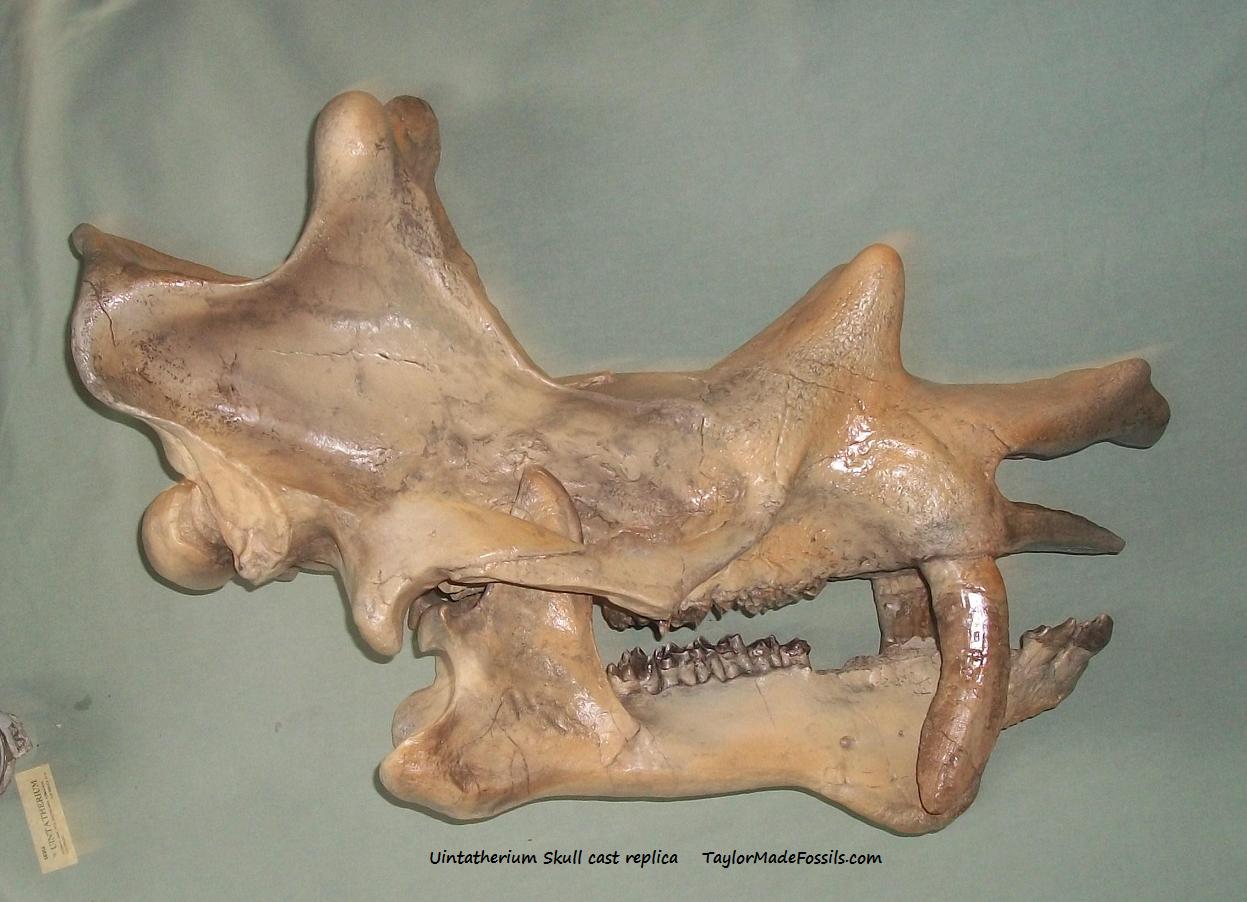
Uintatherium is an extinct genus of mammals. Fossil remains were discovered near Fort Bridger, Wyoming. This was a large browsing animal, about the size of a rhinoceros. What was most unusual about Uintatherium was its skull which was large and strongly built. Uintatherium had a flat, concave skull a feature not found in any other mammal, save, perhaps in some brontotheres. Its cranial capacity was exceptionally small due the walls of the cranium being tremendously thick. The weight of the skull was mitigated by numerous sinuses permeating the walls of the cranium, like those in an elephant's skull. The large upper canines were apparently formidable defensive weapons and were larger in males than in females.
Uintatherium mounted skeleton measures: 114in (2.89 m) length.
Available mounted: $21,650 or $16,000.00 unmounted (plus shipping)
The skulls of the males bore six prominent knob-like ossicones (horn-like or antler-like protuberance) which grew from the frontal region of the skull. The function of these structures is unknown. They may have been of used for defense or display. Uintatherium lived during the early to middle portions of the Eocene. It was an herbivore, eating leaves, grasses and shrubs. Uintatherium lived near water and used its sabre-like canines to pluck the aquatic and marsh plants which comprised its diet. It became extinct by climatic changes and competition with brontotheres, and true and hyrachodont rhinocerii without leaving any descendants.
Uintatherium Skull cast replica
Mammal amblypod of the Eocene Uinta Formation of Colorado.
Delphinapterus leucas; Single species. Monodontidea.
The original skeleton was found in the Arctic Ocean and adjoining seas. Made of polyurathane, this is a cast of an original San Diego Museum of Natural History specimen.
Measures: 3.2m. / 125.in. Size;125.in Long. 44.5in Wide from flipper to flipper
Zygomaturus is an extinct giant marsupial from Australia during the Pleistocene. It had a heavy body and thick legs and is believed to be similar to the modern Pygmy Hippopotamus in both size and build. The genus moved on all fours. It lived in the wet coastal margins of Australia and became extinct. Zygomaturus also is believed to have expanded its range toward the interior of the continent along the waterways. It is believed to have lived solitarily or possibly in small herds. Zygomaturus probably ate reeds and sedges by shoveling them up in clumps with its lower incisor teeth.
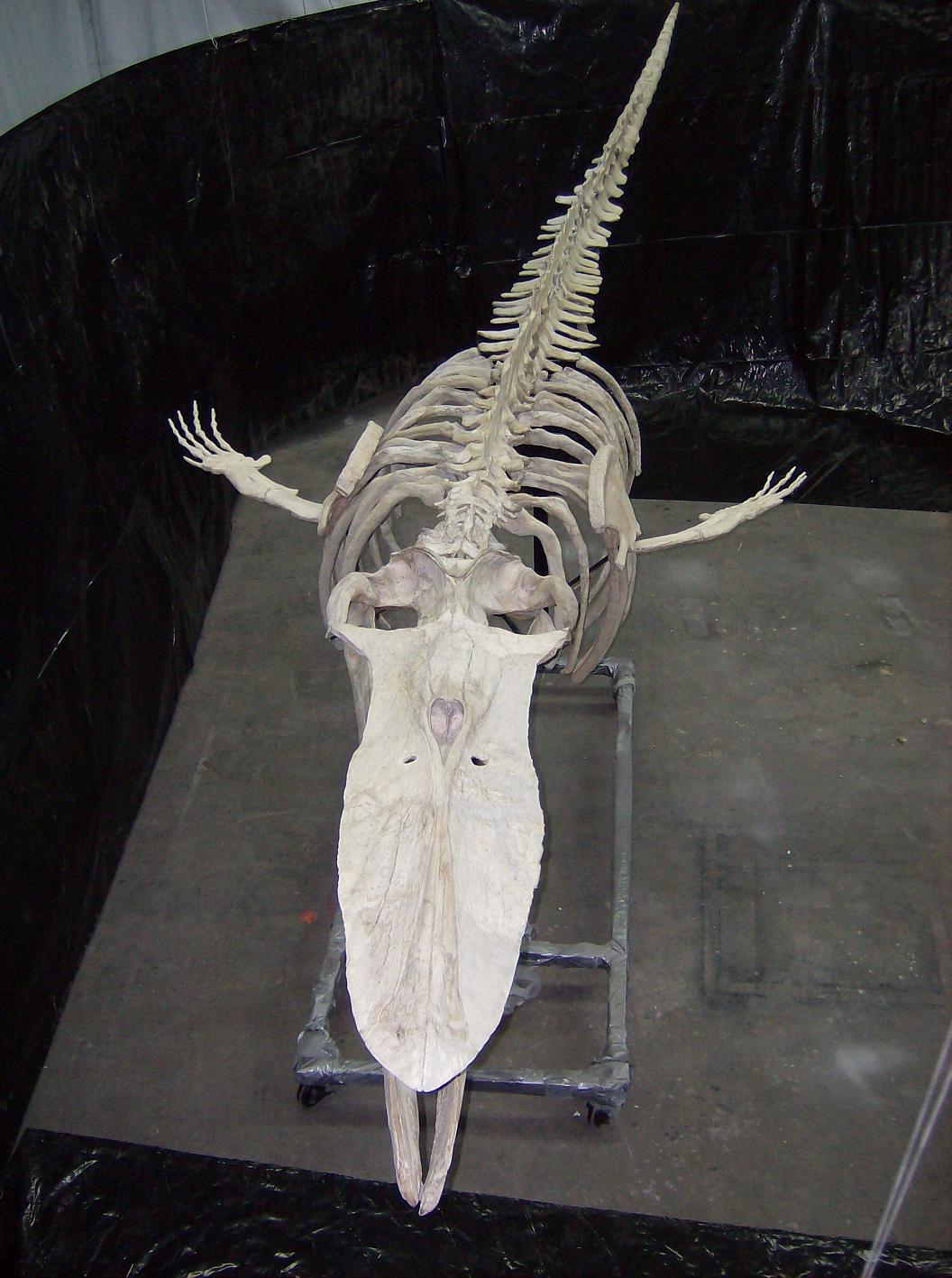
Zygorhiza kochii ("Koch's Yoke-Root") is an extinct species of cetacean. A Eocene Whale Skull & The Mississippi State Fossil
Zygorhiza was a smaller, less elongated, 6 m (20 foot) long relative of the famous Basilosaurus. Zygorhiza had flippers which could, unlike in modern cetaceans, be moved at the elbow. Its hind limbs were rudimentary. Zygorhiza's one-metre (3-foot) skull had fearsome jaws with deadly teeth. Unlike modern cetaceans, Zygorhiza had a neck consisting of seven vertebrae.