


Clock Chimes:
These are a few recordings from clocks I haven't yet added to the site. Once they've been photographed and organized on their own pages, these tunes will be moved with their respective pages. In the meantime, consider this a sneak peek!
Ingraham Black Mantle Clock
Chauncey Boardman Wooden Works Clock
About Me:
I mainly do clock repair in my spare time, as a hobby. Above are the links to my ever-growing clock collection. I actually decided to make this separate website entirely to share my clocks with the public, and with other collectors.
Clocks are my passion. I don't know exactly why, but I've loved old clocks since I was very young. My grandfather used to be a clock and watch repairman, so I like to think that the interest was passed down from him. Sadly he passed away when I was very young. It's too bad he isn't around, because I'm sure he could teach me a lot of interesting things about clock repair, and I'm sure he'd enjoy seeing some of my acquisitions. He mostly worked on watches, and I also have another great uncle who does watch repair (he lives far away in Quebec).
I purchase most of my clocks on eBay. I don't like to pay much, and I prefer to buy clocks that need a lot of TLC. Some of the clocks above were badly painted, or had very bad/peeling veneer or finish. Some just needed to be cleaned and oiled. I prefer early American clocks, especially anything pre-1860.
I owe a lot of my repair skills (and general clock interest) to my very good friend Larry. He is the one who encouraged me to disassemble and clean my first clock movement (which was a partially incomplete spare from mu grandfather's old things). Since then, I have cleaned and repaired MANY. I still have only limited tools (I have no gear-cutting equipment), but I am still able to do a fair amount of complex repairs. I would also like to thank all the nice people from the NAWCC message boards for answering a bunch of my clock related questions.
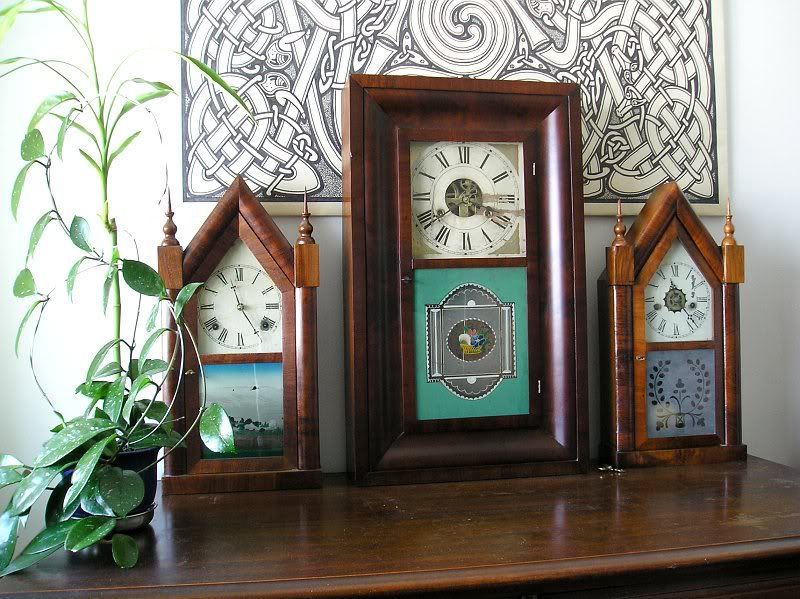
I always try to take a "do no harm" approach when it comes to clock repair. If I don't feel confident that I can repair a clock (due to a complex repair), I will leave it alone. I will only strip and refinish a clock if the original finish is very badly deteriorated. As much as possible, I like to stick only to original materials and techniques. This includes the use of hot hide glue, traditional shellac (applied with a brush, then hand polished), and fasteners like old slot head screws, and square nails.
When I clean a clock, I usually start with the case. If the case is in need of cleaning, refinishing, or repairs, I do that first. Then, once the case is ready (and free of dust) I will go ahead and clean the movement. It is especially important in clock repair, to make sure the case is free of dust (as much as possible), and any excess holes where dust could enter the case. Many clockmakers simply clean the movements without thoroughly cleaning the interior of the case, which is a quick and simple job.
For the most part, I don't own any fancy tools or use any high-tech equipment, just a lot of old fashioned 'elbow grease'. I use a mixture of ammonia and dish soap to clean all the clock parts, and polish (Brasso) for some the other pieces (pendulums, gong bases, etc). I also use very fine steel wool on metal parts, because it's important to remove any visible rust (or it will only spread to other parts).
I like to polish-up old screws, and reshape bent wires. I like to keep all the original parts of a clock (screws, washers, pins, etc), or find old replacement parts to use. Dials are kept in their original condition (unless they are too damaged, or badly flaking). I simply clean the painted dials with warm soapy water, using a soft cloth. In extreme cases, I've done dial restoration, and small touch-ups (which are tedious and require a lot of colour matching).
Contact Info:
If anyone wants more information on any of my clocks, wants to make an offer on clocks I have for sale, or is interested in contacting me for any other reason, you can e-mail me at: jcp_15@hotmail.com or track me down on the NAWCC message board (username: sooth), and leave me a comment or private message there.
