The comments came as US Secretary of State Condoleezza Rice began talks with European and Russian officials in Brussels on Iran's nuclear programme.
A US intelligence report published on Monday said Iran had suspended a nuclear weapons programme in 2003.
But the report also said that Iran was continuing to enrich uranium, which can be used to make nuclear weapons.
Iran says the aims of its nuclear programme are peaceful.
"Iran continues to represent a threat," Mrs Merkel said during a joint news conference with Mr Sarkozy in Paris.
She did not specifically express support for a new UN sanctions resolution against Iran, which the US is calling for.
"We and our partners would like to continue with the UN process," Mrs Merkel said.
"I think we and our partners need to continue to seek dialogue with Iran," she said.
Mr Sarkozy said he agreed with his German counterpart that Iran still posed a danger, and that he supported the push for more sanctions.
"Notwithstanding the latest elements, everyone is fully conscious of the fact that there is a will of the Iranian leaders to obtain nuclear weapons.
"What made Iran move up to now, it was sanctions and firmness," he said.
The National Intelligence Estimate (NIE) released on Monday reversed earlier statements on Iran by the Bush administration.
Iranian President Mahmoud Ahmadinejad called the US report a "great victory" for Iran.
Ms Rice, who was in Brussels to urge more international pressure on the Iranians to halt uranium enrichment, said they still needed explain a covert programme up to 2003.
"I don't see that the NIE changes the course that we're on," Ms Rice said while travelling to Brussels, AP reported.
His comments in Brussels contrasted sharply with those of French President Nicolas Sarkozy, who congratulated President Vladimir Putin on Monday.
The EU's Portuguese presidency said Sunday's parliamentary election failed to meet international standards.
The previous Polish government blocked talks on a new EU-Russia agreement after Russia imposed a ban on imports of Polish meat products.
Referring to the Russian election, Mr Tusk said "we should not in Europe be tolerant of a situation where certain democratic standards are being broken".
The EU statement on Tuesday echoed that criticism, noting that "there were many reports and allegations of media restrictions as well as harassment of opposition parties and NGOs" during the election.
It called on Russia to investigate the allegations about irregularities.
Mr Tusk received a warm welcome from the European Commission president, Jose Manuel Barroso.
Mr Tusk was critical of the Russian authorities' treatment of the opposition activist and former chess star Garry Kasparov, whom he described as "my political friend".
Mr Kasparov was detained during the election campaign and his party was prevented from taking part in the election.
But Mr Tusk added that he wanted ties between Warsaw and Moscow to improve.
Meanwhile, Mr Sarkozy's call to President Putin has angered human rights groups in France and the opposition Socialist Party.
In a significant change from the Eurosceptic stance of his predecessor Jaroslaw Kaczynski, Mr Tusk said there was no conflict between the interests of Poland and those of the European Union.
"Along with others who have fought for the European Union, I will stand up and defend the European interest as well," he said.
Our European Affairs correspondent Oana Lungescu says top EU officials were all smiles, welcoming Donald Tusk as a dedicated European and an old friend.
It was a marked contrast to Mr Kaczynski, who shocked the rest of the EU by demanding more voting rights in exchange for the 6.5 million Poles killed by Germans during World War II.
His government had also decided to opt out of a European charter of fundamental rights because it thought it would encourage gay marriages.
Mr Tusk said Poland could reconsider its position on the charter in the future, but only after ratification of the new EU Reform Treaty, of which the charter is part.
Mr Tusk has also been having talks with Nato officials about Russia and the controversial US missile defence system.
Jaroslaw Kaczynski agreed to have a missile interceptor base built in Poland and Mr Tusk's government says it wants to reassure Moscow about the project while working in partnership with its Nato and EU partners.
Russia and Poland will have their highest-level talks for more than a year when the Polish Foreign Minister, Radek Sikorski, meets his opposite number Sergei Lavrov in Brussels on Thursday.
Mr Sarkozy was recently attacked by some in Algeria over his refusal to apologise for France's colonial past.
Mr Sarkozy said both France and Algeria should fight "all forms of racism".
France invaded Algeria in 1830. An eight-year war of independence in the 1950s and 1960s cost hundreds of thousands of lives.
Mr Sarkozy expects to finalise a series of big business deals during the visit.
In a speech to Algerian business leaders, Mr Sarkozy condemned colonialism.
"Yes, the colonial system was profoundly unjust, contrary to the three founding words of our Republic: freedom, equality, brotherhood," he said.
"But it's also fair to say that inside the system, there were many men and women who liked Algeria, before having to leave it."
He said numerous crimes had been committed on both sides during Algeria's independence war from 1954 to 1962.
"The moment has come to entrust Algerian and French historians with the task of writing this page of tormented history together," Mr Sarkozy said.
A minister in Algerian President Abdelaziz Bouteflika's government attacked Mr Sarkozy last week, saying he had been elected thanks to the "Jewish lobby", alluding to the Jewish origins of his maternal grandfather.
Mr Bouteflika later said those comments did not reflect the official position.
Mr Sarkozy said on Monday: "There is nothing that more closely resembles anti-Semitism than Islamophobia. Both have the same face: that of stupidity and hate."
He has concentrated on the increasing economic ties between the two countries, expressing the hope of signing contracts worth 5bn euros (£3.55bn).
The contracts include billion dollar investments in the Algerian oil and gas business by the French energy companies Total and Gaz de France.
France is already the biggest investor in Algeria outside the energy sector.
Amsterdam city council ruled in March that the rotting 150-year-old tree must be felled as a danger to the public.
The tree won a first reprieve in October but the council issued an order last week for the tree to be chopped down on Wednesday morning.
Judge Jurjen Bade ruled on Tuesday that the tree posed no immediate danger and called for alternative measures to be explored.
He said that felling the tree should be a "last resort" and told the council to meet with conservationists to find a solution. They have until mid-January to come up with a plan.
A Utrecht-based firm, Trees Institute, has suggested a salvage plan involving treatment and support for the trunk and limbs, such as anchoring the tree with cables.
Spokesman Edwin Koot told Associated Press: "We finally get the possibility to have time to look into the alternatives and that is exactly what we have asked for so long already.
"This is a monumental tree of unusual cultural and historical value. It's a symbol of freedom all over the world and it summons forth a lot of emotion," he said.
The tree was a ray of hope for Anne Frank, the famous Jewish diary writer, as she hid in the attic of a canal-side warehouse.
As a teenager she remained indoors with her family for 25 months until they were arrested in August 1944.
She died of typhus in the Bergen-Belsen camp in March 1945.
The attic window from which Anne Frank could see the tree was the only one that had not been blacked out.
In an entry dated February 23, 1944, she wrote: "From my favourite spot on the floor I look up at the blue sky and the bare chestnut tree, on whose branches little raindrops shine, appearing like silver, and at the seagulls and other birds as they glide on the wind...
"As long as this exists, I thought, and I may live to see it, this sunshine, the cloudless skies, while this lasts I cannot be unhappy."
The 27-tonne tree is diseased with fungi and the owner wants it cut down as he would be liable for any damage caused should it fall.
The tree is adjacent to the building that now houses the Anne Frank Museum.
The Anne Frank House told Judge Bade it was in favour of felling the tree, out of concern for the safety of the building and the hundreds of thousands of visitors it receives each year.
The museum has taken grafts and wants to replace the tree with a sapling from the original.
He is due to address a joint session of Congress and hold talks with US President George W Bush.
Mr Sarkozy will also present the Legion of Honour, France's highest award, to several US citizens.
The two presidents are expected to discuss the issue of Iran's nuclear ambitions, about which officials say they are in close agreement.
Correspondents say the visit will help heal the divisions between the two countries that came to a head when France opposed the US invasion of Iraq in 2003.
The French president, who was elected in May and visited the US on holiday in August, is seen as more pro-American than his predecessor Jacques Chirac.
The BBC's Justin Webb in Washington says that the Bush White House increasingly sees President Sarkozy as its principal ally in efforts to halt Iran's nuclear programme.
However the French AFP news agency says there will be some areas of disagreement.
In his address to Congress, President Sarkozy will touch on environmental issues, and is expected to call on the US to take the lead in the fight against climate change.
Ahead of the meeting, he voiced concern about the weakness of the US dollar, saying "a strong economy should have a strong currency. You don't need a dollar too weak."
The new museum at Bergen-Belsen, in the north of Germany, highlights the fates of those who died at the camp during World War II.
Among the exhibits are the drawings and diaries of Jews imprisoned there, plus video statements by survivors.
Some 100 survivors were at the ceremony at the camp, where an estimated 50,000 Jews perished during the Holocaust.
The new exhibition is part of an effort to reconstruct the lives of those sent to Bergen-Belsen during the Nazi occupation of Europe.
It contains photographs, prisoners' records and objects donated by the survivors.
"Use of the new material makes it possible to faithfully recreate the history of the camp," said Christian Wulff, governor of the state of North-Rhine Westphalia.
"The genocide of Europe's Jews - a crime against humanity of unimaginable proportions - will now and forever keep its paramount place within the German memory," German Culture Minister Bernd Neumann said as he opened the museum.
Liberated by Allied troops in 1945 and later razed, Bergen-Belsen began life as a prisoner of war camp.
From 1943 until the end of the war it was a concentration camp for Jews, gypsies and homosexuals, with an estimated 125,000 people held there.
He said EU nations were not arresting or extraditing PKK members.
Turkey has regularly asked countries to do more against the PKK, which the EU regards as a terrorist group.
Mr Erdogan was speaking after talks between Turkey and Iraq ended without progress on Iraqi proposals to stop PKK attacks on Turkey from Iraq.
Turkey has warned it will not tolerate more cross-border raids and has massed troops along the border.
Hundreds of people held demonstrations in Turkish cities on Saturday,
condemning the PKK and calling for action.
Mr Erdogan questioned the sincerity of EU nations on the PKK issue.
"No EU country has extradited members of the PKK to Turkey, despite labelling it as a terrorist organisation," Mr Erdogan said on Turkish TV.
He did not mention any European nation by name.
But he did refer to a recent disagreement with Austria over its refusal to arrest a senior PKK member who then boarded a plane to northern Iraq, AFP news agency reported.
Talks in the Turkish capital Ankara between Turkish and Iraqi officials were aimed at heading off military action by Turkey's armed forces across their common border, after a series of attacks on Turkish troops by rebel Kurdish fighters based in northern Iraq.
But the talks ended without progress on Friday and no further meetings were planned.
The Iraqi delegation said the proposals put forward were practical, realistic and feasible, according to the BBC's Jim Muir in Baghdad.
The proposals included using multinational forces - presumably Americans - to monitor the border, the rehabilitation and strengthening of old Iraqi border posts, the closure of what it called illegal bases and steps to dry up the PKK's finances, our correspondent says.
Turkey had said the Iraqi proposals would have taken too long to take effect.
Turkey wants the PKK's mountain bases in the far north of Iraq closed and the leadership handed over.
Mr Erdogan is due to meet US President George W Bush in Washington on 5 November.
A senior Turkish general suggested that Turkey's threat to launch a ground offensive into Iraq would not be carried out before that meeting.
"The armed forces will carry out a cross-border offensive when assigned," NTV television quoted General Yasar Buyukanit as saying on Friday.
"Prime Minister Erdogan's visit to the United States is very important, we will wait for his return."
Turkish military and civilian leaders have also recommended economic measures against northern Iraq, which relies heavily on Turkey for food and electricity.
The PKK - which is designated a terrorist organisation by Turkey, the US, and the EU - is thought to have about 3,000 rebels based in Iraq.
The agreement in Lisbon was sealed shortly after midnight after objections from Italy and Poland were overcome.
The treaty is designed to replace the European Constitution that was rejected by French and Dutch voters in 2005 and will be formally signed on 13 December.
It includes the creation of a new longer-term president of the European Council and an EU foreign policy chief.
If ratified by all member states, the treaty will come into force in 2009.
In the last-minute negotiations, Italy gained an extra seat in the future European Parliament, returning it to parity with the UK and restoring Italian national pride, the BBC's Oana Lungescu in Lisbon says.
Poland got guarantees that a small group of countries would be able to delay EU decisions they do not like - a victory for the Polish government just days before Sunday's early parliamentary election, our correspondent adds.
Earlier, Austria reached a deal over its bid to maintain quotas for foreign students, with the European Commission agreeing to suspend for five years its legal action over Austria's quota.
Bulgaria also won the right to call the EU single currency the "evro", rather than euro, in its Cyrillic alphabet.
The new Reform Treaty is designed to speed up decision making in the expanded European Union. It will also create a new president of the European Council, a new EU foreign affairs chief, a reformed voting system and scrap vetoes in dozens of areas.
However, the 250-page document has been stripped of any trappings of a super-state, such as the mention of the EU anthem and flag.
It amends, rather than replaces, existing EU treaties, a point which some countries - notably the UK - have argued means there is no need for national referendums on the document.
After the agreement was reached, Jose Socrates, the prime minister of Portugal, which holds the rotating presidency, said Europe had emerged from an "institutional crisis".
"With this treaty, Europe is showing that the European project is on the move. Now we can look forward to the future with confidence," he added.
European Commission President Jose Manuel Barroso said the treaty was a "great achievement".
"I believe we have a treaty that will give us now the capacity to act," he said.
"Our citizens want results. They want to see in concrete terms what Europe brings them in their daily lives."
Correspondents say the UK government had little to say in this round of negotiations.
Prime Minister Gordon Brown said the UK's "red lines", which his government had declared around various policy areas, had been secured.
On Thursday, Mr Brown once again ruled out a referendum on the treaty.
A poll published earlier showed a majority of people in the EU's five biggest countries, including the UK, would like to have a say.
"We believe they have been kidnapped together with two Afghans," the defence ministry said in a statement, adding that a search was under way.
Contact was lost after the men crossed a police checkpoint in Herat province.
An Afghan driver and interpreter were with the soldiers at the time but have since returned to Herat city and are to be questioned by police, reports say.
The four had driven through a police checkpoint in the Shindand district of Herat province on Saturday before all contact was lost, said Gen Ali Khan Hassanzada, chief of police criminal investigations in western Afghanistan.
The Italian defence ministry said the military personnel were "carrying out liaison activities with local civilian authorities".
There is some speculation that the Italians were intelligence officials but this has not been confirmed, the BBC's Charles Haviland reports from Kabul.
An Italian embassy official in Kabul said the two men last spoke with officials at their base late on Saturday during "routine contact".
Officials in Rome said the families of the men had been notified.
Western Afghanistan is a relatively safe area, our correspondent says.
But Shindand district has become more volatile as it borders a province where the militant insurgency has been on the rise, he adds.
Earlier reports, later corrected, had said the two were journalists.
In March, Afghan President Hamid Karzai was criticised for making a deal with the Taleban to free kidnapped Italian journalist Daniele Mastrogiacomo.
Italy has more than 2,000 troops in Afghanistan, many of them based in the west.
Dutch cabinet rules out EU vote

The Dutch cabinet has decided against holding a referendum on the EU's new Reform Treaty, amid fears the public would reject it at the polls.
Voters in the Netherlands and France rejected the treaty's predecessor - a proposed European constitution - two years ago, plunging the EU into crisis.
Reports had indicated the Dutch public would vote against the new treaty too.
The decision on a referendum now goes before the Dutch parliament, where many MPs are said to favour a public vote.
The 2005 referendum, effectively scuppering the proposed constitution, was held at the initiative of parliament, rather than the government.
The lower house of parliament is believed to have a majority that favours a referendum, while the upper house is against the idea.
Labour split
Dutch Prime Minister Jan Peter Balkenende, of the Christian Democrat party, said the new treaty did not propose constitutional changes and therefore did not require a referendum.
"This is a normal change of treaty and only needs a normal procedure to approve it," he said.
He said on Friday that the entire cabinet had backed the decision against holding a referendum.
Two of the three parties in the Dutch governing coalition had opposed a referendum on the new treaty, but a third, the Labour Party, was split over the issue.
Although the Labour party supports the EU Reform Treaty, a faction within it has argued that the views of the public must be taken into account before the document is adopted.
BBC Europe editor Mark Mardell says it is expected that some policies unpopular with the Labour Party will soon be dropped, in return for Labour ministers having given their consent to the decision against holding a referendum.
A Dutch decision in favour of holding a referendum on the EU Reform Treaty would have put fresh pressure on the British and Danish governments to do the same in their countries.
Both London and Copenhagen have been eager to avoid plebiscites on the new EU Reform Treaty.
France approves immigration curbs

The French National Assembly has passed a controversial bill tightening entry conditions for the relatives of immigrants living in France.
Under the legislation, the relatives will have to prove they are solvent financially and can speak French.
It also includes plans for DNA testing of foreigners seeking to join family members living in France.
But the new bill has been criticised by some members of President Nicolas Sarkozy's centre-right government.
The legislation would require immigrant family members older than 16 to take a test in their country of origin, demonstrating a good knowledge of French language and values.
Applicants would also have to prove that their family in France could support them and earn at least the minimum wage.
Deportation quotas
If immigration officials doubt that an applicant is a genuine relative of the person they seek to join, they could be asked to take - and pay for - a DNA test to prove a biological link.
An amendment to the bill on these tests says they will be carried out for a trial period of only two years.
The legislation was "fair" and would provide "tools to fight against illegal immigration", Eric Ciotti, an MP from Mr Sarkozy's centre-right UMP party, told Reuters news agency.
But Foreign Minister Bernard Kouchner, a socialist, and Martin Hirsch, a campaigner for the homeless who joined Mr Sarkozy's government, criticised the measure.
The opposition voted against the bill, which will be debated in the Senate next month.
The UMP and its allies have a majority in both chambers.
Mr Sarkozy has set up deportation quotas, promising to send home 25,000 illegal immigrants this year alone.
EU anti-death penalty day vetoed

Poland has blocked plans to hold a European day against the death penalty, the EU's Portuguese presidency says.
It says Warsaw rejected the idea at a meeting of ministers in Brussels, arguing that any such event should also condemn abortion and euthanasia.
The EU, where the capital punishment is outlawed, had planned to mark the anti-death penalty day on 10 October.
Poland's conservative government has in the past called for a re-opening of the debate on capital punishment.
The European Commission said a conference scheduled to launch the EU day against the death penalty would still go ahead on 9 October.
But with Poland digging in its heels, delegates may find the debate is livelier than they had expected, the BBC's Alix Kroeger in Brussels says.
'Broader approach'
"Unfortunately, it was not possible to find a consensus among all the 27 [EU] member states," Portuguese Justice Minister Alberto Costa told reporters after the Brussels meeting of EU justice and interior ministers.
EU officials also confirmed that Warsaw alone objected to the move.
Polish Deputy Justice Minister Andrzej Duda said that the EU "should approach the subject in a broader way and debate the protection of life".
"The death penalty is only one element of the debate; there are more - for example, abortion and euthanasia," he said.
This is the latest in a series of political clashes between Brussels and Warsaw, on everything from homosexuality to environmental protection, our correspondent says.
She says that Poland's junior coalition partner, the ultra-conservative League of Polish Families, wants to bring back the death penalty for paedophiles.
Polish President Lech Kaczynski last year called on EU member states to reintroduce the death penalty.
Poland, along with Ireland and Malta, are the only members where abortion is illegal.
Poland's Roman Catholic clergy and politicians have described the practice of euthanasia in countries such as the Netherlands as a "culture of death".
The latest row comes as Poland prepares for early general elections on 21 October.
Charges over Austria Nazi salutes

The Austrian army has charged three conscripts in connection with a video posted on YouTube showing young soldiers exchanging Nazi salutes.
Two men can be seen in the footage. The third is suspected of having filmed them on his mobile phone.
Those seen doing the salutes will also be taken out of military service.
Any display of Nazi propaganda or symbols is a crime in Austria. Defence Minister Norbert Darabos said there was "zero tolerance" for such actions.
The footage is said to have been filmed at an army barracks in the western city of Salzburg.
In one video posted on Monday, a man in uniform is seen stretching his arm into a Nazi salute while another one shouts "Heil Hitler!"
A second, similar video showing the two conscripts appeared on Wednesday.
Both videos have now been removed from YouTube.
The men could face up to 10 years behind bars if found guilty.
'Casual lunch' for Bush, Sarkozy

US President George W Bush welcomed his French counterpart, Nicolas Sarkozy, to his family home in Maine on Saturday for an informal lunch and boat ride.
Officials stressed the meeting was not a summit but instead a chance for the two men to get to know each other over hot dogs and hamburgers.
France's former President Jacques Chirac's opposition to the Iraq war saw Franco-US relations fall to a new low.
But Mr Sarkozy has made it clear that he will adopt a more pro-US stance.
Mr Bush praised Mr Sarkozy as he waited with his wife and parents on the lawn of the family home in Kennebunkport, on the Atlantic seaside.
"The good thing about President Sarkozy is you know where he stands," Mr Bush told reporters.
Before the lunch, Mr Sarkozy, who is on holiday in America, said he admired the US as "a great democracy, a country of freedom".
He called the US a "close friend", comparing France's relations with it to a family which sometimes had disagreements.
"Do we agree on everything? No.
"Even within the family there are disagreements but we are still of the same family and we may be friends and not agree on everything but we are friends nevertheless. That's the truth."
Despite protestations that the meeting was just a casual lunch, some observers remarked that it was impossible to imagine Mr Bush issuing a similar invitation to Mr Chirac.
In addition to the Iraq war, disagreements over trade and climate change further strained the relationship between Mr Bush and Mr Chirac.
In contrast, Mr Sarkozy made it clear from the outset of his presidency that America could count on his friendship.
US officials have pointed out that the countries are already working closely on issues such as Iran, Lebanon and Sudan.
Hot dogs and hamburgers
The lunch included hot dogs and hamburgers, as well as corn-on-the-cob, baked beans, and fresh blueberry pie.
No mention was made of whether french fries were on the menu. Some Americans started calling chipped potatoes "freedom fries" after Mr Chirac opposed the 2003 invasion of Iraq.
The French president's wife, Cecilia Sarkozy, was meant to be at the lunch but phoned First Lady Laura Bush to say she and her children were feeling unwell and would not attend.
After lunch, President Bush and his father, former President George Bush, took Mr Sarkozy for a 30-minute boat ride.
The Sarkozys have been on holiday in nearby New Hampshire, although Mr Sarkozy briefly returned to France for the funeral on Friday of Cardinal Jean-Marie Lustiger.
Mr Sarkozy's decision to take a holiday in the US has led to some negative comments at home, especially from critics who believe he would like to see the French economy overhauled to follow the American free market model.
Only one other foreign leader has been invited by President Bush to his family's home in Maine. Russian President Vladimir Putin went there in July for an informal meeting that was dubbed the "lobster summit".
Libya and EU seek improved ties

Libya and the EU have said their ties will improve following the release of six Bulgarian medical workers.
The six had been imprisoned for deliberately infecting children with HIV and are now celebrating their freedom in Bulgaria.
They were released on Tuesday following years of negotiation.
French President Nicolas Sarkozy is to meet Libyan leader Muammar Gaddafi in Tripoli, where he is expected to sign agreements on bilateral co-operation.
The five nurses and a Palestinian-born doctor, who served eight years of the life sentences they received, had always maintained they were innocent.
All six were pardoned on their arrival in Sofia by Bulgarian President Georgi Parvanov.
'New page'
Europe and the United States had made it clear to Libya that resolving their situation was the key to improving ties.
There are reports that Mr Sarkozy could sign agreements on security, immigration, energy and scientific research.
Mr Sarkozy wants to further Libyan help in the fight against terrorism, says the BBC's Emma Jane Kirby in Paris.
And he wants more support in to stem the flow of illegal immigrants crossing into southern Europe from North Africa.
The six medics were flown from Tripoli to Sofia early on Tuesday at the end of a three-day trip to Libya by Mr Sarkozy's wife Cecilia and the EU's External Affairs Commissioner Benita Ferrero-Waldner.
Ms Ferrero-Waldner said it marked "a new page in the history of relations between the EU and Libya".
European Commission President Jose Manuel Barroso said the EU could now begin to normalise trade and political ties with Libya.
Compensation confusion
Mr Sarkozy and the EU denied making any financial payment to secure the medics' release.
However, the families of the 438 infected children reportedly agreed last week to a compensation deal worth $1m (£500,000) per child, channelled through the Gaddafi Foundation, a charity run by Seif al-Islam, the Libyan leader's son.
Libya's foreign minister said both the EU and France had contributed to the fund, AFP reported.
The medics were convicted of deliberately injecting the 438 children with HIV-tainted blood. Fifty-six of the children have since died.
The six, who had been in prison since 1999, say they were tortured to confess.
Foreign experts say the infections started before the medics arrived at the hospital, and are more likely to have been a result of poor hygiene.
Turkey unhappy at EU talks delay

Turkey has said it is not satisfied with the EU's reasons for not opening membership talks in the area of economic and monetary policy.
The talks were delayed because France signalled objections, reflecting President Nicolas Sarkozy's opposition to Turkey joining the European Union.
But membership negotiations were started in two other areas on Tuesday.
Turkey's chief negotiator, Ali Babacan, said Ankara hoped the problems would be overcome in the next six months.
"We are not satisfied with the technical justifications that were given to us and we hope that there will be progress in this matter during the Portuguese presidency," he said.
Turkey and the euro
Germany, which will hand the EU presidency over to Portugal on 1 July, had hoped to make more progress with the negotiations during its six months in charge.
The BBC's Oana Lungescu in Brussels said France's decision to delay the talks on economic and monetary policy was intended to demonstrate that Mr Sarkozy was keeping an election promise to keep Turkey out of the EU.
A French diplomat said discussing monetary union with Turkey implied that Turkey could one day adopt the euro.
Croatian breakthrough
There are 35 policy chapters which must be successfully negotiated before a country can join the EU.
Turkey now has four chapters under way.
Croatia, which began membership talks at the same time as Turkey, opened six more chapters at Tuesday's talks, bringing its total to 12.
Croatia seems well on track to become the EU's 28th member by the end of the decade, our correspondent says, provided it continues reforms and tackles corruption. But Turkey's bid, she says, seems to go from crisis to crisis.
The EU suspended negotiations on eight chapters last year, after Turkey failed to open its ports and airports to traffic from EU-member Cyprus.
It has decided that chapters not linked to trade policy can still be opened, but not closed until the Cyprus issue is resolved.
EU treaty 'in Britain's interest'

The treaty agreed by EU member states is "quintessentially" in Britain's interests, Tony Blair has said.
The prime minister told MPs the government had achieved a "leadership position" within Europe.
The treaty, expected to be finalised later this year, preserves much of the planned EU constitution, rejected by Dutch and French voters in 2005.
Conservative leader David Cameron said Mr Blair had "broken" a promise to hold a referendum.
He accused the prime minister of handing powers to the EU "without the permission of the British people".
'Completely protected'
The treaty gives an opt-out on a human and social rights charter and keeps an independent foreign policy and tax and benefit arrangements.
Mr Blair, in a statement to the Commons, said the UK's social security and benefits system was "completely protected".
The EU's powers to set "substantive" foreign policy would not be extended, he added.
"The new treaty will confirm for the first time explicitly that national security is the sole responsibility of nation states," Mr Blair said.
The treaty is planned to replace the failed EU constitution.
Mr Blair and his successor Gordon Brown insist a referendum is not required because Britain's "red lines" - control over human and social rights, foreign policy and tax and benefits - have not been crossed.
However, Irish foreign minister Dermot Ahern has said it is "likely" a public vote will be held there.
'Flagrant'
Mr Blair had pledged to hold a referendum on the constitution but the government says the changes included in the Reform Treaty are not significant enough to warrant one.
Amid noisy scenes, Mr Blair told MPs: "Over the past 10 years Britain has moved from the margins of European debate to the centre. This is absolutely right for Britain."
He added: "Britain has for a decade been in a leadership position in Europe. That is exactly where we should stay."
But Mr Cameron said Mr Blair had sanctioned the transfer of powers from Britain to Brussels "without the permission of the British people".
He added: "This will be remembered as one of the most flagrant breaches of any of the promises you have made."
Liberal Democrat leader Sir Menzies Campbell said: "Listening to the prime minister today it was still unclear whether his principle aim in negotiating this treaty was the national interest or appeasement of the eurosceptic press.
"Having drawn up artificial 'red lines', he has flown home to trumpet a disingenuous victory in defending them."
EU chiefs 'satisfied' with treaty

EU leaders have expressed measured approval of a draft treaty to reform EU systems agreed at a summit in Brussels.
German Chancellor Angela Merkel hailed a good compromise with Poland over planned changes to voting rights, which proved the key to the final agreement.
French President Nicolas Sarkozy said Europe was moving again, while British PM Tony Blair said the EU could now concentrate on issues of real concern.
The treaty, to be finalised later this year, will come into force in mid-2009.
Following marathon discussions which were at times on the brink of failure, leaders from the 27-member bloc emerged smiling at dawn on Saturday to announce the results.
Having led the negotiations and brokered the compromise, Ms Merkel, the current EU president, said: "We are very, very satisfied with what we have been able to conclude."
Poland's President Lech Kaczynski, whose objections to proposed voting rights almost de-railed the summit, said his country would now be able to co-operate better with its partners.
"We really were fighting but we also encountered solidarity. The striving for success was something that was observed on everybody's part and Poland understood this," he said.
The new treaty preserves much of the planned EU constitution, which was rejected by French and Dutch voters during referendums in 2005.
It will need to be ratified by each of the EU's member states.
Tony Blair said that the arduous process had shown why the treaty was needed - to streamline EU mechanisms which were not designed for the current number of states.
Mr Sarkozy said the treaty was crucial for the future, adding that there were no winners or losers.
"The mandate is clear and precise and the dates are fixed. And you will now have a Europe with institutions. This is a very important message," he said.
'Double majority'
Mrs Merkel conceded the talks had been hard - with Poland, the UK and the Netherlands each staunchly defending their interests.
The main obstacle had been Poland's demand to keep its voting power, which is currently almost equal to that of Germany's, even though its population is only half as large.
The new system - known as a "double majority" - will now be phased in beginning in 2014 and fully implemented three years later.
Under this system, a 55% majority of EU countries with at least 65% of the bloc's population will be required for a change to be approved.
Britain and the Netherlands also got what they wanted from the summit.
Mr Blair wanted to ensure the Charter on Fundamental Rights would not alter British law, and to maintain national control over foreign policy, justice and home affairs.
The Netherlands, too, was satisfied that the role of national parliaments in Europe is to be strengthened and the criteria for new members joining the EU are included in the treaty.
Poland pressed on EU treaty deal

Germany's chancellor has threatened to call a conference on a draft EU treaty without Poland's consent, if Warsaw does not compromise on voting reforms.
Angela Merkel's spokesman said Poland would have "an opportunity to join the consensus" later this year.
A preliminary agreement struck in Brussels with the Polish President, Lech Kaczynski, was blocked by his twin brother Jaroslaw, the prime minister.
Speaking on Polish television, Jaroslaw Kaczynski said talks "had hit a wall".
The original treaty perished when Dutch and French voters rejected it in 2005.
'Red lines'
Despite intensive debate during the ongoing two-day summit, the Polish government has refused to budge on its demand for a radical rethink of the proposed voting system.
Mrs Merkel, who holds the EU presidency until the end of June, said that in the light of the Polish rejection it was important to take action to avoid "leaving Europe to mark time".
The BBC's Johnny Dymond in Brussels says the move by the German government is a sign of their frustration.
The inter-governmental conference is the body that is charged with drafting the EU's reform treaties, traditionally created with the unanimous agreement of member states.
To do so without Poland's agreement is almost inconceivable, our correspondent says.
Diplomats are being very cautious about the German proposal, described as quite premature by one, while others say the suggestion is designed simply to put pressure on Poland.
Various solutions have been offered to try to overcome Poland's objections to the new voting system, which Warsaw says would give too much influence to Germany.
As President Kaczynski continued tough talks in Brussels, his twin brother said the offer on the table, that would have delayed introducing a new voting system for seven more years, was "far too little to be acceptable".
Speaking live on Polish television, Jaroslaw Kaczynski said Poland was open to compromise but that "one cannot give way all the time".
'Fresh crisis'
Britain meanwhile, seen as the other problem country, is also trying to get water-tight guarantees that the Charter of Fundamental Rights, which could give workers extra rights to strike, will not apply to the UK.
Britain also wants to maintain national control over foreign policy, justice and home affairs.
Earlier, the UK and others asked for clarification on why reference to the EU's commitment to free competition had been dropped from the draft treaty at the request of the French.
"The notion that this in any shape or form changes the legal basis of the internal market and the way the European economy works and the Commission's powers in relation to it is wrong," said Mr Blair, adding that a protocol would be added to the treaty.
EU leaders have struck other compromises, including the job title of a new EU foreign policy chief.
The post-holder will not be called a minister, as in the European Constitution, but High Representative of the EU, and will combine the job of the vice-president of the European Commission, which comes with a significant aid budget and staff.
A draft treaty submitted for debate at the summit makes several concessions to EU member states that had opposed key parts of the planned constitution.
EU leaders grapple with reforms

European Union leaders are meeting in Brussels, where they are struggling to reach agreement on new ways to run the 27-member bloc.
Germany, which holds the EU presidency, has called for a treaty to replace a planned constitution that was rejected by French and Dutch voters in 2005.
The UK and Poland are both threatening to use their vetoes.
The UK opposes any growth of EU powers, while the Poles are resisting plans to reduce their voting rights.
A draft paper tabled by Germany makes several concessions to EU member states opposed to key parts of the failed constitution.
But both the British Prime Minister Tony Blair - attending his final EU meeting before leaving office next week - and his Polish counterpart have taken a hard line.
Touchy subject
Poland's Prime Minister Jaroslaw Kaczynski has suggested that his country deserves a greater share of voting rights than it is being offered under the current draft.
He said Poland was disadvantaged because of the millions of Poles killed by Nazi Germany during World War II.
Under the current system Poland has just two fewer votes than Germany, but under the proposed treaty Warsaw would have a much smaller share because EU votes would be linked to population.
Mr Kaczynski argues that his country would be a much larger country now if not for the war, and should therefore qualify for stronger voting rights.
Mr Blair has set out a number of "red lines" which the UK government regards as unacceptable.
These include proposals to make the EU Charter of Fundamental Rights legally binding.
Agreement urged
European Commission President Jose Manuel Barroso has warned all member nations to be open to a compromise, and has suggested that the draft treaty would be a "good deal" for the UK.
The German draft paper removes any mention of the word "constitution", accepts that the title of EU-wide foreign minister will not be used, and provides countries with a chance to opt out of EU policies in the area of policing and criminal law.
The Netherlands and the Czech Republic also have concerns about the treaty.
German Chancellor Angela Merkel says every member nation will have their issues addressed at the summit.
But she too urged leaders to move towards a deal.
"Many are watching us, not only in Europe," she said.
"It is important that we don't drag on too long and that we make every effort to reach an agreement."
Correspondents say failure will plunge the EU into a fresh crisis as deep as the one that followed the rejection of the constitution two years ago.
In one early decision, leaders agreed to allow Cyprus and Malta to adopt the European single currency, the euro, beginning in January 2008.
EU to drop idea of constitution

Germany has proposed to EU states that they should agree to drop the idea of a constitution when they meet at a summit in Brussels on Thursday and Friday.
The "constitutional concept... is abandoned", says a paper circulated by Germany, which will chair the summit.
The paper makes several concessions to EU member states opposed to key parts of the failed constitution.
But Poland and the UK are still warning they could use their vetoes if they do not get their way on a new treaty.
Polish Prime Minister Jaroslaw Kaczynski said a veto remained "highly likely" while UK Foreign Secretary Margaret Beckett said no deal was better than a bad deal.
Mrs Beckett told Parliament: "If it comes down to deal or no deal at this European Council the UK government is clear... no deal is better than buying any old pig in a poke."
She added that Britain wanted a Europe "of sovereign nations, not a superstate".
The summit is intended to issue a mandate for an intergovernmental conference to agree the precise wording of a treaty to replace the failed constitution.
If it fails, it will plunge the EU into a political crisis as deep as the one that followed the rejection of the constitution by French and Dutch voters two years ago.
The German paper proposes that the new treaty is called "The Reform Treaty", accepts that the EU will not have a "foreign minister", and provides countries with a chance to opt out of EU policies in the area of policing and criminal law.
Correspondents say the biggest remaining problem for the UK could be Germany's continued support for the idea of making the EU's Charter of Fundamental Rights legally binding.
The UK fears this could allow the European Court to make decisions that would change British labour law.
Olive branch
The part of the constitution that Poland most disliked - the introduction of a new voting system for decisions taken by member states - is preserved in the latest German proposals, seen by the BBC.
However, the BBC's Oana Lungescu in Brussels says the German paper offers Poland a "discreet olive branch".
For the first time it mentions, in a footnote, that the Poles, backed by the Czechs, want to raise the idea of changing the voting system at the summit.
The new system would benefit larger member states to the detriment of smaller and medium-sized ones, and have the effect of reducing Poland's clout.
Despite his warnings of a possible veto, Mr Kaczynski hinted Poland could drop its opposition if it guaranteed a strong voice in EU decision-making.
"We realise we cannot stop the process [of reform] - that would be too risky for the future," Mr Kaczynski told Reuters news agency.
He said there was a 50-50 chance of the summit ending in agreement.
Under the latest German proposals, Britain gets reassurances that the European Courts will have no power to examine foreign affairs policies.
And at the request of the Dutch, the draft gives more power to national parliaments to block EU laws.
But a Dutch proposal to enshrine criteria for further enlargement in the treaty, is not fully satisfied.
That would send a very negative signal to Balkan countries, an EU diplomat said.
Warning to EU members over treaty

European Commission President Jose Manuel Barroso has told EU members not to block progress towards an EU treaty.
Mr Barroso warned against taking a tough line into negotiations, telling member states that opposition to the treaty was not in their interest.
The UK and Poland are opposed to key elements of the treaty, with Warsaw against changes to voting rules.
France and Spain have proposed a 10-point document backing an expansion of EU powers.
Germany, which holds the rotating EU presidency, has aimed to put core elements of the aborted 2005 EU constitution at heart of a new agreement.
However, British and Polish objections have dominated the build-up to two days of negotiations at the end of this week.
Mr Barroso did not refer to the UK or Poland directly, but refused to deny that their opposition was causing problems.
"It is not in the interest of any member state to be in a position that is seen as hardliner," he said in Brussels.
"The environment for a deal is clearly there. Please avoid appearing as blocking. This is not intelligent, this is not in your interest.
"Defend your positions, but don't come with these red lines and vetoes."
Objections
UK Prime Minister Tony Blair has listed four so-called "red lines" that the British government insists it will not cross during negotiations.
They are: a Franco-Spanish call for a Charter of Fundamental Rights; and EU-wide legislation on foreign policy, common law and tax and benefits.
Mr Blair's successor-in-waiting, Chancellor of the Exchequer Gordon Brown, said on Tuesday that he was confident the UK would get what it was seeking from any treaty.
Polish Prime Minister Jaroslaw Kaczynski said Warsaw's pursuit of a greater share of voting rights was not negotiable, adding: "There is no plan B."
But Mr Barroso issued a coded warning to Poland, a new EU member, saying newcomers had a responsibility to help bridge divides within the union.
"It will be in their interest for them to show that their membership of the European Union is not making European Union life more difficult but, on the contrary, they are giving more impetus to the European Union," he said.
EU moves to ban cat and dog fur

The European Parliament is set to back a ban on cat and dog fur imports, in a move to reduce the two million cats and dogs slaughtered in China each year.
MEPs say shoppers buy goods made with the fur unknowingly, because exporters attach false labels.
It is used in coats, linings for boots and gloves, stuffed toys, and even homeopathic aids for arthritis.
MEPs have agreed with EU member states on the text of the law, which will come into effect by December 2008.
"Many people are unwittingly deceived into buying garments made out of cat and dog fur due to mislabelling. This law will put an end to these deceptive practices," said Labour MEP Arlene McCarthy.
Conservative MEP Struan Stevenson, said: "Slaughter of these animals is horrific, with cats strangled outside their cages as other cats look on.
"Dogs noosed with metal wires are slashed across the groin until they bleed to death as the wire noose cuts into their throat."
DNA tests
 Liberal MEP Liz Lynne said a Europe-wide ban would add weight to bans already in force in several EU member states and the United States.
The legislation was initiated by the European Parliament, more than half of whose members signed a written declaration supporting a ban in December 2003.
The European Commission then drafted a regulation in 2006.
It aims to:
- Block cat and dog fur imports at the border
- Introduce penalties for traders
- Encourage sharing of information on how to detect cat and dog fur
The Commission says the obligation on member states to carry out checks and test for the fur will also provide a clearer picture of what products it is being used in, and where it comes from.
Main markets
As cat and dog fur can be hard to detect when it is dyed, some states are already using hi-tech systems - mass spectrometry or DNA testing - to identify it.
Europe and Russia are reported to be the main markets for the cats and dogs killed in China and some other Asian countries.
David Neale, UK director of Animals Asia Foundation, said the ban would stop hundreds of thousands if not millions of animals from being killed.
Ministers from the EU member states will need to give the ban their approval, but are not expected to reject it, following an informal agreement with the parliament on the text.
Sarkozy party wins in French poll

President Nicolas Sarkozy's centre-right party has won a majority in parliamentary elections in France, according to early poll projections.
But his UMP party fell far short of the landslide majority it was predicted to win in the second-round vote.
The opposition Socialists fared better than expected, the early results said. Voter turnout was low, at about 60%.
The results will be seen as a minor setback for Mr Sarkozy's party, says the BBC's Caroline Wyatt in Paris.
However, a major blow for the UMP was the defeat of former Prime Minister Alain Juppe, who was made energy and environment minister in the new government after Mr Sarkozy's election.
Mr Juppe said he would offer his resignation. Mr Sarkozy has insisted that any minister would have to leave the government if they failed to be elected.
But the victory gives Mr Sarkozy enough room to start pushing his reforms through parliament, our correspondent says.
Mr Sarkozy has promised to give universities more autonomy, impose tougher sentences on repeat offenders, tighten immigration, make labour laws more flexible and reduce taxation.
'Coherent choice'
The UMP and allied parties would win around 340 seats, according to polling institutions, down from 359 in the previous parliament.
Socialists and their allies were braced for up to 233 seats in the 577-member National Assembly, up from 149.
The centrist Democratic Movement, founded by presidential candidate Francois Bayrou, was expected to win just two seats. The far-right National Front party was not expected to win any seats.
French Prime Minister Francois Fillon said the result gave Mr Sarkozy a strong mandate to introduce his reforms.
"Your participation has resulted in a clear and coherent choice, which will allow the president of the Republic to implement his project," he said.
Royal split
The leader of the Socialists, Francois Hollande, said the result was "good for the country".
"The blue wave that had been predicted... has not taken place. In the new assembly, there will be diversity and pluralism," he said.
He also described the result as an indictment of "unfair measures" set to be introduced by the UMP such as raising sales taxes from 19.5% to 24.5% to finance healthcare costs.
The Socialists' results are a relief to the party, which has been riven by infighting since its candidate Segolene Royal, Mr Hollande's partner, lost the presidential elections in May.
Ms Royal is expected to take over from Mr Hollande as party leader.
Meanwhile the defeated presidential candidate said in a book to be published this week, that the couple were splitting up.
In the book, Ms Royal accuses her partner of having an affair.
"I have asked Francois Hollande to leave our home, to pursue his love interest which is now laid out in books and newspapers and I wish him happiness," she said in an interview ahead of the book's release on Wednesday.
The couple have been together for more than 25 years and have four children.
Merkel urges EU treaty compromise

German Chancellor Angela Merkel has urged EU leaders to be ready to compromise on a new constitutional treaty before a crucial summit.
Mrs Merkel met Polish President Lech Kaczynski in Germany for crucial talks on the simplified treaty.
Germany, the current holder of the EU presidency, wants states to agree to a road map for a new constitution at next week's summit in Brussels.
Mr Kaczynski has threatened to veto any deal reducing Poland's voting rights.
'Time to act'
Speaking on her weekly video podcast, released just before she met with Mr Kaczynksi on Saturday, Mrs Merkel said Europe needed to "recover its ability to act".
"For [the timetable] to be agreed on, readiness to compromise on the part of everyone will be necessary," she said.
"We are working on it and thank many member states for pursuing the same goal."
She urged leaders from the EU's 27 member states to act quickly to resolve the constitutional crisis.
"We need a new contractual basis for this, but we also must not devote our attention to ourselves for too long," she said.
French and Dutch voters rejected a proposed EU constitution in 2005.
The new, simplified treaty is expected to address demands for institutional change to help the EU to operate more efficiently.
'Herculean effort'
But Mr Kaczynski has threatened to block efforts to draft it next week because of the proposed changes to the bloc's national voting system.
EU constitution 'can be simple'

An EU summit next week may agree to re-name the European constitution and re-package it as a simple treaty, a report by German officials suggests.
But the report, seen by the BBC, says this "major concession" will only be made if the "substance" of the original deal is preserved.
Germany will be chairing the summit in Brussels, which may agree the outline of a treaty replacing the constitution.
BBC Europe editor Mark Mardell says the report poses some problems for the UK.
He says several areas would be difficult for British leaders to sell to the British public without a referendum.
The constitution was signed by EU member states in 2004, but was rejected by French and Dutch voters in referendums in 2005.
British, French and Dutch politicians have argued that the treaty must be simplified to prevent the need for further referendums.
It has not been general practice, in most member states, to put routine amendments of EU treaties to a public vote.
'Important' days
The German proposals are also likely to be unwelcome in Poland, because they say nothing about changing the voting system at meetings of the 27 governments.
Poland has threatened to block the new constitution, unless its demands are met, but is coming under intense pressure to drop its objections.
French President Nicolas Sarkozy held talks with his Polish counterpart, Lech Kaczynski, on Thursday, and Mr Kaczynski is due to travel to Germany for a meeting with Chancellor Angela Merkel on Saturday.
"We think that during these days of extreme importance, June 21 and 22, that we will reach a compromise and all member states will come away from the summit fairly satisfied," Polish President Lech Kaczynski told a news conference after his meeting with Mr Sarkozy.
Single legal personality
Our Europe editor says the Germans are proposing that the treaty would give the European Union a "single legal personality".
This would allow it to join international organisations, or sign international agreements, and is opposed by some who see the EU weakening the role of nation states.
The report also lists a number of sticking points, where further discussions are needed.
These include:
- Whether or not to mention symbols, such as the EU flag and anthem
- Whether or not to include the Charter of Fundamental Rights
- The delimitation of competences between the EU and member states
- The role of national parliaments
- Aspects of EU foreign policy
The report does say that the Charter of Fundamental Rights, signed in 2000, should be made legally binding - a move opposed by some governments, including the UK.
Ms Merkel told the German parliament on Thursday that agreement on the new treaty was "still not in sight".
But she said she nonetheless hoped next week's summit would take a clear step forward and produce a "roadmap" to a new treaty by 2009.
Germany wants the summit to issue a mandate for an intergovernmental conference, which would agree the details of the new treaty later this year.
EU's carbon trade 'set to fail'

The EU's carbon trading scheme - deemed a key to tackling climate change - is set to "fail" yet again, says the WWF.
The European Trading Scheme (ETS) was launched in 2005 to cut carbon dioxide (CO2) emissions, but its success was limited, partly due to lax limits.
The wildlife charity is worried that the ETS' next phase will also "fail to deliver" significant emissions cuts.
Failure to cut carbon dioxide levels could cause irreversibly damaging climate change, scientists fear.
Good principle
"While the mechanism of carbon trading is sound in principle, the first phase of the EU scheme (2005 to 2007) has been seriously undermined by weak political decisions," said the WWF.
The first phase of the ETS - which covered around 40% of the EU's emissions - has been accused by critics of falling short of its promises because the CO2 limits were not strict enough.
Moreover, the large polluters were given credits free of charge.
For firms that managed to cut emissions easily, they then had a surplus of carbon credits, which they could then sell for a profit.
Next phase
Now the EU has set new limits for the next phase of the scheme for a number of nations including the UK, Germany and Luxembourg. Others are yet to be finalised.
But the WWF's new report called Emission Impossible shows that the next phase of the ETS - which runs from 2008 to 2012 - could also fail "because of the potential for very heavy use of imported credits".
In practice this means that large polluters could buy carbon credits from projects overseas that claim to reduce emissions.
The WWF questions whether these projects are all genuine emission reduction plans.
The ETS could become "a messy and deeply flawed market for a virtual commodity that only really benefits the traders", WWF warns.
Bulgaria presses Bush on shield

US President George W Bush has held talks in Bulgaria on US plans to build a missile defence shield in Europe.
Bulgaria's government, a staunch US ally, is concerned it may be left out of the plan, which would include bases in Poland and the Czech Republic.
The issue has contributed to raised tensions between the US and Russia.
Mr Bush also backed Bulgarian calls to free five nurses sentenced to death in Libya on charges of infecting children with HIV.
Speaking at a news conference with his Bulgarian counterpart Georgy Parvanov in Sofia, Mr Bush said the nurses' release was a "high priority".
Mr Bush spoke as an EU delegation was in Libya attempting to negotiate the release of the five.
"They should be released and they should be allowed to return to their families," he said, adding that the US would make representations to Libya on behalf of the Bulgarian authorities.
Mr Bush's trip to Sofia is the final leg of an eight-day European tour including visits to the G8 summit in Germany, the Czech Republic, Poland, Italy and Albania.
Defence fears
During formal talks with President Parvanov and Bulgarian Prime Minister Sergey Stanishev, Mr Bush thanked Bulgaria for its support in Iraq and Afghanistan.
Thirteen Bulgarians have been killed in Iraq, while the country's 200-strong force in Afghanistan is soon to expand to 800 troops.
More than 3,000 US troops are due to start arriving at a new base in Bulgaria in September, as part of a US policy to move many of its European forces closer to the Middle East.
The former Communist bloc nation joined Nato in 2004, and became a member of the European Union this year.
But Bulgaria remains concerned that despite its loyalty, much of the country would fall outside the range of the US missile shield.
However, talks to include Bulgaria in the missile defence plans will only inflame tensions with nearby Russia, which views the system as a threat and a challenge to its influence in the region, says the BBC's Jonathan Beale.
Russia opposes the plan, which it regards as a threat, and President Vladimir Putin has threatened to point Russian missiles at Europe in response.
The US says its missile shield is not directed at Russia, but at what it considers "rogue states" such as Iran.
'Distinguished guest'
On Sunday, Mr Bush received a hero's welcome in Albania, another staunch ally, and reiterated his support for a UN plan for independence for Kosovo.
His sentiments were welcomed in Kosovo but rejected by a spokesman for the Serbian government, which opposes independence.
The G8 failed to reach a consensus on the Kosovo issue at a summit last week.
Russia remains strongly opposed to the blueprint for independence laid out in April by UN special envoy Martti Ahtisaari.
Sarkozy party 'set for landslide'

Projections after the first round of France's parliamentary elections suggest President Nicolas Sarkozy's party is heading for a landslide.
Although most seats will not be decided until next week's second round, polling firms said Mr Sarkozy's UMP party would win at least 383 of the 577 seats.
Analysts say a big majority would allow the new president to press ahead with his sweeping economic reforms.
Turnout is reported to have reached a record low, at around 61%.
That contrasted with a turnout of 84% at the presidential election a month ago.
"Many people seem less interested in the parliamentary elections because they think Sarkozy will win a large majority anyway," Mikhael Perez, a 48-year-old voter from Paris told Reuters news agency.
Socialists flounder
With a second round of voting to follow next week, the size of the UMP's likely majority was still uncertain.

Polling companies said the party could win anything between 383 and 501 of parliament's 577 seats, compared to its 359 at present.
Mr Sarkozy's Prime Minister, Francois Fillon, said: "Today you have chosen to give the presidential majority a beautiful lead... Tonight we have gone some of the way.
"But everything will really be decided next Sunday. This is why all the French need to go to vote. Change is on the march."
The Socialists, whose presidential candidate Segolene Royal lost to Mr Sarkozy, appeared set for another big disappointment.
It was predicted they could lose some of their 149 seats - and possibly as many as half of them.
Ms Royal urged left-wing voters to show up next weekend. "The republic needs you, because the republic needs a great force of the left to watch over things," she pleaded.
Blue wave
If candidates do not win more than 50% of the vote, with at least a 25% turnout, the constituency must vote again on 17 June.
Most will go to a second round. Any candidate with a first-round score of 12.5% or more of the registered vote is eligible to stand.
France has not returned the same government to power since 1978 - but this time the pattern looks set to change, the BBC's Emma Jane Kirby in Paris says.
France's "blue wave" means the president will get exactly what he wants - strong backing with which to implement his ambitious programme of economic reforms, our correspondent adds.
The parties of the left - including the communists, who look set for their worst result in memory - have called for a big turnout next week, warning voters not to give absolute power to Nicolas Sarkozy.
"He is a sort of hyper-president," said Socialist Pierre Moscovici, a member of the European parliament.
Mr Sarkozy has said he will hold a special session of parliament in July to initiate his first set of political reforms, which include tougher immigration rules and more freedom for universities.
A new finance bill will mean that overtime earnings are no longer taxed, inheritance tax is abolished for most people and overall individual taxation is capped at 50%.
President And Pope Meet Amid Protests

(CBS/AP) President Bush, in his first meeting with Pope Benedict XVI, defended his humanitarian record around the globe, telling the papal leader on Saturday about U.S. efforts to battle AIDS in Africa.
Mr. Bush shook hands, posed for photos and shared a few laughs with the pope and then sat down with him at a small desk in Benedict's private library.
The president called his half-hour meeting with the pope "an experience like no other," and one he says he is "not poetic enough to describe," according to CBS News correspondent Mark Knoller.
The president and the pope discussed international politics, especially the Middle East and what a Vatican statement termed "the worrisome situation in Iraq." The pope has spoken out against the violence and bloodshed there, saying nothing positive can come out of it.
At a press conference later in the day with Italian Premier Romano Prodi, President Bush said the pope had expressed "deep concern" to him about the Christians inside Iraq. "He was concerned that the society that I was evolving would not tolerate the Christian religion, and I assured him it would," he told reporters.
Benedict asked the president about his meetings with leaders of other industrialized nations in Germany, the pontiff's homeland, and then changed the topic to international aid.
"I've got a very strong AIDS initiative," Mr. Bush said.
The president promised the pope that he'd work to get Congress to double the current U.S. commitment for combating AIDS in Africa to $30 billion over the next five years.
The pope also asked the president about his meeting in Germany with Russian President Vladimir Putin, who has expressed opposition to a U.S. missile shield in Europe.
"The dialogue with Putin was also good?" the pope asked.
Mr. Bush, apparently eyeing photographers and reporters who were about to be escorted from the room, replied: "Umm. I'll tell you in a minute."
The pope was introduced to the president's top aides. Bush speechwriter William McGurn kissed the pope's ring. The pontiff gave each of them a small gift and the pope and the president also exchanged gifts.

(AP)
Americans here on vacation or business have been warned by the embassy to stay clear of the rally for fear that they become targets. Thousands of peace activists and leftists opposed to the war in Iraq and to Italy's deployment of troops in Afghanistan will be marching, along with anti-globalization protestors.
Thousands of security officers were deployed in downtown Rome Saturday morning. Dozens of trucks and buses surrounded the Colosseum, the downtown Piazza Venezia and other historic venues as scores of officers, some in anti-riot gear, poured from their vehicles. The main boulevard leading to St. Peter's Square and the Vatican was closed to traffic. Police and helicopters guarded the area.
Mr. Bush was greeted in the courtyard of the Vatican by members of the Swiss Guard, the elite papal security corps dressed in their distinctive orange, blue and red-stripped uniforms.
Cardinal Tarcisio Bertone, the Vatican's No. 2, said Benedict planned to discuss the war in Iraq and the plight of Christians in the unstable, violence-wracked country. The war was vigorously opposed by the late Pope John Paul II. In his Easter message, Benedict said "nothing positive comes from Iraq, torn apart by continual slaughter as the civil population flees."
In a pre-trip interview, Mr. Bush said: "I think His Holy Father will be pleased to know that much of our foreign policy is based on the admonition, 'To whom much is given, much is required.'"
Mr. Bush arrived in Rome Friday night, after a stop in the Czech Republic, three days at a summit of industrialized democracies on Germany's northern coast, and a quick, three-hour visit to Poland. The president stays in Rome Saturday night, too, before going on to Albania and Bulgaria.
First CIA rendition trial opens

The first criminal trial over the CIA's "extraordinary rendition" of terror suspects has opened in Italy.
Twenty-six Americans and six Italians are accused of kidnapping a Muslim cleric from Italy and sending him to Egypt, where he was allegedly tortured.
The American CIA agents and military personnel will be tried in absentia. Italy has not announced if it will seek their extradition to the Milan trial.
US President George W Bush arrived in Italy hours after the trial began.
Mr Bush will have his first meeting with Pope Benedict XVI at the Vatican on Saturday and will later hold talks with Italy's prime minister, Romano Prodi.
Mr Prodi has already said that the extraordinary rendition case will not be on the agenda.
Surprise witness
This is a controversial trial and it made a stuttering start, says the BBC's Christian Fraser in Rome.
In their opening submissions this morning, defence lawyers called for proceedings to go behind closed doors, but the judge rejected their request.

The defence team is supported by the Italian government which has asked the country's highest court to set aside the rendition trial, saying prosecution documents will break state secrecy laws and damage relations with the CIA.
The Constitutional Court is due to rule on that appeal by September, and defence lawyers are expected to ask that the trial be adjourned until the high court makes its ruling.
Prosecutor Armando Spataro told the court that the rendition trial should continue despite the pending decision.
"In a democracy, the separation of powers is critical," he said.
Only one defendant, Luciano di Gregori, who worked for Italian intelligence at the time of the abduction, appeared at the trial.
"I have been doing this work for 33 years," Mr Di Gregori said. "I did it with my head held high and in the full light of day. I have nothing to hide."
'No extradition'
The cleric, Hassan Mustafa Osama Nasr - also known as Abu Omar - was snatched from a Milan street in February 2003.
Italian prosecutors say Nasr was taken to US bases in Italy and Germany before being taken to the Egyptian capital of Cairo. Nasr says he was tortured during his four-year imprisonment in Cairo.
At the time of his arrest he was suspected of recruiting fighters for Islamic groups but had not been charged.
He was released by Egypt earlier this year, his lawyer said.
A senior US official has said that the 26 Americans accused of Nasr's kidnapping would not be sent to Italy even if Rome made an extradition request.
Meanwhile, Swiss senator Dick Marty, leading an investigation on behalf of the Council of Europe, said he had evidence that secret CIA prisons "did exist in Europe from 2003 to 2005, in particular in Poland and Romania".
Mr Marty also said a secret agreement among Nato allies provided the framework for CIA activities.
G8 leaders agree to climate deal

Leaders of the G8 nations have agreed to seek "substantial" cuts in emissions in an effort to tackle climate change.
German Chancellor Angela Merkel said the G8 would negotiate within a UN framework to seek a replacement for the Kyoto Protocol by the end of 2009.
No mandatory target was set for the cuts, but Mrs Merkel's preference for a 50% emissions cut by the year 2050 was included in the agreed statement.
Developing nations should also cut emissions, the leaders agreed.
Elsewhere at the summit, US President George W Bush met Russian President Vladimir Putin against a backdrop of disagreements over US plans for missile defence.
Mr Bush said the pair had had a "constructive" meeting, in which Mr Putin suggested using a radar station in Azerbaijan instead of facilities elsewhere in Europe.
Turning the tide
Announcing the climate change deal, Mrs Merkel described it as a "significant and important step forward".
"We agreed... that CO2 emissions must first be stopped and then followed by substantial reductions," the German chancellor said.
Her preferred benchmark of 50% cuts by 2050 - backed by the EU, Canada and Japan - would be given serious consideration, she said.
According to an extract from the agreed text published on the G8 website, the leaders agreed to take "strong and early" action.
"Taking into account the scientific knowledge as represented in the recent IPCC [Intergovernmental Panel on Climate Change] reports, global greenhouse gas emissions must stop rising, followed by substantial global emission reductions," the text says.
Yvo de Boer, head of the UN's climate change division, quickly welcomed the agreement.
He told the Reuters news agency the deal augured well for a meeting to discuss a post-Kyoto consensus scheduled for Bali in December.
Blair optimistic
The BBC's diplomatic correspondent Jonathan Marcus, in Heiligendamm, says Mrs Merkel has crafted a compromise while appearing not to have abandoned her principles.
Ahead of the meeting President Bush proposed the establishment of his own process of climate control negotiations.
The compromise appears to bring Mr Bush's plan into the wider UN-brokered process - something the US had previously resisted, saying it would not even discuss a post-Kyoto deal.
But changing diplomatic chemistry and an evolving debate on climate change back in the US forced the president to give ground, our correspondent says.
Speaking to reporters in Heiligendamm, UK Prime Minister Tony Blair deflected concerns about the absence of a precise definition of the term "substantial cuts".
"I'm both surprised and very pleased at how far we have come forward in the couple of years since [the 2005 G8 summit at] Gleneagles," he told reporters.
"Now we have an agreement that there will be a climate change deal, it will involve everyone, including the US and China, and it will involve substantial cuts."
Man Tries To Jump Into Popemobile

(CBS/AP) A man tried to jump into Pope Benedict XVI's uncovered popemobile as the pontiff began his general audience Wednesday and held onto it for a few seconds before being wrestled to the ground by security officers.
The Pope was not hurt in any way and continued to hold the audience as if nothing happened, reports CBS News correspondent Sabina Castelfranco.
At least eight security officers who were trailing the vehicle as it moved slowly through the square grabbed the man and wrestled him to the ground. The pope didn't even look back.
The man "looked a little crazy," said the Rev. Federico Lombardi, a Vatican spokesman. He said the man was being held for questioning by Vatican police.
The man, a 27-year-old German whose name was not released, was wearing a pink T-shirt and dark shorts, a beige baseball cap and sunglasses. He appeared to have vaulted himself up and over the barricade from the second or third row back. He got as far as the back of the jeep, holding onto it for a few seconds, before being wrestled to the ground.
The jeep kept moving, and Benedict kept waving, then proceeded with the audience as if nothing had happened.
Since the Sept. 11, 2001, attacks, the Vatican has tightened security in St. Peter's Square when the pope is present. All visitors must pass by police to get into the square, with some walking through metal detectors or being searched with metal- detecting wands.
Nevertheless, virtually anyone can attend the audience. While tickets are required, they can often be obtained at the last minute �Eparticularly in good weather when the audience is held outside in the piazza.
When the pope uses the popemobile in St. Peter's, it is usually uncovered; when he travels overseas or outside the Vatican, he usually uses one outfitted with bulletproof glass.
The pope is protected by a combination of Swiss Guards, Vatican police and Italian police.
On Wednesday, the head of the Swiss Guards, Col. Elmar Maeder, walked along one side of the popemobile while the pontiff's personal bodyguard, Domenico Giani, took the other side. Several plainclothes security officials trailed them.
Benedict stood up behind the driver, holding onto a bar to steady himself, with his personal secretary, Monsignor Georg Ganswein, seated behind him.
St. Peter's is cordoned off with wooden barriers to create "routes" that the popemobile can drive along to make the pontiff more visible to the crowd, which on Wednesday numbered about 35,000.
From his perch on the jeep, the pope waves and blesses the crowd, and occasionally will bless a baby handed up to him by a security guard. The jeep, though, never stops, with security officials walking or jogging alongside the whole way.
Polish Teen's Holocaust Diary Revealed

(AP) The diary of a 14-year-old Jewish girl, dubbed the "Polish Anne Frank," unveiled by Israel's Holocaust museum more than 60 years after the teenager wrote it, vividly describes the world crumbling around her as she came of age in a Jewish ghetto.
"The rope around us is getting tighter and tighter," Rutka Laskier wrote in 1943 shortly before she was deported to Auschwitz, her words read aloud Monday at the Yad Vashem museum in Jerusalem. "I'm turning into an animal waiting to die."
Within a few months Rutka did die and, it seemed, so did her diary. But last year, a Polish friend who had safeguarded the notebook finally came forth, exposing a riveting historical document.
"Rutka's Notebook" is both a daily account of the horrors of the Holocaust in Bedzin, Poland, and a scrapbook detailing the life of a typical teenager in extraordinary circumstances. The 60-page memoir includes innocent adolescent banter, concerns and first loves �Ecombined with a cold analysis of the fate of European Jewry.
Six million Jews were killed by the Nazis during World War II, after European Jews were herded into ghettos, banned from most jobs and forced to wear yellow stars to identify them.
"I simply can't believe that one day I will be allowed to leave this house without the yellow star. Or even that this war will end one day. If this happens I will probably lose my mind from joy," she wrote on Feb. 5, 1943. "The little faith I used to have has been completely shattered. If God existed, He would have certainly not permitted that human beings be thrown alive into furnaces, and the heads of little toddlers be smashed with butt of guns or be shoved into sacks and gassed to death."
Reports of the gassing of Jews, which were not common knowledge in the West by then, apparently filtered into the Bedzin ghetto, which was near Auschwitz, Yad Vashem experts said.
The following day she opened her entry with a heated description of her hatred toward her Nazi tormentors, but then, in an effortless transition, she speaks about her crush on a boy named Janek and the anticipation of a first kiss.
"I think my womanhood has awoken in me. That means, yesterday when I was taking a bath and the water stroked my body, I longed for someone's hands to stroke me," she wrote. "I didn't know what it was, I have never had such sensations until now."
Later that day, she shifted back to her harsh reality, casually describing watching a Nazi soldier tearing a Jewish baby away from its mother and killing it with his bare hands.
In addition to chronicling her life in the diary, between January and April 1943, Rutka also shared it with her friend Stanislawa Sapinska. The two met after Rutka's family moved into a home owned by Sapinska's family, which had been confiscated by the Nazis to be included in the Bedzin ghetto. Sapinska randomly came to inspect the home and the young girls �Eone Jewish, one Christian �Eformed a deep bond.
Netherlands sued over Srebrenica

Relatives of the victims of the 1995 Srebrenica massacre have filed a case against the Dutch state and the UN, saying they allowed it to happen.
The Bosnian town of Srebrenica was a UN safe haven under the protection of Dutch peacekeepers at the time.
About 8,000 Muslims were killed after Bosnian-Serb forces overran the town.
The case was filed before The Hague district court. Dutch officials say compensation claims should be directed at the perpetrators of the massacre.
Two-hundred women from the group known as the Mothers of Srebrenica carried banners in a silent march outside the Dutch parliament.
Their lawyers said the Dutch were to blame for refusing to give air support to their own troops defending Srebrenica, claiming that would have prevented Bosnian-Serb forces from advancing.
The Dutch cabinet resigned in 2002 after a report blamed politicians for sending the Dutch UN troops on an impossible mission.
The Bosnian-Serb troops were under the command of General Ratko Mladic and the former leader Radovan Karadzic, the war crimes tribunal's most wanted fugitives.
Riots break out at German rally

Protesters have clashed with police at a largely peaceful anti-globalisation rally in the German city of Rostock.
Rocks, bottles and sticks have been hurled at riot police, who are using tear gas and batons charges to try to disperse the hundreds of rioters.
However, the violence only involves a small portion of the estimated 30,000 people police say had joined the rally.
They are protesting against next week's G8 summit of leading industrial nations in Heiligendamm, 25km (16 miles) away.
More than 160 groups of anti-globalisation activists, left-wing groups, students and anarchists had been taking part in the march.
Organisers had predicted that 100,000 people would be joining the protest, and though the police estimates of 30,000 are much lower, the BBC's Tristana Moore in Rostock says many more people are still arriving in the city by bus and train.
Police say that at least 146 officers have been hurt in the fighting.
Masked protesters have broken up paving stones to use as projectiles and overturned and torched several vehicles, spreading a pall of black smoke over the area.
"The police were attacked massively from the violent protesters. They threw bottles, fire crackers, rocks and Molotov cocktails," police spokesman Frank Scheulen told the Associated Press.
Riot police have responded with tear gas and water cannon in an effort to drive them back.
Our correspondent says that although police have been involved in running charges with protesters they are isolated incidents on the fringes of the rally, involving just a fraction of those in attendance.
The majority of demonstrators have already passed through the city centre and are gathered near the harbour to enjoy a pop concert, our correspondent says.
The challenge for the police now is to contain the violence and ensure it does not reach that concert area, she adds.
Organisers at the concert have been making announcements urging people to stay where they are and not venture over to the part of town where the violence is taking place, but, according to our correspondent, many have been leaving to do just that.
Here to stay
The German authorities had warned in advance that there were serious concerns that far-left groups were planning violent attacks.
The authorities said they would react quickly to any trouble and had deployed at least 13,000 police onto the streets.
Some shops had boarded up their windows as a precautionary measure.
Many of the protesters have travelled to Rostock from all over Europe and the majority have made camp by the harbour saying that they will stay put until the G8 summit, which runs from 6-8 June.
The activist have pitched their tents in a large field where the main entrance bears the words: "No police and no neo-Nazis."
"It's very important people all over the world come and protest against the politics of G8, which actually refer to all people of the world, although they are driven from the high elite in the G8 countries," said one protester.
"They actually use citizens of the world and the environment of the world as their playground to achieve more money and power."
Geneva synagogue fire 'was arson'

A fire that gutted a synagogue in Geneva last week was caused by arson, a Swiss judge has said.
Investigating magistrate Michel Graber said all leads were being followed - including the possibility that extremists were involved.
Investigators are hoping to take DNA samples from a cigarette butt found at the scene, the judge added.
No-one was hurt in the fire, which charred the inside of the Hekhal Hanes synagogue and blackened its facade.
Other parts of the synagogue, built in the Malagnou district during the 1970s, were severely damaged by water used to extinguish the fire.
A Geneva-based group representing Switzerland's French-speaking Jewish communities, Cicad, said it had been very concerned by the "odious" attack, but added that it did not necessarily represent an escalation of anti-Semitic activity in the country.
"The investigation has not yet been able to determine whether this act was anti-Semitic," it said in a statement.
The group's secretary-general, Johanne Gurfinkiel, said there were 67 anti-Semitic acts in 2006 and 75 in 2005.
The Swiss police said last week that they had not found any graffiti or hate messages near the synagogue.
Pope meets parents of Madeleine

The parents of Madeleine McCann have met Pope Benedict in Rome and had a photograph of the abducted four-year-old blessed by him.
Kate and Gerry McCann, from Rothley in Leicestershire, spoke briefly to the Pope as he met selected worshippers after his weekly audience.
Afterwards, Mr McCann said the meeting had been a positive experience for him and his wife.
Madeleine disappeared during a family holiday in Portugal on 3 May.
Her parents, who are devout Catholics, flew to Rome from the Algarve resort of Praia da Luz in tycoon Sir Philip Green's private jet.
'Mixed emotions'
The general audience given by Pope Benedict XVI takes place every Wednesday and is held in St Peter's Square during the summer months. About 25,000 people were at the audience attended by the McCanns.
Mrs McCann showed the Pope a photograph of Madeleine when she met him, which he blessed. He put his hand on the arms of both parents during the emotional meeting.
At a later press conference, Mr McCann said: "Today, meeting the Pontiff was an experience that has caused very mixed emotions for us.
"In ordinary circumstances it would be a highlight for any Catholic to meet the Pope. Of course it's saddened by the marked realisation that our daughter is still missing.
"We know people everywhere are praying for our daughter and that helps sustain our belief that we can get her back safely."
Mr McCann said the goodness that had been generated by "one evil act" had restored his faith.
The McCanns reiterated their appeal for information on Madeleine and urged people to visit their website, www.findmadeleine.com.
Height mistake
The McCanns, both 38, are staying at the residency of the British ambassador to the Holy See, Francis Campbell.
They have left their two-year-old twins in the Algarve with Mr McCann's sister, Trish Cameron, and her husband Sandy, deciding they were too young to take on the trip to Italy.
The couple are also due to visit Spain, the Netherlands, Morocco and Germany to raise awareness of their daughter's disappearance.
This week the family released the last video clips taken of their daughter before her abduction.
Meanwhile, Portuguese police have received hundreds of calls after they released a description of a man seen near the McCanns' holiday flat.
But the family said on Tuesday that police had got a crucial fact wrong in the description of the man.
The height of the man given on the Portuguese press release was 170cm (5ft 7in) but it mistakenly appeared as 5ft 10in in the English version.
Pope reinstates Islam department

Pope Benedict XVI has reversed a controversial decision he took a year ago to downgrade the Vatican department which deals with the Islamic world.
The Council for Interreligious Dialogue will be restored to its former position as a department in its own right.
It is not clear if the department's former head, British archbishop Michael Fitzgerald, will also be reinstated.
His removal was seen as a sign the Pope was more interested in improving ties with other Christian denominations.
The BBC's David Willey in Rome says that by reversing his decision, which was interpreted negatively in the Muslim world, the Pope has tacitly admitted that this was a mistake.
Relations between the Vatican and Muslims have deteriorated over the past year, particularly over remarks made by the pontiff during a visit to Germany last September, in which, some thought, he appeared to equate Islam with violence.
The Pope insisted his words had been taken out of context and that he meant no offence to the Muslim religion.
Merger reversal
In a rare about face, Vatican Secretary of State Cardinal Tarcisio Bertone told the Italian newspaper, La Stampa, that the Council for Interreligious Dialogue would again become "a dicastery in its own right".
In March 2006, the Pope had downgraded the office by merging it with the Pontifical Council for Culture.
"The change highlights the importance of inter-religious dialogue," Cardinal Bertone said.
The cardinal did not, however, identify who would be asked to lead the council after its reinstatement.
The last president, Archbishop Fitzgerald, an expert on Islamic affairs, was appointed papal nuncio to Egypt and the Vatican's representative at the Arab League in Cairo.
Our correspondent says the archbishop, a fluent Arabic speaker, is much respected as a negotiator for the Vatican within the Muslim world.
Sarkozy rejects Turkish EU place

New French President Nicolas Sarkozy has said he will stand firm in his opposition to Turkey being allowed to join the European Union.
"I couldn't have been a candidate for the presidency with one view and then changed it having become president," he said after a European Commission visit.
He said the issue should be debated once the EU reformed its institutions.
Mr Sarkozy said a simplified treaty was the only way forward to replace the stalled EU constitution.
'Way out'
"I do not see the use of raising the issue of Turkey since it is not being discussed now. We have enough to cope with," Mr Sarkozy said after meeting European Commission President Jose Manuel Barroso in Brussels.
The French president said that instead his priority was to clinch an agreement on a reform treaty at next month's EU summit in Brussels.
"We need to move forward and a simplified treaty is the way forward.
"Europe cannot remain at a standstill, we cannot remain in this relative paralysis... we have to find a way out of this impasse," Mr Sarkozy said.
In his turn, Mr Barroso said he was counting on France to provide fresh dynamism in Europe, and that a consensus was now emerging within the EU in support of a slimmed-down treaty.
Voters in France and the Netherlands rejected a proposed constitution at referenda two years ago, leading to the current deadlock.
The constitution needs the backing of all 27 nations of the EU.
Italy row over Church abuse film

An Italian politician has sparked a furore by urging state broadcaster Rai to block the transmission of a controversial BBC documentary.
The programme, aired in the UK in October, investigates the sexual abuse of children in the Catholic Church.
Italian journalist Michele Santoro has asked to purchase the rights to the film to broadcast it on his talk show.
But Mario Landolfi, who heads Rai's parliamentary oversight committee, has asked Rai to prevent its transmission.
The programme, Sex Crimes and the Vatican, has been Google Italia's most popular online video choice since a version with translated subtitles was put online.
The Catholic newspaper Avvenire says that the bloggers who posted the documentary online have committed "wicked slander".
'Preventative censorship'
Mr Landolfi, of the right-leaning Alleanza Nazionale party, said the programme should not be screened "to avoid public service television becoming a media execution squad ready to open fire on the Church and the Pope".
His intervention has drawn the wrath of other politicians who attacked his attempts at what they called "preventative censorship".
"Neither the oversight committee nor individual politicians have the right to ask for a preventive censorship of any journalists or topic," said lawmaker Giuseppe Giulietti.
Mr Santoro, a left-leaning journalist, wants to air the documentary as the centre-piece of his discussion programme, "Year Zero".
The investigation examines a secret document which sets out a procedure for dealing with child sex abuse scandals within the Catholic Church.
Crimen Sollicitationis, it says, is a Latin document penned in 1962 and imposing an oath of secrecy on the child victim, the priest dealing with the allegation and any witnesses.
Romania president survives vote

Romanians have overwhelmingly voted against impeaching suspended President Traian Basescu, preliminary official results have shown.
Mr Basescu was accused of violating the constitution and was suspended by parliament on 19 April.
He has been locked in a long-running power struggle with his former ally, Prime Minister Calin Popescu Tariceanu.
Data collected from 92% of polling stations showed 74% of people voted against impeaching the president.
Turnout was about 44%.
Despite the result, a major debate is likely on the future division of powers between parliament and president, says the BBC's Nick Thorpe in Bucharest.
The president will still be facing his opponents in parliament, who also control the government. The president has called for them to resign, but legally he cannot force them to go, our correspondent says.
The voters had to decide between conflicting views of Mr Basescu - as a threat to democracy or a political hero pushing for renewal and good governance.
'Vote for justice'
Prime Minister Tariceanu, speaking after exit polls on Saturday evening, said the low turnout meant it was a victory without glory for the president.
There were more than 18 million eligible voters, including two million Romanians living abroad.
"I voted for our own good, for justice," Iuliana, 70, a pensioner in Timisoara told the BBC. "Why shouldn't Traian Basescu be president? We voted for him once and now we elect him a second time."
The opposition Social Democratic Party (SDP), who initiated the impeachment process, describe Mr Basescu as dictatorial and corrupt, a failure who has never lived up to his constitutional duties.
"I voted for the chance of a new beginning for all those who don't want scandal and chaos and who want to live in... a democratic Europe," said SDP head Mircea Geoana.
The president says his enemies are desperate to stop his anti-corruption drive, which has rattled what he calls "the economic mafia".
Some analysts say only a general election could calm the situation, but the next poll is more than 18 months away.
On Friday, Foreign Minister Adrian Cioroianu warned that Europe's patience with Romania had a limit and that after the referendum, politicians should stop fighting and get back to work.
Sarkozy brings socialist to team

French President Nicolas Sarkozy has named socialist human rights campaigner Bernard Kouchner as foreign minister in a leaner, broad-based cabine
The Socialist Party immediately moved to distance itself from Mr Kouchner, saying he was no longer a member.
The new president fulfilled a pledge to improve the gender imbalance in French politics by appointing seven women.
Cabinet positions have been halved and some portfolios expanded, with Alain Juppe handling environment and energy.
The former French prime minister will also be in charge of transport and sustainable development as part of a new super-ministry.
Government of 'all talents'
The slimmer cabinet, headed by Prime Minister Francois Fillon, is part of Mr Sarkozy's plan to cut costs and make the French government more efficient.
The reduced number led to fierce competition for cabinet jobs.
Mr Kouchner is best-known for having founded the aid organisation Medecins Sans Frontieres (MSF).
The appointment of Mr Kouchner, who has also served in a socialist government, to a centre-right cabinet follows Mr Sarkozy's call for a "government of all the talents".
The decision sparked anger among his former colleagues with Socialist Party leader Francois Hollande quoted by AFP news agency as saying that Mr Kouchner was no longer a member of the party.
But Mr Kouchner's pro-American line should fit in well with Mr Sarkozy's thinking, the BBC's Caroline Wyatt reports.
He was one of the few French politicians to support the US-led invasion of Iraq in 2003, on the grounds that it would topple Saddam Hussein.
Former Social Cohesion Minister Jean-Louis Borloo will manage the economy and employment in Prime Minister Fillon's team.
Mr Borloo faces the tough job of reducing France's high unemployment rate of 8.3% and pushing through tax cuts and labour market reforms, in line with Mr Sarkozy's promise of a "rupture" with the past.
Former Prime Minister Mr Juppe's return to office is a dramatic comeback for the senior Chirac ally who was given a suspended jail sentence for his role in a Paris city hall funding scandal.
As minister of state he is now the number two in the cabinet.
Women prominent
France will now have its first ethnic minority figure in a senior cabinet post, with Rachida Dati named as justice minister. She was Mr Sarkozy's campaign spokeswoman and has strongly backed his ideas on affirmative action to counter racial discrimination in the jobs market.
Former Defence Minister Michele Alliot-Marie goes to the interior ministry. She was a loyal follower of Mr Chirac and was the first woman to lead the governing UMP's right-wing predecessor, the Gaullist RPR party.
Former Trade Minister Christine Lagarde is going to agriculture - a key job, with world trade discussions going on and EU farming subsidies up for debate again soon.
The other women appointed include Culture Minister Christine Albanel, Health and Sports Minister Roselyne Bachelot and Higher Education Minister Valerie Pecresse.
Defence has gone to centrist MP Herve Morin, who heads the UDF party in parliament.
The new Ministry of Immigration and National Identity will be headed by Mr Sarkozy's long-time friend and ally, Brice Hortefeux.
As if to prove this will be a more dynamic government, determined to act quickly, the first cabinet meeting is scheduled for Friday afternoon - after Mr Sarkozy has been to visit workers and trades unions at the troubled Airbus factory in Toulouse, our correspondent says.
Rows overshadow EU-Russia talks

Russian President Vladimir Putin is meeting EU leaders in southern Russia amid tension between the two sides.
German Chancellor Angela Merkel, whose country holds the union's rotating presidency, is leading the EU team at the summit in the city of Samara.
She warned that it would yield no concrete results, but said talks might get to the bottom of disagreements.
Disputes have arisen over the status of Kosovo, energy supplies, trade, and ties between Russia and Estonia.
An EU official attending the talks told the BBC that the tension was palpable.
And in a separate development, Moscow police prevented former world chess champion Garry Kasparov and other opposition leaders from flying to Samara to attend a protest rally near the summit.
Veto
Initially the main summit issue was the security of Europe's energy supplies - much of which come from Russia.
But the BBC's Richard Galpin, who is in Samara, says there are now sharp differences over the future status of Kosovo, on how to resolve a trade dispute with Poland and over Estonia's treatment of ethnic Russians.
Ms Merkel, who had dinner with Mr Putin on Thursday, said: "It is better to talk with each other than about each other."
She added: "There are no direct results that can be expected but we will get clues about the reasons for our different opinions."
In a break with previous practice, no joint declaration has been prepared.
Nor will the two sides be able to begin delayed talks on a new strategic partnership agreement, because of a veto imposed by Poland, now supported by Lithuania.
Human rights record
The veto follows Russia's decision last year to block meat imports from Poland over apparent food safety issues.
The EU has also said it could withhold final approval of Russia's bid to join the World Trade Organization until trade tariff problems are resolved.
A major factor in the deterioration of relations has been Estonia's removal last month of a World War II monument to Red Army soldiers in central Tallinn.
The event sparked unrest by ethnic Russians in Estonia, and a blockade of the Estonian embassy in Moscow.
More recently, EU leaders have expressed alarm about Russian threats to veto a UN Security Council resolution proposing Kosovo's independence from Serbia.
Russia's record on human rights is also an issue at the summit.
A protest by opposition groups has been allowed to go ahead in Samara, but leaders, including Mr Kasparov, had their passports and tickets removed by police as they tried to board a plane at Moscow airport. Several foreign journalists were also reportedly prevented from travelling.
Organisers said they were not expecting more than 1,000 people to attend, and a demonstration by pro-Kremlin groups will go ahead simultaneously.
Sarkozy Sworn In As New French President

(CBS/AP) Nicolas Sarkozy took office as the new president of France on Wednesday, waving farewell to outgoing leader Jacques Chirac and promising to move quickly and boldly to equip the nation for a new era.
Chirac, ending 12 years in power, transferred the country's nuclear codes to President Sarkozy in a behind-closed-doors meeting that was a highpoint of the transfer of power.
A 21-gun salute signaled the change in leadership after the 74-year-old Chirac took his leave with a handshake at the entrance of the ornate Elysee Palace and a walk alone to a waiting car. Sarkozy, with a clenched jaw, returned the waves before turning to enter his new home for the next five years.
The blunt-talking, pro-market Sarkozy, 52 — the sixth president of the Fifth Republic that was founded by Charles de Gaulle in 1958 — was elected on May 6 on pledges of market reforms and a break with the past.
In his first speech as president, a determined Sarkozy noted that he was elected with a mandate for change that he was honor-bound to fulfill.
"The people conferred a mandate on me .... I will scrupulously fulfill it," he said, adding that further delays "will be fatal."
Chirac handed over the helm of the world's sixth-largest economy after two mandates marked by lackluster reforms and tensions in rundown, immigrant-packed housing projects far from the glory of the Elysee Palace.
Issues demanding attention include a jobless rate of more than 8 percent and the identity and cohesion of an old nation in a quickly changing world.
"Never has opposition to change been so dangerous for France," Sarkozy said, promising to restore the values of "work, effort, merit" and to invent new solutions.
Sarkozy said that issues of security, order, authority and results would be priorities of his administration.
Even before taking office, Sarkozy sought to set himself apart from Chirac, holding surprising preinaugural meetings with labor unions and some leading Socialists.
Sarkozy is expected to appoint a fellow conservative, four-time former minister Francois Fillon, as prime minister in the coming days.
The popular Bernard Kouchner, a former Socialist health minister and founder of the Nobel-prize winning organization Doctors Without Borders, is among those being considered for the post of foreign minister.
Chirac bids farewell urging unity

French President Jacques Chirac has bid farewell to the nation he has led for more than a decade, in a televised address to the country.
Mr Chirac, whose political career spanned four decades, said he was "proud of a duty well accomplished".
He expressed "great confidence in the future of France" and wished his successor - his rival Nicolas Sarkozy - best wishes for his new role.
The 74-year-old will formally hand over power to Mr Sarkozy on Wednesday.
Mr Chirac urged his compatriots to "always stand united" in what analysts said recalled one of the low points of his tenure - the 2005 race riots that spread from Paris to other major cities.
"A nation is a family. This link that unites us is our most precious asset," he said.
'Generous nation'
The outgoing president said he was convinced France would remain at the forefront of European affairs.
"France will show itself to be an exemplary nation, a nation which drives the building of Europe, a generous nation," he said in his final address from the Elysee Palace.
He said the three key challenges faced by the world were peace, development and the environment and pledged to use his influence to ensure these remain at the top of the political agenda.
"I will continue in my struggles," he said, "I will contribute my experience to make specific projects progress - both in France and beyond."
Mr Chirac plans to establish a foundation devoted to saving the environment and promoting cross-cultural dialogue.
The foundation, which is to bear his name, will be launched this autumn as part of Mr Chirac's pledge to serve France "in a different manner".
Run on private funds, it will resemble that set up by former US President Bill Clinton.
Corruption allegations
Earlier on Tuesday, Mr Chirac accepted the resignation of Prime Minister Dominique de Villepin, a move which clears the way for Nicolas Sarkozy to nominate a new government later this week.
The next French prime minister is widely expected to be moderate conservative Francois Fillon, who could take office as early as Thursday morning.
Mr Chirac will leave the Elysee for good on Wednesday after a ceremony transferring power to Mr Sarkozy at 1100 (0900 GMT). He will also hand over the launch codes of France's nuclear arsenal.
After stepping down, Mr Chirac will be given an office paid for by the state and a pension of 19,000 euros ($26,000) per month.
As a former head of state, he will also become a member of France's highest constitutional authority, the Constitutional Council.
The president's retirement may be overshadowed, however, by the prospect of being questioned by a judge investigating an illegal party-funding scheme dating back to his 18 years as mayor of Paris.
Under French law, Mr Chirac's presidential immunity will expire on 16 June, one month after he leaves office.
Sealed Nazi Archives To Be Released

(AP) Copies of documents from a secretive Nazi archive, locked away in a quiet German town for more than 50 years, will be released to Holocaust institutions within a few months under an agreement reached Tuesday.
The documents will give historians an intimate view of the systematic slaughter of millions during the Holocaust, and will let survivors and victims' families search for their own histories, as recorded by their tormentors.
The 11-nation governing body of the International Tracing Service, which runs the archive in Bad Arolsen, Germany, voted to sidestep legal obstacles and begin distributing electronic copies of the documents to member states as soon as they are ready.
The archive contains Nazi records on the arrest, transportation, incarceration, forced labor and deaths of millions of people from the year the Nazis built their first concentration camp in 1933 to the end of the war in May 1945. It also has a vast collection of postwar records from displaced persons camps.
The name index refers to 17.5 million victims, and the documents fill 16 miles of shelves.
Until now, the files have been used to track missing people, reunite families and validate restitution claims. The Tracing Service is an arm of the International Committee of the Red Cross.
The decision to release the copies circumvents the requirement to withhold them until all 11 countries ratify 2006 treaty amendments that enabled the unsealing of the archive. It was likely to speed up the distribution of the documents by several months.
Institutions that receive the documents can organize the electronic files and integrate them into their own archival systems, but they are prohibited from allowing access to researchers until the ratification process is complete, said archive director Reto Meister.
Yad Vashem, Israel's Holocaust memorial in Jerusalem, which sent a representative to the meeting, welcomed the decision. "I am delighted to see this project moving forward," said the memorial's director Avner Shalev.
"This was a huge hurdle for many people" on the commission, said J. Christian Kennedy, the State Department's special envoy for Holocaust issues. He said the U.S. government would work to ensure the final four countries ratify the accord quickly.
Those countries �EItaly, Greece, Luxembourg and France �Ehave all pledged to endorse the agreement by the fall, Meister said. The United States, Israel, Britain, the Netherlands, Belgium, Poland and Germany have already finished the legal process.
Meister said the first 10 million pages, about one-fifth of the documents, will be ready for transfer to the countries by early September, with another huge batch following in November.
The United States, France and Germany pledged to donate more than $700,000 to offset costs for preparing and transmitting the papers, Kennedy said, just short of the amount needed.
Seized by the Allies from concentration camps and Nazi offices after the war, the files were closed under a 1955 agreement to protect the privacy of survivors and the reputation of the dead who may have undergone humiliating medical experiments or been falsely accused of crimes.
Few people were allowed to see the actual papers. Since 1955, the archive has received more than 11 million requests for information, but it often responded with form letters giving minimal information. Sometimes, copies of documents were given to families.
Meister, a Swiss diplomat who took over as head of the Tracing Service earlier this year, said that approach is changing.
"People have the right to see their files. It's their files. They may be written by the Gestapo. Ultimately, this is the property of the person whose name appears there. Somebody who visits us gets the original to see, to touch, to receive a copy," Meister said.
Last year's amendments to the 1955 accords, reached after years of negotiations and resistance by several members, stipulated that some privacy guarantees remain.
A single copy of the documents would be available for inclusion in the 11 member states' archives, but each government was expected to take into account "the sensitivity of certain information" the files may contain, the new agreement said.
The U.S. Holocaust Memorial Museum in Washington and Yad Vashem in Jerusalem already have already asked for copies. France also has expressed an interest.
Earlier at the meeting, delegates agreed to declassify all correspondence with the Tracing Service dating back more than 25 years. The correspondence covers requests and responses for information by individuals and governments, including requests by the U.S. Department of Justice for the files of former Nazis suspected of visa fraud when they immigrated.
'Pro-family' groups rally in Rome

Hundreds of thousands of "pro-family" protesters have gathered in the Italian capital to protest against laws giving more rights to homosexual couples.
The proposed law would allow all unmarried couples greater rights in areas such as inheritance, but stops short of legalising gay marriage.
Hundreds of activists attended a counter-demonstration supporting the law nearby, in Rome's Piazza Navona.
The divisive issue is causing problems for Prime Minister Romano Prodi.
Catholics and Communists from Mr Prodi's coalition attended both rallies, magnifying the same divides that brought down his government in February, says the BBC's Christian Fraser.
'Test of commitment'
People from around the country gathered amid a carnival-like atmosphere for Italy's first "Family Day" rally, at Rome's St John Lateran square.
Music, clowns and games kept children entertained, while older demonstrators listened to speeches by Catholic officials.
"Living together is not family," protester Anna Manara, 58, told Associated Press news agency.
"A commitment such as marriage cements the bond, while other models make it easier to be together and therefore end up making it less valuable."
Reports say between 500,000 and 1.5 million protesters turned out.
The demonstration had the backing of the Vatican and Italy's Catholic bishops, although neither was involved in organising the protest.
At the counter-demonstration across town, Italy's Minister of International Trade and European Affairs, Emma Bonino, condemned the Vatican's interference in domestic politics.
"The Pope is just stepping in politics every single day," she said.
"You are not in a position to open the news, any evening at all, without a speech from the Pope, be it on Turkey, be it on whatever."
Franco Grillini, president of Italy's main gay rights group, Arcigay, said the country was "scared of diversity".
Yet Mr Grillini said he welcomed the Family Day rally.
"It will be a big protest against us, and that is the best advertisement we could ever have."
Missing out
About 500,000 unmarried Italian couples are without shared rights or benefits.
They miss out on social benefits, property or inheritance, a situation that is now at odds with many countries in Europe.
When Mr Prodi came to power last year he promised his supporters that the government would bring in new laws to protect cohabiting couples.
But with only a razor-thin majority in the Senate, Mr Prodi needs the full support of all sides of his coalition, our correspondent says.
Recent polls showed that most Catholics in Italy are in favour of changes to the legislation despite Church opposition.
Scholar defends Pope Pius' record

A senior Catholic scholar has defended the Vatican's decision to put Pope Pius XII, who led the Catholic Church from 1939 to 1958, on the road to sainthood.
Pope Pius has long been accused by Jewish groups and scholars of turning a blind eye to the fate of the Jews.
A Vatican commission of cardinals and bishops unanimously voted this week for him to be considered for beatification.
Professor Peter Gumpel said there was no truth in any of the allegations raised about the late Pope.
He said that, as far as he was concerned, the objections that had been raised over the years had now been researched and discounted.
"The case against Pius has been studied at length and in detail by many serious and independent scholars," said Professor Gumpel, a German Jesuit who contributed to the commission's work.
"I would not have signed the research papers that we put forward to the commission if I believed there was any truth behind the objections or allegations that were raised."
Criticism
The commission, called the Congregation for the Causes of Saints, has considered the case of Pope Pius for more than three months.
The cardinals and bishops - from Italy, Spain, Portugal, Mexico, Japan and the US - poured over six volumes of work comprising more than 3,000 pages and hundreds of documents.
The file was compiled by a number of scholars and historians, of all nationalities, who have investigated many of the criticisms that have been levelled against the wartime Pope.
Pope Pius abstained from signing the Allied Declaration condemning the extermination of the Jews.
There have also been many objections to his case for beatification, fuelled over the years by the publication of several books that claimed the Pope cared more about securing a concordat with Nazi Germany than he did about saving Jewish lives.
Critics have included John Cornwell, author of Hitler's Pope, and Daniel Goldhagen, who wrote A Moral Reckoning.
Hurdles
The Vatican has always contended that the wartime Pope led quiet diplomacy that saved the lives of thousands of Jews.
With the opening of the Vatican's pre-war archives to scholars in February, Professor Gumpel says researchers will soon have access to new evidence that proves Pius actually helped the Jews.
With the investigation now complete, Pope Pius XII has overcome one of the biggest hurdles on the path to sainthood.
Pope Benedict must still sign the decree and Pope Pius XII must still be credited with one miracle before he can be beatified - and another before he will become a saint.
Pope arrives in Brazil for visit

Pope Benedict XVI has arrived in the Brazilian city of Sao Paulo for a five-day visit to the world's most populous Roman Catholic nation.
It is his first visit to Latin America since becoming Pope in April 2005.
He is to perform a series of open air Masses before travelling to Aparecida for the focus of the visit, a major conference of Latin American bishops.
There he is expected to touch on the growing challenge the Catholic Church faces from evangelical groups.
Talking to journalists on the flight, the Pope said his main concern in the region was the loss of millions of disaffected Roman Catholics to evangelical churches.
According to a recent study, some 64% of Brazilians are Catholic, but this number represents a 10% fall compared to 10 years ago and contrasts with an upsurge in converts to evangelical churches.
The issue of abortion is also expected to feature, amid dismay within the Catholic Church at Mexico City's move to legalise it.
'Peace to all of you'
Brazilian President Luiz Inacio Lula da Silva greeted Pope Benedict as his plane touched down at Sao Paulo's international airport.
"I extend my greetings to all the peoples of Latin America and the Caribbean in the words of the Apostle: 'Peace to all of you who are in Christ'," the Pope said, speaking in Portuguese.
Crowds waited in the rain to catch a glimpse of the pontiff, who later went to a monastery where he will stay during the visit.
At the monastery, the faithful chanted "Bento, Bento" as he arrived and waved flags as he blessed them.
On Thursday, he is to address a youth gathering in the city's Pacaembu stadium and on Friday canonize Brother Antonio Galvao, Brazil's first native-born saint, during a public Mass.
Then on Sunday, Pope Benedict is to open the bishops' conference, the first such meeting for 15 years.
The two-week forum will bring together almost 200 bishops and cardinals from across Latin American and the Caribbean to set out the Church's agenda and policies in the region for the coming years.
Abortion debate
The conference comes only weeks after Mexico City's decision on abortion.
Talking to journalists on the plane, Pope Benedict appeared to back Mexico City church officials who said that politicians who supported the law and medical workers who performed abortions would be excommunicated.
A Vatican spokesman later clarified the issue, saying the Pope did not intend to excommunicate anyone.
However, Father Federico Lombardi said that "legislative action in favour of abortion is incompatible with participation in the Eucharist" and therefore "politicians exclude themselves from Communion".
The subject is also up for debate in Brazil. The health minister has recently said he would like to see discussion on abortion - currently permitted only in limited circumstances - a suggestion that has already prompted a vigorous response from senior clergy.
Warm welcome
President Lula has already made it clear that he regards the question more as a matter of public health than a moral choice.
But our Vatican correspondent, David Willey, who is travelling with the Pope, says that the Church is reluctant for even a similar public discussion on the issue in Brazil.
The Pope said it was the issue of Catholics choosing to join evangelical churches that was "our biggest worry". "We need to find a convincing response," he said.
Pope Benedict is sure of a warm welcome from the Catholic faithful in Brazil, says the BBC's Simon Watts.
But his problems is that both he and the local Catholic hierarchy are more conservative than most Brazilians.
To the converts, the evangelicals offer the chance of redemption now, rather than in the after-life, as well as a social network and help with problems like drink or drugs.
In contrast, Catholic rituals can seem stuffy and out-of-touch with day-to-day reality for most Brazilians, our correspondent adds.
KLM accused of helping Nazis flee

The Dutch airline KLM is facing calls for an inquiry into reports that it helped Nazi war criminals escape to Argentina after World War II.
According to papers found by Dutch journalists, KLM asked Switzerland to let Germans cross its borders and fly to South America without proper papers.
Suspected war criminals were forbidden from leaving Germany by the Allies.
KLM acknowledges some of its passengers may have been fleeing justice, but denies it sought to help them escape.
A spokesman for the airline, Bart Koster, told the BBC that it was not responsible for carrying out background checks on passengers who had been allowed to leave by the Allies.
Dutch MPs, historians and Jewish groups have demanded an independent investigation into the reports first aired last week, particularly because a member of the Dutch royal family may have been involved.
Prince Bernhard, the father of Queen Beatrix, was the director of KLM at the time.
Mr Koster said KLM did not want to run away from the allegations and was willing to co-operate with any inquiry.
"We would welcome everything which could help clarify what may have happened," he said.
Royal controversy
According to documents found in Switzerland by Dutch TV documentary-makers, a local representative for KLM, Mr Frick, asked the Swiss border police in 1948 to allow his airline's passengers from Germany to enter the country without the proper papers so they could fly to Argentina.

Sander Rietveld from the Netwerk programme said that although the memo from the border police about Mr Frick's visit showed his request had been refused, many Germans were allowed to enter Switzerland without permission.
"The point is that it shows KLM actively approached the Swiss police," he told The Times.
Marc Dierikx, an aviation historian at the Institute for Netherlands History, said other documents showed that many Germans had paid large sums of money to leave the country and that KLM was "intensively involved".
Mr Koster said KLM had no record of a former employee called Mr Frick in its archives, nor evidence that its board had known anything about the allegations.
"We have no information whatsoever that our board was actively involved," he said.
"However, it cannot be excluded that KLM representatives were not involved at a local level."
Experts say more research is needed in Europe and Argentina, because no passenger lists for KLM flights have been kept.
Argentina was notorious for welcoming war criminals into the country when President Juan Peron was in power between 1945 and 1955.
More than 150 Nazis were given refuge - among them Adolf Eichmann, who is considered to have been the chief architect of the Holocaust.
Sarkozy's Message: I Won't Be A Poodle

(CBS/AP) To the world, President-elect Nicolas Sarkozy sends this message: France is back.
Sarkozy said in his victory speech that his France will stand up against tyranny, dictators and fundamentalist Muslim oppression of women.
Maybe the most significant result from this side of the Atlantic is that Sarkozy promises to be a lot more friendly toward Washington than outgoing president Jacques Chirac, who forcefully opposed the Iraq War, and who looked to build a European counterweight to U.S. influence, reports CBS News senior political correspondent Jeff Greenfield.
But Sarkozy, in his victory speech, pointedly noted that the United States must do more about global warming.
By urging the United States to take the lead on fighting global warming, Sarkozy also signaled that an invigorated friendship with Washington would not mean subservience. His speech Sunday provided comfort to a populace worried that France's global voice is fading.
"The message was, 'Don't take me for granted,"' said Francois Heisbourg, a leading expert on French strategic and foreign policy. "This was wise in terms of domestic policies but also in terms of the overall relationship. He was saying, 'I'm not going to be a poodle."'
Sarkozy has won the label "Sarko the American" for openly admiring the get-up-and-go spirit in the United States, and indicated that he would toe a less-accommodating line toward the Arab world than his predecessors �Ewhose close ties to the Middle East were rooted in France's past as a colonial power in the region.
Overall, though, his campaign gave short shrift to foreign policy, and his limited international experience has left many wondering how he will steer France in global affairs.
Sarkozy sought to quell that uncertainty in a speech barely 30 minutes after his electoral triumph.
France, he said, will stand alongside "all those persecuted by tyranny, by dictatorships." He reached out to "all those in the world who believe in the values of tolerance, freedom, democracy and humanism."
"France will not abandon women who are condemned to the burqa," the full head-and-body covering worn by women in Afghanistan and some Muslim women in Britain and elsewhere, he said. He did not elaborate on how that would translate into policy.
Sarkozy was a member of the government that instituted a law banning head scarves and other "ostentatious" religious apparel in classrooms.
In his speech, he appealed for all warring parties in the Middle East to "overcome hate."
"France will be at the side of the world's oppressed," he went on. "That is the message of France, that is the identity of France, that is the history of France."
While some of the language was reminiscent of Chirac �Ea fellow conservative and one-time Sarkozy mentor �Ethe message itself was new.
"This is a new generation," Heisbourg said. "It is a clear change. It is values rather than interests. He talked about what the Americans would call 'democracy promotion.'"
Chirac, too, spoke often of tolerance �Ebut critics said that meant tolerating African dictators with whom France harbored longtime ties, and turning a blind eye to human rights abuses in Russia and China. Though he cajoled the Western community into intervening in Bosnia in 1995, Chirac later spoke more of cultural understanding than exporting Western values.
Both Chirac and Sarkozy say the U.S.-led war in Iraq was a mistake, and the president-elect has called for a deadline for a U.S. pullout. But Sarkozy has not let that dampen his enthusiasm for the trans-Atlantic relationship: He eagerly met with President Bush in September, drawing criticism from a populace that has had a complex and sometimes bumpy relationship with the United States.
He has also indicated that he would oppose war against Iran, although analysts predict he will stake out a tough stance in the coming weeks in international efforts to keep Iran from developing nuclear weapons.
The most obvious shift is likely to be felt in the Arab and broader Muslim worlds. Sarkozy has reached out to France's 5 million Muslims, but he also has been more open to Israel than Chirac; his support among French Jews was very strong.
"He has abandoned whatever remained of France's Arab policy," said Olivier Roy, a specialist on Islam at the National Center for Scientific Research. "It will mean less activism in the Arab world. He has chosen a position like the American neo-conservative position."
Israeli Prime Minister Ehud Olmert expressed confidence that Israeli-French relations would improve after years of acrimony.
In Algeria, observers braced for possible tensions with Sarkozy. Algerian daily El Watan turned his speech on its head, saying Monday: "The strong image of a humanist and democratic France will suffer a terrible blow with Nicolas Sarkozy."
Roy said Sarkozy's burqa message was aimed as much at a domestic audience as a foreign one. "It was a statement against fundamentalism," he said. It also came, he noted, as France is negotiating for the release of a French aid worker held hostage for more than a month by the Taliban in Afghanistan.
Sarkozy's initial foreign policy focus, however, is likely to stay closer to home, in aiming to mend a frayed European Union.
Nicolas Sarkozy Wins French Election

(AP) Nicolas Sarkozy, a blunt and uncompromising pro-American conservative, was elected president of France Sunday with a mandate to chart a new course for an economically sluggish nation struggling to incorporate immigrants and their children.
Sarkozy defeated Socialist Segolene Royal by 53-47 percent with 85 percent turnout, according to near-total results. It was a decisive victory for Sarkozy's vision of freer markets and toughness on crime and immigration, over Royal's gentler plan for preserving cherished welfare protections, including a 35-hour work week that Sarkozy called "absurd."
"The people of France have chosen change," Sarkozy told cheering supporters in a victory speech that sketched out a stronger global role for France and renewed partnership with the United States.
There were few reports of unrest, despite fears that the impoverished suburban housing projects, home to Arab and African immigrants and their French-born children, would erupt again at the victory of a man who labeled those responsible for rioting in 2005 as "scum." That abrasive style raised doubts over whether Sarkozy, himself the son of a Hungarian refugee, could truly unite the increasingly diverse and polarized nation.
Sarkozy pledged in his victory speech to be president "of all the French, without exception." But that task will not be easy. The 52-year-old former interior minister inherits a nation losing faith in itself, paralyzed by worries over globalization, bitter at American dominance and saddled with social tensions.
Late Sunday, small bands of youths hurled stones and other objects at police at the Place de la Bastille in Paris, who fired volleys of tear gas.
For all his determination and talk of change, Sarkozy also is certain to face resistance from powerful unions to his plans to make the French work more and make it easier for companies to hire and fire.
"Like Thatcher in Britain, like Reagan in the United States, Sarkozy will change things," said supporter Thierry Gauvert, 55.
The White House said President Bush had called to congratulate Sarkozy, who is largely untested in foreign policy but reached out to the United States in his victory speech, an indication of his desire to break from the trans-Atlantic tension of the Chirac era.
Sarkozy also made it clear that France would remain an independent voice.
The United States, he declared, can "count on our friendship," but he added that "friendship means accepting that friends can have different opinions."
He urged the United States to take the lead on climate change and said the issue would be a priority for France.
"A great nation, like the United States, has a duty not to block the battle against global warming but �Eon the contrary �Eto take the lead in this battle, because the fate of the whole of humanity is at stake," Sarkozy said.
In some European capitals, Sarkozy's victory inspired hope that he might lend a decisive hand to efforts to salvage the European Union's hopes of greater integration, largely on ice since French and Dutch voters rejected a proposed EU constitution in 2005.
Royal's program seemed more in line with the policies pursued under the outgoing Jacques Chirac �Ewho is from Sarkozy's own party, the Union for a Popular Movement. Chirac, 74, held the presidency for 12 years but failed repeatedly to push through reforms.
The handover of power ushers in a president from a new generation, who has no memory of World War II and waged the country's first high-octane Internet campaign.
Royal, an unmarried mother of four, would have been France's first female president. Her defeat could throw her party into disarray, with splits between those who say it must remain firm to its leftist traditions and others who want a shift to the political center like socialist parties elsewhere in Europe.
Conceding minutes after polls closed, Royal said her campaign had launched a "profound renewal of political life, of its methods and of the left ... What we tried to do for France will bear fruit, I am sure."
Cracks immediately started appearing in the Socialist Party, which now must try to regroup ahead of June legislative elections that Sarkozy's party must win to give him the majority he needs to reform.
Dominique Strauss-Kahn, a Socialist former finance minister, noted that it was his party's third consecutive defeat in presidential elections.
"The left has never been so weak, because the French left has still not renewed itself," he said.
Sarkozy �Efor whom the presidency has been a near-lifelong quest will formally take over Chirac on the very last day of his term, May 16. Sarkozy aide Francois Fillon, a favorite to be the prime minister, said that for a few days from Monday, Sarkozy plans "to withdraw to somewhere in France to decompress a little" and to prepare his government team.
French rivals hold final rallies

The two candidates in France's presidential election have held their final campaign rallies before Sunday's run-off vote.
The rallies, at opposition ends of the country, attracted thousands of people.
Conservative Nicolas Sarkozy, in the southern city of Montpellier, promised to unify the nation, re-invigorate the economy and restore full employment.
Socialist Segolene Royal, in the northern city of Lille, called for help to build a new France.
Frontrunner Mr Sarkozy, from the ruling UMP party, addressed about 15,000 supporters who braved driving rain and storms to attend his rally in Montpellier.
He spoke of his love for France, saying he had come to think of the country almost as a person.
He appealed for help to "create the conditions for a French rebirth", saying the nation had two days for "a new energy to rise out of the country's depths".
Mr Sarkozy, 52, also addressed his most controversial previous statements, saying he did not regret using the word "rabble" to describe delinquents from Paris' poorest suburbs, nor did he regret speaking about cleaning housing estates "with a pressure hose".
Ms Royal, 53, was greeted by 25,000 supporters under sunny skies in France's traditional socialist heartland of Lille.
She urged voters to make the "audacious choice" to elect her France's first woman president.
She too called for a French rebirth, but said she offered a safe choice for those wanting "a protecting France, a fraternal France, a competitive France".
"We do not want to appeal to people's dark side, but to the light and hope inside them," she said.
But these rallies may not make much difference, says the BBC's Caroline Wyatt in Montpellier, because 90% of voters have already made up their minds.
Race to the centre
Both candidates claimed victory in a fiery TV debate on Wednesday evening, their only face-off ahead of Sunday's run-off election.
They clashed over employment, the economy and law and order.
The debate was watched by an estimated 23 million people, about half of the electorate, but neither candidate was thought to have landed a decisive blow, analysts say.
The Opinionway poll, which was conducted after the debate on Wednesday night, was based on the views of some 900 internet users who watched it.
Mr Sarkozy and Ms Royal are vying for votes from the 18% of voters who backed centrist Francois Bayrou in the first round of the election.
Mr Bayrou, who has been strongly critical of Mr Sarkozy, said in an interview with Le Monde newspaper following Wednesday's debate: "I will not vote for Sarkozy."
He said the conservative candidate "could further rip France's social fabric apart", but did not say whether he would back the socialist challenger or abstain.
Le Pen calls on voters to abstain

French far-right leader Jean-Marie Le Pen has urged supporters not to vote in Sunday's presidential run-off between Nicolas Sarkozy and Segolene Royal.
Mr Le Pen said that neither candidate deserved support from the voters who backed him in first round polling.
The veteran lawmaker came fourth in the 22 April vote, with 10.4% of the vote.
Mr Sarkozy and Ms Royal are now working to secure votes from people who backed him and the third-placed candidate, centrist Francois Bayrou.
Mr Le Pen gave his instructions at his National Front party's May Day parade.
"I call on voters who have shown their confidence in me to cast their vote neither for Madame Royal nor for Mr Sarkozy and to abstain en masse," he said.
Socialist 'danger'
Despite Mr Le Pen's instructions, analysts believe that a large majority of his supporters will plump for the centre-right candidate, Mr Sarkozy, who has set out a tough stance on immigration and crime.
Mr Le Pen accuses Mr Sarkozy of poaching his voters, but he told the crowd that this was no reason to vote for the Socialist candidate, Ms Royal.
"It would be illusory and dangerous to vote for the Socialist candidate to get revenge for the hold-up carried out on our programme by Nicolas Sarkozy," he said.
He told his supporters to save their votes for legislative elections in June instead.
Mr Sarkozy and Ms Royal, meanwhile, are also battling for the centre ground and the support of the 18.6% of voters who backed Mr Bayrou.
Mr Sarkozy is thought to be in the lead ahead of a highly-anticipated two-hour televised debate between the two rivals on Wednesday.
US and EU agree 'single market'

The United States and the European Union have signed up to a new transatlantic economic partnership at a summit in Washington.
The pact is designed to boost trade and investment by harmonising regulatory standards, laying the basis for a US-EU single market.
The two sides also signed an Open Skies deal, designed to reduce fares and boost traffic on transatlantic flights.
But little of substance was agreed on climate change.
However, EU leaders were pleased the US acknowledged human activity was a major cause.
Richest regions
Economics rather than the environment or politics was the focus of the summit, says the BBC's Europe correspondent, Jonny Dymond, from Washington.
The two sides agreed to set up an "economic council" to push ahead with regulatory convergence in nearly 40 areas, including intellectual property, financial services, business takeovers and the motor industry.
The aim is to increase trade and lower costs.
Some reports suggest that incompatible regulations in the world's two richest regions add 10% to the cost of developing and producing new cars.
German Chancellor Angela Merkel, whose country holds the EU's rotating presidency, said last month that if the US and EU could set business norms today, they would "secure the markets of tomorrow".
She has made repairing damaged relations with the US a top priority, since she came to office 18 months ago.
Emission cuts
The Europeans said they were pleased that the US now officially acknowledges that climate change is happening and that human activity is a major cause of it.
"We agree there's a threat, there's a very serious global threat," said European Commission President Jose Manuel Barroso.
"We agree that there is a need to reduce emissions. We agree that we should work together."
But behind the scenes, says our Europe correspondent, officials were saying that not much had changed.
Ms Merkel will try to nudge the US towards a global approach to climate change before a G8 summit Germany is chairing in six weeks' time, says our correspondent.
But the US has consistently rejected the European approach of imposing national limits on greenhouse gas emissions, saying they would harm the international economy.
Visa hope
The Open Skies agreement will take effect on 30 March 2008 and will allow EU carriers to fly to anywhere in the US and vice versa.
The deal promises to lower airfares and widen choice for passengers on both sides of the Atlantic.
The EU hopes to go further and create an "Open Aviation Area" between the two sides "in which investment can flow freely and in which European and US airlines can provide air services without any restriction," said a EU statement.
The EU is also hoping that the US will agree to withdraw its visa requirement for travellers from a number of EU states.
Sarkozy woos Bayrou supporters

French presidential candidate Nicolas Sarkozy has held a rally in Paris before thousands of supporters.
He called on those who had backed the defeated centrist candidate, Francois Bayrou, to join him.
Both Mr Sarkozy and his socialist challenger, Segolene Royal, have been battling to win over the voters from the political centre ground.
A week before the decisive round of voting the opinion polls have shown a slight lead for Mr Sarkozy.
After several days dominated by events surrounding Segolene Royal's televised debate with Francois Bayrou, this was Nicolas Sarkozy's chance to regain centre stage.
The indoor stadium was packed with cheering supporters, many more watched on giant screens outside.
Much of his speech was devoted to the themes he has addressed many times on the campaign trial.
He stressed that France would not tolerate violent crime and that the country needed to value work again.
But there were overtures towards the centre ground.
He said the views of Mr Bayrou's supporters would be taken into account and he offered to introduce some proportional representation in parliament.
As the campaign enters its final week the tussle for the centre ground is showing no sign of easing up.
When Segolene Royal was asked whether she would consider making Mr Bayrou her prime minister, she said she ruled nothing out.
France's Royal in Bayrou debate

French presidential hopeful Segolene Royal and defeated candidate Francois Bayrou have held a televised debate in which they vowed to seek common ground.
But both ruled out working more closely together before the final vote next month, stressing their differences.
The debate, on a cable TV channel, has dominated recent political campaigning.
Another cable channel pulled out of broadcasting it out of fear it would not be allocating airtime fairly to the other contender, Nicolas Sarkozy.
Mr Sarkozy, who takes on Ms Royal in a 6 May run-off, had refused to take part in the three-way debate, prompting Mr Bayrou to accuse him of stifling free speech.
'Slanderous insinuation'
The BBC's Alasdair Sandford in Paris said the debate, which took place in front of hundreds of journalists in a Paris hotel, had dominated political debate in recent days.
Mr Bayrou repeated his stance that he was not going to back either of the candidates.
But there was consensus on some of the issues between the pair.
On institutional and parliamentary reform they agreed power needed to be spread more evenly; on Europe, both said a new treaty should be put to a referendum, our correspondent says.
But Mr Bayrou did not agree with the Socialist candidate's spending plans outlined in her presidential manifesto.
Mr Sarkozy derided the debate, calling it part of Ms Royal's "little games".
Ms Royal and Mr Bayrou had agreed to hold the debate following her call for talks about a possible centre-left alliance.
Who takes Mr Bayrou's 6.8m votes from the first round may well decide who wins the run-off.
When Mr Sarkozy declined to take part, both Ms Royal's Socialists and Mr Bayrou accused him and his supporters of intimidating broadcasters and the industry watchdog to try to stop the debate.
Mr Sarkozy's team strongly denied the allegations, saying they were a "slanderous insinuation".
Mr Sarkozy, who won 31% of the first-round vote, and Ms Royal, who took nearly 26%, will hold their own TV debate on 2 May.
Opinion polls show her closing the gap but still trailing Mr Sarkozy.
The legacy of Guernica

Josefina Odriozola was a 14-year-old girl shopping in the market with her mother when German and Italian planes supporting the Fascist forces of Gen Franco closed in on the town.
"I remember it well," she says.
"We left everything in the market and went home. We lived just outside the town, but the bombing started and we were there in the main square. Three planes flew in full of bombs and then left empty. Bomb, bomb, bomb, bomb, until everything was burning."
Josefina is one of about 200 people, many in their 80s, who are still alive to describe what they witnessed on that day. Today, it is not the bombing that makes her most angry, but what followed.
"They burnt the city down with their planes and they denied they had done it - they blamed it on the Communists," she says.
"My sister was 13 years older than me and they told her that the Reds had destroyed Guernica. But she said: 'No, the Reds don't have planes.' And they said to her: 'You little Red, we're going cut all your hair off.' Why? Because she was telling the truth. We couldn't even say the truth about the attack."
Historical truth
That same concern with historical truth is on the minds of more and more Spaniards as the country marks the 70th anniversary. Spanish society is becoming more interested in knowing the full story about its recent history, from the Civil War to the death of dictator Gen Franco in 1975.

Jose Ortunez and his Guernica History Association have spent 30 years reconstructing the truth about what happened here in 1937. The forces of Gen Franco blamed the attack on their enemy in the Civil War: the Communist-backed Republican government.
Thanks partly to work by people like Jose, Spaniards know the truth, that the attack from the air was by German and Italian planes supporting General Franco.
Gen Franco wanted to terrorise the people in the Basque region, an area of strong resistance to his nationalist forces in the Civil War. For Nazi Germany and Fascist Italy, it was an opportunity to get some practice with a new form of warfare: strategic, aerial bombing of civilians.
No strictly military objectives were touched. Factories and bridges were left alone - civilians were the only targets.
Ironically for a town almost completely destroyed by armed conflict, Guernica, before the Civil War and afterwards, continued to be a major production centre for bombs and automatic pistols.
The figures for the number of casualties in the bombing are still disputed, but most historians think between 200 and 250 people were killed and many hundreds wounded.
Positive message
The attack not only terrorised the people of Guernica. This methodical and well-planned destruction spread fear across Europe on the eve of World War II.

But today, Guernica is sending out a more positive message. Iratxe Astorkia, director of Guernica's Peace Museum, says the permanent exhibition of the museum aims to make the visitor reflect on three things: the nature of peace, what happened in Guernica 70 years ago and what happens nowadays with peace in the world.
The museum and its centre for investigation have converted Guernica into a world centre for peace studies and conflict resolution.
And for many Spaniards, Guernica is symbolic of the renewed interest in unearthing the truth about their own recent past.
"I think Guernica is a good example of not forgetting and trying to go further," says Ms Astorkia.
"More and more young people in Spain want to know about it. They lost their parents, their sisters their brothers and they didn't know much more than that."
Ms Astorkia partly blames the education system for ignorance about this period. Barely a few pages are devoted to Spain's Civil War in official school text books.
An estimated 30,000 people murdered during the Civil War still lie in mass graves. The government is preparing new legislation that will officially honour victims of the Franco regime for the first time.
Keeping the young informed
With survivors and witnesses of the bombing in their 80s, the challenge now is to convey the importance of Guernica to a new generation.
One witness who does a very good job of that, is Luis Iriondo. Seventy years ago, as a 14-year-old boy, Luis ran across Guernica's main square and found refuge from the bombs in a shelter.
Through a doorway is the wine cellar-like room where Luis found safety with dozens of others. He says it was completely dark and there was no ventilation, so after five minutes he could hardly breath.
As the bombs started dropping he says he was terrified and expected to be buried alive.
"This bombardment lasted for three, maybe three and a half hours," he says.
"You could hear the bombs and feel the hot currents of air being forced away by the explosions. I tried to pray.
"Finally it finished, and I didn't really know what had happened, I knew that it was a bombardment and expected houses to be in ruins. But when I left the shelter I could see that everything was on fire."
Incendiary bombs had destroyed three quarters of the town. Luis fled to the hills and remembers looking back and seeing the buildings collapse. He says when he sees images of the twin towers falling down in New York, it reminds him of that day seven decades ago.
Iconic painting
Today, 84-year-old Luis thinks it's more important than ever to remember Guernica and its message:

"War doesn't solve anything," he says. "It just sows the seeds for more war. World War I led to World War II. The attack on Iraq - look where that's led."
Luis is an artist and talks in schools about his experience, encouraging children to paint what happened in Guernica. Back in Madrid, it is the artwork of one of the world's most famous painters that has helped bring Guernica's message to millions of people.
At the Reina Sofia Art Gallery, Pablo Picasso's Guernica is always surrounded by visitors, of all ages, both Spanish and foreign. But it was not always in the gallery.
Picasso would not allow it to return to Spain while the country was a dictatorship. For that reason, says the head of collections at the Reina Sofia, Javier de Blas, many Spaniards associate the work with their country's desire to be free of Gen Franco.
"It was a symbol of this construction of democracy," says Mr De Blas. "The whole world accepted that the country had recovered its political and social liberties in part because Picasso permitted the return of the painting to Spain."
For many, it is also a constant reminder of the truth that the Franco regime preferred to cover up.
"We're in an moment of reflection concerning everything that happened in our recent past," says Mr de Blas. "This painting continues to do transcendental things in order to bring us towards understanding the truth."
After the death of Franco in 1975, there was an agreement between the left and right of politics, not to critically examine the past.
But as the country marks 70 years since the bombing of Guernica, things seem to be changing. Many Spaniards feel that their transition to democracy will not be complete until they take a closer look at their recent history.
Sarkozy, Royal Reach French Runoff

(AP) Nicolas Sarkozy and Segolene Royal advanced to a runoff in Sunday's presidential election, presenting France with a fundamental left-right choice between a conservative who could push his anxious nation toward painful change and a socialist who would be the country's first female leader.
Royal is the first woman to get this close to the helm of this major European economic, military and diplomatic power after a campaign marked by suspense, surprise and unusually dynamic candidates who lured voters to the ballot box in near record numbers.
Sarkozy has the advantage heading into the May 6 runoff. Partial results from the Interior Ministry, based on a count of 30 million votes, or more than 80 percent, had Sarkozy leading with 30 percent, followed by Royal with 25 percent.
Either way, France will get its first president with no memory of World War II to replace the 74-year-old Jacques Chirac, who is stepping down after 12 years to usher in a new generation of candidates.
Sunday's first round of voting shut out 10 other hopefuls, from Trotskyists to far right leader Jean-Marie Le Pen. Le Pen had hoped to repeat his shockingly strong showing of 2002 but instead finished a weak fourth.
Both Sarkozy, a Hungarian immigrant's son, and Royal, a military officer's daughter who beat Socialist heavyweights to win her party's nomination, are in their 50s and have traveled long, arduous roads to get to this point.
The winner's task will be tough: France is a troubled nation, still haunted by the riots by young blacks and Arabs in poor neighborhoods in 2005.
Decades of stubbornly high unemployment, increasing competition from economies like China's, and a sense that France is losing influence in the world made this a passionate campaign. Both Royal and Sarkozy have promised to get France back on its feet but offer starkly different paths for doing that.
Sarkozy would loosen labor laws and cut taxes to invigorate the sluggish economy, while Royal would hike government spending and preserve the country's generous worker protections.
Royal, too, champions change but says it must not be brutal.
"I extend my hand to all those women and men who think, as I do, that it is not only possible but urgent to abandon a system that no longer works," she said.
The runoff offers "a clear choice between two very different paths," she said.
Outside Socialist Party headquarters in Paris, supporters reacted to the result with joy, chanting, "We're going to win!"
Sarkozy told cheering supporters Sunday night that by choosing him and Royal, voters "clearly marked their wish to go to the very end of the debate between two ideas of the nation, two programs for society, two value systems, two concepts of politics."
Despite Sarkozy's lead, he faces a powerful "Anything But Sarkozy" push by those who call him too arrogant and explosive to run a nuclear-armed nation. He once called young delinquents "scum," a remark that outraged the residents of poor neighborhoods and has dogged him politically.
Final rallies in French election

The main candidates in the French presidential election have held their final campaign rallies.>
A new opinion poll indicates that centre-right candidate Nicolas Sarkozy is still leading with 29%, ahead of the Socialist Segolene Royal at 25%.
The BVA poll also showed the centrist candidate Francois Bayrou slipping a few points to 15%.
But at least one-third of voters remain undecided ahead of Sunday's first round. A runoff is expected on 6 May.
Mr Sarkozy appeared before 12,000 cheering supporters packed into a conference hall in Marseille, trying once again to shed the tough image he gained as interior minister.
"To unite the French people, to be able to speak on their behalf, to be able to govern, you must be able to love," he said.
He was joined on stage by footballer Basile Boli and a range of former prime ministers and ministers.
Thumping rock music
Spain's Socialist Prime Minister Jose Luis Zapatero appeared with Segolene Royal in the south-western city of Toulouse.
To the sound of thumping rock music and the cheers of about 15,000 supporters, she promised a "fairer and stronger" France.
"A France that does not discriminate against a job seeker because he does not have the right skin colour, the right name, the right address. This will be the fight."
Not far away in the town of Pau, Francois Bayrou, leader of the Union for French Democracy (UDF), said rising tensions in France concerned him.
"I want France to be secure and calmed," he said.
Far-right National Front leader Jean-Marie Le Pen, currently polling about 13%, spoke in the party's Riviera stronghold of Nice.
He said a "great national wave will sweep away the oligarchy". He came a surprise second in the 2002 election, beating the Socialist candidate to run against Jacques Chirac in the runoff.
Hard to predict
An editorial in the French daily Le Monde urged voters to send Mr Sarkozy and Ms Royal into the second round, saying it was important for two differing "visions of society" to be represented in the runoff.
There are more than one million newly registered voters, the biggest increase in 25 years. Many of them are young people or French living abroad, whose voting intentions are hard to gauge, BBC European affairs correspondent Oana Lungescu reports.
Another novelty is the use of electronic voting machines in some districts, criticised by the Socialists and some other opposition parties as dangerously unreliable. They will be used by 1.5 million voters.
Six out of 10 voters say they trust neither the left nor the right to govern the country, and one in eight is ready to switch allegiance, Oana Lungescu reports.
Ms Royal hopes to become France's first woman president, but left-wing voters are among the most volatile, surveys suggest. She has several rivals on the left who could undermine her support.
Instructor On Racist Military Video Fired

(AP) The German Defense Ministry said Tuesday that it has dismissed an instructor who told a soldier to imagine hostile blacks in New York's Bronx while firing a machine gun.
The instructor was let go under a provision that permits the immediate dismissal of personnel who violate service obligations, or whose continued service would harm the order or reputation of the military, a ministry spokesman said on condition of anonymity, as is customary.
The incident, captured in footage posted on the Internet, led the Bronx borough president to call for discipline against those responsible.
The clip shows an instructor and a soldier dressed in camouflage in a forest. The instructor tells the soldier, "You are in the Bronx. A black van is stopping in front of you. Three African-Americans are getting out and they are insulting your mother in the worst ways. ... Act."
The soldier fires his machine gun and yells an obscenity several times in English between bursts. The instructor then tells the soldier to curse even louder.
The Defense Ministry on Monday described the incident as "completely unacceptable" but said an investigation could take several weeks.
The instructor, whom authorities have not named, has admitted being the person in the video, the ministry said. The soldier who made the video is also being investigated.
In New York, Bronx Borough President Adolfo Carrion Jr. demanded an apology.
"The German government obviously has work to do to correct something that is insidious. ... Clearly these folks don't know anything about African-Americans or the Bronx," he said Saturday, after the video was aired on German television.
The incident is the latest embarrassment for the German military.
A group of army instructors is currently on trial on charges they abused and humiliated recruits in 2004. Last year, newspapers published photos of German soldiers in Afghanistan posing with skulls �Eincluding one soldier who exposed himself.
France Knew Of Hijack Plot Before 9/11

(AP) France's foreign intelligence service learned as early as January 2001 that al Qaeda was preparing a hijacking plot likely to involve a U.S. airplane, former intelligence officials said Monday, confirming a report that also said the CIA received the warning.
Le Monde newspaper said it had obtained 328 pages of classified documents on Osama bin Laden's terror network that were drawn up by the French spy service, the DGSE, between July 2000 and October 2001. The documents included a Jan. 5, 2001, intelligence report warning that al Qaeda was at work on a hijacking plot.
Pierre-Antoine Lorenzi, the former chief of staff for the agency's director at the time, said he remembered the note and that it mentioned only the vague outlines of a hijacking plot �Enothing that foreshadowed the scale of the Sept. 11, 2001 attacks.
"It wasn't about a specific airline or a specific day, it was not a precise plot," Lorenzi told The Associated Press. "It was a note that said, 'They are preparing a plot to hijack an airplane, and they have cited several companies."'
The Sept. 11 commission's report on the four hijacked flights has detailed repeated warnings about al Qaeda and its desire to attack airlines in the months before Sept. 11, 2001.
In a version declassified last September, the report shows that the Federal Aviation Administration's intelligence unit received "nearly 200 pieces of threat-related information daily from U.S. intelligence agencies, particularly the FBI, CIA, and State Department."
George Little, a CIA spokesman, said the agency does not generally comment on reports of information from foreign partners, but noted that the Le Monde story "merely repeats what the U.S. government knew and reported before Sept. 11 �Ethat al Qaeda was interested in airliner plots, especially hijackings," Little said.
"The article does not suggest that U.S. or foreign officials had advance knowledge of the details surrounding the Sept. 11 plot. Had the details been known, the U.S. government would have acted on them."
The French warning, part of which was published in Le Monde, detailed initial rumblings about the plot.
In early 2000 in Kabul, Afghanistan, bin Laden met with Taliban leaders and members of armed groups from Chechnya and discussed the possibility of hijacking a plane that would take off from Frankfurt, Germany, the note said, citing Uzbek intelligence.
The note listed potential targets: American Airlines, Delta Airlines, Continental Airlines, United Airlines, Air France and Lufthansa. The list also included a mention of "US Aero," but it was unclear exactly what that referred to.
Two of the airlines, United and American, were targeted months later on Sept. 11.
Lorenzi said details of the threat would certainly have been passed along to the CIA, though he was unable to specifically confirm that they had been.
"That's the kind of information concerning a friendly country that we communicate," he said. "If you don't do it, it's an error."
He also stressed that officials could not say whether the plot they outlined in January 2001 was an early warning about the attacks to come in September.
At the time, Lorenzi said, officials had heard echoes only about a standard hijacking �Ethey had no idea al Qaeda planned to slam planes into buildings, let alone the World Trade Center and the Pentagon.
Uzbek officials apparently tipped off the French about the plot. Alain Chouet, a former top anti-terrorism official within the DGSE, said that an Afghan warlord from the Uzbek community who was fighting the Taliban at the time had sent men to infiltrate al Qaeda camps �Eand their information was passed down the chain to Western intelligence officials.
Confirming information in Le Monde, Chouet said such intelligence was likely checked out before it was put into a note. He also said that to the best of his knowledge, "all identified threats, even indirect and minimal ones, were passed in both directions" between the CIA and the CGSE.
The 9/11 commission said that, as 2001 began, the CIA started receiving "frequent but fragmentary" threat reports. Among other warnings, the intelligence community sent out a March 2001 terror threat advisory about a heightened threat of Sunni extremist attacks against U.S. facilities, personnel and other interests.
During that investigation, then-CIA Director George Tenet told the commission that "the system was blinking red."
Pope envoy ends Holocaust protest

The Vatican's envoy to Israel has attended the annual Holocaust remembrance event in Jerusalem after earlier threatening not to be present.
Archbishop Antonio Franco was angered by a caption in the Yad Vashem Holocaust museum describing the actions of wartime Pope Pius XII.
The photo caption had said the Pope remained silent even when reports about the murder of Jews reached the Vatican.
The museum's chairman has now said he is happy to review the matter.
Archive request
"Yad Vashem believes it was inappropriate to link an issue of historical research with commemoration of the victims of the Holocaust," the museum said in a statement.
The museum added that it would be glad to study Vatican archives from the period "to possibly learn new and different information than what is known today".
The Vatican has denied access to its archives, including those covering the period during World War II, to researchers.
The caption in question said that during World War II, Pope Pius XII "abstained from signing the Allied declaration condemning the extermination of the Jews" and "maintained his neutral position throughout the war".
Archbishop Franco had protested that the caption was offensive to Catholics.
The Vatican has always maintained that the wartime Pope led quiet diplomacy that saved the lives of thousands of Jews.
The memorial ceremonies are traditionally attended by all foreign diplomats in Israel.
The museum said that the Vatican envoy's absence would have been the first case of a diplomat missing the official events.
German army in 'racist video' row

A video aired on German TV has shown an army recruit on firing practice being ordered to pretend he was in New York's Bronx facing hostile African Americans.
In the grainy 90-second video, the instructor tells the soldier to swear as he fires his gun.
US civil rights leader, Al Sharpton, said it was outrageous to depict blacks as "target practice".
New York officials say they are saddened and frustrated that the Bronx district is depicted so negatively.
"Clearly these folks don't know anything about African-Americans or the Bronx," said Bronx borough president Adolfo Carrion Jnr, who recently returned from a trip to Germany to promote tourism to the district.
He has demanded an apology from the Germany military over the clip.
Skulls
During the filmed training session, an instructor tells the soldier: "You're in the Bronx, a black van pulls up in front of you and three African-Americans get out and start really insulting your mother... act!".
The soldier then fires his gun several times and shouts obscenities in English, as the instructor encourages him to curse even louder.
The clip was filmed in a forest in July 2006, near the barracks of the northern German town of Rendsburg .
The German army said it has been aware of the video since January and was investigating it.
It is the latest in a series of scandals to hit the German military.
A group of 18 army instructors are on trial in the country accused of abusing and humiliating recruits during training in 2004.
Last year, German newspapers published images of German soldiers serving in Afghanistan posing with skulls.
Oxfam calls for Palestinian aid

Oxfam has called on the European Union to resume sending aid to the Palestinian government or risk its territories becoming a failed state.
A report by the British charity says the year-long boycott of the Hamas-led government has seen an increase in poverty in Gaza and the West Bank.
Oxfam said poverty levels had risen by 30%, basic services faced meltdown and factional violence plagued the streets.
This situation, it says, may prevent a two-state solution with Israel.
Oxfam said the EU should not miss what it called an "opportunity to restore the faith of the Palestinian people in the Europeans' role as an honest broker" of the Middle East peace process.
"International aid should be provided impartially on the basis of need, not as a political tool to change the policies of a government," said Oxfam International Executive Director Jeremy Hobbs.
"With Palestinian institutions collapsing and insecurity growing, the resumption of international aid to the Palestinian Authority is a necessary step to preventing further suffering and securing a just and lasting settlement on the basis of international law," he said.
'Worsening crisis'
The EU was the biggest aid donor to the Palestinian government until the Hamas militants came to power in March 2006.
Since then, the EU has redirected its aid, worth 700m euros (US $943m) in 2006, through a special mechanism to help the neediest people while bypassing the government to avoid contact with Hamas.
This week the new Palestinian Finance Minister, Salam Fayyad, told EU leaders in Brussels that his government urgently needed a resumption of funds.
Mr Fayyad said that one billion euros ($1.35bn; £681m) in aid was still needed this year in order to avert a deepening of the crisis.
Israel suspended the transfer of taxes to the Hamas-led government because of the party's refusal to recognise the Jewish state, renounce violence and respect past political agreements.
The international community took a similar position, though the formation of a national unity government last month has opened the way for some countries to deal directly with non-Hamas ministers.
Palestinians press EU for funds

The Palestinian finance minister has urged the EU in Brussels to resume financial aid as the new unity government faces a funding crisis.
Salam Fayyad said his government needed one billion euros ($1.3bn) in aid.
The European Commission offered technical assistance, but said it needed more time to decide whether it could resume financial aid.
The EU provides humanitarian aid to the Palestinians but suspended direct aid to the Palestinian Authority last year.
The embargo followed the election of Hamas, which it regards as a terrorist organisation.
Cautious approach
Mr Fayyad, on his first trip abroad, said the new unity government was going through a very acute financial crisis, with the government operating on just a quarter of the funds it needs for this year.
The Palestinians do not aspire to be a beggar nation, Mr Fayyad said.
He said the assistance was necessary for Palestinians to get back on their feet.
For now, all the European Commission is offering is technical expertise, to ensure the finance ministry works in a more transparent and accountable way.
While the EU clearly supports the reforming efforts of Mr Fayyad, a former International Monetary Fund official, European Commissioner for External Affairs Benita Ferrero-Waldner made it clear that direct aid would not be resumed overnight.
It is a cautious approach endorsed last month by EU foreign ministers, who said they would keep up contacts with moderates such as the finance and foreign ministers, but would continue to assess the Palestinian government on its deeds.
Mr Fayyad is next going to Norway, the first European country to have recognised the unity government, and then to Washington, where he will attend the spring meeting of the International Monetary Fund.
Jail for Serb video death squad

Serbia's war crimes court has jailed four Serb paramilitaries who were filmed as they shot dead six captured young Bosnian Muslims.
The Scorpions unit leader and one of his accomplices were given 20 years each - the others 13 and five years.
A fifth man was cleared of the murder which took place during the Srebrenica massacre in Bosnia in July 1995.
This was the first trial in Serbia to deal with the massacre of nearly 8,000 Muslim men and boys around Srebrenica.
It was also the biggest war crimes trial of Serbs by Serbs to date.
But relatives of the victims expressed disappointment that the maximum sentences - of 40 years - had not been handed down.
Prosecutors said the five suspects were members of a paramilitary unit called the Scorpions.
On the video, paramilitaries are heard taunting the youths about their virginity before shooting them in the back as they lay in a ditch.
The tape was played at the international war crimes tribunal in The Hague (ICTY) in June 2005 at the trial of the late Yugoslav leader Slobodan Milosevic.
Victims unhappy
Correspondents say the video shook the popular belief in Serbia that any war crimes their side had committed were done in the heat of battle.
The former commander of the Scorpions unit, Slobodan Medic, and his main accomplice, Branislav Medic, were each given 20 years in jail.
Pera Petrasevic, the only defendant to have confessed to the crime, was given 13 years. The fourth defendant, Aleksandar Medic, was given five years while a fifth man, Aleksandar Vukov, was acquitted
"Slobodan Medic ordered the three defendants and two others to execute the prisoners, take them away from the site and make it seem as if they had been killed in conflict," Judge Gordana Bozilovic Petrovic said.
"By committing such acts against defenceless civilians, by showing off their power and not showing remorse, the defendants did not give the court the choice to pass lower sentences," the judge added.
'Justice not done'
But several relatives of the victims, who had been brought from Bosnia under police escort, expressed disappointment at the verdicts.
"Whatever the ruling, my child is not here," said Nura Alispahic, who saw her 16-year-old son being killed in the video.
Pilgrims mark Holy Week in Rome

In Rome tens of thousands of foreign pilgrims are attending Holy Week ceremonies.
On Easter Sunday morning Pope Benedict will be giving his traditional blessing and message, Urbi et Orbi, to the city of Rome and to the world.
On Friday night, the white-robed Pope led rites at the Colosseum, the ancient Roman amphitheatre.
The ceremonies commemorate the suffering and death by crucifixion of Jesus Christ.
Thousands of pilgrims, each carrying a flickering candle, prayed with him as a procession of church dignitaries and ordinary believers wound its way through the 2,000-year-old ruins.
On Saturday night, the Pope will celebrate Easter midnight Mass in St Peter's Basilica.
As the mass begins, the huge darkened building will be suddenly flooded with light symbolising the resurrection of Christ.
And on Easter Sunday morning Pope Benedict, who celebrates his 80th birthday in a few days' time, will deliver his traditional Easter blessing and message to the city of Rome and to the world.
Thousands of people are planning also to march through the centre of Rome on Sunday morning in support of international moves to abolish the death penalty in the diminishing number of countries which still carry out capital punishment.
Bosnian Serb jailed for 15 years

A Bosnian Serb former policeman has been sentenced to 15 years in jail by the UN war crimes tribunal for the rape and torture of Bosnian Muslim women.
Dragan Zelenovic, 46, pleaded guilty to the crimes, which took place during the 1992-1995 war in the former Yugoslavia.
In exchange for the plea, prosecutors at The Hague war crimes tribunal agreed to drop another seven charges.
Zelenovic was indicted in 1996. He was arrested in Russia in 2005 and extradited to The Hague last year.
Prosecutors at the International Criminal Court for the former Yugoslavia (ICTY) had sought a 10 to 15-year sentence, while the defence had asked for seven to 10 years.
'Unspeakable pain'
Zelenovic showed no emotion, sitting with his head bowed and eyes closed as the presiding judge read out a summary of his crimes before passing sentence.
One of the women was just 15 when she was illegally imprisoned and gang-raped. Another had a gun held to her head while she was raped, the court heard.
"The victims... suffered the unspeakable pain, indignity and humiliation of being repeatedly violated, without knowing if they would survive the ordeal," said judge Alphons Orie.
"The scars left by the sexual assaults were deep and might never heal. This perhaps more than anything speaks about the gravity of the crimes in this case."
Zelenovic pleaded guilty in January, saying he wanted to spare his victims the ordeal of having to testify.
Zelenovic was among Bosnian Serb forces responsible for a campaign of rape and sexual assault of Muslim women in 1992 and 1993 in Foca, where he was deputy commander of the military police.
When it first came to court in 2001, the case established rape and sexual enslavement as a crime against humanity.
Zelenovic was on the run at the time, but was arrested in Russia in 2005, where he had been working on building sites in Siberia under a false identity.
Three other Bosnian Serbs indicted at the same time were convicted and given jail sentences ranging from 12 to 28 years in 2001.
UK drops bid to boost EU rebate

The UK has given up attempts to claw back some of the EU rebate sacrificed in 2005 by Tony Blair to achieve a long-term EU budget deal.
Chancellor Gordon Brown launched a bid in June to shave about £90m (133m euro) off the annual £1bn Mr Blair gave away.
But the UK has now given up its claim to this money in a deal on details of the way the budget will be implemented.
The Treasury has denied that the U-turn was a concession to France to prevent it blocking changes to UK VAT rules.
The EU budget deal negotiated by Mr Blair in December 2005 resulted in a cut of about 20% in the UK rebate - equivalent to about 10.5bn euros (£7bn) between 2007 and 2013.
'No changes'
The deal also included lump-sum refunds to four other countries which pay considerably more into the EU budget than they get out - Austria, Germany, the Netherlands and Sweden.
Mr Brown argued that the UK should get a rebate on its contributions to those refunds, as well as to the rest of the EU budget, causing EU officials to say that the UK was refusing to pay its "fair share".
Although Mr Brown was consulted during the budget negotiations he is reported to have regarded the outcome as a bad deal.
Agreement on the implementation of the budget was finally reached at a meeting of ambassadors in Brussels on Tuesday.
"There are no additional costs to the UK, and no changes to the position on our rebate beyond those agreed in 2005," a British Treasury spokesman said.
France was reported in February to have told Mr Brown that it would hold up UK plans to tackle a multi-billion-pound VAT fraud, unless he gave way on the rebate.
French fears
The scam, known as carousel fraud, involves the repeated import and export of high value goods, such as mobile phones, free of VAT from other EU countries.
France, which says the fraudsters could migrate across the Channel, dropped its opposition earlier this year, allowing the UK to announce last month to announce that the VAT change would take effect from 1 June.
EU diplomats repeated on Tuesday that the two issues had been linked, but this was rejected by the Treasury spokesman.
Changes to national sales taxes have to be unanimously approved by other EU member states because of the potential knock-on effects for them.
EU ministers put pressure on Iran

EU foreign ministers have demanded the immediate release of 15 British navy personnel seized by Iran a week ago.
The 27 ministers voiced "unconditional support" for Britain in the dispute, in a statement agreed at a meeting in the north German port city of Bremen.
They urged "the immediate and unconditional release" of the crew.
The EU said it reserved the right to take "appropriate measures" if Iran did not comply - though the measures were not spelled out.
The BBC's Oana Lungescu in Bremen says the strongly-worded EU statement goes much further than the UN's expression of "grave concern" about the Iran-UK dispute on Thursday.
Germany hosted the EU meeting as it currently holds the EU presidency.
'Unacceptable act'
Earlier, French Foreign Minister Philippe Douste-Blazy described Iran's detention of the Royal Navy crew as "a very serious and unacceptable act which we immediately condemned".
"We stand shoulder-to-shoulder with the British," he added.
The UK Foreign Secretary, Margaret Beckett, did not explicitly ask for a suspension of EU business ties with Tehran.
France and other big European countries, including Germany and Italy, have important economic interests in Iran and would be reluctant to heed such calls, our reporter says.
The European external affairs commissioner, Benita Ferrero-Waldner, warned that the EU had to be careful at a very delicate moment in relations with Iran.
Europe should make clear where it stood, she said, but also hold the door open to negotiations on Tehran's controversial nuclear programme.
The foreign minister of Turkey, whose country is trying to intervene on the UK sailors' behalf, was also invited to the meeting in Bremen.
The ministers also discussed the Middle East and Kosovo.
A paper prepared for the meeting says an EU police mission - the largest of its kind set up by the bloc - could be in place in Kosovo for at least two years and the international community will need to raise $2bn (£1bn) to prop up the province's fragile economy.
Italians held in EU fraud probe

Three Italians, including an EU official, have been arrested and held in custody as part of a European Commission corruption probe.
An EU civil servant and an assistant to a European Parliament member were among those under arrest, a spokesman for the Brussels public prosecutor said.
The three were arrested as part of a multi-million euro case over suspected fraud involving EU building tenders.
On Tuesday, European police raided the European Commission and Parliament.
The public prosecutor in Brussels, Jos Colpin, said the situation seemed to be "a very big case of corruption".
The names of the three Italians were not made public.
The three individuals - who also include a company director - were suspected of defrauding European taxpayers of the money over a decade.
The investigation over the awarding of tenders for EU buildings was launched three years ago.
"The investigation involves suspected bribery of European civil servants, forming a criminal organisation, violating professional secrecy, breaches of public tender laws and forgery," a spokesman for the prosecutor said on Tuesday.
Italian Carabinieri, French financial police and Belgian fraud squad officers were all said to be co-operating with the case.
EU effusion 'lost in translation'

Sharp-eyed professors have spotted what they say is evidence of "political translation" of the EU's Berlin Declaration, agreed at the weekend.
Both the Danish and English versions of downplay the emotional language of the original German, they say.
Instead of saying that the EU member states are united in "happiness", they say that they have united "for the better", or "for the best".
An EU spokesman said the texts had been agreed by the national governments.
"We, the citizens in the European Union, are united zu unserem Gluck ", the German-language version of the declaration reads. The phrase can be rendered in English as "united in our fortune/happiness".
By contrast, the English-language version reads: "We, the citizens of the European Union, have united for the better".
While in the Danish version, the word "Gluck" has been replaced with "'vor faelles bedste" meaning "for the best".
Gushing terms
Professor Henning Koch from Copenhagen University told the Danish paper Politiken the low-key translation could be no coincidence.
"It would come as a big surprise to me if the translators are bad at German. So then it's a political translation," he said.
Gushing and emotional terms were something Danes feared, he added.
Professor Rudinger Gorner, head of the German department at Queen Mary, University of London echoed Professor Koch's point, looking at the English version of the Declaration.
He told the BBC that the German phrase used in the declaration implies that it is "really a fortunate thing we have united".
"The English rendering certainly downplays the meaning", he said. "There's no doubt that if one wanted to express the German sentiment, one could do so."
He said there was also a subtle difference in that the English version "suggests something happening in the future".
"Yet again, it's an attempt on this side to downplay things wherever possible."
Compromise text
Mats Persson of the Eurosceptic thinktank Open Europe, which focuses on EU reform, said that it was clear there had been a struggle over the translation of the declaration.
"It is quite common that people use the maximum room available to accommodate shades of meaning," he said.
"The Swedish version also reads quite awkwardly. The Berlin Declaration is a reflection of a political compromise and this is reflected in the translations."
A spokesman for the EU Council said all the translations of the declaration were "official" ones and had been agreed by the national delegations of the member states.
EU celebrates its 50th birthday

European Union leaders have joined a gala concert in Berlin celebrating the 50th anniversary of the bloc, which was founded by the 1957 Treaty of Rome.
The concert, conducted by Britain's Sir Simon Rattle, will be followed by dinner for the 27 leaders at German President Horst Koehler's residence.
Berliners will also join events at city clubs and museums throughout the night.
A leader's summit on Sunday will endorse a statement emphasising the EU's achievements and challenges ahead.
Chancellor Angela Merkel will use the event to relaunch the debate on the EU's stalled constitution, rejected by French and Dutch voters in 2005.
Divisive issues
But correspondents say the statement will mask divisions among EU members.
"We, the citizens of Europe, have united for the better," says the draft statement, known as the "Berlin Declaration".
The statement, drawn up by the EU's German presidency, hails some of the EU's achievements over the past 50 years, including open borders, the common market and the euro, and an end to Europe's Cold War divisions.
The BBC's Oana Lungescu in Berlin says there is no explicit mention of the most divisive issues - future enlargement to admit Turkey and the Balkan nations, and the EU constitution.
Just weeks before the French presidential elections, and faced with stiff opposition from the Czech Republic, Poland and Britain, Angela Merkel has chosen the vaguest of terms, our correspondent says.
A single coded reference to the constitution talks about "placing the EU on a renewed common basis" before the 2009 elections to the European Parliament.
'Great achievements'
Dutch Prime Minister Jan Peter Balkenende said it was best to avoid the word "constitution".
"It's a very good declaration and what we need now is a change of treaties," he said.
Germany hopes that a new text can be agreed by the end of the year, or early next year at the latest, so that it can be ratified by mid-2009.
Many European leaders believe the project will come unstuck again if member states decide to ratify the treaty by referendum.
But a poll by a British Eurosceptic think tank, Open Europe, suggests that three-quarters of Europeans would like a referendum on any new treaty giving more power to the EU.
According to the poll, carried out in all 27 EU countries, 41% of people in the EU would Yes in such a referendum and the same proportion, 41%, would vote against.
However, a majority would vote No in 16 EU countries, including Germany.
British officials say that if the new treaty is very small, and contains only a few of the ideas in the original draft constitution, there will be no need for a referendum.
Ms Merkel told reporters that the city of Berlin itself was testimony to the importance of European unity.
"A city that was once divided and is now re-united... stands symbolically for what has succeeded in Europe over the 50 years," she said.
Basque leader acquitted in court

Basque separatist leader Arnaldo Otegi has been cleared of praising terrorism, only hours after being arrested and taken to court by hooded police.
The leader of Batasuna, the political wing of militant group Eta, was due to have gone on trial on Wednesday.
He failed to turn up at court in Madrid, blaming snowstorms in northern Spain. A judge promptly ordered that he be arrested and flown to the capital.
But Otegi walked free when prosecutors said they were dropping charges.
He had been accused of glorifying terrorism by allegedly praising a suspected Eta member who blew herself up while preparing explosives in 2001.
Prosecutors had been seeking a 15-month jail sentence.
Otegi, 48, a convicted Eta kidnapper, denied the charges, saying he had only spoken about Basque self-determination and the need for a solution to the Basque conflict.
In April last year he was sentenced to 15 months on the same charge, relating to a different incident, but was freed pending an appeal and has not served the sentence.
Batasuna is banned because of its links to Eta but is seeking a way to participate in regional elections in May.
The government broke off peace talks with Eta after it killed two people in a bomb blast at Madrid airport at the end of last year.
Fifty years of fraternal rivalry
The European Union claims it has secured peace among historical enemies, spread democracy to its neighbours and created a new model of international co-operation.
But none of that was pre-ordained.
The milestones of the past 50 years tell a story of bitter national rivalries, personality clashes and tortured compromises which have threatened the project's survival more than once and may do so again in the coming years.
 Winston Churchill, Britain's wartime leader, called postwar Europe "a rubble heap, a charnel-house, a breeding-ground for pestilence and hate".
The challenges for Europe included the retreat from colonial empires and the imminent security threat posed by the Soviet Union's domination of eastern Europe.
But a different concern motivated the architects of the European integration project - fear of an over-mighty Germany.
The story began as a search for an over-arching political framework to tie West Germany's destiny to that of its western neighbours and make another war impossible.
First fiasco
The first attempt ended in fiasco. In 1954 six nations signed an ambitious treaty to set up a European Defence Community as a rival to the US-led Nato alliance.
But the French parliament rejected the plan, judging that it would be too weak to allow France to keep the upper hand over a revived West Germany.
Economic integration proved more fruitful. The European Coal and Steel Community had shown the way by pooling national sovereignty in key industries.
The Treaty of Rome built on that to unite France and West Germany, together with the four other founder members, in a European Economic Community.
But the fledgling EEC soon faced another life-threatening crisis.
In 1965, an imperious French President, Charles de Gaulle, threatened to wreck the EEC unless the others acknowledged France's special role in taking the Community's big decisions, especially over the Common Agricultural Policy's system of lavish subsidies, of which the lion's share went to French farmers.
The result was the "empty chair crisis", a French boycott of EEC meetings which forced the rest to agree that each country would keep the power to veto common decisions to protect its vital national interests.
Thus France firmly staked its claim to ownership of the European project.
And Charles de Gaulle acknowledged his motives in vetoing the UK's attempts to join the EEC until 1973. Britain, he feared, would be a "Trojan Horse" for American influence.
Two speeds
That mistrust pointed to what was to come - a titanic, ongoing struggle among European states between a French-inspired Euro-centric, dirigiste vision of the Community's purpose and a looser, free-market and Atlanticist vision championed by Britain.
With the fall of the Berlin Wall in 1989 and the end of the Cold War the political battle for Europe was joined again with renewed fervour. European leaders ruled that German re-unification must be accompanied by a new effort to unify Europe politically.
Two formidable figures, Chancellor Helmut Kohl of Germany and President Francois Mitterrand of France, forged a uniquely close alliance and claimed a special role as the joint "engines" of European integration.
They made history by paving the way for the euro currency and the Maastricht Treaty which was to establish a European "Union".
But to latecomers such as Britain and Denmark it was all very hard to swallow. A breaking-point seemed close when in 1990 Britain's Prime Minister Margaret Thatcher stridently rejected the prospect of more powers being signed over to European institutions, saying: "No.No.No."
That immediate crisis passed when Mrs Thatcher was ousted from power at home.
But the underlying tensions remained. The idea of a "two-speed" Europe took root. Some nations embraced more common policies, such as the currency union, while others stood aside.
End of a dream
And the EU faced another Catch 22: the "widening" of the Union through enlargement clashed with its long-standing commitment to "deepening".
So by the year 2000, as the EU prepared to mark its triumph in bringing Poland and other ex-communist states into the European family, Europe was in other ways already coming apart.
Hungarian protests turn violent

There have been violent clashes between police and far-right protesters on the streets of Budapest.
The trouble began when nationalist leader Gyorgy Budahazy, who has been wanted by the police since disturbances began last September, was detained.
Police decided to clear the city centre using tear gas and water cannon as the crowd of demonstrators swelled.
Earlier thousands of supporters of the main opposition party held a peaceful mass rally to mark National Day.
There has been tight security, amid fears of a repetition of last October's clashes that marred the 50th anniversary of the anti-Soviet uprising.
The unrest followed Prime Minister Ferenc Gyurcsany's admission that he had lied during the electoral campaign about the state of Hungary's finances.
TV siege
The far-right rally began peacefully, with speeches from, among others, British historian David Irving, who was imprisoned until recently in Austria for Holocaust denial.
The rioting began in the early evening after police identified and arrested Mr Budahazy, who is wanted in connection with the siege of a public TV station during last September's disturbances.
As the crowd grew to around 1,000, people converged on the centre of the city, with some clearly looking for a fight with police, others just curious, correspondents say.
There were no immediate reports of serious injuries, although eyewitnesses mentioned that some demonstrators had attacked journalists.
Police drove down the city's main boulevard firing water cannon and tear gas canisters in an attempt to break up the protest, which they consider illegal.
Protesters responded by throwing bottles and stones, and built and set fire to barricades to obstruct the police.
Flag row
At official ceremonies for the holiday, which marks Hungary's brief independence from Habsburg rule in 1848, Mr Gyurcsany was booed by a few hundred protesters, who shouted "Go, Gyurcsany, go!"
Later, Budapest Mayor Gabor Demszky, an ally of Mr Gyurcsany, had to be protected with an umbrella against eggs thrown by protesters during his speech.
The main conservative opposition party, Fidesz, held its own rally on Thursday afternoon, attended by tens of thousands of supporters.
Fidesz made it clear it had nothing to do with the far-right protesters.
Organisers asked participants at the Fidesz rally to carry only the official flag and not the traditional Hungarian Arpad flag, a modified version of which was used by the pro-Nazi government of 1944-1945.
Yet some participants still carried the Arpad flag and sang songs lamenting the demise of Greater Hungary after World War I.
Fidesz has been accused in the past of not dissociating itself from far-right elements. The party is in the main centre-right group in the European Union - the European Popular Party - and has vehemently denied that it harbours xenophobic or anti-Semitic views.
France's Le Pen 'to run' in poll
France's far-right leader Jean-Marie Le Pen has collected the 500 sponsor signatures he needs to run in April's presidential election, his party says.
The leader of the National Front will submit the 500 signatures to the Constitutional Council himself later on Wednesday, the AFP news agency reports.
Every candidate must be endorsed by at least 500 elected officials to stand, and has until Friday to do so.
Most of the 42,000 elected officials entitled to sign are mayors.
Last week, the front-runner for next month's presidential election, centre-right candidate and Interior Minister Nicolas Sarkozy, appealed to uncommitted mayors to sign for presidential hopefuls who were struggling to get the 500 endorsements needed.
Recent polls show Mr Sarkozy has a narrow lead over his Socialist rival, Segolene Royal, ahead of the 22 April poll.
Mr Le Pen currently has 13% of the first-round vote, according to the latest poll published on Wednesday.
On Sunday, President Jacques Chirac confirmed in a TV address that he would not be seeking a third term in office in the election.
Chirac will not seek fresh term

Veteran French President Jacques Chirac has confirmed in a TV address that he will not be seeking a third term in office in April's election.
Mr Chirac, 74, has been president since 1995 and has had a political career spanning four decades.
"The moment has come for me to serve you in a different way," he said.
Recent polls show Interior Minister Nicolas Sarkozy has a narrow lead over his Socialist rival, Segolene Royal, ahead of the 22 April poll.
Mr Sarkozy, who has won backing from the governing centre-right UMP party, said he hoped to receive Mr Chirac's endorsement.
Mr Chirac told the nation in his Sunday evening address that he would find new ways to serve France after leaving office.
"In a different way, but with the same enthusiasm, and the same passion to work for you, I will continue to take part in our shared struggles - my life struggle - for justice, for progress, for peace, for the greatness of France," he said.
The president said he was "proud of the work which we have carried out together," citing in particular improvements for the elderly and the disabled, reforms of the pension system and reductions in crime and unemployment.
And he called on France to defend its values.
"France is not a country like others. It has particular responsibilities, the legacy of its history and the universal values it helped create," he said.
Cameron sets out vision for EU

Conservative leader David Cameron has set out his vision for the EU, saying it should focus on the "things that matter" rather than internal wrangling.
In a rare speech on European issues in Brussels, he resisted calls to lead a Tory retreat from the union.
He promised instead to push for the UK's national interest on issues like climate change and tackling poverty.
Europe in the 21st century needed "more flexibility, not more centralisation", Mr Cameron said.
Some Conservative MEPs are thought to be unhappy about the party leader's plan to leave the centre-right, federalist European People's Party (EPP) after the 2009 European elections.
He is also under pressure from euro-sceptics at Westminster, including a small group of MPs who want British withdrawal from the EU, who say he has broken his promise to pull out of the EPP sooner.
Mr Cameron is attempting to form a new group in the European Parliament, the Movement for European Reform.
'Polite'
Mr Cameron, who is trying to attract like-minded parties to join the new group, spoke at its first conference, which was also addressed by Czech Prime Minister Mirek Topolanek.
Under EU rules there must be parties from at least five countries to form a parliamentary group.
In his speech, Mr Cameron said the priorities should be the "three Gs" of globalisation, global warming and global poverty.
He reaffirmed his commitment to a referendum on the European Constitution.
'Debris of the past'
He said: "Those who will succeed in the 21st century will be those who can adapt, who can respond quickly, who can innovate.
"The modern world places a premium on diversity over uniformity. It forces a focus on results over procedures.
"The European Union needs to change if it is to be fit for the challenges of the new century, not stuck haggling over the debris of the last."
Mr Cameron added: "Only a decentralised political system will be able to hold Ireland and Turkey, Italy and Estonia in any sort of community
"Some people say that because we are 'widening' Europe we need to 'deepen' it too.
"But that doesn't make sense. Yes - of course we need a new framework to make a bigger EU work.
"But there is no case for the Constitution, or a Constitution-lite."
'Warm words'
Europe minister Geoff Hoon said Mr Cameron's pledge to withdraw from the EPP - a move he said was described by senior Tory MP Ken Clarke as "head-banging" - would reduce Britain's influence in Europe.
"Unless David Cameron now names which other parties he has persuaded to sign up to his new group, his speech will be seen as nothing more than warm words," he added.
Liberal Democrat foreign affairs spokesman Michael Moore said Mr Cameron had isolated his party from Europe because he refused to accept the reality that European countries had to work with each other.
UKIP said Mr Cameron had won his party's leadership contest by promising to be "tough" on Europe in order to attract euro-sceptic supporters but had since let them down.
Commenting on Mr Cameron's speech, UKIP leader Nigel Farage said: "If you're in Europe, then you're run by Europe.
"This is the same Mr Cameron who deliberately misled not just his party, but the public, with a vow to withdraw Britain from the Social Chapter, when he knows full well that this is not possible unless Britain withdraws from the European Union."
Swiss 'genocide' trial for Turk

A Turkish nationalist leader has gone on trial in Switzerland for denying that the mass killings of Armenians in Turkey in 1915 amounted to "genocide".
Dogu Perincek, 65, is accused under Swiss law of racial discrimination.
The Swiss parliament, along with more than a dozen countries, recognises the killings as "genocide". Turkey firmly rejects the "genocide" allegation.
The prosecutor in the city of Lausanne called for a six-month jail sentence for genocide denial.
Dogu Perincek, head of the Turkish Workers' Party, made the statements in a public speech in Lausanne in 2005.
"I have not denied genocide because there was no genocide," he said in court on Tuesday.

Armenians say 1.5 million of their people were killed in a genocide by Ottoman Turks during World War I, either through systematic massacres or through starvation. More than a dozen countries, various international bodies and many Western historians agree that it was "genocide".
Turkey says there was no genocide. It acknowledges that many Armenians died, but says the figure was below one million.
A law criminalising the denial of genocide was adopted in 2003 by the parliament in the Swiss canton of Vaud.
Twelve Turks prosecuted in Switzerland on similar charges in 2001 were acquitted.
In a controversial move, Swiss Justice Minister Christoph Blocher, who opposes the Swiss law on genocide, met his Turkish counterpart Cemil Cicek in Bern at the weekend.
Mr Blocher, leader of the right-wing Swiss Popular Party, caused a furore in Switzerland when he suggested in October 2006, during a visit to Turkey, that the Swiss law should be changed.
Hundreds arrested in Danish riots

Danish police have arrested almost 600 people in Copenhagen, in three days of violent protests over the eviction of squatters from a youth centre.
Some 2,000 people attended a peaceful demonstration on Saturday, but police are braced for more clashes overnight.
The riots started after an anti-terror squad raid to evict squatters from the Youth House (Ungdomshuset) building.
Vandals have also painted Copenhagen's Little Mermaid statue pink, but it is unclear if this is linked to the riots.
Left-wing activists have occupied the youth centre in the Noerrebro district since 1982, but it was sold by the city in 2000 to a Christian fundamentalist group.
That group obtained a court eviction order last year - but the activists vowed not to leave, saying the council had no right to sell the building while it was still in use.
Foreign activists
Police have been drafted in from outside Copenhagen in readiness for trouble, with activists reportedly using text messages to urge further protests.
Officers in riot gear used tear gas to disperse rioters in the early hours of Saturday, as cars were set alight and petrol bombs thrown.
"In the last 10 years we haven't had riots like we've seen in the past two days," Copenhagen police spokesman Flemming Steen Munch said.
Police say scores of those arrested since the protests began on Thursday have been foreigners, many of them from Germany, Sweden and Norway.
Left-wing politicians who spoke at the demonstration in Copenhagen's central square on Saturday appealed to young activists to stop the violence.
The BBC's Julian Isherwood in Copenhagen says parts of the city centre resemble a war zone, with the remains of barricades, dug up cobble stones and burnt-out cars.
As darkness descended on the capital, and despite the detention of many activists, the Danish police authorities were preparing for another night of trouble, he said.
But miraculously, he said, despite widespread destruction to property and vehicles, only two people have been slightly injured.
Danish Prime Minister Anders Fogh Rasmussen has condemned the rioters.
Last December, a protest in Copenhagen against the eviction plans turned violent, and more than 300 people were arrested.
Did you witness the clashes? Send us your comments and experiences using the form below. If you have any pictures you can send them to yourpics@bbc.co.uk.
German push for US missile talks

Germany says the US should include its Nato allies in discussions on the possible deployment of a missile defence shield in Europe.
The German Defence Minister, Franz Josef Jung, said "we should discuss developing such a defence measure within a Nato framework".
The US is negotiating with Poland and the Czech Republic over the deployment of a radar and 10 missile interceptors.
Russia has condemned the US plan and says it is developing new missiles.
Mr Jung said Russia's concerns should be addressed at an existing forum, the Nato-Russia Council. He was speaking on Friday after an EU defence ministers' meeting in Wiesbaden, Germany.
Caucasus plan
The head of the US Missile Defence Agency, Lt Gen Henry Obering, said in Brussels that a US "forward deployable radar" might also be set up in the Caucasus as part of the defence shield.
Russia reacted coolly to his comments.
"Let them deploy it. It is their problem. We have everything we need to respond to all these deployments in a commensurate way," Russian air force commander Vladimir Mikhaylov told Rossiya TV.
Moscow has warned Poland and the Czech Republic that they risk being targeted by Russian missiles if they agree to host the US defence system.
The US says it wants the shield as protection against missiles that might be fired one day by a "rogue" state such as North Korea or Iran.
The Czech and Polish governments have given their approval in principle to the deployment on their territories of the defence system.
But the political situation, especially in the Czech Republic, is very delicate, as Prime Minister Mirek Topolanek has no majority in parliament and on Friday a poll showed that three-fifths of Czechs were opposed to having the US shield on their territory.
Poles who saved Jews are honoured

More than 60 Poles who saved Jews during the Second World War have been honoured by Holocaust survivors and Jewish leaders.
Poland's three million strong Jewish community was almost completely wiped out in the Nazi Holocaust.
But a number were saved through the bravery of Poles who risked their lives to hide them.
The gathering at a Jewish school in Warsaw was one of the largest in many years.
Miriam Schmetterling, 82, was one of those saved. She attended the gathering.
She met Jozefa Czekaj-Tracz, who was 15 when her family hid Miriam and five other relatives from the Nazis.
They hid in the attic of the Czekaj family's house near Lviv, now in Ukraine, for 10 months in 1941.
Food for the Schmetterlings was winched up on pulleys hidden in the chimney, and Jozefa played the piano whenever visitors arrived, to mask any sounds from the attic.
"I nearly cried. It is very, very emotional for me to be here because they saved my life," said Mrs Schmetterling.
"We got our food and everything through the chimney. They even sent us books to read. They are an example for humanity. There's always hope if there are people like that."
Given the risks, most Poles turned a blind eye to the plight of the Jews during the war. Some even informed on them, the BBC's Warsaw correspondent Adam Easton says.
The Poles at the reunion are recipients of the award known as the Righteous Among the Nations. It is given by the Holocaust memorial agency in Israel to non-Jews who risked their lives to save Jews from the Nazis.
Poland has nearly 6,000 recipients - more than any other nation.
Before the war Poland was home to the largest Jewish community in Europe. But 90% of that community was killed in the Holocaust.
Genocide ruling frustrates Bosnia

Bosnian Muslim leaders have voiced disappointment after the top UN court cleared Serbia of direct responsibility for genocide during the Bosnian war.
The International Court of Justice in The Hague said the massacre of 8,000 men in Srebrenica was genocide, but Belgrade was not directly responsible.
But it said Serbia broke international law by failing to stop the killings.
Serbia's president acknowledged the ruling, and urged parliament to condemn the Srebrenica massacre.
The case was the first of a state being charged with genocide. Individuals have been convicted of genocide in Bosnia.
At least 100,000 people died in the 1992-1995 war, triggered by the break-up of the former Yugoslavia. Bosnia's Muslims and Croats wanted to cut ties with Belgrade, a move opposed by Bosnian Serbs.
No reparations
The case, Bosnia and Herzegovina versus Serbia and Montenegro, began a year ago.
Bosnia argued that Belgrade incited ethnic hatred, armed Bosnian Serbs and was an active participant in the killings.
Belgrade said the conflict was an internal war between Bosnia's ethnic groups and denied any state role in genocide.
In the ruling, the president of the court, Judge Rosalyn Higgins, said: "The court finds that the acts of genocide at Srebrenica cannot be attributed to the respondent's (Serbia) state organs."
However the court added that the leaders of Serbia failed to comply with its international obligation to prevent the killings and punish hose responsible.
The court also rejected Bosnia's claim for reparations.
"Financial compensation is not the appropriate form of reparation," the ruling said.
The war crimes tribunal in The Hague has already found individuals guilty of genocide in Bosnia and established the Srebrenica massacre as genocide.
Stalled talks
The BBC's Nicholas Walton in Sarajevo says many Bosnian Muslims were hoping for a clear ruling that Serbia as a state was responsible for pursuing a genocide in Bosnia during the 1990s.
The Bosnian Muslim member of the country's tripartite presidency, Haris Silajdzic, told the BBC there was "disappointment" at the outcome.
However he welcomed the fact that the court had "ruled that Serbia and Montenegro had violated the Convention on the Prevention and Punishment of the Crime of Genocide by not preventing or punishing the perpetrators of the genocide".
In the Serb Republic, Krstan Simic, a senior member of the governing ruling Union of Independent Social-Democrats, said he was pleased that the judges had taken "real facts " into account.
In Serbia itself, President Boris Tadic urged parliament to pass a declaration "condemning the crime in Srebrenica without any doubt".
The German presidency of the European Union urged Serbia "to use today's judgment as a further opportunity to distance itself from the crimes committed by the Milosevic regime".
The ruling comes with Serbia still facing challenges linked to the break-up of the former Yugoslavia.
Admission talks with the EU have been stalled over Belgrade's failure to hand over war crimes suspects for trial.
Le Pen presents election plans

The leader of France's far-right National Front party - Jean-Marie Le Pen - has presented his campaign platform for April's presidential vote.
At the party convention in Lille, he said he would halt immigration and integration with the European Union.
It is his fifth and probably last bid for the presidency, and correspondents say he has little chance of winning.
Mr Le Pen came a surprise second in the 2002 race, but is currently trailing in the opinion polls.
The 78-year-old politician arrived on stage to chants of "Le Pen, president!" and launched into an attack on the whole French political class who he blamed for leading the country to ruin, says the BBC's Jonathan Marcus in Lille.
'Miserable people'
He told 2,000 supporters that the situation in France was "catastrophic".
"There can not be any economic reform nor a return to growth without putting a halt to uncontrolled immigration of all the miserable people of the planet who are coming to compete with our impoverished workers," he said.
His promise to return illegal immigrants to their countries of origin raised loud cheers from the audience.
He said he would cut off social and health care benefits to immigrants and lower taxes, build more prison cells and boost military spending.
Mr Le Pen beat Socialist Lionel Jospin to the second round of the election in 2002, but opinion polls show him trailing in fourth place this time with about 13% of the vote.
However, the party's deputy leader said the polls were misleading.
"The polls have always been lower than the final result - sometimes not even half of what we finally get," said Bruno Gollnisch.
The centrist Francois Bayrou has jumped to 17% in the opinion polls, potentially sapping support from both the main candidates.
Socialist Segolene Royal and conservative Nicolas Sarkozy from the governing UMP are running level at about 28% in the polls.
Mr Le Pen has not yet collected the 500 signatures from elected officials that will enable him to register as a candidate.
He cannot win the presidency even if he makes it to May's second round vote, our correspondent says, but his legacy will have been to establish his far-right party as a seemingly permanent fixture on the French political scene.
Italian PM hands in resignation

Italian Prime Minister Romano Prodi has handed his resignation to the country's president after losing a crucial foreign policy vote in the Senate.
President Giorgio Napolitano is now expected to hold talks with political leaders before reaching a decision.
He could accept the resignation or ask Mr Prodi to stay in power.
In the vote, several of Mr Prodi's coalition partners opposed troop deployments in Afghanistan and plans to expand a US airbase in northern Italy.
The BBC's Jonny Dymond says it is not a foregone conclusion that the government will fall.
Mr Napolitano has several options, of which dissolving parliament and calling new elections is the most radical.
A spokesman for the prime minister said Mr Prodi needed the full support of the coalition if he was to continue.
"Prodi has acknowledged this is a serious crisis and he doesn't have a majority in the Senate," Silvio Sircana said.
"He is ready to carry on as prime minister if, and only if, he is guaranteed the full support of all the parties in the majority from now on."
The coalition's leader in the lower house of parliament, Dario Franceschini, said the main parties in the coalition would continue to back him.
"We are ready to renew our full confidence in Prodi," he said.
"Let's hope the consultations will be useful to clear things up."
Dramatic scenes
Mr Napolitano cut short a trip to Bologna to return to Rome for talks with Mr Prodi.
He could also ask Mr Prodi, who took office 10 months ago with a wafer-thin parliamentary majority, to test his support with a confidence vote, ask him to form a new government, choose a different prime minister from the ruling coalition or appoint a government of technocrats.
A statement from the president's office said he "reserved his decision" on Mr Prodi's move.
Consultations with party leaders would begin at 1000 local time (0900 GMT) on Thursday, and in the meantime Mr Prodi would continue in a caretaker role, it added.
Mr Prodi's foreign minister had earlier said the government could resign if it lost the parliamentary motion.
The announcement of the result of the vote was met by shouts of "resign! resign!" by right-wing senators. The sitting was suspended shortly afterwards.
Foreign Minister Massimo D'Alema had urged senators to approve the motion - which is non-binding - saying unity was crucial for Italy to retain its place on the world stage.
The motion asked the Senate to approve the government's foreign policy, a policy which it said was inspired by a repudiation of war and respect for the role of the EU, UN and international alliances.
It received 158 votes in favour, just short of the majority of 160 needed for approval, while 136 members of the conservative opposition voted against the motion.
Some 24 senators decided to abstain from the vote.
French wartime collaborator dead

French Nazi collaborator Maurice Papon, convicted of sending French Jews to Nazi camps in World War II, has died, aged 96.
He underwent surgery earlier in the week to adjust his pacemaker after being hospitalised with heart problems.
Papon was the second-highest official in France's south-west Bordeaux region during the German wartime occupation.
In 1998, he was jailed for 10 years for helping to send about 1,500 French Jews to Nazi-run death camps during WWII.
Papon never expressed remorse for his wartime actions but was freed in 2002 because of his age, after serving only three years of his sentence, a move which angered Holocaust survivors.
His appeal for a retrial was rejected by France's highest court in June 2004.
Papon died in his sleep, said his lawyer Francis Vuillemin.
"He fought to the end," said Mr Vuillemin. "He died a free man."
However Benjamin Abtan, president of the French association of Jewish students, said that while Papon died quietly, "that was not the case for all those he sent to their deaths.
"We will remember him not just as a criminal but also as a symbol of the responsibility of the French state in the attempt to destroy Jews in Europe," he said.
Ministerial career
After the war, Papon was not prosecuted and he went on to serve as France's budget minister from 1978 to 1981.
It was only in 1981 that his actions came to light.
In 1998, he was convicted of crimes against humanity for signing deportation orders for 1,690 Jews in Bordeaux in 1942-44.
He is the highest-ranking French citizen to have been convicted in such a case.
After being found guilty, Papon fled to Switzerland, but he was detained there and returned to France to begin his sentence.
He was stripped of his Legion d'Honneur award after his conviction, and was later fined for wearing the medal illegally.
During World War II, about 76,000 Jews were deported from France to German death camps, many to Auschwitz. Only 2,500 survived.
Italy orders CIA kidnapping trial

An Italian judge has ordered 26 US citizens - most of them CIA agents - to stand trial over the kidnap of an Egyptian cleric in Milan in 2003.
Osama Mustafa Hassan was allegedly seized by the CIA and flown to Egypt, where he says he was tortured.
Seven Italians were also indicted, including Italy's ex-military intelligence chief, Nicolo Pollari.
The case would be the first criminal trial over the secret US practice known as "extraordinary rendition".
During rendition, people suspected of involvement in terror activities are taken from one country and flown to another, where many claim they are tortured.
Extradition decision
Most of the indicted US citizens are believed to have returned home from Italy.
The Italian government has yet to decide whether or not it wishes to request their extradition.
Prime Minister Romano Prodi is coming under renewed pressure to do so at a time when Italian-US relations are sticky at best, says the BBC's Christian Fraser in Rome.
The US has never commented on the case.
Those indicted include the former station chief of CIA operations in Milan, Robert Seldon Lady, who says his opposition to the proposal to kidnap the imam was over-ruled.
He is reported to be among those who have returned to the US, leaving behind a villa in Italy which he bought with his life savings.
Mr Pollari, the former head of the Italian secret service, SISMI, had already been removed from his job following a parliamentary inquiry into the claims.
Of the seven Italians who were charged, six were charged with abduction and one is accused of withholding information on abductions.
Lawyers say they have compiled thousands of pages of documents and testimony from Italian agents past and present, some of whom have acknowledged working with the US in planning the abduction.
The trial is due to begin on 8 June.
Torture claims
Mr Hassan, also known as Abu Omar, was released from prison in Egypt only on Sunday.
He says that he was repeatedly beaten and tortured during his four years of detention in Cairo.
He described one form of torture in which he was forced to lie on a wet mattress through which an electric current was passed.
Mr Hassan still faces the risk of arrest as a terror suspect if he returns to Italy, our correspondent says, but his lawyer has said that he wishes to come to Milan nonetheless to testify during the trial.
On Wednesday, EU lawmakers endorsed a damning report accusing some member states of turning a blind eye to rendition, naming Italy as one of the countries involved.
EU endorses damning report on CIA

The European parliament has approved a damning report on secret CIA flights, condemning member states which colluded in the operations.
The UK, Germany and Italy were among 14 states which allowed the US to forcibly remove terror suspects, lawmakers said.
The EU parliament voted to accept a resolution condemning member states which accepted or ignored the practice.
The EU report said the CIA had operated 1,245 flights, some taking suspects to states where they could face torture.
The report was adopted by a large majority, with 382 MEPs voting in favour, 256 against and 74 abstaining.
Vigilance
The final version denounces the lack of co-operation of many EU member states and it condemns the actions of secret services and governments who accepted and concealed renditions.
It is unlikely, the report says, that European governments were unaware of rendition activities on their territory, something the British government, among others, has denied.
"This is a report that doesn't allow anyone to look the other way. We must be vigilant that what has been happening in the past five years may never happen again," said Italian Socialist Giovanni Fava, who drafted the document.
The parliament also called for an "independent inquiry" to be considered and for closure of the US' Guantanamo Bay detention camp.
Human rights campaigning group Amnesty International welcomed the EU lawmakers' vote, but urged member states to carry out independent investigations.
Revealing facts
Although the report has no force in EU law, Mr Fava said during the parliamentary debate that the related investigation, over a year, had uncovered much new evidence.
Many of those taken from EU states were subjected to torture to extract information from them, the report said.
It said there was a "strong possibility" that this intelligence had been passed on to EU governments who were aware of how it was obtained.
It also uncovered the use of secret detention facilities used as the flights made their journey across Europe towards countries such as Afghanistan.
It was not possible to contradict evidence or suggestions that secret detention centres were operated in Poland and Romania, the report said.
'Incommunicado detention'
Centre-right MEPs - the largest group in parliament - have been highly critical of the report, saying it is primarily motivated by anti-Americanism.
EU Justice Commissioner Franco Frattini said the commission would act on the truth, even if it were uncomfortable or unpalatable. But he called for a relaunching of the Euro-Atlantic relationship and said Europe must continue to work with its US partners.
During the course of their investigation, delegations of MEPs travelled to countries including Romania, Poland, the UK, the US and Germany to investigate claims of European involvement in so-called extraordinary renditions.
The governments of Austria, Italy, Poland, Portugal and the UK were criticised for their "unwillingness to co-operate" with investigators.
The report defines extraordinary renditions as instances where "an individual suspected of involvement in terrorism is illegally abducted, arrested and/or transferred into the custody of US officials and/or transported to another country for interrogation which, in the majority of cases involves incommunicado detention and torture".
Portugal will legalise abortion

Prime Minister Jose Socrates has said abortion will be legalised in Portugal despite the turnout for a referendum being too low to be legally binding.
Turnout was about 40%, far less that the 50% required, but of those who did vote, 57-61% backed a proposed change to the current law, exit polls suggest.
The proposal allows all women abortion until the 10th week of pregnancy.
Currently abortions are only allowed in cases of rape, a health threat to the mother or serious foetal abnormality.
"The law will now be discussed and approved in parliament," Mr Socrates said. "Our interest is to fight clandestine abortion and we have to produce a law that respects the result of the referendum."
"The people spoke with a clear voice," he added.
Portugal has one of the most restrictive abortion laws in the European Union. Only Ireland, Malta and Poland have such similarly strict legislation.
The mainly Catholic country currently allows abortions up the 12th week to save a woman's life or to preserve her mental or physical health.
In cases of rape, abortions are allowed within 16 weeks. The limit is 24 weeks if there is a risk that the child will be born with an incurable disease or deformity.
'National shame'
As a result many Portuguese women go to Spain for terminations or resort to illegal abortions.
Some women have abortions done in unsanitary conditions and risk ending up with infections or other serious complications from which they may die.
Mr Socrates had called for voters to back the changes to put an end to the "national shame" of back-street abortions.
"The choice placed before Portugal is whether it resigns itself to staying in the group of the most conservative countries or if it embraces modernity and joins the most developed nations," he said on Thursday.
In a referendum held in 1998, voters upheld the existing abortion law by 51% to 49%, but the result was declared void as nearly seven out of 10 voters stayed away.
The Socialists made holding another referendum part of their election platform in 2005.
Jail threat
Voters were being asked to decide whether to make abortion legal in the first 10 weeks of pregnancy, if carried out at the woman's request in a registered clinic.
But since the wording says nothing about the woman having to justify her decision, those against the reform say it is abortion on demand.
The idea of sending someone to prison for having an illegal abortion is universally unpopular - the offence carries a jail sentence of up to three years.
But many people in the staunchly Catholic country want the crime on the statute books to stop abortion becoming routine.
The Catholic Church has gone further, saying that Catholics, who account for 90% of Portugal's population, must oppose abortion.
"Whatever the motives that justify this dramatic act in the eyes of a woman, it is always the denial of a place in the world for a human life that was conceived," Cardinal Jose da Cruz Policarpo, the Patriarch of Lisbon, has said.
EU to get tough on 'green crimes'

Plans to turn environmental offences over to the criminal courts across the EU are set to be unveiled by the European Commission.
It marks an extension of the EU's powers, following a landmark ruling by the European Court of Justice in 2006.
It is one of the first times the EU would have the power to make criminal law and set penalties.
Most offences covered by the draft directive relate to the dumping, transport or treatment of waste.
This includes both nuclear material and radioactive substances.
Heavy fines
A draft of the proposal, leaked to the BBC, said "environmental crime often has a transboundary nature...offenders are therefore currently in a position to exploit the existing differences between member states".
The directive also takes in the illegal trade in endangered species, the "unlawful significant deterioration to a protected habitat", and the unlawful use of ozone-depleting substances.
Most of the offences would be punishable by one to three years in prison. However, that could rise to five years if there was negligence or if the offences caused death or serious injury.
And for offences committed intentionally, the maximum penalty foreseen is 10 years in prison. Fines could go as high as 750,000 euros (£500,000).
The environmental pressure group Greenpeace welcomes the plan but says it does not go far enough.
"It will make it easier for member states to prosecute criminal gangs, individuals and companies that make a business out of shady practices such as the trade in endangered species and in ozone-depleting substances," says Katherine Mill from Greenpeace.
But she says the fines are "minimal", compared with the penalties in EU internal-market cases.
"In comparison, 1.5m euros is the recommended starting fine for the release of radioactive material which causes death. This is peanuts for a large company."
The commission appears to agree with the principle, if not the criticism of the fines.
The draft says: "Only criminal penalties will have a sufficiently dissuasive effect...administrative or financial sanctions may not be dissuasive in cases where the offenders are impecunious or, on the contrary, very strong."
But that has set alarm bells ringing among those who fear the EU is taking over the powers of member states.
"It's a significant transfer of power to the commission," says Timothy Kirkhope, leader of the British Conservatives in the European Parliament.
"The decision on whether or not to criminalise offences in Britain should be a matter for Britain, not for the EU. We all support penalties against environmental vandals but this sets an alarming precedent."
Effective laws?
Britain supported earlier proposals to criminalise environmental offences, but on a different legal basis. This would have left it to the member states to set the penalties.
But that framework decision by the EU Council of Ministers was overturned by the European Court of Justice last year. Judges ruled that the EU's competence on environmental law overruled the member states' powers on criminal justice.
In their ruling, judges said: "The European Community has the power to require the member states to lay down criminal penalties for the purposes of protecting the environment."
But how effective would these new laws be? And are they really necessary?
One case recently in the spotlight is that of the Probo Koala. The tanker, chartered by Trafigura, a company based in the Netherlands, left Amsterdam in August, carrying a load of chemical waste.
The waste was offloaded in Ivory Coast by a local contractor. Most of it was dumped in open-air sites. The Ivorian government says 10 people died and tens of thousands needed medical attention. The public outcry forced the cabinet to resign.
Trafigura denies any wrongdoing, and says it is "distressed by the deaths and illnesses which have occurred in Abidjan".
'Normal' waste
It says the slops from the Probo Koala were made up of "spent caustic soda, gasoline residues and water.
"They resulted from normal maritime gasoline trade operations during June and July 2006 and were, as is usual, held in separate waste tanks aboard the ship."
Dutch lawyer Bob van der Goen is working together with British and French lawyers on a claim for damages for hundreds of Ivorians who say their health was damaged by the waste.
He says there are already laws which would cover the case of the Probo Koala, but they are not being properly enforced.
"There is a lot of window-dressing going on," he says. He believes it is a lack of political will, and not a gap in the legislation, which is the biggest barrier to punishing environmental offenders.
Italian fans face stadium lockout

Italy's football stadiums will not re-open to fans until existing safety regulations are met, Interior Minister Giuliano Amato has said.
Mr Amato said only nine clubs currently meet those standards, and without swift action all other matches will be played behind closed doors.
All football matches in Italy were suspended indefinitely on Friday after a policeman was killed by rioting fans.
A decision on when matches resume will come after cabinet talks on Wednesday.
"Only those stadia that meet the security norms will re-open to the fans. The other stadia will be used to play in but without fans until they meet guidelines," Mr Amato said after an emergency meeting with Italian football federation officials.
"In stadia like that of Catania [where the policeman was killed] I will not admit anyone, I am firm on this."
Mr Amato also outlined tougher controls on supporters.
At the moment, fans who are arrested often escape with a caution, but in the future punishments will be much stronger and those arrested for violence will be processed much more quickly through the courts, within 48 hours.
There will be no block sale of tickets to the so-called "Ultras", the hardcore fans who have been blamed for Friday night's violence, and clubs must end their close relationship with them.
Draft bill
The Italian Olympic Committee, which oversees all sport in Italy, said it would introduce stewards for stadiums, similar to those that control crowds in British stadiums.
 The cabinet will meet on Wednesday to put the proposals into a draft bill, and the BBC's Christian Fraser in Rome says that unlike previous occasions where legislation has been ignored, these proposals will be introduced immediately.
Our correspondent says football violence has until now been ignored by the government and allowed to fester - in part because the trouble was contained within Italy, unlike with the travelling hooligans from the UK, who took their violence overseas.
But after Friday's events, our correspondent says, many people are calling for the authorities to look to how British clubs have tackled football hooliganism through the creation of fully seated stadiums, greater use of surveillance cameras and intelligence sharing and strict punishments for anyone involved in violence.
Deadly blow
Earlier on Monday, thousands of people gathered at Catania cathedral in Sicily for the funeral of police officer Filippo Raciti.
Mr Raciti was killed outside the city's Massimino stadium following a match against a nearby rival team from Palermo.
Although he was initially believed to have died when a homemade bomb was hurled into his vehicle, a post-mortem revealed that a blow from a blunt object caused the injuries which killed him.
A senior Italian football official has said deaths are part of football, a comment condemned as "madness" by Prime Minister Romano Prodi.
In an interview with La Repubblica newspaper on Monday, Antonio Matarrese, the president of Italy's Professional Football League Clubs association, said matches should be allowed to start again.
"Deaths unfortunately form part of this huge movement which is football and which the forces of order are not always able to control," Mr Matarrese was quoted as saying.
"Football should never be stopped. It's the number one rule: football is the industry... do you think there's an industry that would close its factories and not know when they're going to reopen?"
'Unacceptable' situation
But Mr Prodi, speaking to reporters on a trip to Luxembourg, said such a view was "unacceptable".
"I read the unacceptable comments this morning about what happened as if it were something that is inevitable. It's madness," he said.
"It is unacceptable that this incident be considered normal. The Italian government will take all the necessary measures."
Gianna d'Avanzo, a supporter of Inter Milan football club, told the BBC that the Italian game was falling foul of groups of hooligans who attended matches simply to fight.
"In the stadiums we have young fighters going there, not to see the football matches, but just to start a fight. So the problem is not with all the supporters but with just a part of it, quite violent people, they're just fanatics and mainly young fascists, willing to fight," he said.
Holocaust Day marked in Europe

Events have been taking place to mark Holocaust Memorial Day in memory of the six million Jews and other victims of the Nazi death camps.
Most of the commemorations take place on 27 January - the date on which the Auschwitz concentration camp was liberated by the Soviets in 1945.
Victims of more recent atrocities are also being remembered.
On the eve of the memorial, the UN General Assembly on Friday adopted a resolution condemning Holocaust denial.
The resolution, proposed by the United States and co-sponsored by more than 100 countries, says "ignoring the historical fact of these terrible events increases the risk they will be repeated".
The resolution does not mention any particular country, but diplomats said it was aimed at Iran, which has cast doubt on the Nazi genocide of Jews during World War ll.
'Dignity of Difference'
Two years ago, the UN designated 27 January as the date for international commemorations.

Events this year included a ceremony at the former concentration camp of Sachsenhausen in Germany.
There was also a wreath-laying ceremony on Berlin's Putlitz Bridge, where there is a plaque commemorating the deportation of the city's Jewish community during the Nazi regime.
The bridge has been targeted in the past by far-right groups.
At Saturday's ceremony, the head of the Green Party, Claudia Roth, said: "We all have a responsibility to combat anti-Semitic and far-right attitudes."
It was a view echoed by German Chancellor Angela Merkel, who urged "all courageous democrats" to fight against the far-right NPD party, which is represented in regional parliaments.
On Saturday evening, hundreds of people attended a concert at Berlin Cathedral. The proceeds will go to a group that provides counselling and support for survivors of the Holocaust living in Israel.
Events have been organised in the UK with the message "The Dignity of Difference" and with the aim of educating people about the dangers of anti-Semitism, racism and all forms of discrimination.
The victims of other atrocities of the 20th Century, including in Cambodia, Rwanda, Bosnia and Kosovo, are also being honoured.
Some six million Jews were killed during the Holocaust - the attempt by Nazi Germany to exterminate Europe's Jewish population during World War ll.
The Nazis also targeted other groups who were seen by them as racially inferior or degenerate, including Slavs, Roma, homosexuals and disabled people.
It is estimated that about 1.5m people were killed at Auschwitz, the biggest of the concentration camps.
EU constitution 'is still alive'

Ministers from 17 European Union countries are due to meet in the Spanish capital, Madrid, hoping to keep alive the idea of an EU constitution.
The 17 countries have approved the constitution, and want it to come into force with as few changes as possible.
The proposals were rejected by voters in France and the Netherlands in 2005.
Germany, which is currently leading EU efforts to revive the constitution, regards the meeting as unhelpful, and is only sending an observer.
Germany did back the constitution in a parliamentary vote, but its leaders are concerned that the meeting could alienate France and the Netherlands, as well as the seven other countries that have put ratification on hold.
The countries sending ministers to the meeting are: Austria, Belgium, Bulgaria, Cyprus, Estonia, Finland, Greece, Hungary, Italy, Latvia, Lithuania, Luxembourg, Malta, Romania, Slovakia, Slovenia and Spain.
Observers from Ireland and Portugal, which have not yet ratified the constitution, are also expected to attend.
'One voice'
The Europe Ministers of Spain and Luxembourg, who organised the conference, say the countries that have approved the constitution - with a combined population of more than 270 million - want their voice to be heard.
In a joint article published in a number of European newspapers, Spain's Alberto Navarro and Luxembourg's Nicolas Schmit say that in today's globalised world "a united and capable Europe is more necessary than ever".
"We cannot resign ourselves to Europe being no more than a huge market or a free trade area," they write.
"We want a political Europe that can speak with one voice, and with one minister of foreign affairs and a common foreign service."
They also back the draft constitution's shift towards more qualified majority voting, and the inclusion in the text of the Charter of Fundamental Rights.
In an interview with Reuters news agency, Mr Schmit said the meeting would send a message that the constitution was not dead.
"It is a positive action aimed to remind people that Europe needs profound reform and that at this stage the best reforms on which agreement has been reached are those found in the constitutional treaty," he said.
'Crazy timing'
German Chancellor Angela Merkel has warned that it would be a "historic mistake" not to complete institutional reforms of the kind envisaged in the constitution by 2009.
But even supporters of the constitution have questioned the usefulness of the Madrid meeting.
The leader of British Liberal Democrats in the European Parliament, Andrew Duff, a prominent supporter of the constitution, said there was serious risk of dividing the union.
"The only way this crisis can be solved is if all member states arrive at a common position informed by a debate involving all of them," he said.
Timothy Kirkhope, leader of UK Conservative MEPs, said holding the meeting now was crazy timing.
"It raises false expectations for those who want a constitution and unnecessary fears for those that share the conservative view that Europe doesn't need a constitution," he said.
Pope offers olive branch to China

Pope Benedict XVI is to write a letter to China's 10 million Catholics and attempt to restore full diplomatic relations with Beijing.
The moves were announced after a two-day meeting at the Vatican to review Church strategy towards China.
Ties have been severed since the 1950s. China's state Church has about four million followers with millions more in organisations loyal to the Vatican.
China has ordained a number of bishops without the Pope's consent.
It is also unhappy that the Vatican has diplomatic relations with Taiwan.
Olympics
In a statement, the Vatican expressed a willingness to pursue dialogue with the Chinese authorities to overcome what it called the incomprehension of the past.
The BBC's David Willey in Rome says a compromise might be reached on closing down the papal embassy in Taipei, but that it is difficult to foresee the Vatican backing down on its demand for a final say in all Episcopal appointments.
The Chinese authorities take the view that the Vatican is interfering in Chinese internal affairs when it demands the right to appoint bishops in China.
At least three were appointed without Vatican approval last year.
Our correspondent says there is speculation in the Vatican that both sides are ready to move towards a new relationship, given that they would welcome the possibility of a papal visit around the time of the 2008 Olympics in Beijing.
The Vatican statement did not say what would be in the Pope's letter to his Chinese flock or when it would be written.
It also paid tribute to the Catholics in China who had "without yielding to compromise... kept their loyalty to the Seat of St Peter, at times even at the price of great suffering".
The Rome meeting was attended by leading Chinese Catholics, including outspoken advocate of religious freedom, Cardinal Joseph Zen of Hong Kong.
The Pope himself did not attend the talks.
EU plans 'industrial revolution'

The European Commission has urged its members to sign up to an unprecedented common energy policy, unveiling a plan to diversify the bloc's energy sources.
Commission chief Jose Manuel Barroso said it was time for a "post-industrial revolution" which would see Europe slash greenhouse gases by 20% by 2020.
But political as well as environmental concerns should spur change, he noted.
EU vulnerability as an oil importer was thrown into sharp relief this week when Russia's row with Belarus hit supplies.
Binding targets
This is the first step towards a common energy policy, says the BBC's Europe editor Mark Mardell.
There are three central pillars to the proposed integrated EU energy policy.
- A true internal energy market
- Accelerating the shift to low-carbon energy
- Energy efficiency through the 20% target by 2020
In addition to the 20% of all EU energy that should come from renewable power by 2020, 10% of vehicle fuel should come from biofuels, said EU energy chief Andris Piebalgs.
The EU wants to make these targets to be binding for the first time, he said.
It also wants to make sure all new power stations are carbon neutral in 13 years - they should be built in such a way that carbon can be captured and buried - as well as ensuring there is a big increase in renewable power like wind and wave energy.
"We need new policies to face a new reality - policies which maintain Europe's competitiveness, protect our environment and make our energy supplies more secure," said Mr Barroso.
"Europe must lead the world into a new, or maybe one should say post-industrial revolution - the development of a low-carbon economy."
Without such investment and energy efficiency measures, the EU report predicts that EU energy imports will rise from 50% of consumption to 65% by 2030, requiring increased reliance on potentially unpredictable sources.
Internal market
Although energy has been a driving factor of the EU, which was born as the European Coal and Steel Community in 1951, policy has on the whole remained a national issue.
The EU wants to fully open up the existing energy market to enable half a billion citizens to get their electricity or gas from anywhere else in Europe.
Mr Barroso proposed stopping power generation and power supply being owned by the same company, which is very controversial in France and Germany.
"We have two points of disagreement with the commission, which are the possible eventual abolition of controlled prices and the question of separating asset ownership by integrated operators," AFP cited an official source at the French industry ministry as saying.
Meanwhile the commission's proposal to reduce emissions was lambasted by one environmental pressure group.
Polish archbishop quits amid row

The controversial Archbishop of Warsaw has resigned, less than an hour before he was due to be installed in his post.
Stanislaw Wielgus has been at the centre of a communist-era spying row, and recently admitted collaborating with the secret police.
He announced the decision in person at a special Mass for his installation, to a mixture of applause and shouting.
The Vatican's mission in Poland said in a statement that Pope Benedict XVI had accepted the archbishop's resignation.
The Pope has asked Cardinal Jozef Glemp, Archbishop Wielgus' predecessor, to return to his post temporarily "until further decisions have been taken concerning the archdiocese", the brief statement added.
The BBC's David Willey in Rome says the archbishop was under tremendous pressure to resign, but the decision to step down minutes before his lavish inauguration is unprecedented.
Poland's president was expected to attend the event, which has now been turned into a service in honour of Cardinal Glemp.
Shocking
Archbishop Wielgus was consecrated in a closed-door ceremony on Friday.
But he publicly admitted his collaboration, and a statement acknowledging he had not been truthful about the matter in the past was read out in churches throughout Poland on Saturday.
He announced his resignation on Sunday morning, following urgent talks between Polish and Vatican officials overnight.
Announcing his decision at the service with tears in his eyes, the archbishop said he had reached the decision after much reflection.
There was an immediate reaction from the congregation with applause, cheers and shouting.
People who had expected to see him inaugurated reacted by saying: "No, you can't do this."
The BBC's Adam Easton in Warsaw says that in a country where the Catholic Church plays such an important role, this scandal could hardly have been more shocking.
The Polish Church has launched a series of investigations in recent years to identify collaborators.
Krakow Archbishop Stanislaw Dziwisz, who heads an investigation in his home diocese, said the communist era had been "a time of persecution of the Church, often bloody and brutal".
'No informing'
The decision to appoint Archbishop Wielgus divided opinion in the staunchly Catholic country.
In one survey, two-thirds of people asked, said Archbishop Wielgus should resign.
His admission came after a Church commission acknowledged he had collaborated with the communist secret police.
Archbishop Wielgus said he had had contacts with security agents, but denied informing on priests.
He said documents suggesting otherwise were drawn up only by communist "functionaries".
Pope Benedict XVI made the appointment last month.
Just before Christmas, the Vatican released a statement insisting the Pope had been fully briefed on Archbishop Wielgus' past and supported his appointment.
The Church plays a very prominent role in Polish society and was highly esteemed because of its leading role in the fight against communism in Poland and worldwide, particularly during the time of Polish Pope John Paul II.
But historians estimate that up to 15% of Polish clergy agreed to inform on their colleagues in the communist era.
New Polish archbishop in spy row

The Roman Catholic Church in Poland says the new archbishop of Warsaw was a collaborator with the former communist regime, amid an escalating row.
Stanislaw Wielgus has been at the centre of a furore in Poland since a newspaper questioned his past after his appointment by the Vatican.
The archbishop took office earlier and will be confirmed at Sunday Mass.
He has admitted having had contacts with security agents but denied informing on priests.
He repeated on Friday: "I did not carry out any intelligence task. I never inflicted any harm on anyone." He said documents suggesting otherwise were drawn up only by communist "functionaries".
'Secret collaboration'
Polish ombudsman Janusz Kochanowski said the files he examined showed that Archbishop Wielgus collaborated with the Sluzba Bezpieczenstwa (SB) secret police in the 1970s.
Then on Friday the Church's own investigative committee said: "There exist numerous, important documents which show that Father Stanislaw Wielgus said he was ready to collaborate, in a conscious and secret manner, with the communist security services, and that he had begun that collaboration."
It went on to say that there was no clear proof that he caused anyone any harm.
The revelations have triggered calls for his resignation.
The BBC's Adam Easton in Warsaw says Poland's communist authorities were particularly anxious to infiltrate the Catholic Church because they viewed it as a centre of resistance, but most priests refused to inform on their colleagues.
'Agent training'
Last month Pope Benedict XVI appointed Stanislaw Wielgus Archbishop of Warsaw, one of the most senior positions in the Polish Catholic Church.
Just before Christmas, the Vatican released a statement insisting the Pope had been fully briefed on Archbishop Wielgus' past and supported his appointment.
The Church has a very prominent role in Polish society and was highly esteemed because of its leading role in the fight against communism in Poland and worldwide, particularly during the time of Polish Pope John Paul II.
Father Wielgus says he - like all priests - was obliged to meet SB agents.
But Polish media have alleged that he was more involved than most, and was given "special training for agents".
Historians estimate up to 15% of Polish clergy agreed to inform on their colleagues in the communist era.
Merkel: 'Boost EU-US trade ties'

German Chancellor Angela Merkel has said she wants to see "ever-closer economic co-operation" between the 27-nation EU and the US.<
She told the Financial Times the pair should harmonise their financial market regulations, patent laws and other economic mechanisms more closely.
Germany currently holds the six-month rotating presidency of the EU and year-long presidency of the G8 nations.
She said closer harmony between the EU and US would boost investment flows.
'Expertise'
Mrs Merkel told the FT that her ambition was to create a single transatlantic market for investors.
Such a market would have common rules and standards in a number of areas, including intellectual property and financial regulation.
"We have accumulated a certain expertise about single markets in Europe, which we can apply on the transatlantic level," she said.
"With increasing globalisation, this can be a good basis for transatlantic cooperation."
'Clear advantages'
The chancellor said she would touch on this topic during talks with US President George W Bush in Washington this week.
She enjoys good personal relations with the president, and will tell him the EU and US must "not drift apart, but instead come closer together, where there are clear advantages for both sides".
Germany's relationship with the US hit stormy weather under the previous chancellor, Gerhard Schroeder, but has improved since Mrs Merkel took over in 2005.
Spain says Eta peace talks 'over'

The peace process between the Spanish government and Basque separatists Eta is "finished" following a bombing in Madrid, Spain's interior minister says.
Two Ecuadoreans are still missing in the rubble of a multi-storey car park at Barajas airport that was brought down by a bomb on Saturday.
The government has blamed Eta, which called a "permanent" ceasefire nine months ago.
"ETA has evidently broken off the peace process," Alfredo Perez Rubalcaba said.
The process was "broken, liquidated, finished", he said.
The government of Prime Minister Jose Luiz Rodriguez Zapatero had earlier been criticised by opposition parties for suspending peace talks, rather than declaring they were over.
Mr Rubalcaba is expected to meet representatives of the major political parties next week to seek consensus on how to end terrorism, the deputy leader of the governing Socialist Party said.
Girlfriend saw blast
The huge car bomb on Saturday brought down the five-storey car park at Barajas airport's terminal four. Eta made three warning calls in the hour before the blast, officials said.
The Ecuadorean men, who were asleep in their car in the car park, are thought to have been trapped when the bomb exploded.
The girlfriend of one of the men, who had gone to pick up a passenger, was returning to the car when she saw the explosion, according to an Ecuadorean immigrants' association.
The bodies of Diego Armando Estacio, 19, and Carlos Alonso Palate, 35, have still not been recovered.
Authorities say it will take several days to clear an estimated 40,000 tons of concrete, under which about 400 cars are thought to be buried.
Madrid's mayor said on Tuesday crews were trying to find the car in which the men were sleeping, and the van in which the bomb was planted, as quickly as possible without destroying evidence and jeopardising the criminal investigation.
Romania and Bulgaria join the EU

Huge celebrations have been held in Romania and Bulgaria to mark their accession to the European Union, 17 years after the fall of Communism.
Thousands attended concerts in the two capitals, Bucharest and Sofia.
Several European leaders joined in a folk dance in Bucharest, and European Commission President Jose Manuel Barroso delivered a speech in Sofia.
Their entry brings EU membership to 27 - up from 15 three years ago - and a population of half a billion.
"It was hard, but we arrived at the end of the road. It is the road of our future. It is the road of our joy," Romanian President Traian Basescu said, as tens of thousands of revellers cheered.
"We arrived in Europe. Welcome to Europe," Mr Basescu said on stage in University Square, where he was joined by EU Enlargement Commissioner Olli Rehn and government ministers.
Foreign ministers of Germany, Denmark, Austria and Hungary, who were also attending, wished Romanian citizens a happy new year.
Earlier, the EU flag was raised outside the government headquarters in Bucharest to the European anthem, Beethoven's Ode to Joy.
In Sofia, a pyramid of light illuminated the sky, with rays emanating from the city's Orthodox cathedral, its Armenian church, a synagogue, a mosque and another church.
Thousands of people in Battenberg Square cheered as midnight struck. Fireworks lit the sky over the building where the Communist Party once held its headquarters.
In an emotional address to the nation, Bulgarian President Georgi Parvanov called the country's EU entry a "heavenly moment".
"The day we are welcoming - 1 January 2007 - will undoubtedly find its place among the most important dates in our national history.
"But let's make it clear, our future success as a nation depends not on European funds and resources, but on our own work," he said.
'Falling enthusiasm'
The accession of the two new countries comes amid falling enthusiasm in Europe for the bloc's continuing expansion.
A recent Eurobarometer poll suggested only 41% of people in the 15 states that were part of the EU before 2004 supported further enlargement.
The two new countries will now be subject to strict monitoring, to ensure they make more progress in the fight against corruption and organised crime.
They face export bans on certain foods, and Bulgaria has been warned that 55 of its aircraft could be grounded unless they reach EU safety standards.
Analysts say there is a risk that EU aid will be mis-spent, or just not taken up because the countries' institutions are too disorganised.
There are also fears that the countries' economies will fail to compete with the rest of the EU's once trade barriers come down.
Immigration fears
Both Bulgaria and Romania are much poorer than the rest of the EU, with GDP per capita of about 33% of the EU average, compared with 50% in Poland.
Some Western European member states fear a flood of new immigrants, but officials in both countries say most of those who wanted to work abroad have already left.
Most of the 15 older EU member states have put in place restrictions on the free movement of workers from the two new members - though Finland and Sweden are two exceptions.
Most of the 10 newer member states, including Poland, say they will erect no barriers.
Bulgaria closed two reactors of its Kozloduy nuclear power station in the hours before joining the EU - one of the last remaining conditions of membership.
Also on 1 January, Slovenia became the first of the 10 states which joined the EU in 2004 to adopt the European currency, the euro.
The existing Slovenian currency, the tolar will remain in dual use with the euro for 14 days.
Germany also takes over from Finland for six months as the country holding the presidency of the European Union.
Garda received JFK death threats

Gardai were alerted to two telephone messages alleging that the US leader would be assassinated during his three-day trip and a third was phoned to the newsdesk at Independent Newspapers.
One threat claimed a sniper armed with a rifle would be waiting on a roof near the president's route from Dublin Airport to the Irish president's residence, Aras an Uachtarain, and would be ready to open fire as the motorcade passed.
The second involved a claim that a bomb would be planted on board an aircraft at Shannon Airport as Mr Kennedy prepared to return to the United States.
The classified files from the Department of Justice in 1963, just released, revealed a threat phoned to Independent Newspapers with a man claiming that an attempt would be made on the president's life at Dublin Airport.
It was treated as a hoax.
A letter was also sent to the American embassy, claiming that a bag of flour would be dropped on Mr Kennedy's head during his trip, but senior gardai assured authorities there was little chance of it happening.
Briefing notes from the garda commissioner's office about security for the president's historic visit said that, although the threats were thought to be bogus, extra security precautions were taken.
Some of the measures included gardai travelling ahead of the motorcade and using binoculars to check all roofs near the route from Dublin Airport.
Officers were also armed with rifles, Thompson guns and revolvers to use if a sniper was spotted.
US Secret Service agents were also allowed to carry side-arms. Permission was granted even though it had been against the law for foreign security personnel to be armed.
As final security arrangements were put together, 10-14 days ahead of the visit, garda commissioner Daniel Costigan warned that "the eyes of the world would be on Ireland".
In a letter the commissioner stated: "(The visit is the) most important visit to this country since the establishment of the state, with worldwide publicity and British journalists are likely to be ready to criticise any fault in arrangements.
"While any attempt on the life of the president is most unlikely, we cannot overlook the possibility of some lunatic, fanatical, communist, Puerto Rican, or some other suchlike person, coming here to try to assassinate the president."
Mr Kennedy's three-day whistle-stop tour of the country ran from 26 June until 29 June 1963, with visits to Dublin, Wexford, Cork and Galway.
The US Secret Service praised the gardai for their efforts to protect the president.
One note stated that Mr Kennedy told assistant commissioner Michael Wymes immediately before boarding his plane in Shannon: "The police did a mighty fine job, thanks very much.
"I would like you to thank them all for me."
And a letter from Commissioner Costigan to the Department of Justice noted: "Mr Jim Rowley, head of the US Secret Service, said to me that in all his experience of presidential journeys, his staff never received from any other police force as much co-operation in planning the security arrangements or as much help in carrying them out as they did here."
The letter added that it was Mr Rowley's considered opinion that An Garda Siochana was the most efficient police force at crowd control, acting on the force of personality and self-confidence.
The papers also revealed that on the night of JFK's arrival in Ireland almost half (42%) of the country's gardai were deployed on duty between the airport and the Irish presidential residence.
Over each day of the visit, an average of 2,969 gardai were deployed. The documents noted that Mr Kennedy was mobbed on three occasions by massive crowds, but on each occasion it was his eagerness to great well-wishers in person rather than the fault of the gardai.
But in a letter from JFK's secretary, he expresses sincere appreciation and gratitude for the many splendid public receptions.
Irish language to get EU status

The Irish language (Gaeilge) is set to get official status in the EU on 1 January, bringing the total to 23.
The European Commission says Bulgarian and Romanian are expected to get official status on the same day, when the two Balkan countries join the EU.
According to Ireland's 2002 census, 1.57 million of the four million population can speak Irish.
The commission says the EU will not have to translate all legislation into Irish, "mainly for practical reasons".
The EU will have a team of 29 translators and editors to handle Irish, as well as 450 freelance interpreter days annually, costing some 3.5m euros (£2.3m; $4.6m).
Despite the resurgence of interest in Irish, increasing numbers of students are choosing not to sit exams in Irish, the commission says. The language is compulsory in Ireland's schools.
The commission describes linguistic diversity as a "key theme" in the EU, noting that Catalan, Basque and Galician have been granted semi-official status.
If they become official the costs will probably be incurred by Spain, it says.
Pope Makes Christmas Appeal For Children


(CBS/AP) Pope Benedict XVI celebrated Christmas Midnight Mass in the splendor of St. Peter's Basilica early Monday with an appeal for abused children around the world, including child soldiers, beggars and others deprived of sustenance and love.
"The child of Bethlehem directs our gaze toward all children who suffer and are abused in the world, the born and the unborn," Benedict said in his homily, referring to the church's stand against abortion.
In celebrating Jesus' birth, he said people should direct their thoughts toward children forced to serve "as soldiers in a violent world, toward children who have to beg, toward children who suffer deprivation and hunger, toward children who are unloved.
"Let us pray this night that the brightness of God's love may enfold all these children," the pontiff said. "Let us ask God to help us do our part so that the dignity of children may be respected."
Earlier, the pope used his weekly Sunday blessing to ask the world to overcome prejudice, while some Christians celebrated amid heightened security due to the threat of terror attacks.
Peace on earth seemed a distant dream this Christmas. Police guarded churches in Pakistan and Indonesia, and in Bethlehem, there were no Christmas carols this year.
Queen Elizabeth II sent a special Christmas message to British troops overseas, telling them "your courage and loyalty are not lightly taken" amid mounting losses in Iraq and Afghanistan.
The pope began the Midnight Mass, broadcast to 44 nations, with a call for peace in Latin: "Pax vobis" ("Peace be with you). The faithful responded: "Et cum spiritu tuo." ("And also with you.")
To symbolize the worldwide reach of the Roman Catholic Church, children in native costumes from around the world -- including Korea, Poland and Burkina Faso -- brought flowers to a figure of the Baby Jesus near the altar.
Benedict told worshippers to "not forget the true gift: to give each others something of ourselves, to give each other something of our time, to open our time to God."
Christmas gift-giving also means giving to those who cannot give anything back, he said.
"This is what God has done," the pontiff said.
Twelve hours after the solemn ceremony, the 79-year-old Benedict was scheduled to deliver the traditional "Urbi et Orbi" speech �ELatin for "to the city and to the world" �Eto a crowd expected to number in the tens of thousands in St. Peter's Square.
His predecessor, Pope John Paul II, used this traditional Christmas Day message to review progress and setbacks for humanity.
Wearing gold-colored vestments, smiling at the faithful and raising a hand in blessing, Benedict strode up the main aisle to take his place on the central altar, which was decorated with red poinsettia flowers. He walked around the altar, sprinkling incense.
Earlier, Benedict delivered his weekly Sunday blessing to a crowd of pilgrims and tourists gathering in St. Peter's Square, waiting for midnight Mass.
Speaking from a window overlooking the square, the pope said people should strive to "overcome preconceived ideas and prejudices, tear down barriers and eliminate contrasts that divide or worse �Eset individuals and peoples against each other, so as to build together a world of justice and peace."
Tight security for Mozart opera

The German Opera's controversial production of Mozart's Idomeneo has gone ahead in Berlin.
It had been feared that the revival could prompt violent demonstrations by Muslim groups.
One scene shows severed heads of the Prophet Muhammad, Jesus Christ, Buddha and the Greek god Poseidon. Islamic tradition bans images of Muhammad.
Audience members underwent stringent police security checks. The event passed off peacefully.
Nearly 2,000 ticket-holders filed through metal detectors, delaying the start of the show by an hour.
Several Muslim leaders refused to attend, but the head of Germany's Turkish community, Kenan Kolat, criticised their decision.
"I think it is important to set up a sign for freedom of art and that's why I'm here tonight," he told reporters outside the opera house.
Controversial twist
The opera was pulled from the schedule in September - a decision that triggered criticism from several German leaders, including Chancellor Angela Merkel, who warned against self-censorship by fear.
And while some Muslim leaders praised the move, Mr Kolat branded it as a step back to "the Middle Ages".
The production, by director Hans Neuenfels, received its premiere three years ago, and it was his idea to include the controversial twist with the religious icons.
It gained little attention at the time, but the subsequent riots over Danish cartoons depicting the Prophet Muhammad meant that Monday's performance generated controversy.
And Mr Neuenfels himself was critical of the revival of his production, insisting his staging was not altered.
The scene in question, where the king of Crete presents the severed heads, was a protest against "any form of organised religion, or its founders", he added.
EU summit to reconsider expansion

The heads of the 25 European Union states are expected to make it harder for new members to join, when they meet for their annual summit in Brussels.
This, they will argue, will allow time to reform the EU's key institutions.
Arguments are expected over a call by the EU's executive, the Commission, for the veto over justice and home affairs to be dropped, our correspondent says.
The UK, Germany and the Netherlands are expected to oppose the proposal which is meant to help fight terrorism.
'Turkey problem'
EU leaders are expected to call for issues such as judicial reform and fighting corruption to be tackled early on when considering new applications for membership.
The summit comes after EU foreign ministers decided on Monday to partially suspend accession talks with Turkey.
The decision stems from Turkey's refusal to open its sea and air ports to EU member Cyprus, under a customs union pact it signed with the bloc last year.
Finnish Prime Minister Matti Vanhanen who will chair the summit, told Reuters news agency that his purpose was to find some kind of consensus about enlargement.
"Now we can have this general debate about enlargement without this Turkey problem," he said.
National veto
The European Commission has argued strongly that the fight against crime and terrorism needs far closer cooperation between countries.
This, they say, could be best achieved by governments dropping their national veto.
However, the idea was part of the constitution already rejected in the French and Dutch referendums.
That said, Finland - the current EU chair - will ask the 25 prime ministers and presidents to sign up to a statement saying the ideas in the constitution about the veto are the best way forward.
If it is not, those who warn parts of the constitution will be introduced by the back door will feel vindicated, the BBC's Europe Editor, Mark Mardell, says.
Iran set for Holocaust conference

Iran is hosting a two-day conference which it says will examine whether the Holocaust actually happened.
Organisers say the event will offer a chance to discuss "questions" about the Holocaust without restrictive taboos.
The conference has been condemned by Germany - where denying the Holocaust is illegal - and by Israel and the US.
Iranian President Mahmoud Ahmadinejad, who backs the conference, has publicly questioned the scale of the Holocaust, in which six million Jews were killed.
Mr Ahmadinejad has repeatedly downplayed the extent of the killing, describing it as a myth used to justify the existence of Israel and oppression of the Palestinians.
He has called for the dismantling of Israel, branding its leaders "terrorists".
Iran resolutely denies accusations of anti-Semitism, pointing to its 25,000-strong Jewish community.
However, Iran's one Jewish MP, Morris Motamed, told the BBC he opposed the conference.
"Holding this conference after having a competition of cartoons about the Holocaust has put a lot of pressure on Jews all over the world and it can give nations and governments a very negative impression of Iran," he said.
Free speech?
A spokesman for Iran's foreign ministry, Manouchehr Mohammadi, said the conference would examine fundamental questions about the Holocaust.
"The first question to be posed is: did the Holocaust actually happen or not? And the second one is: if it did happen, what was the scale of it?
"The allegation that six million Jews were killed or burnt in this event, is it true or not?"
Iran knows this conference is going to cause outrage abroad but it says it wants to test the limits of the West's commitment to freedom of speech, says the BBC's correspondent in Tehran, Frances Harrison.
Iran is drawing a parallel with the Danish cartoons depicting the Prophet Muhammad, which provoked outrage in the Islamic world but were defended by Western liberals, she adds.
The US state department described the conference "yet another disgraceful act on this particular subject by the regime in Tehran".
Khaled Kasab Mahameed, an Israeli Arab who plans to attend the conference and runs a small museum about the Holocaust in his home in Nazareth, told the BBC that the concept was flawed.
"I think the Iranian president acknowledges the importance and the centrality of the Holocaust in shaping policies in the world.
"He thinks that Israel gets support because of the Holocaust, so his only weapon is to deny it, and that's not good."
St Paul's tomb unearthed in Rome

Archaeologists working for the Vatican have unearthed a sarcophagus containing what they believe are the remains of St Paul the Apostle.
The tomb dates back to at least AD390 and was found in a crypt under a basilica in Rome.
It has long been thought that the crypt contained the tomb of St Paul but the altar had hidden it.
St Paul was an influential early Christian who travelled widely in the Mediterranean area in the 1st Century.
Excavations at the site began in 2002 and were completed last month.
Ancient pilgrims
The basilica of St Paul's Outside the Walls is the largest church in Rome after St Peter's.
For the past three years, archaeologists have been excavating underneath the altar to remove two huge slabs of marble and now, for the first time in almost 1,700 years, the sarcophagus of St Paul is on public view.
The original inscription on the top reads: Paulo Apostolo Mart - Latin for "Paul Apostle Martyr".
The holes through which the ancient pilgrims would have pushed pieces of cloth to touch the relic are clearly visible.
"What we can see at the moment through a grating, a new grating that's been put there, is the side of the sarcophagus of Paul which seems to be white marble-like material," said Father Edmund Power, abbot of the nearby Benedictine monastery.
St Paul travelled widely through Asia Minor, Greece and Rome in the 1st Century.
His letters to the early churches, found in the Bible's New Testament, are arguably some of the most influential on Christian thinking.
St Paul is said to have been beheaded in AD65 by the Roman Emperor Nero.
His sarcophagus will be on public view for the foreseeable future but the church is yet to rule out the possibility that one day the interior itself will be opened and examined.
Vatican Holocaust claim disputed

The man who later became Pope John XXIII tried in vain to challenge the Vatican's perceived indifference to the Nazi Holocaust, a new study has found.
Papers and diaries show then Archbishop Giuseppe Roncalli posted an urgent telegram in 1944 to Pope Pius XII on the atrocities at Auschwitz.
The telegram's date contradicts the Vatican's official version of when it received a report.
The new insight comes from the papers of a Jewish emissary, Haim Barlas.
He had befriended Archbishop Roncalli, then the papal nuncio to Istanbul, in the 1940s.
Scribbled synopsis
The exchange of letters between Barlas and Roncalli, mostly in French, was recently uncovered in a private collection in Israel.
The letters show that Roncalli was frustrated by the Vatican's silence in the face of what was emerging in Europe.
They show that in 1943, the archbishop took it upon himself to write to the president of Slovakia asking him to stop the Nazi deportation of Jews.
On 23 June 1944, Barlas passed Roncalli a chilling 30-page report.
The document, now known as the Auschwitz protocols, had been compiled by two Jews who had escaped the camp that April.
The archbishop quickly scribbled a synopsis of the report and sent it by telegram.
His message made clear that the camp's purpose was the mass killing of Jews.
The date the telegram was sent contradicts the Vatican's official version that it only received details of the report in October 1944.
Vatican officials, when asked about the alleged discrepancy, suggested the question be directed to historians of the period.
But while all of the archbishop's correspondence with his Church superiors has been preserved in the Vatican archives, the part that could clarify when he sent the details has not been made available to scholars.
Polish race hate groups spark concern

Racist groups in Poland are forging links with Neo-Nazis in the UK, a race relations conference has been told.
Immigration and high unemployment had led to an upsurge in racist activity in Poland, said Dr Krystyna Bleszynska, of Warsaw University.
And groups banned there were cooperating with Combat 18 and other race hate groups in Germany and the US.
Combat 18 takes its name from Adolf Hitler's initials, the first and eighth letters of the alphabet.
Neo-Nazi groups are outlawed in Poland, as they are in many European countries, but there has been growing concern about skinhead activity linked to football hooliganism.
In July, Polish police working with the US Federal Bureau of Investigation (FBI) shut down a neo-Nazi website and charged a man suspected of running it.
'Cosmopolitan'
The website published details of people on its hate list - such as left-wing activists, homosexuals and members of ethnic minorities, police said.
It was operated by the Polish wing of Blood and Honour, an international group which originated in the UK. The site used a US-based server.
Asked about Polish attitudes to migration at a Commission for Racial Equality conference in central London, Dr Bleszynska said Poland was a "cosmopolitan" and "multi-ethnic" society with a strong sense of social justice.
But there were also nationalists on both the right and left who had racist views.
"In Poland, we have certain legal and illegal organisations acting against immigrants on the basis of racism and that's really very sad," Dr Bleszynska told the Commission for Racial Equality conference in central London.
She said some of the groups were cooperating with Combat 18 in the UK as well as German, Serbian and US groups such as the Aryan Brothers.
'Nationalistic'
Extremist views were not confined to the political margins in Poland, she added.
"Certain groups of nationalists, which also display also racist attitudes, act in the frame of legal organisations.
"You can find them in the right wings of our parties, or strong left wings, for instance in the League of Polish Families you can meet some political leaders who are nationalistic and racist," Dr Bleszynska said.
Poland had been a multi-ethnic country for centuries, with immigrants from the Ukraine, Belarus and elsewhere, but it had only very recently become a multi-racial society, with the arrival of immigrants from Asia, she said.
Average unemployment was 16% but it was 25% among young people and immigrants were sometimes seen as "people who will take Polish jobs".
Some Polish migrants in the UK, meanwhile, were being supported in their "unpleasant" behaviour by British nationalist and Neo-Nazi groups, said Dr Bleszynska, who is professor of multicultural education at Warsaw University.
'Ghettos'
Many Poles were highly qualified and found it easy to find work in the UK, Dr Bleszynska said.
But others, who were less well-educated, sometimes found it difficult to find jobs and were not accustomed to the multiracial nature of British society.
In particular, they found it difficult to understand "positive discrimination," which they viewed simply as "negative discrimination".
In areas such as Ealing, in West London, Polish "ghettos" were forming, Dr Bleszynska claimed, with some young Poles unable to find work but also unable to return home.
"They are ashamed to come back to tell their friends and family, I am sorry I was not successful," she said.
They sometimes faced "very unpleasant behaviour" when competing for jobs with British people, she said, but their behaviour in response was "also not pleasant".
And they were being "supported by British nationalists and Nazi groups," she added.
About 600,000 people have come to work in the UK from eight nations which joined the European Union in 2004, according to official figures, with the majority, about 447,000, coming from Poland.
Charles arrives for Nigerian tour

Prince Charles has attended a state reception hosted by the President of Nigeria following a "low key" arrival in the West African country.
President Olusegun Obasanjo flew in just minutes ahead of the Prince, who was then whisked away to a reception, marking the start of his Royal visit.
British High Commissioner Sir Richard Gozney also greeted the Prince at Nnamdi Azikiwe International Airport.
This is the prince's third tour of the state, after visits in 1990 and 1999.
New rail network
The prince, who is embarking on the two-day visit without his wife the Duchess of Cornwall, received a warm welcome from the president when he arrived for the reception at the State House banqueting hall in Abuja.
The two men met during Charles' last visit to the country in 1999.
The pair both own farms. President Obasanjo, 69, a former Korea soldier, has a chicken farm, while the prince established Home Farm in Gloucestershire, which is run on organic principles.
It is thought on Tuesday evening, they discussed their mutual interest in agriculture.
The Nigerian government's plans to expand its railway systems was also thought to be among subjects discussed.
Oil exporter
The prince is on the second leg of his tour of West Africa, promoting regional stability, sustainable development and national reconciliation.
He earlier spent a day in Sierra Leone.
His tour of Nigeria will take him to remote villages, religious buildings and meetings with regional tribal chiefs
Years of military rule in Nigeria ended in 1999, when a civilian government came to power, but since then the country has experienced increasing religious and ethnic tensions.
The introduction of Sharia law in 12 northern states, which have a large Muslim population, in 1999 has provoked problems between followers of Islam and Christians.
Outbreaks of violence in Kano in 2000 and Kadena in 2002, left several thousand people dead.
Despite being the world's eighth largest oil exporter, Nigeria is a poor country.
Corruption and misrule has led to many of its population of more than 130m having to survive on very little.
Berlusconi collapses during rally

Former Italian Prime Minister Silvio Berlusconi has been diagnosed with a minor heart complaint after being taken ill during a speech in northern Italy.
Mr Berlusconi, 70, slumped at the podium at a rally in Tuscany and collapsed into the arms of his aides.
He is spending the night under observation in a Milan hospital but has said he is doing fine.
Twice prime minister, Mr Berlusconi has been leader of the opposition since losing power in elections in April.
Mr Berlusconi - Italy's richest man - went on trial last week for alleged fraud and money laundering and could face up to 12 years in jail if convicted. He denies all charges against him.
The trial is due to resume in Milan on Monday.
'Irregular heartbeat'
Mr Berlusconi had been speaking for about 40 minutes in the spa resort of Montecatini Terme when he suddenly slumped at the podium.
Several members of Mr Berlusconi's entourage rushed to his aid but he was unable to stand up and had to be carried out of the room.
His doctor said he was examined by a cardiologist before leaving the venue half an hour later.
Shortly after he collapsed, former lower house speaker Irene Pivetti told the audience that Mr Berlusconi was recovering.
"He felt unwell due to the tension, he is very sorry and wants to continue but the doctor has told him not to," Ms Pivetti said.
Speaking outside his villa later on Sunday, Mr Berlusconi told reporters he would spend the night in a Milan hospital.
"I collapsed from exhaustion, from the heat, from hard work, from antibiotics I am taking for a knee operation," he said.
An electrocardiogram had revealed "something like an irregular heartbeat", he added, so doctors wanted to keep him under observation.
Spy death dominates EU summit
There is never a dull moment when the Russian President Vladimir Putin is in town.
Well, that is not entirely true, but there is no doubt that his presence adds a good dose of spice to EU meetings that have been known to drag a little.
In the days leading up to Friday's summit in Helsinki the talk was all of Poland; whether or not it would yield in its demand that the Russian embargo on its meat and vegetable products be lifted, and would allow the EU to start negotiations on a successor to the Partnership and Cooperation Agreement.
By the time the summit had come to Helsinki - flashing blue police lights around every corner and heavy-set men with earpieces at every hotel door - it looked like the EU-Russia meeting was doomed.
Poland had vetoed the start of negotiations; once again the EU's divisions, and its inability to patch them up, were laid bare.
'Cool scorn'
Obituaries for Finland's Presidency of the EU were being written.
The night before the summit Russian officials briefed correspondents.
The briefing took place in a private bar in central Helsinki.
Behind one senior official twin TV screens played Fashion TV, a channel beloved of nipple-starved adolescents the world over.
You could not, or would not, make up such a scene.
Did the president enjoy the summits with the EU, the official was asked; deadpan, he replied that the president understood the importance of such meetings.
But the talk soon turned serious.
Alexander Litvinenko lay dying.
The official poured cool scorn on those who suggested that the Russian government had any responsibility for his poisoning.
The point-blank denial set the tone for the summit.
Dominating the stage
Mr Litvinenko died during the night.
As the summit got started it was clear that there were two sets of meetings going on; one, where officials waded through the discussions on energy, foreign policy and the transport problems on the Russo-Finnish border.
And another, in the press room, where journalists clustered round Russian representatives and peppered them with questions about the life and death of Mr Litvinenko.
The press conference was not long in coming; journalists ran - yes, ran - to grab the best seats.
One seasoned diplomatic correspondent wondered aloud whether it would be the most uncomfortable outing the Russian president would make.
Not a bit of it. Smaller than many on the platform, Vladimir Putin dominated it.
His expression was studiedly cool, almost poker-faced, with a hint of melancholy, a hint of boredom.
Every time he lifted his ice-blue eyes to the audience or skies the camera flashes exploded.
For every probing question he faced from the European journalists, a soft lob would be tossed up by the Moscow press corps.
And when the question about Mr Litvinenko's demise came, the response was classic Mr Putin.
He expressed his condolences. He noted that it was the responsibility of the British authorities to secure the safety of their citizens.
He said it was unfortunate that the death was being used for "political provocations".
And he cast doubt on the veracity of Mr Litvinenko's deathbed accusation.
And that was that. Vladimir Putin stood up, more cameras flashing, and shook hands with the others on the platform.
And then, as the summit ended, he broke into a series of broad smiles.
Le Pen struggles to find backers
 The French far-right leader, Jean-Marie Le Pen, says he is having problems gathering enough signatures to stand for the French presidency next April.
Candidates must collect 500 signatures from elected local officials in at least 30 different French regions.
Mr Le Pen accused mainstream parties of exerting pressure on the local officials not to endorse him.
He shocked France during the last elections in 2002 when he went through to the second round of voting.
Mr Le Pen, 78, has until March to gather the signatures.
But age has not diminished the far-right leader's fiery rhetoric, says the BBC's Caroline Wyatt in Paris.
Secrecy call
At a press conference, Mr Le Pen was keen to portray himself as the victim of an "oligarch-like conspiracy between the parties in place and the state institutions to stop the candidate of national opposition from being present".
He said local officials were hesitating to endorse him because they knew their names would be made public and were scared to be seen supporting his National Front.
"I ask mayors to have the courage to carry out the duty assigned to them by the law," Mr Le Pen told reporters at his party headquarters near Paris.
"This is about the fate of the country," he said, calling on the mayors to "overcome their reservations or fears".
He also asked French Prime Minister Dominique de Villepin to change the rules so his supporters could remain anonymous - an idea the prime minister has rejected.
Yet it seems Mr Le Pen will have no problem persuading a significant number of people to vote for him again, says our Paris correspondent.
Opinion polls show that between 11 and 15% of the French would back him as president.
The far right is attracting many in France who worry about high unemployment and immigration, as well as some who are deeply disillusioned with the French political elite, our correspondent says.
Some fear Mr Le Pen could go through to the second round next time too, especially if the centre-right fields more than one serious candidate, she says.
The governing UMP party is expected to back Interior Minister Nicolas Sarkozy as its official candidate, although President Jacques Chirac has not yet ruled out standing for a third term in office.
Dutch Muslims condemn burqa ban

Dutch Muslims have criticised a government proposal to ban women from wearing the burqa or veils which cover the face in public places.
Dutch Muslim groups say a ban would make the country's one million Muslims feel victimised and alienated.
The Dutch cabinet said burqas - a full body covering that also obscures the face - disturb public order and safety.
The decision comes days ahead of elections which the ruling centre-right coalition is expected to win.
The proposed ban would apply to wearing the burqa in the street, and in trains, schools, buses and law courts in the Netherlands.
Other forms of face coverings, such as veils, and crash helmets with visors that obscure the face, would also be covered by a ban.
Immigration Minister Rita Verdonk, who is known for her tough policies, said it was important that all people in the Netherlands were able to see and identify each other clearly to promote integration and tolerance.
Last year a majority of MPs in the Dutch parliament said they were in favour of a ban.
An estimated 6% of 16 million people living in the Netherlands are Muslims.
But there are thought to be fewer than 100 women who choose to wear the burqa, a traditional Islamic form of dress.
Civil rights debate
The latest move came after an expert committee judged that it would not contravene Dutch law.
France Socialists vote for Royal

Segolene Royal will be the French Socialists' presidential candidate at elections next year, after beating two rivals in a ballot of party members.
The 53-year-old mother-of-four hopes to become France's first woman leader.
She won a clear victory over former Finance Minister Dominique Strauss-Kahn and ex-Prime Minister Laurent Fabius, thus avoiding a second round of voting.
Ms Royal said she felt honoured by the result. "To be chosen in this way is something extraordinary," she said.
Speaking shortly before her win was formally announced, she added: "The hour now is for unity."
Both her rivals conceded victory, saying it was important for the Socialists to forget their differences and focus on the presidential campaign.
'Relentless contest'
The BBC's Mark Mardell in Paris says Ms Royal's main opponent from the right is almost certain to be the Home Affairs Minister, Nicolas Sarkozy, although he has not officially announced that he is a candidate yet.
The next five months will see a relentless contest to be France's next head of state, our correspondent adds.
Recent polls suggested Ms Royal would stand an even chance of beating Mr Sarkozy in the presidential poll - but her two rivals would not.
The three contenders made bitter attacks on each other during the campaign.
If no candidate had achieved an overall majority of votes, there would have been a second round next week.
But party officials said 60.6% of the party's 220,000 members had plumped for Ms Royal, a former environment minister.
"The results show rather clearly the fact that there will only be one round, and we can say that Segolene Royal is already the candidate for the Socialist Party," said party official Stephane Le Foll, giving early results.
Mr Strauss-Kahn took 20.8% of the vote and Mr Fabius 18.5%, he added later.
'Chauvinistic comments'
Ms Royal's rivals tried to destabilise her campaign during the final days on the election trail.
Teachers reacted angrily after a video appeared on the internet last week featuring a party meeting earlier this year in which she said they should work longer hours in school.
Ms Royal responded by highlighting what she described as "chauvinistic comments" made by her rival candidates, something they strongly deny.
Mr Strauss-Kahn attacked her policies as incoherent.
Meanwhile, Mr Fabius said the destiny of the political left was at stake.
The French government has set 22 April 2007 as the date for the presidential election.
Brussels sets deadline for Turkey

The European Commission has given Turkey until mid-December to open its ports to Cypriot ships, or face unspecified consequences.
The warning is set out in a report criticising the pace of Turkish reforms in the year since EU entry talks began.
The Commission says it will make "relevant recommendations" to EU leaders if Turkey does not meet its obligations towards Cyprus.
Correspondents say the leaders may opt to freeze Turkey's membership talks.
The decision would be made at a summit in Brussels on 14 and 15 December.
Turkey agreed last year to extend its customs union with the EU to Cyprus, which joined the bloc in 2004, but has not done so, with the result that Turkish ports and airports remain closed to Cypriot traffic.
"Failure to implement its obligations in full will affect the overall progress in the negotiations," the report says.
"The Commission will make relevant recommendations ahead of the December European Council if Turkey has not fulfilled its obligations."
Turks tiring
Finland, the current holder of the EU's rotating presidency, is trying to persuade Turkey to open its ports to Cypriot shipping, by linking it to attempts to start direct trade between the Turkish Cypriot community and EU states.
Cyprus, an EU member since 2004, has so far blocked all proposals for direct trade.
"We decided to give a chance for the diplomatic efforts to find a solution," said the President of the European Commission, Jose Manuel Barroso.
The Commission's report on Turkey raises serious concerns about allegations of torture, freedom of religion, women's and trade union rights, civilian control over the military, and the rights and freedoms of the Kurdish population.
It also says Ankara must ensure freedom of expression "without delay" by repealing or amending article 301 of the penal code, which has led to the prosecution of numerous writers for "insulting Turkishness".
Correspondents say Turks are tiring of the constant pressure from Brussels and are increasingly convinced that the EU does not see the country as a future member.
Some polls show support for EU membership plummeting as low as 30%.
Nevertheless, Turkish Foreign Minister Abdullah Gul said his country was committed to EU membership and remained "determined to meet all criteria set by the EU".
He said all sides must "take a step forward" to resolve the dispute over Cyprus.
Further expansion
Another European Commission report summing up the state of play with the EU's enlargement policy, says the 2004 expansion of the EU, which took membership from 15 to 25 states, has been a "considerable success" increasing prosperity across the bloc.
France to declassify Rwanda files

France says it will release classified documents on the Rwandan genocide, after claims that French troops were complicit in the 1994 massacre.
Some 105 documents will be given to a magistrate investigating the claims by four genocide survivors.
Defence Minister Michele Alliot-Marie took the decision on the recommendation of France's defence secrets commission.
The plaintiffs accuse soldiers of rape, murder and complicity "in genocide and/or crimes against humanity".
The Rwandan Tutsis, aged between 25 and 39, have brought their case against the French military in the French courts.
During the genocide some 800,000 Tutsis and moderate Hutus were killed by Hutu extremists.
French troops were sent to Rwanda as part of a United Nations force.
Rwanda has repeatedly accused Paris of complicity in the genocide. France has denied any role.
The four survivors say French troops committed crimes themselves, and also let Hutu killers enter refugee camps under their protection.
An inquiry began last month in Rwanda into alleged French complicity in training and arming the Hutu extremists.
After hearing testimony from witnesses, the Rwandan panel will rule on whether to file a suit at the International Court of Justice.
Woman burned in France bus attack

A woman has been seriously burned and three others are suffering from smoke inhalation after youths set fire to a bus in the French city of Marseille.
A group of teenagers reportedly forced open the doors of the vehicle and threw flammable liquid inside before fleeing.
There have been several attacks on buses over the past week, coinciding with the one year anniversary of riots in poor suburbs across the country.
The riots were sparked by the deaths of two teenagers in the capital, Paris.
Minor skirmishes were reported in Paris on Saturday. An additional 4,000 officers had been deployed - six were injured and 47 people were arrested, according to the interior ministry.
At least six buses have been set on fire in suburbs around the capital this week in an upsurge of violence ahead of the anniversary of the riots.
'Calm and dignity'
Earlier, about 500 people marched in memory of two teenage boys, both from immigrant families, who died in 2005.
Their deaths and the suggestion they had been running from police triggered three weeks of suburban clashes.
During the violence last year - between youths of mainly North African origin and police - more than 10,000 cars were set ablaze and 300 buildings firebombed.
The families of the two dead youths, Bouna Traore and Zyed Benna, laid wreaths at the electricity sub-station where they were electrocuted.
A monument to the boys was unveiled and the local mayor appealed for calm.
"Once again France, and even the world, is watching us and waiting to see what we do. So I appeal solemnly for calm and dignity to prevail here," said mayor Claude Dillain, quoted by the Associated Press.
But others have warned that the factors which played a key part in the riots - high unemployment, discrimination and youth alienation from mainstream society - remain unchanged.
French police put on high alert

French Interior Minister Nicolas Sarkozy has ordered police to be on maximum alert in areas where outbreaks of violence could occur.
Several buses have been torched in the run-up to the anniversary of last year's widespread rioting in suburban areas.
Mr Sarkozy said that all "sensitive" bus routes would be protected.
"We will do everything possible to ensure that public services are not disrupted anywhere," he said.
This time last year saw three weeks of violent clashes between youths of mainly North African origin and police in suburbs throughout France, when more than 10,000 cars were set alight and 300 buildings firebombed.
Thursday saw armed youths hijack and set fire to a bus in the suburbs of Paris, while hooded gangs torched two others on Wednesday night.
'Copycat' fears
Mr Sarkozy, a conservative front-runner in next year's presidential election, said the media should act responsibly in reporting on the anniversary of last year's violence, to avert "copycat" crimes.
"We should not give any publicity to people who want nothing else," he said.
A security services report leaked to a French newspaper this week said that the conditions that led to last year's riots were still in place.
Law and order has become a major issue, with presidential elections due next year. Candidates from the two biggest parties have promised a tough approach to crime.
European ministers discuss terror

Challenging extremist ideas and finding ways to pre-empt terror attacks will be discussed when six European interior ministers meet in the UK.
Home Secretary John Reid will host his counterparts from Germany, France, Spain, Italy and Poland for two days.
The ministers will also discuss how to encourage dialogue with Muslim communities, transnational organised crime and illegal migration.
The Home Office said the meeting would "explore how they can work together".
The meeting was aimed at sharing ideas and "best practice" rather than taking concrete decisions, it said.
On Thursday, the ministers will discuss how to shut off illegal immigration routes and how to work with unspecified third countries to control migration flows.
They will also debate how to reduce the harm caused by organised crime, including value added tax (VAT) fraud and trafficking of drugs and people.
Known as the G6, the group has no formal decision-making powers, nor any direct impact on EU policy, but they do show the position of the countries which together account for three-quarters of the EU's population.
Past attacks
The Madrid train bombings of 11 March 2004 claimed the lives of 191 people.
And suicide bomb attacks in London on 7 July 2005 killed 52 people and injured hundreds of others.
The G6 meeting comes just days after counter-terrorism officials revealed their belief that Al-Qaeda has become more organised and sophisticated and has made Britain its top target.
They told the BBC that the network is now operating a cell structure in the UK - like the IRA did - and sees the 7 July bomb attacks "as just the beginning".
The G6 group was established in 2003 - initially as G5 before Poland joined - and meets two to three times a year.
Britain holds the group chair and the meeting is to be held in Stratford-upon-Avon, Warwickshire.
Hungary remembers 1956 uprising

Hungary has begun ceremonies to commemorate the 50th anniversary of the uprising against Soviet rule.
President Laszlo Solyom spoke at a ceremony on Sunday, calling for national unity in a country that has seen bitter recent political divisions.
On Monday, events will include the unveiling of a huge monument in Budapest's Heroes Square to those who died in the events of 1956.
Soviet troops put down the uprising in 12 days amid bloody fighting.
Boycott
Speaking at the Hungarian State Opera, President Solyom said some Hungarians were using the commemorations to serve their own interests.
"[Politicians] are not only celebrating apart, they are celebrating different things... I however say: there is only one revolution of 1956," he said.
Austrian President Heinz Fischer, speaking as a representative of the foreign presidents, prime ministers and kings attending the events, echoed Mr Solyom's words, saying: "Parties are important, but the country is even more important."
The main opposition Fidesz party has said it will boycott official anniversary events at which Prime Minister Ferenc Gyurcsany is speaking.
Mr Gyurcsany caused political uproar recently when he admitted he had lied to the public about the economy.
Swift response
The uprising started in Budapest on 23 October 1956, with a crowd of 23,000, the reading of a pro-democracy manifesto and the singing of banned national songs.
By evening, there were 200,000 people in the centre of Budapest.
A giant statue of Stalin was pulled down, leaving only the dictator's boots on the pedestal.
The Soviet response was swift.
Air and artillery assaults on Hungarian cities preceded an armoured invasion by 17 tank and infantry divisions.
Imre Nagy, the reforming Prime Minister, made a final impassioned plea to the outside world by radio.
He and hundreds of others were arrested and executed, among thousands of Hungarians who died.
On Sunday, Mr Gyurcsany and Serbian President Boris Tadic unveiled a memorial at the Serbian Embassy, where Nagy had sought asylum.
"For many, this building was first the home of hope," Mr Gyurcsany said. "Unfortunately, the road of lies began here."
The BBC's Alan Little says the uprising was the moment the world accepted the post-war partition of Europe and the apparent permanence of what Winston Churchill had called "the Iron Curtain".
On Monday, there will be a ceremony of remembrance at the statue of Imre Nagy.
The national flag will be hoisted in a ceremony outside parliament and the Budapest 1956 Freedom Declaration will be signed inside.
Then a memorial will be unveiled at the site where Stalin's statue was toppled.
The Fidesz party will hold its own rally close to the state radio building, the scene of bitter fighting in 1956.
EU to discuss energy with Putin

European Union leaders are meeting in southern Finland to discuss how to ensure stable supplies of energy.
They will be joined for dinner by Russian President Vladimir Putin, whose country supplies a quarter of the gas and oil consumed in the EU.
The leaders will urge Mr Putin to improve conditions for EU companies to invest in Russian energy projects.
They will also call on Russia to find the killer of the murdered journalist, Anna Politkovskaya.
The summit's Finnish hosts say its purpose is to encourage the EU to "speak with one voice" in its energy dealings with Russia.
Good atmosphere
They, and the European Commission, want to avoid a situation where Russia sells energy to one EU country on one set of terms, and to another on less advantageous terms.
They also want European investors to have the same access to the Russian energy market as Russian companies have to Europe's market, and the ability to use Russian pipelines to export any gas and oil they produce in Russia.
Before they meet Mr Putin, the leaders will also discuss proposals for increasing energy imports from the Mediterranean, Black Sea, Caspian, Middle East and Gulf regions.
A Russian official quoted by Reuters said Mr Putin was ready to address European concerns about energy and that Moscow expected the discussion would take place in the "traditional good atmosphere".
Immigration
Other items to be discussed at the informal summit include:
- Climate change, which the UK and Dutch prime ministers said on Thursday was close to a "catastrophic tipping point"
- Ways of improving innovation in Europe, turning inventions into new products, jobs and patents
- A European Commission proposal for European Institute of Technology, which would pool Europe's resources and help universities and business collaborate
- A plea from Spain and Italy for more help to deal with a large flow of African immigrants arriving by boat
- The problem of Darfur, and appeals for the EU to put more pressure on the Sudanese government to stop the killing of civilians
Finnish Prime Minister Matti Vanhanen, who currently holds the EU presidency, has said he will raise the subject of the murder of Anna Politkovskaya in Moscow earlier this month, at the beginning of the dinner.
"As you well know, we have from the EU side a demand to make a full investigation about the murder and we are expecting that Russian authorities can find the murderer," he said.
Correspondents say it is possible that the leaders will also ask Mr Putin to explain his country's latest actions against Georgia.
EU foreign ministers issued a statement on Tuesday expressing "grave concern" about the economic, political and humanitarian consequences of Russia's sanctions against Georgia, and urging Moscow "not to pursue measures targeting Georgians in the Russian Federation".
Turkey condemns 'genocide' vote

Turkey has condemned a French parliamentary vote which would make it a crime to deny that Armenians suffered "genocide" at the hands of the Turks.
Turkey called it a "serious blow" to relations and has threatened sanctions. The vote was also criticised by the EU.
The bill, tabled by the opposition but opposed by the French government, needs approval from the Senate and president.
Armenia says Ottoman Turks killed 1.5 million people systematically in 1915 - a claim strongly denied by Turkey.
There are accusations in Turkey that the Armenian diaspora and opponents of Turkey's European Union membership bid are using the issue to stop it joining the 25-member bloc.
'Unfounded'
Turkey has been warning France for weeks not to pass the bill which was sponsored by the opposition Socialist party.
It provides for a year in jail and a 45,000-euro (£30,000) fine - the same punishment that is imposed for denying the Nazi Holocaust.
"Turkish-French relations, which have been meticulously developed over the centuries, took a severe blow today through the irresponsible initiatives of some short-sighted French politicians, based on unfounded allegations," the Turkish foreign ministry said.
The BBC's Sarah Rainsford in Istanbul says many Turks are angry at what they see as double standards in the EU, where opinions are sharply divided about whether Turkey should be allowed to join.
The European Commission has said that if the bill becomes law it will "prohibit dialogue which is necessary for reconciliation" between Turkey and Armenia.
European Union 'faces TB crisis'

Drug-resistant strains of tuberculosis in Eastern Europe and central Asia are putting EU states at risk of a deadly outbreak, health officials have warned.
The Red Cross called it the most alarming tuberculosis situation since World War II and urged EU leaders to do more to combat the threat.
The World Health Organization (WHO) said the "hottest zones" of new strains were all on the borders of the EU.
Of 450,000 cases in Europe and central Asia annually, 70,000 are new strains.
'Wake up'
The health groups' warnings came as they launched the Stop TB Partnership in Europe to try to fight the epidemic.
Markku Niskala, head of the International Federation of Red Cross and Red Crescent Societies, said the message for EU leaders was: "Wake up, do not delay, do not let this problem get further out of hand."
"The drug resistance that we are seeing now is without doubt the most alarming tuberculosis situation on the continent since World War II," he said.
The WHO has found high levels of multi-drug resistant tuberculosis in Baltic countries, Eastern Europe and central Asia.
And studies in Latvia showed 18% of drug-resistant cases there are the most extreme variant.
"The hottest zones of drug-resistant tuberculosis are all around the periphery of the European Union," said Mario Raviglione, director of the WHO's Stop TB division.
"Investment in tuberculosis control must reflect the real emergency we are facing and be placed higher on the European agenda, especially in donor countries," he said.
The partnership between the Red Cross and the WHO is designed to boost detection, infection control and treatment of TB.
About 1.7m people die of the disease every year.
Germans uncover 'Nazi mass grave'

Skeletons of 22 children and 29 adults have been found in a suspected Nazi-era mass grave excavated in Germany.
The remains were exhumed from the cemetery of a Catholic church in the village of Menden-Barge.
Officials said the dead may have been victims of Adolf Hitler's "euthanasia" programme, under which many disabled people were murdered.
Hitler's Nazi regime killed more than six million Jews and other minorities across Europe during World War II.
"We assume that these were victims of the Nazi regime," state prosecutor Ulrich Maass said.
Difficult search
Mr Maass said authorities would search for evidence about the suspected killings and witnesses to any atrocities.
At least one witness, a former church assistant, said he saw corpses brought to the grave by horse-drawn cart.
But he admitted that it could be difficult to find enough strong evidence to bring charges against any individual, 61 years after the end of the war.
Poisons often used to kill victims would be hard to detect after so many years.
The prosecutor said a culture of secrecy surrounded the grave until recent years.
The cemetery is near the site of a hospital once run by Hitler's personal doctor Karl Brandt, who headed the "euthanasia" programme, called Action T4. Victims were killed by lethal injection or by carbon monoxide fumes piped into sheds from car exhausts.
Victory for Austrian opposition

Austria's opposition Social Democrats have won a surprise election victory, defeating Chancellor Wolfgang Schuessel's People's Party.
With all but absentee ballots counted, the centre-left Social Democrats won 35.7% of the vote, narrowly beating the the People's Party at 34.2%.
Even as votes were being counted, Mr Schuessel said it would take "a small miracle" for his party to win.
The Social Democrat's Alfred Gusenbauer is likely to become the new chancellor.
The far right Freedom Party, which ran an anti-immigrant campaign, came in at third place with 11%, followed by the Greens at 10%.
The far-right party founded by Joerg Haider, the Alliance for the Future of Austria, seems just to have made it into parliament with 4% - this, despite its split from the Freedom Party last year.
Before the vote, opinion polls had suggested a narrow victory for Mr Schuessel's party.
About 400,000 postal votes have still be to be counted and that could affect the final results, in particular, for the Greens and the Alliance for the Future of Austria.
Coalition negotiations are likely to be time-consuming and difficult, reports the BBC's Bethany Bell in Vienna.
The most obvious alliance is a grand coalition between the People's Party and the Social Democrats, an option preferred by many Austrians.
Otherwise, the conservatives could in theory try to form a coalition with the two far-right parties. But so far, Austria's leading politicians are refusing to commit themselves.
Mr Schuessel took office in 2000 in a controversial alliance with the far-right Freedom Party, then led by Mr Haider. He won re-election in 2002.
More than six million Austrian voters were eligible to vote for the 183-seat parliament.
Swiss back tighter asylum rules

Voters in Switzerland have backed tougher laws on asylum-seekers.
In a national referendum, some 67.8% of voters supported the new measures, which the government says are needed to combat abuse of the asylum system.
The new laws cut welfare payments to those whose applications are rejected, and restrict applications from those unable to produce identity documents.
The United Nations refugee agency, the UNHCR, described the referendum result as regrettable.
The vote gives Switzerland some of the strictest asylum and immigration laws in Europe.
Justice Minister Christoph Blocher says they will prevent abuse while protecting real refugees.
Ahead of the vote, he said the aim of the reforms was "to uphold Switzerland's humanitarian tradition while at the same time halting abuses".
'Small problem'
But the UNHCR has expressed concern about a requirement for asylum seekers to produce valid identity papers within 48 hours. Many genuine refugees have been deprived of their passports by the very persecutors they are fleeing, it says.
And Swiss church groups say they are determined to ensure that no-one ends up on the streets because of the cut in welfare payments to rejected asylum seekers.
The BBC's Imogen Foulkes, in Geneva, says the strong support for the laws is a reflection of a feeling among many Swiss that their traditionally generous treatment of refugees should not be abused.
But she adds that many refugee groups fear these measures are far too harsh an answer to a problem which is actually rather small.
About 10,000 people applied for asylum in Switzerland last year, a sharp drop from previous years.
The measures have already been passed by both parliament and the government, but opponents raised enough signatures to force a national vote.
The laws were supported by a majority of those voting in all of Switzerland's 26 cantons.
Pope to meet Muslim ambassadors

Pope Benedict XVI has invited envoys of Muslim nations for talks on Monday to try to smooth relations following a speech that offended the Islamic world.
The talks at his summer residence near Rome will be aimed at explaining that the pontiff's recent speech in Germany was misunderstood, the Vatican said.
The Pope has said three times that he regrets the offence caused, expressing "deep respect" for Islam.
Muslim leaders have been demanding an unequivocal apology from the Pope.
Iran's deputy ambassador to the Vatican, Ahmad Faihma, described the Pope's invitation as "a positive signal".
"I know that this [the talks] will improve relations with the Islamic world," Mr Faihma told Reuters news agency.
'Misunderstood'
The Pope invited Muslim ambassadors and leaders of Italy's Muslim community to his residence at Castelgandolfo, the Vatican said.
On Sunday, the pontiff said he was "deeply sorry for the reactions in some countries to a few passages of my address at the University of Regensburg" in Germany.
On Wednesday, he told pilgrims at the Vatican that his remarks in Bavaria last week had been "misunderstood".
He said his use of medieval quotes from 14th Century Byzantine emperor Manuel II Paleologos, which criticised some teachings of the Prophet Muhammad as "evil and inhuman", did not reflect his personal opinion.
The Pope said his real intention had been to "explain that religion and violence do not go together, but religion and reason do".
Pope says he was 'misunderstood'

Pope Benedict XVI has told pilgrims at the Vatican that his remarks on Islam which angered Muslims around the world had been "misunderstood".
He expressed his "deep respect" for Islam during his weekly audience.
He said his use of medieval quotes from a 14th-Century Byzantine emperor, which were critical of Islam, did not reflect his own convictions.
He said he hoped his recent speech in Germany could lead to a "self-critical dialogue" among faiths and cultures.
"I included a quotation on the relationship between the religion and violence. This quotation unfortunately was misunderstood. In no way did I wish to make my own the words of some medieval emperor," he told thousands of faithful.
"I wish to explain that not religion and violence, but that religion and reason, go together. I hope that my profound respect for world religions and for Muslims who worship the one God and which help to promote peace, liberties, justice and moral values for the benefit of all humanity is clear.
"I trust that after the initial reaction, my words at the university of Regensburg can constitute an impulse and encouragement toward positive, even self-critical dialogue both among religions and between modern reason and Christian faith," he added.
'Inhuman'
The Pope is eating humble pie before the world, says the BBC's David Willey in Rome.
On Sunday, Benedict said he was "deeply sorry" for the reaction in some countries to his speech last week in Germany.
But on Wednesday, he did not retract words uttered during his six-day trip to Bavaria as demanded by his Muslim critics, our correspondent says.
He says it remains to be seen whether his latest remarks are going to be accepted by his Muslim critics.
The Pope has faced calls from Muslims for an unequivocal apology, but has so far only said he regrets the offence his words caused.
In the speech in Germany, he quoted medieval Byzantine emperor Manuel II Paleologos criticising some teachings of the Prophet Mohammed as "evil and inhuman".
The speech sparked several days of protests in Muslim countries.
Budapest hit by wave of violence

Thousands of demonstrators have gathered in the Hungarian capital, Budapest, demanding the resignation of Prime Minister Ferenc Gyurcsany.
Police used tear gas and water cannon against a crowd who threw bottles and stones, and set cars alight.
After several hours the police withdrew, allowing the protestors to break into the state television HQ.
The protests follow Mr Gyurcsany's admission that his socialist government told lies to win a general election.
The main opposition party, the centre-right Fidesz, says it will boycott parliament on Tuesday.
These are the first clashes to take place between police and demonstrators in Hungary since the fall of communism and the establishment of democracy in the late 1980s.
The BBC's Nick Thorpe, in central Budapest, says the trouble at the state television station began when a small group of protestors who had spent the day outside parliament tried to hand in a petition.
A clash with riot police ensued and the square rapidly filled with mainly young people, some waving Hungarian flags.
A Reuters new agency correspondent in the state TV building said: "They are breaking vending machines ... they are not moving to the studios."
Leaked tape
Mr Gyurcsany's comments were heard in a tape of a meeting he had with his MPs a few weeks after April's election.
It is not clear how the tape was leaked.
In excerpts broadcast on state radio, Mr Gyurcsany says harsh economic reforms are needed.
He thanks "divine providence, the abundance of cash in the world economy and hundreds of tricks" for keeping the economy above board.
In a speech sprinkled with obscenities, Mr Gyurcsany says: "We lied in the morning, we lied in the evening."
On Sunday he appeared on state TV stressing the need "to stop the deluge of lies which have covered the country for many years".
He also defended his language, saying it had been used during a meeting of friends and colleagues and that he was proud of his "passionate speech".
The prime minister has received the backing of socialist MPs who on Monday voted unanimously to support him.
However, Hungary's President, Laszlo Solyom, said Mr Gyurcsany had created a "moral crisis", and opposition parties have called for his resignation.
In two weeks' time, local elections are scheduled. The socialists and their liberal coalition allies are trailing Fidesz in the polls.
Pope apology fails to end anger

Pope Benedict XVI's renewed apology for comments he made last week on Islam has been welcomed by some Muslim groups but has failed to end the anger.
There were further protests in Indonesia and Iran and one influential cleric called for a day of anger.
The Pope on Sunday apologised in person for causing offence in the speech.
He said the medieval text he quoted, which said the Prophet Muhammad had brought the world only evil, did not in any way express his personal opinion.
'Stated respect'
The Pope issued his apology from the balcony at his residence at Castel Gandolfo outside Rome as gave the Angelus blessing.
"I am deeply sorry for the reactions in some countries to a few passages of my address at the University of Regensburg, which were considered offensive to the sensibility of Muslims," he told pilgrims.
"These in fact were a quotation from a medieval text, which do not in any way express my personal thought.
"I hope this serves to appease hearts and to clarify the true meaning of my address, which in its totality was and is an invitation to frank and sincere dialogue, with mutual respect."
His clarification was welcomed by a number of Muslim groups, including the Council of Muslims in Germany, where he made the speech.
It said the Pope had taken an important step towards calming the unrest of the past few days.
The Muslim Council of Britain said the Pope's expression of regret was "exactly the reassurance many Muslims were looking for".
In Turkey, the most senior Muslim religious figure, Ali Bardakoglu, said the Pope's stated respect for Islam was a civilised position.
The government said the Pope was still expected to go ahead with a visit to Turkey in November.
But State Minister Mehmet Aydin said the pontiff appeared to be saying he was sorry for the outrage but not necessarily the remarks themselves.
"You either have to say this 'I'm sorry' in a proper way or not say it at all - are you sorry for saying such a thing or because of its consequences?" he asked.
Nun's killing
The Egyptian opposition group, the Muslim Brotherhood, welcomed what it called the Pope's "retraction", but later warned that it did not amount to a definitive apology and would not be enough to satisfy all Muslims.
Protests elsewhere were stronger.
Influential Qatari Muslim scholar, Yusuf al-Qaradawi, called for a day of anger on Friday, saying the Pope had not apologised.
At least seven churches have now been attacked since the speech in areas under the Palestinian Authority.
Sami Abu Zuhri, a spokesman for Hamas, which controls the Palestinian parliament, said: "We do not view the statement attributed to the Pope as an apology."
There was concern that the killing of an Italian missionary nun by gunmen in Mogadishu, Somalia, was in retaliation for the comments.
In the Indonesian capital, Jakarta, a spokesman for the Islamist group, Hizbut Tahrir, told a rally that the Pope's statements had been fuelled by an extreme hatred of Islam, and his expressions of regret were insincere.
In the Iranian city of Qom, several hundred people took part in a protest.
At the UN in New York, the president of the General Assembly, Haya Rashed al Khalifa, the first Muslim woman to head the global assembly, called on religious leaders to promote reconciliation.
She made no specific reference to the Pope's remarks but said religious forces could advance dialogue, reconciliation and peace and help people embrace difference.
Muslim anger grows at Pope speech

A statement from the Vatican has failed to quell criticism of Pope Benedict XVI from Muslim leaders, after he made a speech about the concept of holy war.
Speaking in Germany, the Pope quoted a 14th Century Christian emperor who said Muhammad had brought the world only "evil and inhuman" things.
The head of the Muslim Brotherhood said the Pope's remarks "aroused the anger of the whole Islamic world".
The Vatican said the Pope had not intended to offend Muslims.
"It is clear that the Holy Father's intention is to cultivate a position of respect and dialogue towards other religions and cultures, and that clearly includes Islam," said chief Vatican spokesman Federico Lombardi in a statement.
But in spite of the statement, the pontiff returned to Rome to face a barrage of criticism from the Muslim world over the remarks, reports the BBC's David Willey in Rome.
Violence and faith
In his speech at Regensburg University, the German-born Pope explored the historical and philosophical differences between Islam and Christianity, and the relationship between violence and faith.
Stressing that they were not his own words, he quoted Emperor Manual II Paleologos of the Byzantine Empire, the Orthodox Christian empire which had its capital in what is now the Turkish city of Istanbul.
The emperor's words were, he said: "Show me just what Muhammad brought that was new and there you will find things only evil and inhuman, such as his command to spread by the sword the faith he preached."
Benedict said "I quote" twice to stress the words were not his and added that violence was "incompatible with the nature of God and the nature of the soul".
'Angry and hurt'
The Pope's "hostile" remarks drew a demand for an apology from a top religious official in Turkey - where he is due in November on his first papal visit to a Muslim country.
Ali Bardakoglu recalled atrocities committed by Roman Catholic Crusaders against Orthodox Christians and Jews, as well as Muslims, in the Middle Ages.
In Egypt, Muslim Brotherhood head Mohammed Mahdi Akef said the Pope's words "do not express correct understanding of Islam and are merely wrong and distorted beliefs being repeated in the West".
In a statement, he was "astonished that such remarks come from someone who sits on top of the Catholic church which has its influence on the public opinion in the West".
Sheikh Youssef al-Qardawi, a prominent Muslim cleric in Qatar, rejected the Pope's comments, in remarks reported by Reuters.
"Muslims have the right to be angry and hurt by these comments from the highest cleric in Christianity," Mr Qardawi reportedly said.
"We ask the Pope to apologise to the Muslim nation for insulting its religion, its Prophet and its beliefs."
The 57-nation Organisation of the Islamic Conference also said it regretted the Pope's remarks, and news agencies reported a furious reaction on Islamic websites.
Pope holds Mass in native Bavaria

Pope Benedict XVI has celebrated an outdoor Mass attended by hundreds of thousands of followers in his southern German homeland of Bavaria.
In his homily, the pontiff suggested that the West could learn lessons about faith from people in Asia and Africa.
The Mass, at a fairground near Munich, was one the highlights of the Pope's six-day visit to Bavaria, which he described as a joyous personal journey.
In the coming days he is due to visit his native village and his brother.
About 250,000 people attended Sunday's Mass near Munich.
The Pope said that in today's world many people were listening to so many frequencies that they "were no longer able to hear God".
He praised people in Africa and Asia for rejecting "the cynicism that considers mockery of the sacred to be an exercise of freedom and that holds up utility as the supreme moral criterion".
Family visit
The event in Munich will be followed by other open-air Masses in the small town of Alltoeting and in the city of Regensburg.
During his trip the pontiff is also due to visit Marktl-am-Inn, the village where he was born.
He will see his brother, retired priest Georg Ratzinger, and together they will go to the graves of their parents and sister.
On his arrival on Saturday Pope Benedict was greeted by Chancellor Angela Merkel and spoke of his love for his homeland, saying: "My heart beats Bavarian."
While he faces a warm welcome from many thousands of Catholics in Germany, some have been critical of his uncompromising condemnation of gay marriage and abortion, the BBC's David Willey says.
Such criticism has tempered German pride in last year's election of the first German Pope for centuries, our correspondent adds.
This is the Pope's second visit to Germany.
He last visited his native country just over a year ago to attend the World Youth Day celebrations in Cologne.
Pope Benedict taught theology in Regensburg from 1969 until becoming archbishop of Munich in 1977, where he stayed until 1982 before being called to work at the Vatican.
Spain to build up Lebanon force

The Spanish government has approved plans to send 1,100 troops to Lebanon as part of a UN peacekeeping force.
Defence minister Jose Antonio Alonso has instructed the armed forces to prepare for the deployment, which will be carried out in two phases.
The Spanish parliament is expected to support the plan next week.
Separately, the first group of soldiers from Italy, which aims to deploy over 2,500 soldiers, arrived to the southern Lebanese port city of Tyre.
The Spanish troops will join the 15,000-strong UN force to police the ceasefire that ended the 34-day war between Israel and Hezbollah.
The majority of Spanish lawmakers, including the opposition, are expected to support the government's decision.
But the leader of the opposition Popular party, Mariano Rajoy, has criticised the government for being willing to send the military to Lebanon, but not to Iraq, the BBC's Danny Wood reports from Madrid.
In response, Mr Alonso said that the Spanish people fully understand the difference between this troop deployment and the war in Iraq.
Mr Alonso says Spanish soldiers in Lebanon will be on a peacekeeping mission that complies with international law.
Europeans to provide 'backbone' of Mideast force; U.N. plans Lebanon 'exclusion zone'
BRUSSELS (AP) — U.N. Secretary-General Kofi Annan said Friday that Europe had agreed to provide the "backbone" of a peacekeeping force for Lebanon, providing nearly half of a 15,000-member contingent.
European officials said it would take up to three months to get all the troops on the ground.
Speaking after an emergency meeting of European foreign ministers, Annan also said has "firm commitments" from Malaysia, Indonesia and Bangladesh, and was consulting with Turkey about joining the peacekeeping force.
Israel has said it would oppose the deployment of troops from Muslim nations with which it does not have diplomatic ties, saying their inclusion would make it impossible for Israel to share vital intelligence information with the U.N. force.
"Europe is providing the backbone of the force," Annan said. "We can now begin to put together a credible force."
By pledging 6,900 troops, European countries overcame initial concern about being caught in the middle between Israel and the militant group Hezbollah, which agreed Aug. 14 to lay down arms under a U.N. brokered cease-fire after 34 days of fighting that claimed hundreds of lives and caused significant damage, especially in Lebanon.
France, in particular, had held back from promising a large contribution and demanded a clearer definition of the mission and the rules of engagement.
Annan said he asked France — which dramatically increased its pledged contribution to 2,000 troops late Thursday — to lead the 15,000-member mission until February 2007.
French Foreign Minister Philippe Douste-Blazy said Annan gave guarantees for the safety of European troops and on rules of engagement, and that France wanted an arms-free "exclusion zone" in south Lebanon.
"We think the best solution for disarming Hezbollah is to make an exclusion zone with the retreat of the Israeli army on one side and the deployment of the Lebanese army on the other, reinforced by the U.N. troops," he said.
"Our objective is clear, to disarm Hezbollah," Douste-Blazy said, but added that military force was not the answer. "The only solution is to have a political solution."
Annan said Hezbollah could not be disarmed by force.
"The troops are not going there to disarm Hezbollah, let's be clear on that," he said.
Douste-Blazy said he hoped all five permanent U.N. Security Council members — the United States, China, Britain and Russia, in addition to France — will send troops to participate in the force.
"The Europeans should not be the only ones. We hope particularly that the permanent members of the Security Council will participate, as well as Muslim countries," he said.
The United States has explicitly ruled out participation in the peacekeeping force. The U.S. often provides logistics for U.N. peacekeeping forces — which it is expected to do in Lebanon — but as a rule it does not provide troops unless it is commanding the force.
Finnish Foreign Minister Erkki Tuomioja said the entire U.N. force should be in place within two to three months. Annan said he hoped the force would be able to start deploying in "days, not weeks."
The EU's foreign policy chief, Javier Solana, called on Israel to lift its air and sea blockade of Lebanon. Ending the blockade has been linked to forming a U.N. force.
Israel said it would lift the blockade after the Lebanese army and the bolstered international force take control of the country's ports and borders to prevent Hezbollah guerrillas from importing new arms.
"The minute they are there, we will be able to lift it," Foreign Ministry spokesman Mark Regev said. The statement left unclear at what point Israel would consider there would be enough troops on the ground to lift the blockade.
Israel is maintaining the blockade, despite the cease-fire, to prevent Hezbollah from rearming with the help of its Syrian and Iranian patrons. Regev said preventing the guerrillas from importing new weapons was a key element of U.N. Security Council Resolution 1701, which called for the cease-fire.
Regev declined to comment on Annan's statement about the participation of Malaysia, Indonesia and Bangladesh in the peacekeeping force.
In New York, a U.N. official said the world body is expected to hold another formal meeting Monday for countries that have expressed interest in contributing troops to the peacekeeping force. The official spoke on condition of anonymity because there has been no official announcement.
About 150 French soldiers — an engineering team — landed Friday at Naqoura in southern Lebanon. They joined 250 of their countrymen already in Lebanon, and raised to 2,200 the number of peacekeepers already in the south.
Those UNIFIL troops, in place since the 1970s, have been widely considered ineffectual and have been dogged by a vague mandate.
Ambiguities remain in the recent U.N. resolution, but it does considerably clarify the rules of engagement, authorizing the expanded U.N. force to "to take all necessary action" to prevent hostile activities wherever peacekeepers are stationed.
The peacekeepers will help 15,000 Lebanese troops extend their authority into southern Lebanon, which has been controlled by Hezbollah guerrillas, as Israel withdraws its soldiers after a monthlong attack.
Annan said that the U.N. force would be able to deploy along the Lebanese-Syrian border to help prevent weapons shipments to Hezbollah, but only if the Lebanese government asked for such help. Lebanon, to date, has neither asked for this nor ruled it out — but Syrian President Bashar Assad has strongly objected.
Italy steps in with Lebanon offer

Italy has said it would be willing to lead a force to police the ceasefire in southern Lebanon.
France had been expected to shoulder the task, but has expressed concern about the lack of a clear mandate for the force, and offered only 200 troops.
Meanwhile, Israeli troops shot three men they suspected of being Hezbollah fighters in an incident correspondents say underscores the truce's fragility.
Israel says the men were approaching its troops in "a threatening manner".
Two of the men died and a third was injured in the incident near the Lebanese village of Shama, about 4km (2.5 miles) from the border with Israel, the Israeli military said.
The ceasefire is in its ninth day, but Israeli troops remain in southern Lebanon and both sides accuse each other of violations.
An Israeli commando raid deep into Lebanon on Saturday was condemned by the UN Secretary General Kofi Annan as a violation of the ceasefire.
'Positive role'
In Italy, Prime Minister Romano Prodi said his country was willing to lead the planned international force.
Italy has indicated it could offer up to 3,000 troops - the most substantial offer so far - but has not given a firm commitment.
Mr Prodi said UN Secretary General Kofi Annan would make a decision on the force by the weekend.
Italy's "positive role" was welcomed by the Lebanese cabinet, Information Minister Gazi Afridi said.
Israel has already said it would be happy if Italy led the force.
But Italy's offer to lead the force appears to be conditional on an agreement being reached on a new UN resolution, the AFP news agency reported.
The agency quoted Mr Prodi as saying a new resolution should provide "a specific mandate, specific contents and a very clear definition of the alliances".
At a hastily-convened news conference on Monday, President Bush announced that the US would boost its aid package to Lebanon to $230m (£121m), and said there was an urgent need for the bolstered force.
EU ministers in air terror talks

Interior ministers from several European Union countries are gathering in London for talks on last week's alleged airline bomb plot.
They will agree to accelerate EU counter-terrorism action where necessary, according to a statement from the UK's Home Office.
Home Secretary John Reid will also brief the ministers about the "emerging threat and current operation".
Twenty-four people are now in custody in the UK over the alleged plot.
Mr Reid will first hold trilateral talks with the French and German interior ministers.
The three will then be joined by interior ministers from Finland, Portugal and Slovenia, Justice Commissioner Franco Frattini, and EU counter-terrorism co-ordinator Gijs de Vries.
"Investigation after investigation underlines the international nature of this current form of terrorism, and it is through working closely with our partners, both in Europe and beyond, that we are able to respond to the threat effectively," the Home Office said.
Veto question
BBC European affairs correspondent William Horsley says the UK is looking into possible links between some of those arrested in the UK and individuals in mainland Europe.
He adds that the talks in London will also discuss EU plans to counter the radicalisation of young Muslims.
The 7 July bombings in London last year pushed counter-terrorism up the EU agenda, and helped former Home Secretary Charles Clarke clinch a deal to force companies to retain telephone and e-mail data for use in investigations.
The European Commission is currently trying to persuade governments to give up their veto powers in the area of criminal justice, arguing that it will help the anti-terrorism effort.
Mr Clarke was cautiously in favour, but Mr Reid was described as unconvinced before the latest arrests.
'Global threat'
The Commission said the pre-dawn arrests in the UK last Thursday showed that "terrorism is a continuous and global threat" which called for a concerted response.
"The European Union's counter-terrorism policy in all its dimensions, including prevention, protection, prosecution and response, will be implemented with full vigour to this end," Mr Frattini said.
A meeting of European aviation security and counter-terrorism experts has been scheduled for later in the week.
The Finnish Interior Minister Kari Rajamaki is attending because his government holds the rotating presidency of the European Union.
The German, Portuguese and Slovenian governments will hold the presidency in 2007 and the first half of 2008.
The UK security threat level was raised to "critical" last week amid fears of a plot. On Monday it was downgraded to "severe", meaning an attack is now considered highly likely but not imminent.
Some European Union governments followed the UK in preventing passengers carrying drinks or gels into aircraft cabins.
Swiss charged over 2002 air crash

A Swiss prosecutor has filed manslaughter charges against eight employees of an air traffic control firm over an air crash in July 2002.
The Winterthur prosecutor called for jail terms of six to 15 months, alleging "homicide by negligence".
The collision killed 71 people, most of them Russian schoolchildren. It involved a jet of Russia's Bashkirian Airlines and a DHL cargo plane.
Swiss firm Skyguide controlled flights over southern Germany at the time.
The accused, who were not named by Swiss media, denied responsibility for the collision.
An air accident inquiry last year concluded that a catastrophic chain of human error was to blame. It accused Skyguide of organisational failures contributing to the crash.
The collision happened over a German village near Lake Constance.
The investigators found that a single Skyguide air traffic controller on duty had given the pilots just 43 seconds to act.
The controller was fatally stabbed by a Russian man in 2004, in a suspected revenge attack.
The controller had told the Russian pilots to descend, while their onboard collision avoidance system had told them to climb to avoid the DHL cargo plane.
Pope renews appeal for peace in Mideast

VATICAN CITY (AP) — Pope Benedict XVI on Wednesday issued a new appeal for peace in the Middle East, saying his heart was full of pain for the bloodshed of innocent people.
The pope also made a reference to the Israeli attack last weekend in the southern Lebanese town of Qana.
"Our eyes are filled with the chilling images of torn bodies of so many people, especially children — I am thinking in particular of Qana," the pontiff told pilgrims during a weekly audience in St. Peter's Square.
The attack killed 56 civilians, mostly women and children.
"I want to repeat that nothing can justify the spilling of innocent blood, wherever it is coming from," said Benedict. "With my heart full of pain, I renew once again a pressing appeal for the immediate cessation of all hostilities and all violence."
The pontiff also urged "the international community and those who are more directly involved in this tragedy to lay down conditions as soon as possible for a definitive political solution to the crisis, one that can provide coming generations with a more serene, safer future."
Benedict has issued several appeals in recent weeks, as fighting between Israel and Hezbollah guerrillas in southern Lebanon spiraled.
The pontiff, who has transferred to his summer residence in Castel Gandolfo, a hill town south of Rome, came back to the Vatican for the audience.
Some 50,000 faithful filled St. Peter's, the vast majority altar boys and girls from Germany, Hungary and elsewhere in Europe.
Spain tackles civil war fallout

Spain's government has backed a bill to address the grievances of the losing side in the civil war of the 1930s.
The law, which must be approved by parliament, offers the possibility of compensation to victims of the war and dictatorship of Francisco Franco.
The deputy PM said the bill would help Spain to close a "tragic chapter", but it was criticised by the opposition.
About 350,000 people were killed in the three-year war before the Nationalists defeated the Republicans in 1939.
Correspondents say Spaniards remain divided about the causes of the conflict and how to deal with its consequences.
For Spain's military, backed by conservative political forces and the Roman Catholic Church, the civil war was a battle against communism. For the Republican government the conflict was a struggle against fascism.
Republicans were executed, jailed or exiled following the Nationalist victory, and Franco established a dictatorship spanning nearly four decades.
'Rewriting history'
Under the new bill, the use of symbols from the Franco era would be banned on public buildings, and it would be made easier to locate and exhume the bodies of thousands buried in mass graves.
Deputy Prime Minister Maria Teresa Fernandez de la Vega said the law would help "to heal wounds without re-opening them".
"And to do this it is necessary to honour and restore everyone who suffered injustices and wrongs," she added.
But the leader of the right-wing opposition Popular Party, Mariano Rajoy, said it was a mistake to try to rewrite history.
"Spain has to look at the future and resolve the problems that people are really interested in," he said before the bill was approved.
"The vast majority of Spaniards don't want to talk about the civil war or Franco."
EU to fund embryo cell research

Ministers from European Union member states have agreed to continue funding research on embryonic stem cells.
Some countries oppose the research, but scientists say the cells are the key to treating diseases such as Alzheimer's and Parkinson's.
Last week US President George W Bush used his veto for the first time to limit federal funding for the research.
The EU ministers agreed not to fund activities that destroyed human embryos but said other research could continue.
European Commissioner for Science and Research Janez Potocnik said the EU would not finance the "procurement" of embryonic stem cells - a process which results in the death of the embryo - but it would finance the "subsequent steps" to make use of the cells.
Stem cells are able to turn themselves into any other type of cell in the body, and it is hoped therefore that they can be used to repair parts of the body or develop new drugs.
Conserving life
The cells are removed from human embryos left over from fertility treatment and earmarked for disposal.
Five countries voted against the decision - Austria, Lithuania, Malta, Poland and Slovakia.
No end to German doctors' strike
 -
-
Talks aimed at ending more than three weeks of industrial action by doctors in Germany have broken down.
Around 70,000 doctors in up to 700 municipal clinics have been involved in the dispute, which is over pay and working conditions.
Each day, some 10-15,000 doctors have staged rolling strikes.
The doctors' union, the Marburger Bund, has insisted that emergency care provision will not be affected by the industrial action.
It is a long, hot summer and the patience of Germany's doctors is wearing thin.
All this week, doctors at municipal clinics across the country have staged a series of strikes.
Around 700 hospitals have been affected by the industrial action.
Worst hit are clinics in the southern states of Baden Wuerttemberg and Bavaria.
'Eighty-hour week'
The doctors are demanding a pay rise of up to 17% and better working conditions.
According to the Marburger Bund, a German doctor works on average 60 to 80 hours a week, which is double the number set out in their contract, and these extra hours are often unpaid.
The last round of talks between the union and the local governments broke down this week.
A spokesman for the Employers' Association blamed the doctors' union for not showing any willingness to make a compromise.
Union leaders are now threatening to extend the strikes, but they still say they are ready to get back to the negotiating table.
'Secret' Euro meetings
Ministers from the UK and the EU's largest states have come under fire for holding meetings on issues about terrorism and immigration "in secret".
The UK House of Lords EU Committee says the public has a right to know what goes on behind closed doors.
The peers claim important decisions are reached, yet no report is ever made to Parliament and no publicity is given about them by the Home Office.
However, the Home Office insists that meetings of the G6 are "transparent".
'Not publicised'
The last gathering of the G6 interior ministers was held in March, 2006.
Then Home Secretary Charles Clarke represented the UK at the meeting, which also included Germany, France, Italy, Spain and Poland - known as the G6, and who account for three quarters of the EU's population.
Ministers at the talks, which took place over two days at the Baltic resort of Heiligendamm, Germany, discussed their joint response to terrorism, illegal immigration and organised crime.
The peers said they would expect decisions taken at those meetings to "attract wide interest from the media", the European Parliament and national parliaments.
But they complained: "This was not the case.
"They discussed almost every aspect of EU policy of interest to them, and in many cases reached firm conclusions on the action which should be taken and the timetable for it.
"However, in the United Kingdom, the meetings went almost entirely unnoticed.
"The Home Office did not issue a press notice and the then Home Secretary Charles Clarke, who attended the meeting on behalf of the UK, did not make an oral or written statement to Parliament."
English translation
The peers added: "The Home Office seems on the contrary to have gone out of its way to disclose little or nothing about the meeting."
The meetings have been taking place since 2003, and the next, in October, is due to be chaired by new Home Secretary John Reid.
Bosnian Serbs face genocide trial

Seven former Bosnian Serb officers have gone on trial at The Hague war crimes tribunal for alleged involvement in the 1995 massacre at Srebrenica.
The men are pleading not guilty to a range of charges including murder, persecution and genocide.
The trial, the largest yet staged at The Hague, is one of just a handful dealing with the killing of 8,000 Bosnian Muslims in the UN safe haven.
The massacre is the only event from the Bosnian war classified as genocide.
Five of the seven standing trial at The Hague face genocide charges, as well as crimes against humanity.
The prosecution alleges that some of the defendants were involved in the "systematic" operation to kill thousands of Bosnian Muslims and then conceal them in mass graves.
Objections
The trial opened in confusion when chief prosecutor Carla Del Ponte began to describe a visit to Srebrenica.
"Earlier this week I was in Potocari [near Srebrenica] to mark the 11th anniversary of the Srebrenica atrocity. I stood with thousands of mourners, mostly women..." she said, before being cut off.
Defence lawyers objected to her statement, complaining that it was "emotive", and judges ruled that Ms Del Ponte would have to wait until official opening statements before she could speak.
Although the defendants have entered their pleas, opening statements in the trial are not due until after the tribunal's summer recess.
The case was adjourned until opening statements on 21 August.
Correspondents say the case is one of the most important yet brought before the tribunal.
Just six men have so far been convicted over the Srebrenica massacre, and only two of those on genocide charges.
The two men accused of masterminding the massacre, former Bosnian Serb leader Radovan Karadzic and his military commander Ratko Mladic, remain at large.
President Bush in Germany visit

US President George W Bush has arrived in Germany for a two-day visit en route to the G8 summit in Russia.
The visit is the first by the president since German Chancellor Angela Merkel came to power last year.
The two leaders are expected to discuss the Middle East, Iran's nuclear programme and North Korea's missile tests during the trip.
Security has been tightened as thousands of anti-US protesters prepare to demonstrate against the visit.
On Thursday, Mr Bush will spend part of the day in the former East Germany, where Mrs Merkel grew up, in her parliamentary constituency of Stralsund.
The BBC's Tristana Moore in Berlin says the fact Mr Bush has been invited to Stralsund is being seen as a sign of the close personal relationship between the two leaders.
Mrs Merkel has already visited Washington twice since coming to power, and analysts say the US has become Germany's most important partner outside of the EU.
Businesses closed
Security in the area has been stepped up for the US president's visit, which Interior Minister Wolfgang Schaeuble said created a "serious security situation".
"We are taking it seriously, and everything has been done for this visit to go well," he told reporters in Berlin.
The historic Old Town in Stralsund has been cordoned off, and businesses inside the cordon will close for the day on Thursday.
Some local residents have complained that the security restrictions remind them of life under the former Communist government.
Residents have been forced to move their cars out of the centre and everything from bicycles to flower pots have been ordered inside, the Associated Press news agency reports.
Officials are preparing for a number of anti-US demonstrations during Mr Bush's visit.
Some 12,000 police officers are expected to be on high alert with helicopters patrolling the skies.
Train crash kills 35 in Valencia

At least 35 people have died in an underground train crash in the heart of the eastern Spanish city of Valencia.
Two carriages derailed and crashed in a tunnel near Jesus station, forcing rescuers to evacuate 150 passengers.
Officials quickly ruled out terrorism as a cause of the crash. They say high speed and a collapsing train wheel are among the likely causes.
Some 47 other people were injured, with 12 remaining in hospital, in one of Spain's worst accidents of its kind.
Two of those in hospital were reported to be in a "very critical" condition.
Earlier reports said the train driver and a pregnant woman were among those seriously injured.
Painstaking work continued after sunset as forensic experts and rescuers worked at the scene of the accident.
No final casualty figure was available, because recovering and identifying bodies from amid the wreckage was proving difficult, regional government spokesman Vincent Rambla said.
Mr Rambla said Monday had been "one of the saddest days for Valencia".
Special units trained in disaster management were deployed in central Valencia.
Those injured were taken to five hospitals around Valencia.
Briton Graham Moore, who lives in Valencia, described a "chaotic and confusing" scene 15 minutes after the accident.
"There were lots of police running around, kids with their parents. There were people with heads bleeding, cuts and bruises. The injuries appeared to be just head, neck and chest injuries - they were quite seriously injured."
Spain's Prime Minister Jose Luis Rodriguez Zapatero, was expected to cut short a visit to India to attend funerals in Valencia's cathedral on Tuesday evening, officials said.
Spanish King Juan Carlos was also expected to travel to the city, which has declared three days of mourning.
Investigations begin
Local officials and emergency services suggested speeding and defective wheels were likely causes of the crash.
Spain's national police service sent five specialist accident investigation officers from Madrid to Valencia to help establish why the train derailed.
Row brings down Dutch government

The Dutch government is resigning after losing the support of one of its coalition partners, says Dutch Prime Minister Jan Peter Balkenende.
D66, the coalition's smallest member, withdrew its support in a row over Immigration Minister Rita Verdonk.
Ms Verdonk had threatened to strip former politician Ayaan Hirsi Ali of her Dutch passport because of false information she gave in 1992.
Mr Balkenende said he would tender the government's resignation on Friday.
"Following this, the remaining ministers and junior ministers decided to tender their positions to the head of state, the Queen. This also counts for me, the prime minister," Mr Balkenende said on television.
U-turn
Mr Balkenende's announcement came after two days of debate in the parliament, where Ms Verdonk had done a U-turn on her stance on Ms Hirsi Ali, claiming she had found a legal loophole that would allow the Somali-born woman to stay.
The D66 party pulled three ministers from the government because Ms Verdonk, known as "Iron Rita" for her tough stance on immigration issues, refused to resign over her treatment of Ms Hirsi Ali.
"A rift was created with my party and I feel there is no other way but to withdraw support for this government," D66 party leader Lousewies van der Laan told parliament today.
Ms Hirsi Ali, 36, became an international figure after writing a controversial film about the treatment of women in Islam, which was directed by Theo Van Gogh, later led to his murder by a Muslim extremist in 2004.
Since admitting to lying in her asylum application, Ms Hirsi Ali has stepped down as a member of parliament and planned a move to the US to work for a think tank.
The resignation of the government could lead to new elections in October.
No repeat over CIA flights urged

Europe's human rights body has called for steps to ensure terror suspects never again "disappear into thin air" from European soil.
The Council of Europe accused states of colluding with the CIA on secret flights transferring prisoners to third countries where they could be tortured.
It urged governments and parliaments in each state to hold their own inquiries.
The US admits renditions have taken place but denies that people sent overseas are subjected to torture.
"People should not be allowed to disappear into thin air, regardless of the crimes of which they accused," said Council of Europe Secretary General Terry Davis.
"If we want to be safe we must be fair.
"The only effective measures against terrorism are those which stop more terrorists than they help to recruit."
Investigation 'duty'
Mr Davis said he would be making recommendations to the 46 member states later this year on how to introduce legal safeguards to prevent renditions or other human rights abuses by foreign security agencies.
Earlier this month, Swiss Senator Dick Marty published a report accusing 14 European countries of helping the CIA spin a "spider's web" of disappearances, secret detentions and illegal flights.
The report, based on air traffic logs, satellite images and personal testimonies said there was evidence that Poland and Romania had allowed the CIA to set up secret detention centres on their territory.
Most countries have followed Poland and Romania in denying any wrongdoing.
Critics have pointed out that the report provides circumstantial evidence rather than any hard proof.
But the Parliamentary Assembly of the Council of Europe approved on Tuesday a resolution based on the Marty report, which said it had been "demonstrated incontestably" that secret detentions and illegal flights took place.
It calls for:
- In-depth inquiries at a national level
- A review of the legal framework regulating the intelligence services
- A review of agreements with the US on the use of military infrastructure to ensure they comply with human rights norms
- Efforts to develop "a truly global strategy" against terrorism, with the US
Member states are obliged to respond.
'Scalpel torture'
EU Justice Commissioner Franco Frattini, who took part in the debate, also said the flights were a "fact" which the member states had a duty to investigate.
Mr Davis said his own questioning of member states had revealed that no European country currently had adequate legal safeguards to prevent renditions occurring.
Germany presses Iran over uranium

Germany's foreign minister has called on Iran to halt uranium enrichment if it wants to resume negotiations with world powers on its nuclear programme.
Frank-Walter Steinmeier was speaking after meeting his Iranian counterpart, Manouchehr Mottaki, in Berlin.
Mr Mottaki, for his part, called for "negotiations without pre-conditions".
The two men discussed incentives offered by the permanent members of the UN Security Council and Germany, to try to get Iran to halt uranium enrichment.
Iran is considering the package - which is thought to include trade concessions as well as economic and technical incentives.
German officials had said they hoped Mr Mottaki would give a concrete indication when Tehran was likely to respond to the package.
But the Iranian foreign minister was non-committal after the Berlin meeting.
"We see positive points in the package and parallel to that there are also things that are unclear and we will have questions," he said.
His comments echoed similar statements made by Iranian officials since the offer was conveyed to Iran earlier this month.
Waiting for an answer
The Tehran government has said it is willing to negotiate with the five permanent Security Council members and Germany.
But Mr Steinmeier made clear the Iranians had to halt uranium work first.
"I can only reiterate and urge Iran to implement very quickly a suspension of enrichment," he said.
The BBC's Tristana Moore in Berlin says the German government wants to avoid setting any deadlines for responding to the package, but it is clear that patience is wearing thin.
Many diplomats are hoping that Iran will use the G8 summit in St Petersburg in mid-July as an occasion to give a formal response.
However, Iran's president said this week mid-August would be a more likely date.
After the Berlin talks, Mr Steinmeier said EU foreign policy chief Javier Solana would meet Iranian officials again in the next week to discuss the package.
Western powers are concerned Iran may use its programme to build a nuclear weapons capability, but Tehran insists it is for purely peaceful, energy purposes.
Polish minister fired in spy row

Polish Finance Minister Zyta Gilowska has been dismissed amid allegations that she covered up communist-era collaboration.
The prime minister accepted her resignation after a special prosecutor launched court proceedings against her.
In Poland, people who worked for the communist secret services can still hold public office, but it is an offence to lie about it.
Mrs Gilowska denied the allegations, saying she was a victim of blackmail.
Prime Minister Kazimierz Marcinkiewicz told a news conference he had asked her to stand down.
"The principles accepted by this government mean that her resignation must take place," he said.
Replacement named
He named his economic adviser, 46-year-old US-trained Pawel Wojciechowski, to replace her. In 1999-2005 he headed the Polish pension fund arm of the German insurer Allianz.
Following media reports, a special prosecutor said there was evidence to suggest Mrs Gilowska had lied in her 2001 declaration, in which she said she had never collaborated with the communist-era secret police.
The prosecutor, Wlodzimierz Olszewski, said "material gathered suggested a possibility that Ms Gilowska might have filed an untrue screening declaration."
Many, including the financial markets, saw her as a guarantor of fiscal responsibility in Poland's new conservative coalition, the BBC's Adam Easton reports from Warsaw.
Her offer to resign sparked a sell-off of Polish zlotys and treasury bonds, but the markets stabilised once her replacement was named.
Mrs Gilowska blamed the prosecutor's move against her on "lies, blackmail, false accusations" by political enemies.
Hungary inspires Iraq, Bush says

US President George W Bush has cited Hungary's thirst for freedom as an inspiration to Iraq.
On a visit to Budapest to mark 50 years since an uprising against Soviet rule, Mr Bush said Hungary represented "the triumph of liberty over tyranny".
Iraqis, he said, would take inspiration and "draw hope" from Hungary's success.
Hungary 1956 revolt was crushed by the Soviet army. Budapest finally broke free of Moscow's influence when the Soviet bloc crumbled 17 years ago.
Hungary is now a member of Nato and the European Union.
'Hungarian patience'
After talks with Hungarian leaders, Mr Bush laid flowers in memory of the victims of the 1956 uprising.
"The lesson of the Hungarian experience is clear - liberty can be delayed but it cannot be denied," Mr Bush told an audience at a ceremony on a hill overlooking Budapest from which Soviet tanks had fired into the city.
The Soviet Union had "crushed the Hungarian uprising but not the Hungarian people's thirst for freedom", he said.
Mr Bush praised the new Iraqi PM, Nouri Maliki, saying Hungarians would recognise his spirit.
But, he said, Iraq's democracy was still under threat from "determined enemies".
"Defeating these enemies will require sacrifices and continued patience, the kind of patience the good people of Hungary displayed after 1956," he said.
His speech acknowledged the high cost Hungary paid in its struggle for independence and thanked it for "leadership in freedom's cause".
He also promoted a vision of democratic regimes triumphing with US backing.
Mr Bush said Americans had learned from the experience of people who had stood up to oppression.
Soviet crackdown
The president's day-long trip comes after he attended a US-EU summit in Austria.
His plane touched down in Budapest on Wednesday evening, where he was met by Hungarian Foreign Minister Kinga Goncz and US ambassador George Herbert Walker.
He was greeted by Hungarian President Laszlo Solyom on Thursday morning, before the pair reviewed Hungarian troops.
Soviet tanks rolled into Budapest in 1956 after a national uprising and subsequent call from Prime Minister Imre Nagy for the country to pull out of the Soviet-led Warsaw Pact.
Thousands of people died in the ensuing crackdown by Soviet forces, while hundreds of thousands more fled the country. In 1958, Soviet authorities announced Mr Nagy had been executed.
Symbolic value
Mr Bush's visit is four months early - the official commemoration is not until October but the US president is unable to attend then.
The symbolic value of a people rising up against a dictatorial regime is close to his heart, says the BBC's Nick Thorpe in Budapest.
But Hungarians underline that they opposed the Soviet power alone, and their appeals for help from the outside world went unheeded, our correspondent adds.
During Mr Bush's visit, Hungary - which joined the EU two years ago - is expected to raise the long-standing demand for it and other recent EU members for visa-free travel to the US.
Hungarian PM Ferenc Gyurcsany said he had discussed with Mr Bush demands to ease visa restrictions for Hungarians visiting the US.
Hungary is one of nine of the 10 new EU member states that do not enjoy the visa waivers granted to most of the bloc's 15 older member states.
"I understand this is a difficult issue," Mr Bush said, adding that the two countries "have developed a roadmap" for resolving it.
Catalonia endorses autonomy plan

Catalan voters have backed plans to give their region greater independence from Madrid.
Around 75% of voters backed the autonomy plans in a referendum held in the region, results showed.
The result means Catalonia, in the north-east, will become one of Europe's most independent regions.
The plan includes giving Catalans more tax revenues and a greater say over how that money is spent, as well as more control over airports and immigration.
It was backed by the Spanish government, Catalonia's ruling Socialists and moderate nationalists - but opposed by both the conservative Popular Party and by leftists who favoured outright independence.
But turnout was low - only about 50% of eligible voters took part.
Given the low turnout, it is uncertain how strong a mandate the new charter will have, the BBC's Danny Wood in Barcelona reports.
Long process
The referendum was the final step in a process which began in September 2005, when Catalonia's parliament approved a new version of the Statute - the document that organises the relationship and the division of political powers between Spain and Catalonia.
The new version refers to Catalonia as a nation.
"I think it is a step forward for the country [Catalonia]," said 28-year-old "Yes" voter Marc Oliva.
Other supporters said Catalonia deserved the extra powers in recognition of its large economic contribution - accounting for a fifth of Spain's economy even though it is home to less than a sixth of the population.
But "No" voters said Catalan politicians were playing with fire, and other regions could now demand greater independence.
"I don't like the idea of Spain breaking up," said 38-year-old Gabino Escribano.
Some critics of the plan have warned that the Basque country, which suffered from an armed separatist struggle for more than 30 years, may now be encouraged to formulate its own demands.
However, observers say the progress of Catalonia's autonomy plan may have influenced the ceasefire announced by the armed Basque separatists Eta earlier this year.
Europe's leaders ponder EU future

The 25 leaders of the European Union countries have begun a summit in Brussels aimed at hammering out a future direction for the EU.
They are considering how it should be organised and how much it should grow.
They are expected to extend a year-long period of reflection on what to do with the EU constitution after its rejection by France and the Netherlands in 2005.
Austria is also pushing for a decision that could further slow down the bloc's enlargement to the south and east.
Timetable?
EU countries are split between those who would like to bury the constitution, and those who would like it to be revived, in one form or another.
At this summit, some want to agree on 2008 or 2009 as a target date for institutional changes of the kind mapped out in the constitution, but others want to avoid setting a timetable.
The Polish Prime Minister, Kazimierz Marcinkiewicz, made clear he favoured an open open-ended pause.
"I am convinced that at this summit, we will simply extend the period of reflection. We will try not to prejudge how long this extension should be," he told reporters.
British Foreign Secretary Margaret Beckett said there seemed to be less consensus now on the way forward than there had been before.
Euro MPs urge Guantanamo closure

The European Parliament has voted overwhelmingly in favour of a motion calling on the US to close the Guantanamo Bay detention camp.
It follows the suicides of three detainees over the weekend.
Austria, which holds the EU presidency, said it would urge US President George Bush to close the camp when EU leaders meet him at a summit next week.
Austrian Foreign Minister Ursula Plassnik said the US base in Cuba was "an anomaly".
"The government of the United States should take measures to close Guantanamo as quickly as possible," Ms Plassnik said.
The European motion carries no legal weight but it is an indication of the level of concern in the EU about Guantanamo, reports the BBC's Alix Kroeger in Strasbourg.
The UN human rights agency has also repeated calls for the camp to close, saying the deaths were "not completely unexpected".
"The focus of attention should be on closing Guantanamo," said Jose Diaz, spokesman for the UN High Commissioner for Human Rights.
The International Committee of the Red Cross (ICRC) has said it plans to make a special visit to Guantanamo in the coming days.
A spokesman told the BBC the purpose of the visit was to assess what happened from the detainees' perspective and to check the overall mood in the camp. It will not be an inquiry into the deaths.
The three men who died - two Saudis and a Yemeni - had been visited by the ICRC, which sends delegates to Guantanamo every six to eight weeks.
However, news of the suicides prompted the Red Cross to tell Washington it wanted to visit the base as soon as possible.
Concerns have been raised over the mental health of the detainees, some of whom have been held for four years.
A former Muslim chaplain at Guantanamo said conditions at the camp were driving inmates to suicide.
"It was bound to happen. The conditions down in Guantanamo were quickly deteriorating way back in 2002 and 2003 when I was assigned there," James Yee told the BBC's World Today.
"And these prisoners are now well into their fifth year of detention - indefinite detentions, lack of due process, no charges.
"That all has to do with contributing to these suicides, in my opinion."
US reaction
The US response to the suicides has come under international criticism.
Base commander Rear Adm Harry Harris described them as an "act of asymmetric warfare waged against us", while deputy Assistant Secretary of State for Public Diplomacy Colleen Graffy told the BBC the deaths were "a good PR move".
She described them as "a tactic to further the jihadi cause".
However, the US state department has sought to distance itself from those comments.
"I would not say that it was a PR stunt," said spokesman Sean McCormack.
There have been dozens of unsuccessful suicide attempts at Guantanamo Bay, which holds some 460 prisoners.
Czechs study Cold War murder plot

A court in the Czech capital Prague has begun hearing a 50-year-old Cold War murder case in which the wife of a senior French politician was killed.
The hearing was adjourned soon after it opened, so that the judge could decide whether the two elderly suspects were fit to stand trial.
Two former agents of the communist-era secret police are accused of sending a parcel bomb disguised as a cigar box.
It killed the wife of Andre Tremeaud, wife of the prefect of Strasbourg.
Prosecutors say the Soviet KGB got the two Czechoslovak agents to send the bomb in 1957.
Jail unlikely
Mr Tremeaud - the intended target - was working for the EU's earliest precursor, the European Coal and Steel Community.
According to prosecutors, the KGB hoped that by killing him and blaming neo-Nazis, they could destroy the Franco-German rapprochement driving the fledgling European integration.
Only one of the elderly defendants - Milan Michel - turned up in court on Monday.
The other, Stanislav Tomes, excused himself on grounds of ill-health.
The BBC's Rob Cameron in Prague says the case is the result of 10 years of evidence-gathering by a body set up to investigate Communist crimes.
Few Czechs expect the defendants to go to prison if found guilty, he says.
Hitler's bunker location marked

An information panel marking the site of the bunker where Adolf Hitler committed suicide at the end of World War II has been unveiled in Berlin.
It is the first time the authorities have allowed the site, just 200 metres (220 yards) from Berlin's Holocaust Memorial, to be officially identified.
There had been fears marking the site would attract right-wing extremists.
Hitler killed himself in the bunker at the end of April 1945 as Soviet troops closed in on the city.
The panel at the site shows the layout of the bunker together with archive photos and a chronology in German and English.
It was put together by a history society which runs guided tours of Berlin's network of underground bomb shelters, Berlin Underworlds, and wants to demystify the site.
"This is one of the most symbolic places in Berlin for the crimes the Nazis committed and we want to make sure people know the whole truth about it," said Sven Felix Kellerhoff.
Car park spot
One of Hitler's former bodyguards, 88-year-old Rochus Misch, who was at the unveiling, said people should be informed of history, even when it was the history of a devil.
"During the last 12 days of the war, I was down here with Hitler and the other bodyguards all the time," he said.
After the war, Soviet soldiers blew up most of the bunker, and in the 1980s the remaining foundation and walls were filled with rubble, making it inaccessible.
It is now buried under a car park surrounded by blocks of apartments built by the former East German government.
Montenegro declares independence

Montenegro has formally declared independence from its union with Serbia in a special session of parliament in the capital, Podgorica.
There were public celebrations, but a fireworks display on Saturday evening was spoilt by heavy rain.
The move officially recognises the result of a referendum two weeks ago, when a slim majority backed the move.
But correspondents say Montenegro is a divided society, with a significant minority backing the union with Serbia.
The last time the region was a country was at the end of World War I, before it was absorbed into the newly-formed Yugoslavia.
The red-and-gold Montenegrin flag, dating back to that period, was flown after the speaker Ranko Krivokapic declared: "Long live Montenegro!"
The anthem "Oh, The Bright May Dawn" was played in the parliament chamber.
Earlier this week, the Montenegro Referendum Commission formally confirmed the result of the referendum, in which 55.5% of the people voted to secede from Serbia, just above the necessary threshold of 55%.
Negotiations between Belgrade and Podgorica on how to disentangle the two states are expected to begin shortly.
They will include everything from property rights and university fees to military facilities and work permits.
Serbian President Boris Tadic sent a message of congratulation wishing the people of Montenegro "peace, stability and overall prosperity".
"Serbia will be the closest friend," he went on.
"I am in favour of preserving family, historic, cultural, economic and political ties, because they present an unbreakable bond between our two countries."
Next week Serbia is expected to declare its own independence, finally bringing to an end the break-up of the six republics of the former Yugoslavia into six fully-fledged states.
Tony Blair to meet Pope Benedict

Prime Minister Tony Blair is due to have a private audience with Pope Benedict XVI at the Vatican.
They will discuss how "moderate voices" from the world's main religions need to work together to tackle extremism and reduce the risk of terrorism.
Moves to end poverty in Africa will also be discussed in their first meeting since the Pope succeeded John Paul II in April last year.
Mr Blair has already met Italian prime minister Romano Prodi during his visit.
The prime minister has been on holiday in Italy for a week, and has also met outgoing Italian prime minister Silvio Berlusconi.
Discussing the topics likely to be covered during the papal audience, a Downing Street spokesman said Mr Blair would want to talk about global challenges such as climate change.
The spokesman added: "The Vatican is an influential player on the world stage and, through all the Catholic communities around the world, has a significant influence on international opinion."
Mr Blair will also stress the importance of the international community during his conversation with the Pope.
Tackling terror
The Downing Street spokesman said: "In particular he will want to discuss with the Pope inter-faith relations and how best inter-faith dialogue can help with conflict resolution and how the moderate voices of the world's main religions need to work together to tackle and confront extremism and terrorism.
"The prime minister will be interested in the Pope's views on key foreign policy issues."
In Mr Blair's last papal audience on the eve of the invasion of Iraq, he explained to the late Pope John Paul the reasons why he thought a military attack on Saddam Hussein would be morally justified.
The prime minister is also expected to extend an official invitation to Pope Benedict to visit Britain, perhaps in 2008.
His talks with Mr Prodi in Rome involved discussing the withdrawal of Italian troops from Iraq.
Spanish 9/11 conviction quashed

The Spanish Supreme Court has quashed an al-Qaeda suspect's conviction for helping plan the 11 September attacks.
The court overturned a 15-year jail term given to Syrian-born Imad Yarkas, but upheld a 12-year sentence for belonging to a terrorist group.
Three other suspects were acquitted over alleged links to a terror group.
Yarkas, also known as Abu Dahdah, was arrested in November 2001, about four years after Spanish police began tapping his telephone.
He is believed to have led a Spanish al-Qaeda cell since 1995.
The three men acquitted by the tribunal - Moroccans Driss Chebli, Sadik Merizak and Abdelaziz Benyaich - were released in April at the request of prosecutors.
The reasons behind the verdicts published on Thursday are due to be given at a later date.
Yarkas was jailed in September last year along with 17 other men convicted on charges of aiding al-Qaeda.
At the trial, prosecutors called for him to be jailed for 25 years for each of the 2,973 people killed in the 2001 attacks.
But earlier this year they asked for his conviction to be overturned because of lack of evidence.
EU court annuls data deal with US

The European Court of Justice has annulled an EU-US agreement requiring airlines to transfer passenger data to the US authorities.
The court said the decision to hand over the data, including addresses and credit card details, lacked an "appropriate legal basis".
The US says the information helps identify potential terrorists.
EU and US officials say they are confident a solution can be found to enable the data transfers to continue.
Stewart Baker, an assistant secretary of state for the US Department of Homeland Security, said: "I am confident that we will find a solution that will keep the data flowing and the planes flying."
The agreement demands that within 15 minutes of take-off for the United States, a European airline must send the US authorities 34 items of personal information about the passengers on board.
Washington had warned that it would impose heavy fines and deny landing rights for any airline failing to comply with the agreement.
The US authorities also said passengers would be subject to long security checks on arrival if the data was not sent in advance.
Parliament opposition
The US demanded tighter airline security worldwide after the 11 September 2001 attacks on New York and Washington by suicide hijackers.
Pope in visit to Nazi death camps

Pope Benedict XVI has made a historic visit to the former Nazi death camps of Auschwitz and Birkenau at the end of his four-day tour of Poland.
The German-born Pope had personally insisted on visiting the camps where more than a million people, mostly Jews, were killed in World War II.
He prayed for peace in his native tongue at a ceremony at Birkenau.
It was particularly difficult as a Christian and a German pope to speak from such a place of horror, he said.
"In a place like this, words fail. In the end, there can only be a dread silence - a silence which is itself a heartfelt cry to God: Why, Lord, did you remain silent? How could you tolerate all this?" he said in a speech in Italian.
"Our silence becomes in turn a plea for forgiveness and reconciliation, a plea to the living God never to let this happen again."
The pope's prayer was the first time he had publicly spoken German during his visit to Poland, and there had been some uncertainty - and controversy - over whether he would use the language at the camps.
Pope Benedict's visit to the camps began when he walked alone under the infamous "Arbeit Macht Frei" gate at the entrance to Auschwitz, where he met survivors and said prayers.
He was to have been driven everywhere during his visit, but the BBC's David Willey at Auschwitz said he wanted to walk around the camp and meditate alone.
Death cell
After entering the camp, he said a prayer in front of a reconstruction of the execution wall where Nazis lined up and shot thousands of prisoners.
He lit a candle in memory of the victims of Auschwitz, before meeting 32 survivors who had returned to the camp to greet him.
Pope Benedict, a former involuntary member of the Hitler Youth, then visited the cell where Catholic priest Maximilian Kolbe died in 1941, after offering to take the place of a prisoner whom the Nazis had sentenced to death by starvation.
He then left the camp to visit the nearby Centre of Dialogue and Prayer, where he was greeted by nuns from a nearby convent.
The Pope blessed the centre before moving on to the site of the gas chambers of Birkenau, where he stood in reflection at the monument to victims of the camp.
He slowly walked past 22 tablets commemorating the 22 languages spoken by those killed there by the Nazis.
Some 500 people, including former Auschwitz inmates and representatives of Jewish communities around the world, attended the Birkenau ceremony.
The BBC's Adam Easton, who was also at the ceremonies, says the Pope made no apology on behalf of his countrymen, nor did he make a direct reference to anti-Semitism.
Before Pope Benedict's visit, some Jewish groups had said a German Pope speaking the language of the Nazis would insult the memory of the million or more Jews murdered there.
The Pope's spokesman, Joaquin Navarro-Valls, said the pontiff was making his visit to Auschwitz Birkenau as a "son of the German people".
He revealed that the trip was not originally in Benedict's schedule, but that the 79-year-old pontiff had personally insisted on it.
Pope urges John Paul canonisation
Pope Benedict XVI has said during a visit to Poland that he hopes to see his predecessor, John Paul II, shortly elevated to sainthood.
The Pope's comments came during a visit to John Paul II's home town of Wadowice on the latest stage of his Polish trip.
He later told hundreds of thousands of young people who had gathered to see him in the town of Krakow to remain true to the teachings of Jesus.
Benedict XVI is to visit the former Nazi death camp of Auschwitz on Sunday.
The German-born Pope, who is said to have insisted on including Auschwitz in his itinerary, will honour the memory of some one million Jews killed by the Nazis during World War II.
Sainthood call
During an hour-long visit to Wadowice, John Paul II visited the house where John Paul, then known as Karol Wojtyla, was born and raised - and which is now a museum dedicated to the Polish pope's life.
He was shown photos and artefacts such as the late pope's skis and camping equipment.
He also stopped in the nearby baroque church where the young Karol was baptised and later became an altar boy.
Crowds in the town's market square sang hymns and waved yellow and white Vatican flags as Benedict appeared.
The 79-year-old pontiff told a cheering crowd that he prayed John Paul II "may soon be elevated to the glory of the altars".
Many Polish Catholics believe the former pope should be declared a saint as soon as possible.
Echoes of John Paul
On Saturday night, Benedict XVI told hundreds of thousands of young people in Krakow that they should model their lives on Christian values.
He urged them to avoid being influenced by secular values that regarded Jesus as "a king of the past who is not for today and certainly not for tomorrow".
The crowd swayed and sang, holding candles in the twilight.
According to the BBC's David Willey, Pope Benedict XVI is copying everything his predecessor used to do - down to greeting young people who gather outside his residence each night.
But, says our correspondent, he does not have the huge charisma of John Paul II - and nor can he ad-lib to the crowds in the way his predecessor used to, for obvious language reasons.
Poles applaud and sing for Pope

Pope Benedict XVI has been greeted by cheering crowds at the start of a visit to Poland - the land of his immediate predecessor John Paul II.
There was choral singing and applause to mark his arrival, while the streets of Warsaw were festooned with the flags of Poland and the Vatican.
Speaking in Polish, the German-born Pope said he had "come to follow in the footsteps" of John Paul II.
On Sunday he will visit the Nazi German extermination camp at Auschwitz.
More than a million people - mostly Jews - died at the camp, where the Pope will pray for reconciliation between nations and faiths.
Pope Benedict, who was once a reluctant member of the Hitler Youth, will walk, not drive, through the notorious death camp gates, and will refrain from speaking German during the visit.
On the way from the airport to St John's Cathedral in Warsaw he made a detour in his Popemobile to pass by the site of the 1943 Warsaw ghetto uprising, honouring the Jews who resisted the Nazi occupation.
At the monument he briefly made a sign of blessing to more than 40 elderly Poles who risked their lives helping Jews during the war.
Flag-waving crowds lined the 10-kilometre (six-mile) route from the airport.
The pontiff later held a special service for Polish clergy at the cathedral.
He will celebrate Mass in Warsaw on Friday, when more than a million people are expected in Pilsudski Square.
Priority pilgrimage
Polish President Lech Kaczynski and Cardinal Primate Jozef Glemp were among the dignitaries who welcomed the Pope at the airport.
Pope Benedict set for Poland tour
Pope Benedict XVI is due to begin a four-day visit to Poland - the birthplace of his immediate predecessor and mentor, John Paul II.
The German-born Pope will celebrate a public Mass in Warsaw, where numerous posters welcome "our Pope".
His most sensitive stop is likely to be his visit to the Nazi German death camp at Auschwitz on Sunday.
He will pray for reconciliation between nations and faiths. More than a million people - mostly Jews - died there.
'Abide in faith'
Pope Benedict will almost certainly get a very warm welcome after his plane touches down in Warsaw, says the BBC's Adam Easton in the city.
Since his election a year ago, the Pope has been to southern Italy and to his native Germany - but the trip to Cologne had been planned by his predecessor.
"Poland is his choice, the first trip he scheduled," the Polish ambassador to the Holy See said last week.
The Pope - who already speaks fluent French, English, Italian, Spanish and Latin - is said to have taken intensive lessons in Polish.
People are unlikely to have the same emotional connection with the new Pope - but as a trusted aide and close friend of John Paul he is the next best thing, our correspondent says.
More than a million people are expected in the city's Pilsudski Square when Benedict XVI celebrates Mass on Friday.
"We must be strong in the faith," said Prime Minister Kazimierz Marcinkiewicz - echoing the theme of the visit.
During the trip, the Pope is due to stop at John Paul's birthplace to pay tribute to his predecessor.
With the possible exception of Malta, Poland is still the most overtly Catholic country in Europe.
Germans warned of neo-Nazi surge

German Interior Minister Wolfgang Schaeuble has urged extra vigilance from the public to help tackle a rise in far-right extremism.
He said there should be no "no-go areas" for foreigners, as he presented an official report showing a rise in neo-Nazi violence last year.
A Turkish-born politician, Giyasettin Sayan, is in hospital following an apparently racist assault on Friday.
There has been growing concern about racist attacks ahead of the World Cup.
Former government spokesman Uwe-Karsten Heye drew criticism from politicians after suggesting that black people should avoid parts of the former communist East Germany.
German police have warned that far-right groups are planning to use the World Cup as a platform to win publicity.
Mr Schaeuble has already warned that the government will take a tough stance against xenophobia during the football tournament, adding that "no one who attempts to attack foreigners, especially people of colour, will succeed".
"We will not tolerate any form of extremism, xenophobia or anti-Semitism," he told reporters on Monday.
Germany's slogan for the World Cup is "A time to make friends" and officials see the 32-nation tournament as a chance to present their country to the world as welcoming, open and tolerant.
The figures in the report by Germany's Office for the Protection of the Constitution showed a total of 2,448 politically-motivated violent crimes in 2005.
The overall figure for far-right criminal offences was 15,914, compared with 12,553 for 2004. They included 958 violent crimes, up from 776 in 2004.
Extremist violence
The office, which is tasked with fighting extremism and terrorism, also reported that the number of neo-Nazis in Germany rose from 3,800 in 2004 to 4,100 last year.
The number of right-wing extremists ready to use violence also rose from 10,000 to 10,400, although overall number of far-right extremists dropped slightly, the report said.
The number of left-wing extremist acts of violence was reported to have risen dramatically in 2005 - from 375 to 896.
Mr Schaeuble said the violence attributed to right-wing extremists may have increased because they have been holding more organised marches - which in turn attract counter-demonstrations by leftists, often resulting in clashes.
Police unions have called on the government to ban any neo-Nazi demonstrations outside World Cup stadiums.
Image worries
Konrad Freiburg, the head of the police trade union, says these violent scenes could be repeated if the marches are not banned.
"The consequences would be violence and injuries," he said. "But there would also be terrible pictures seen all over the world - in which 200 mad neo-Nazis are being protected by a ring of 1,000 policemen from a counter-demonstration. It's not the image of Germany we want to present."
The suspected racist assault on Mr Sayan in Berlin was just the latest in a series of attacks that have made the headlines this year.
In April, an Ethiopian-born man suffered extensive skull and rib injuries in what was reported to be a racist attack in Potsdam.
Spain 'ready to begin Eta talks'

Spain's prime minister says he will announce in June the start of direct talks with the armed Basque separatist group Eta.
Jose Luis Rodriguez Zapatero said he would go to parliament to announce "the start of the process of dialogue to achieve the end of violence with Eta."
Eta declared a permanent ceasefire on 22 March. It has been engaged in an armed campaign for more than 30 years.
Mr Zapatero was speaking at a Socialist party meeting in the Basque region.
He said: "Just as I announced, next month I will communicate to the political forces the start of the process of dialogue to achieve the end of violence with Eta."
'Ceasefire scepticism'
In April, Mr Zapatero discussed the ceasefire with Basque leader Juan Jose Ibarretxe.
The two men said Eta must stop using extortion against businesses and politicians.
Mr Zapatero said multi-party talks on the political future of the Basque region could only begin once the Eta ceasefire was confirmed.
His deputy, Maria Teresa Fernandez de la Vega, said Eta's banned political wing Batasuna would be excluded from such talks.
The BBC's Danny Wood, in Madrid, says the prime minister's latest announcement of the start of a peace process shows that the government is confident that this ceasefire is permanent.
But the Spanish public is not so sure.
A recent poll conducted by a government-financed agency suggested that most Spaniards were sceptical of the Eta ceasefire.
A total of 53.9% of those questioned said they were doubtful of Eta's intentions, while 43.1% said their reaction to the truce was one of hope, Centre for Sociological Research survey said.
On Friday, meanwhile, reports quoted Arnaldo Otegi, leader of Batasuna, as saying the peace process was in a moment of "extreme gravity".
Prodi team gets Senate approval

The centre-left government of Italy's new Prime Minister Romano Prodi has won a key vote of confidence in the Senate, two days after he took office.
The upper house approved Mr Prodi's coalition by 165 votes to 155 against.
Crucially all seven senators for life backed his government in the house, where he has only a two-seat majority.
Mr Prodi's coalition narrowly beat former Prime Minister Silvio Berlusconi in April's election. Mr Prodi has a solid majority in the lower house.
On Thursday, Mr Prodi made his first speech to the Senate as leader, calling the war in Iraq a "grave error" and pledging to push for a troop pullout.
Friday's vote was the first of two confidence votes Mr Prodi is facing in the parliament.
If he lost, the new government would be forced to resign.
In the 640-seat lower house - where Mr Prodi faces a second confidence vote next week - he holds a clear 70-seat majority.
The centre-right opposition led by Mr Berlusconi has said it will seek every opportunity to defeat Mr Prodi's administration.
Uproar
On Thursday Mr Prodi announced plans to reverse many of the policies of his predecessor, pledging to withdraw Italian troops from Iraq, and launched a scathing attack on Italy's political climate.
Iran shuns EU 'reactor incentive'

Iranian President Mahmoud Ahmadinejad has dismissed a possible European offer of incentives to induce Iran to suspend its nuclear enrichment programme.
He likened the incentives, which European negotiators are said to be considering, to the offer of "walnuts and chocolates" in exchange for gold.
France, Germany and the UK are thought to be discussing plans to offer Iran a light-water reactor.
Iran denies accusations among Western powers that it is seeking nuclear arms.
France, Germany and the UK had been due to meet the US, Russia and China on Friday, but this has been delayed.
A spokesman for the foreign office in London said this was to allow for more detailed discussion of the offer.
The meeting is now expected to be held in the next 10 days.
'Bitter experience'
Meanwhile Iranian Foreign Ministry spokesman Hamid Reza Asefi said his government would offer its own economic incentives to Europe to recognise its right to enrich uranium.
"Iran's 70-million population market is a good incentive for Europe," he was quoted as saying by local media.
The BBC's Frances Harrison in Tehran says Mr Asefi's remarks made fun of the Europeans' intense diplomatic efforts.
And speaking to supporters in the central Iranian city of Arak, Mr Ahmadinejad said the Europeans were treating Iran like a child:
"They say they want to give us incentives! Do you think you are dealing with a four-year-old child to whom you can give some walnuts and chocolates and get gold from him?"
Mr Ahmadinejad said Iran simply would not accept suspension of its nuclear work again, having agreed to it for two years and found it was a "bitter experience".
And he warned that the West should not force governments who have signed the nuclear Non-Proliferation Treaty (NPT) to pull out of it.
Iranian suspicions
On Tuesday, the three EU states were reported to be considering reviving an offer to Iran of a light-water nuclear reactor as part of a package to persuade it to suspend nuclear fuel enrichment and research and avoid possible UN Security Council sanctions.
A reactor was tentatively offered in a previous European package of incentives in August that was swiftly rejected by Iran, says the BBC's Frances Harrison in Tehran.
The EU's latest reported initiative comes as the US and some European governments seek a tough resolution on Iran at the UN Security Council.
China and Russia - both veto-holding members of the Security Council - do not want to support any resolution that might eventually lead to further resolutions threatening sanctions or military action.
In Tehran, many suspect the latest package of European incentives is aimed more at wooing Russian and Chinese support than really striking a deal with Iran, our correspondent says.
EU hopefuls await entry verdict

The European Commission is expected to tell Bulgaria and Romania they can join the EU next year as planned, but only if they fulfil 10 more conditions.
Bulgaria in particular will have to show tangible results in the fight against corruption and organised crime.
A draft report obtained by the BBC also warns that both countries could face serious membership restrictions and cuts to EU funds even after they join.
The report will be presented to the European Parliament in Strasbourg.
For Bulgaria and Romania, the answer from the European Commission will be a conditional yes.
The commission does not want to penalise reformist governments in both countries by delaying their entry, but with growing public unease in western Europe over further expansion, it has to keep up the pressure for deeper changes.
So the final assessment will be delayed until the autumn.
Tangible results
Meanwhile Bulgaria has to tackle six areas of serious concern, including high-level corruption and organised crime.
The report calls for tangible results - indictments, prosecutions, trials, convictions and dissuasive sentences.
Romania's to-do list is shorter and more technical, with four points mainly covering food safety and setting up agencies to pay EU farm aids.
The report warns that both countries risk losing billions of euros if these agencies are not in place and that some food exports could be banned to prevent the spread of mad cow disease.
A special monitoring system could also be put in place in the first three years after they join if efforts to tackle corruption and reform the judiciary do not yield results.
Such close monitoring is unprecedented in the EU and some say it could amount to second-class membership.
The president of the European Commission, Jose Manuel Barroso, and the enlargement commissioner, Ollie Rehn, will travel to Romania and Bulgaria this evening to reassure both and ask them to make a final push.
EU and Americas agree closer ties

A summit of European Union and Latin American leaders has ended in Vienna with an agreement by leaders from both continents to build closer ties.
Central American countries agreed to start trade talks with Brussels but the commitment from the rest of Latin America was more lukewarm.
European concerns over energy policy overshadowed the summit of 58 states.
Bolivia's nationalisation of its gas sector and a planned new Venezuelan tax on oil firms dominated the agenda.
The Europeans saw a divided Latin America where their investments would not be secure, BBC Americas editor Simon Watts reports.
Jose Manuel Barroso, president of the European Commission, warned openly of the dangers of populism. President Vicente Fox of Mexico warned that the continent's progress was at risk.
And, our Americas editor notes, Brazil and Bolivia are barely on speaking terms since Bolivian President Evo Morales accused the Brazilian energy company of operating illegally in his country.
Stark divisions
In the summit's final statement, the EU and six Central American states - Costa Rica, Guatemala, Honduras, Nicaragua, Panama and El Salvador - agreed to open negotiations on setting up a free-trade zone.
All states at the summit also agreed to "further promote and strengthen [their] bi-regional strategic partnership".
But with their gas and oil initiatives, Mr Morales and Venezuelan President Hugo Chavez undermined the negotiating power of Latin America's majority, our Americas editor says.
Between them, the two leftist leaders have created enormous diplomatic tension, he adds.
They want Latin America to move away from seeking trade pacts with the rest of the world and towards internal economic alliances.
The rest of the region, including nominally leftist governments like Brazil's, are still interested in trading with a large market like Europe's and they want to encourage investors.
Market appeal
Mr Barroso called for Latin America to make its position clear.
"If we want to fully develop the potential of our partnership we also need to know what is your strategic vision," he said at the opening of the summit.
The summit's host, Austrian Chancellor Wolfgang Schuessel, stressed the need for open markets.
"Open market societies are better in their performance than closed, restricted structures," he told reporters.
UK Prime Minister Tony Blair called on energy suppliers to act "responsibly".
"I don't want to go into the details of what is happening in either Venezuela or Bolivia but I mean all of us have a responsibility to the world community to try to manage this sensibly," he said.
But Bolivia's president remained in combative mood, telling Brazilian TV that some foreign oil companies were no better than "smugglers".
"We said we need partners, not masters," he said.
Brazilian Foreign Minister Celso Amorim said he had little confidence in any commitments made by Bolivia at the negotiating table.
"The Brazilian government will defend the interests of Brazilians in a firm manner, without shying away from dialogue, but we do not expect that any agreements reached through that dialogue will actually be respected, or that they will not be undone by a statement the following day," he said.
Cheney backs greater Croatia role

US Vice President Dick Cheney has pledged strong support for Croatia's bid to join Nato and the EU.
His comments came during a meeting with Croatian Prime Minister Ivo Sanader in the picturesque city of Dubrovnik.
Mr Cheney flew in for talks on Sunday with the heads of Croatia, Albania and Macedonia on Nato membership.
It is his last stop on a tour that also took in Lithuania and Kazakhstan. In a speech in Vilnius, he accused Russia of backsliding on democracy.
Mr Cheney met Mr Sanader after holding talks with Croatian President Stipe Mesic and touring some of the sights of the Adriatic Sea city with his wife Lynne.
"We are strongly supportive of Croatia becoming a full member of the trans-Atlantic community in terms of working with Nato and the EU," Mr Cheney told his host, as they stood on the terrace of a seaside restaurant.
Sharp rebuke
Croatia began accession talks with the EU in October and hopes to join by 2009.
It also signed an agreement - along with Albania and Macedonia - with the US in May 2003 called the Atlantic Charter, which is designed to facilitate their integration into the organisation.
Mr Cheney flew on to the Balkans after an overnight visit to Kazakhstan, where he met President Nursultan Nazarbayev and a small group of opposition leaders.
On the first leg of his trip, Mr Cheney delivered one of the sharpest US rebukes to Russia in years during a speech at an eastern European regional summit in the Lithuanian capital.
He accused Russia of using its vast energy resources to blackmail its neighbours, and said Moscow had a choice to make between pursuing democratic reforms and reversing the gains of the past decade.
Russia rejected Mr Cheney's remarks as "completely incomprehensible".
Rendition row 'hurts US-EU ties'

A US official has said claims that the CIA illegally used Europe's airspace to transfer terror suspects are damaging US-EU co-operation on intelligence.
John Bellinger, a legal adviser to the US secretary of state, said there had been only a few such flights in Europe.
Last month, European lawmakers cited a thousand or more cases of such flights.
Washington's critics say the practice amounts to the seizure of suspects by CIA agents for interrogation, including torture. The US denies the accusations.
"The suggestion that intelligence flights are somehow engaged in illegal activity really undermines the co-operation between the United States and Europe," Mr Bellinger told reporters in Brussels.
He was responding to a European Parliament inquiry which concluded that the CIA had run more than 1,000 flights within the European Union since 2001, often transporting terror suspects for questioning overseas.
Guantanamo
Mr Bellinger said that most flights were only carrying officials or forensic evidence, and suggestions that many had detainees on board were "absurd".
"Someone needs to challenge that," he said. "It's not possible for the United States to prove a negative, but responsible European governments or responsible European officials simply need to say this has gotten out of hand."
He also defended the use of the camp at Guantanamo Bay, Cuba, where hundreds of terrorism suspects have been held for up to four years without trial.
However, he admitted the US had perhaps not been clear enough in explaining the legal basis for Guantanamo.
He refused to comment on individual rendition cases, or on interrogation tactics such as sleep deprivation or simulated drownings.
But he said the US did not use torture or get others to do it on Washington's behalf.
Released hostages to return to Germany
Held captive in Iraq for 99 days
Two German engineers were to return home Wednesday a day after they were released unharmed following 99 days in captivity in Iraq, the German government said.
Rene Braeunlich and Thomas Nitzschke were released Tuesday after being held hostage since Jan. 24. The Foreign Ministry declined to provide details on how the pair were freed, citing safety reasons.
German President Horst Koehler and Chancellor Angela Merkel both expressed relief and joy at the news of the men's release.
''Our thoughts are with Thomas Nitzschke and Rene Braeunlich,'' Koehler said in a statement. ''I wish both of them with all my heart that they are able to swiftly overcome the distress they have suffered.'' Hundreds flocked to the Nikolaikirche, or Church of St. Nicholas, in the pair'shome city of Leipzig where weekly vigils were held throughout their captivity. People embraced, set off fireworks and toasted the news of the release.
Braeunlich, 32, and Nitzschke, 28, both employees of Cryotec Anlagenbau AG near Leipzig, were kidnapped on their way to work at an Iraqi-governm
Italy's Berlusconi set to resign

Italian Prime Minister Silvio Berlusconi is to resign on Tuesday - more than three weeks after his narrow election defeat.
His announcement came after his centre-right alliance failed to get its candidate elected as Senate speaker.
Italy's highest court has confirmed the victory of the centre-left coalition in both houses of parliament.
Mr Berlusconi had until now refused to concede, saying the vote was too close. He will be replaced by Romano Prodi.
The outgoing prime minister said that he would chair his last cabinet meeting at 1230 on Tuesday (1030GMT), before handing his resignation to President Carlo Azeglio Ciampi.
Although Mr Berlusconi said he recognised Mr Prodi had "won the consensus", he insisted that his own right-centre coalition won a larger share of the popular vote in the Senate in the poll on 9-10 April.
"When someone has gained 220,000 votes more (than the opposition) there is little to do," he said.
"We comply because we are democratic, but inside ourselves we remain convinced that the majority prize has been wrongly assigned."
Vulnerable
Earlier on Saturday Fausto Bertinotti, a veteran Communist leader, was elected speaker of the lower house - where Mr Prodi's majority is larger.
EU Accuses CIA of Secretly Transporting Terror Suspects
Evidence Shows More than 1000 Flights Organized
BERLIN-- European Parliament investigators said Wednesday they had uncovered evidence that the CIA has organized more than 1,000 flights through European airspace since 2001 as part of a secret program to transfer and detain terrorism suspects.
A parliamentary committee investigating CIA counterterrorism tactics in Europe reported that it had obtained records of the flights from Eurocontrol, the continent's primary air-traffic management agency. The flights were for U.S.-registered aircraft that investigators believe were chartered by the CIA or owned by front companies working for the agency.
Investigators acknowledged that they had no idea how many of the flights were actually used to transport terrorism suspects. But they accused the CIA of violating human-rights conventions and European law by concealing the true purpose of the flights and not reporting passenger manifests to local authorities.
"The routes for some of these flights seem to be quite suspect," Giovanni Claudio Fava, an Italian member of the parliament who heads the committee, told reporters in Brussels. "They are rather strange routes for flights to take. It is hard to imagine those stopovers were simply for providing fuel."
The preliminary report also assailed several European nations -- including Sweden, Italy and Macedonia -- for allowing CIA officers to apprehend or detain terrorism suspects on their soil but covering up their presence afterward.
"No one among the national security authorities -- save for a few exceptions -- has ever cared to verify what was the real aim of those flights, who were in their crew and passengers, or rather prisoners," Fava said.
The European Parliament has been investigating the CIA flights as well as reports that the CIA detained high-ranking al Qaeda suspects in secret prisons in Eastern Europe. A similar probe is being conducted by the Council of Europe, the official human-rights watchdog for the continent.
The parliament has few powers to compel testimony or obtain documents but is scheduled to hold hearings throughout Europe through the rest of the year. On Thursday, the committee is scheduled to question authorities in Macedonia about the case of a German citizen, Khaled el-Masri, who has said he was kidnapped by security officials in that country in early 2004, handed over to the CIA and taken to Afghanistan.
The committee is also scheduled to hold a hearing in Washington next month and has invited former CIA officials to testify.
Polish forces 'may stay in Iraq'
Poland may not pull its troops out of Iraq at the end of the year as planned, its defence minister has said.
Radek Sikorski told the BBC that while he thought it was unlikely Polish forces would stay on, that could change depending on circumstances.
Poland has about 1,500 troops currently serving in Iraq.
The previous government had said it would withdraw them at the start of the year, but the present administration reversed this when it took power.
In an interview with Europe Today, Mr Sikorski said Polish forces had encountered less trouble in Iraq that some other countries' troops.
He attributed this to a greater reluctance to use force and more respect for the country's religious sites.
"We are a religious country. Maybe the Iraqis pick up the fact that we respect their religious sites perhaps more than some others, and we seem to have good relationships with the local people," he said.
Poland is a staunch ally of the US, and is the fifth biggest foreign contingent in Iraq, after the US, Britain, South Korea and Italy.
Polish troops command a multi-national force in south-central Iraq.
Italy confirms Prodi poll victory
Italy's supreme court has ruled Romano Prodi the country's election winner, after the result was challenged by Prime Minister Silvio Berlusconi.
Mr Berlusconi made no comment after the ruling, but his aides said he was still refusing to concede.
The court confirmed a narrow win for centre-left opposition leader Mr Prodi, nine days after polls closed, after reviewing disputed ballots.
Mr Prodi said there were "no further doubts about our victory".
"We will work to deserve the trust that our voters have shown us and to earn the trust of those who have legitimately decided to vote for the other coalition," the 66-year-old Mr Prodi said.
Asked if he had received a telephone call from Mr Berlusconi, Mr Prodi said: "I'm waiting."
Coalition split
The serving Economy Minister, Giulio Tremonti, a close ally of Mr Berlusconi, said he still did not recognise the court's ruling and called for further checks.
But one of the parties in the centre-right coalition, the UDC party, has broken ranks and admitted defeat.
Mr Berlusconi could mount a legal challenge in the days to come but he may find himself increasingly isolated by his coalition partners, correspondents say.
However some analysts believe Mr Berlusconi is simply trying to undermine Mr Prodi's government-in-waiting, hoping it will be short-lived - in effect, conducting the next election campaign.
ITALIAN ELECTION RESULTS
The Corte di Cassazione reviewed 5,200 ballots not immediately included in the overall count, as the voting intentions were not clear.
It ruled that Mr Prodi had won the lower house by a margin of some 24,000 votes - a similar margin to the one previously announced.
Mr Berlusconi's allies had urged the court not to rush the checking of the ballots and to give a verdict "beyond any reasonable doubt".
Mr Prodi claimed victory in the polls after official results showed he had won just enough seats to control the Senate (upper house) after having already won a lower house majority.
A review of contested ballots in the Senate is still under way.
Further delay
The new parliament is scheduled to convene on 28 April.
Although the court ruling means Mr Prodi can work on forming a government, it cannot be sworn in for a month.
Italian President Carlo Azeglio Ciampi has said he will not seek a second term when his seven year-mandate ends in mid-May.
His departure means Mr Prodi will have to wait until parliament elects a new president before his government can be sworn in and he can be made prime minister.
Under the constitution, the president must give the mandate to form a government, and Mr Ciampi has already said he will leave the task to his successor.
Pope calls for end to Iran crisis

Pope Benedict XVI has called for a negotiated solution to the Iran nuclear crisis, in his traditional Easter message in St Peter's Square in Rome.
"May an honourable solution be found for all parties, through honest and serious negotiations," he said.
He also affirmed Israel's "just right to exist in peace" while calling on the international community to help the Palestinians move towards statehood.
It is Pope Benedict XVI's first Easter as pontiff.
His Easter message - "Urbi et Orbi" - was broadcast live on television to more than 50 countries, while about 100,000 people gathered in the square.
'Peaceful co-existence'
Speaking on Iraq, the Pope called for peace to "finally prevail over the tragic violence that continues mercilessly to claim victims".
He also prayed that those "caught up in the conflict in the Holy Land may find peace, and I invite all to patient and persevering dialogue, so as to remove both ancient and new obstacles".
In an apparent allusion to Iranian President Mahmoud Ahmadinejad's recent threats against Israel, Pope Benedict defended Israel's right to exist.
But he said it was also important for the Palestinian people to have a "state that is truly their own".
The pontiff also prayed that leaders and international organisations would strengthen their will to "achieve peaceful co-existence among different races, cultures and religions".
Addressing the humanitarian crisis in Sudan's Darfur region, the Pope prayed for the spirit of Christ to bring relief to people who were "living in a dramatic humanitarian situation that is no longer sustainable".
Better living conditions were also needed for millions of people in Latin America, he said.
Cheers went up among the crowd when the Pope prayed for "harmony" in Italy, an allusion to disputes over the outcome of the recent general election.
Prime Minister Silvio Berlusconi has refused to concede defeat to opposition leader Romano Prodi, who was declared the provisional winner on Tuesday.
The pope prayed Italian leaders would be strengthened in a "keen desire to reach the objectives of harmony and authentic development, for the good of all".
Berlusconi disputes Prodi victory

Italy's centre-left opposition leader Romano Prodi has been declared official winner of the parliamentary election after an extremely close race.
But his rival, centre-right PM Silvio Berlusconi, refused to admit defeat, saying there had been irregularities.
Official results showed Mr Prodi had won just enough seats to control the Senate (upper house) after having already won a lower house majority.
He rejected Mr Berlusconi's suggestion of forming a grand coalition.
The count gave Mr Prodi 158 Senate seats, against 156 for Mr Berlusconi.
The final results came after a nail-biting night of conflicting forecasts, based on exit polls and partial counts, which variously put the coalitions of Mr Prodi and his rival ahead.
No deal
Mr Berlusconi, who won two previous elections, suggested forming a grand coalition spanning both camps, like that in Germany.
"Anyone with good sense should consider a government... which contains the representatives of all the Italians," he told reporters.
A spokesman for Mr Prodi said the centre-left planned to govern with the coalition it had put to the voters and rejected the idea of a grand coalition "absolutely".
Mr Berlusconi, a billionaire media magnate, also said it was too early for anyone to claim outright victory.
He insisted the voting figures showed "many, many, many murky aspects" and needed to be checked - especially the votes cast by expatriate Italians.
Prodi confident
The coalition led by Mr Prodi - a former prime minister and former president of the European Commission - is thought to have won the vote in the lower house by just 25,000 votes.
New video shows German hostages

Two German engineers abducted in Iraq have made a desperate appeal for help in the first video released by their captors since the end of January.
"We're at the end of our nerves, please help us, we can't take it any more," said Thomas Nitzschke, speaking directly into the camera.
He was shown beside Rene Braeunlich, both bearded and wearing T-shirts.
In an internet statement, their captors issued a threat to kill them if US forces did not release Iraqi prisoners.
Describing the men as "German agents", they said they would be killed if men and women were not freed from the "occupation prisons".
Germany, they added, should stop "all support rendered to the Americans and their supporters".
No deadline was given. The video released in January was accompanied by a similar ultimatum, setting a three-day deadline.
The new video, posted on the internet on Sunday, bears a time signature of 28 March.
Contact established
Mr Braeunlich's mother, Ingeborg, Braeunlich said from Leipzig she was relieved to find out that her son was still alive but upset to see "that they are afraid".
The two engineers were kidnapped near an oil refinery compound in northern Iraq on 24 January by a group calling itself Ansar al-Tawhid wa al-Sunnah.
German Chancellor Angela Merkel has condemned the kidnapping.
"I can assure you that we will do everything possible within our power to save the life of the hostages and to get the hostages back and free to Germany," she told reporters on Sunday.
Germany made contact with the kidnappers after video released in January but did not give any details.
Dozens of foreign hostages are being held in Iraq, as well as hundreds of Iraqi citizens seized by insurgents and criminal gangs.
Europe Stops All Payments to Hamas-Led Palestinians
— The European Union announced today that it had halted payments to the Hamas-led Palestinian government because it had not renounced violence or recognized Israel's right to exist.
The decision increased pressure on the Palestinians' new cash-strapped government, which has already lost funding through Israel and the United States.
"We are not authorizing any payments that go to the Palestinian Authority or through the Palestinian Authority," said a spokeswoman for the E.U.'s executive branch, Emma Udwin, adding that further funding of the Palestinians would be discussed by foreign ministers of the 25-nation bloc when they meet in Luxembourg on Monday. "This doesn't prejudge any decisions they might make," she said.
The European Union has been the Palestinian Authority's largest donor since the government was created under the 1993 Oslo peace accords. Since Hamas won Palestinian elections earlier this year, it has been warning that the Palestinian Authority would lose that aid unless the Hamas-led government renounced violence, recognized Israel and accepted past peace agreements.
Hamas advocates the violent destruction of the Jewish state, but that came into question — briefly — after the Palestinian foreign minister, Mahmoud Zahar, discussed the issue in general in an interview with The Times of London published today.
"Let us speak about what is the meaning of the two-state solution," Mr. Zahar said. "We will ask them what is their concept concerning the two-state solution."
Later today, the Palestinian prime minister, Ismail Haniya, insisted that Hamas had not changed its position. "That is not correct. Where did you hear that?" he said in the town of Khan Younis in the Gaza Strip, Reuters reported.
Mr. Haniya criticized the Europeans' cutoff of aid, saying they were "punishing the Palestinian people for practicing" a democratic choice.
Explaining the decision, officials in Brussels said the European Union had stopped all direct aid to the Palestinian government and payment of public employees' salaries with E.U. funds through the World Bank. Humanitarian aid is to continue to flow through international and non-government organizations.
The European Union has considered making direct payments to Mr. Abbas as a way of supporting him while maintaining financial pressure on Hamas. But critics of that approach say it would undo years of effort by the union and other donors to build up Palestinian institutions necessary for eventual statehood.
The European Union began providing direct budgetary assistance to the Palestinian Authority in 2000 after Israel, trying to isolate Yasir Arafat, froze monthly transfers of tax and customs receipts collected on behalf of the Palestinians under an economic protocol signed in 1994.
Europe's direct payments — which totaled more than $200 million from 2000 to 2002 — led to the establishment of a World Bank-monitored trust fund, which is now used by most international donors to disburse funds to the fledgling Palestinian government in return for its willingness to meet certain standards of improved fiscal governance.
European Union members provided about $600 million in aid to the Palestinians last year. More than half came from the union's budget while the remainder came from individual member states.
The European Union released more than 120 million euros, or $147 million, in direct and indirect aid last month, before Hamas took office. Those payments included 64 million euros for the United Nations Relief and Works Agency and 40 million euros for Palestinian energy and electricity bills, paid directly, primarily to Israeli suppliers.
The remaining 17.5 million euros was half of the money that had been held back last year because the Palestinian Authority had failed to meet donor-mandated budget constraints.
The 17.5 million euros was paid to the caretaker government under the moderate Palestinian Authority president, Mahmoud Abbas, on the condition that it be spent before the Hamas government took power. Another 17.5 million from the union's budget remains in the World Bank trust fund.
Israel is withholding about $50 million in monthly tax and customs receipts to the Palestinian Authority. And the United States has cut off all aid to the Palestinian Authority for day-to-day operations and reconstruction projects, though it said Thursday that it is preparing to redirect some of that money for relief services and civil society in Palestinian areas.
The Palestinian Authority has said that it needs at least $150 million a month to cover salaries and operations. Last month's salaries for 140,000 Palestinian Authority employees have not yet been paid.
French unions give law deadline

French trade unions have set a deadline of mid-April for the government to withdraw a controversial youth labour law designed to tackle unemployment.
Otherwise, the unions said, they were ready to organise a "new day of action" along with student groups.
Union leaders began a meeting with governing party officials on Wednesday to press their demands.
Hundreds of thousands of people marched across France on Tuesday in the latest of a series of rallies.
Critics say the First Employment Contract (CPE) law makes it easier for employers to dismiss young workers. They also say it undermines traditional job protection.
The government argues the law is needed to reduce high youth unemployment.
Concessions
Protesters have given President Jacques Chirac until the start of parliament's spring recess on the Easter weekend to withdraw the controversial law creating the CPE or face more strikes and protests.
A joint statement for protesting groups said they were "ready, unless there is a rapid decision to withdraw the CPE, to decide on a new day of action".
World remembers Pope John Paul II

Tens of thousands of people have gathered in Rome to mark the first anniversary of the death of Pope John Paul II with an evening prayer vigil.
Pope Benedict XVI blessed the candlelit event in St Peter's Square at 2137 local time (1937 GMT), the exact time of his predecessor's death.
He appeared in the window of his apartment, where John Paul died, to address the crowds gathered below.
Bells also rang out in John Paul's homeland Poland to mark the moment.
Crowds gathered in Krakow watched Pope Benedict's address being broadcast live on a large screen, while an open-air candelit Mass was also held in Warsaw.
Pope Benedict said the memory of "our beloved John Paul II" was still very much alive.
"He continues to be present in our minds and in our hearts, he continues to communicate his love for God and his love for man, he continues to arouse in everyone, especially the young, enthusiasm for goodness and the courage to follow Jesus and his teachings."
Poles remember Pope John Paul II

Events to mark the first anniversary of the death of Pope John Paul II are under way in his homeland of Poland.
Hundreds of thousands are expected to attend the main events, including large open air masses and concerts on Sunday.
People in churches across the country will attend special masses on Sunday to remember their beloved Pope.
Huge crowds are expected at two separate open air services in Krakow, where John Paul II spent half of his life, and later in the capital Warsaw.
Before the mass in the capital, Placido Domingo will direct a free memorial concert of Verdi's Requiem in the city's main opera house.
At 2137 local time - the exact time of the Pope's death - church bells will toll across the nation.
Shortly afterwards the current Pope, Benedict XVI, will address the crowds in Krakow from the Vatican via a satellite TV link.
On Saturday the Polish pope's former private secretary, Cardinal Stanislaw Dziwisz, led a mass in Krakow cathedral.
It officially brought to an end the work of a Polish church tribunal set up to gather evidence in the process of making John Paul II a saint.
Many here in his homeland will be praying that process will be successfully completed soon.
Chirac to sign France's job law

French President Jacques Chirac will sign a youth employment law which has sparked mass protests, he has declared.
But in an address to the nation, Mr Chirac promised to modify two of the law's most controversial clauses.
He pledged to shorten from two years to one the period in which youths under 26 could be fired - and said employers would need a reason for the dismissal.
Trade unions said Mr Chirac's plan was unacceptable, and crowds gathered in Paris booed and jeered his speech.
Student leaders and unions have vowed to press ahead with a strike called for next week.
The law, known as the CPE, makes it easier for employers to hire and fire people under the age of 26.
It seems that Mr Chirac's attempt to please everyone has ended up pleasing no-one, says the BBC's Caroline Wyatt in Paris.
It leaves his government looking weak and indecisive, exactly what his Prime Minister Dominique de Villepin had wanted to avoid, she says.
And it will upset those who want real reform to France's economy, while doing little to quell the anger on the streets, our correspondent adds.
'Time to defuse'
The president said he had decided to sign the law because it had been voted through parliament and opened new employment opportunities.
French court: Jobs law is valid

PARIS, France (CNN) -- France's highest court has ruled that a job bill that has sparked massive demonstrations and strikes across the country is valid.
The constitutional court ruled Thursday in a case brought by the Socialist Party that the bill -- proposed by Prime Minister Dominique de Villepin to help younger workers get jobs -- does not discriminate based on age, and in fact even favors younger workers.
The court also ruled that the argument that the bill would violate international employment union and European Union regulations is a matter for those unions and the EU to decide, not the French court.
The bill, called the contrat premier embauche, or CPE, would allow employers to hire and fire workers who are 26 years old and younger any time within their first two years of employment for any reason.
Under current French law, merit in the workplace has little sway. Workers cannot be easily or inexpensively fired.
As a result, employers are reluctant to hire new workers, contributing to an overall French unemployment rate of 9.6 percent.
The ball is now in the court of French President Jacques Chirac, who is expected to address his country Friday evening on the matter.
Chirac still has nine days to sign the bill into law. He could opt instead to send it back to the country's parliament for further consideration.
April 4 is the next planned day of massive rallies and strikes, according to labor unions and student groups.
In the past week, tens of thousands of people have participated in demonstrations against the bill in dozens of cities across France.
Unions and student groups also appealed to Chirac to use his powers to withdraw the contract championed by his prime minister.
De Villepin has repeatedly said he was willing to discuss possible improvements to the job contract but has given no hint he will withdraw it.
Students and labor unions say the contract will erode France's time-honored workplace protections, while Villepin says it will cut down France's 22 percent youth unemployment rate.
France hit by mass job protests

More than one million people are estimated to have joined demonstrations across France against the government's controversial youth employment laws.
Fighting broke out as protesters gathered in Paris, and missiles were hurled at police as they moved into the crowds to try to remove troublemakers.
Tear gas and water cannon were used to disperse the protesters, and by late evening just a small group remained.
A nationwide strike has also caused travel chaos throughout the country.
Arrest orders
The BBC's Jon Sopel in Paris said the protest had been initially mainly peaceful, but the mood had then deteriorated.
As the trouble erupted in the Place de la Republique in north-east Paris, our correspondent said his BBC crew had also come under attack, although he added the violence had remained "low-level".
The BBC's Emma Jane Kirby, also in the French capital, said that despite the trouble, the majority of protesters had been marching peacefully.
Extra riot police were deployed before the march, after a rally in Paris last week led to running battles.
French Interior Minister Nicolas Sarkozy told them to only get tough with those he called delinquents.
"My first instruction is that you protect the demonstrators, especially the youngest ones," he said.
"The second instruction is to arrest as many thugs, that means delinquents, as you can."
Pope makes Afghan convert appeal

Pope Benedict XVI has asked the Afghan president to show clemency towards a man facing possible execution for converting to Christianity.
Abdul Rahman has been charged with apostasy, a religious offence.
The Vatican said the pontiff had appealed to President Hamid Karzai to respect human rights guarantees enshrined in the Afghan constitution.
The Afghan government has been holding talks on the fate of Mr Rahman, who officials say "could be released soon".
Mr Rahman is on trial charged with rejecting Islam. He could be executed under Islamic Sharia law unless he reconverts.
'Understanding and respect'
The appeal was sent in a letter in Pope Benedict XVI's name by Vatican Secretary of State Cardinal Angelo Sodano.
The note, excerpts of which were released by the Vatican, said the pope's appeal was inspired by "profound human compassion" and by a "firm belief in the dignity of human life and by respect for every person's freedom of conscience and religion".
Releasing Mr Rahman would "contribute in a most significant way to our common mission to foster mutual understanding and respect among the world's different religions and cultures", it added.
The Afghan government has come under growing international pressure on the issue.
The US has urged President Karzai to seek a "favourable resolution" to the case.
Austria, current holder of the European Union's rotating presidency, said it would "leave no stone unturned" to protect Mr Rahman.
Key French talks over labour law

Trade union leaders in France are to meet PM Dominique de Villepin on Friday to discuss the controversial new labour law that has led to a wave of protest.
The unions refuse to negotiate unless the law is withdrawn and say they will only use the talks to press demands. They called for a strike next week.
On Thursday violence erupted in several cities across France as thousands protested against the law.
French police say they made around 420 arrests during the protests.
Dozens of youths smashed windows, looted shops, set fire to cars and hurled stones at police.
Government officials said at least 220,000 people - many of them high school or university students - took part, although organisers put the figure at 450,000.
Sixty people were injured, 27 of them police.
In central Paris, clashes with police were brief and involved only a few hundred youths at most, some of whom appeared not to have been part of the march.
Some shop windows were smashed and one shop was set on fire too. Around 140 people were arrested.
The majority of protesters were peaceful, many of them linking arms as police tackled the violent fringe.
Many protesters sought to distance themselves from the violence.
'Turning a page'
Mr de Villepin has said previously he will talk about amending but not scrapping the law, which is an attempt to create jobs for the young by dropping employment safeguards.
French unions, students call for general strike
PARIS, France -- French trade unions and student groups have called for a nationwide "day of action" on March 28 to pressure the government to withdraw the new youth employment law, a source at the trade union CFDT told CNN.
Actions will include work stoppages, strikes and demonstrations, the sources said Monday.
The decision came as French President Jacques Chirac and business leaders offered support to the country's embattled prime minister.
After weekend protests that organizers said saw 1.5 million people take to the streets around the country, union leaders had set a deadline of Monday evening for the government to withdraw or suspend the First Job Contract (CPE) law.
De Villepin has refused to back down over the law, which allows employers to dismiss workers under the age of 26 without a reason during a two-year trial period. He says it will help cut youth unemployment of 23 percent, more than twice the national rate.
"I rule out any withdrawal of the CPE, which must be given a chance to work," de Villepin said in an interview with Citato, a monthly magazine aimed at young people.
De Villepin, whose popularity has dropped in recent weeks, met business leaders, students and unemployed youth to discuss the new law early Monday.
Chirac acknowledged that "questions and worries" about the law were legitimate, but said high youth unemployment in France required action and made a new appeal for talks between opponents and the government.
"The stakes in the next few days are to open a constructive and conscientious dialogue that could improve" the law, he told reporters after a Paris meeting with Jordanian King Abdullah II , according to The Associated Press. Chirac must sign the law for it to take effect as expected next month.
De Villepin was also supported by business leaders, who back changes to France's labor market but have remained silent during the debate.
"We're just in one of those psychodramas that the French love but that is not justified," Claude Bebear, chairman of insurance giant Axa, told AP after joining other business leaders at a meeting with Villepin over the jobs contract.
Julien Dray, a spokesman for the opposition Socialist Party, said: "When youths take to the street, you don't know what can happen.
"By digging in its heels, the government is creating the conditions for troubles (that can have) dramatic consequences," Dray told Radio-J, according to The Associated Press.
Large rallies have the potential to undermine governments in France, as they did in 1995 to then conservative Prime Minister Alain Juppe, who lost snap elections two years later.
But those in Chirac's ruling UMP party fear more protests or strikes could hurt not just de Villepin's ambitions of contesting presidential elections in 2007 but ensure defeat for whoever runs under the Right's colors next year, Reuters said.
Lasting protests could also dent, if briefly, French consumer confidence as did riots in poor suburbs last autumn, when youths angry about unemployment and racism torched thousands of cars.
European Central Bank President Jean-Claude Trichet said Monday the protests were not yet having a major economic impact on the euro zone.
"At the moment, I don't see significant economic effects, certainly not on the level of the euro zone's 313 million inhabitants," Trichet told LCI television.
Trichet said it was vital for European governments to conduct structural reforms if they were to cut unemployment.
New pressure
Student groups and union leaders say the CPE would create disposable workers without job security.
A BVA opinion poll piled fresh pressure on the government, showing 60 percent of French voters want the law dropped.
The poll in Monday's Depeche du Midi newspaper also showed 63 percent of those questioned doubted that de Villepin would back down.
Another poll in Monday's Liberation newspaper showed that 38 percent want the law modified while 35 percent want it withdrawn. Government spokesman Jean-Francois Cope said that poll showed the importance of further discussion.
De Villepin held talks about the crisis on Sunday with Interior Minister Nicolas Sarkozy, according to LCI television.
Both men are likely to run in elections in 2007 when Chirac is expected to step down. Segolene Royal is cited as one possible candidate of the Socialist Party.
Job protests grip French cities
Hundreds of thousands of people have marched through French towns and cities in protest at a new law making it easier to hire and fire young workers.
The marches were mostly peaceful but scattered violence was reported at the end of the march in the capital, Paris, and in some other cities.
Unions said some 1.5 million took part while police put turnout at 500,000.
Ministers say the law will reduce high youth unemployment but opponents fear it will entrench job insecurity.
As the march ended, some youths overturned a car and set it alight and pelted police with missiles.
Hundreds were arrested during unrest in the city earlier in the week.
'Not disposable'
The Parisian march was in the main orderly and good humoured, Hugh Schofield reports.
The participants were a mixture of students, workers, pensioners and families.
"We are not disposable - we deserve better," student Aurelie Silan said.
"Aren't we the future of France?"
Civil servant Nicole Beauregard, who marched with her teenaged daughter, said: "Young people are less well-armed than we are to defend themselves.
"Getting into the workforce is already hard enough for them, and now they are putting up another obstacle."
In Toulouse, in the south-west, up to 33,000 people took to the streets while between 10,000 and 25,000 people demonstrated in Lyon.
Dijon, Marseille, Strasbourg and Bordeaux also saw large demonstrations.
Protesters are bitterly opposed to the new First Employment Contract (CPE), which allows employers to end job contracts for under-26s at any time during a two-year trial period without having to offer an explanation or give prior warning.
The government says it will encourage employers to hire young people but students fear it will erode job stability in a country where more than 20% of 18 to 25-year-olds are unemployed - more than twice the national average.
The demonstrations came after a series of mass protests by students in dozens of French universities, which have severely disrupted classes.
Political headache
The BBC's Caroline Wyatt in Paris says the street protests are fast turning into the biggest headache French Prime Minister Dominique de Villepin has had to face.
He came to office in the aftermath of the French "no" to the European constitution last May - a rejection that resulted from a similar mixture of mistrust of the French government and a wider sense of disgruntlement in France, our correspondent adds.
Mr de Villepin, the architect of the CPE law, said he was prepared to hold talks with labour leaders, but said the legislation would stand.
His government proposed the law as part of a series of measures designed to help youths in the French suburbs who took to the streets last year.
Mourners greet Milosevic's return

Supporters of former Yugoslav president Slobodan Milosevic have turned out to witness the return of his body to Serbia from the Netherlands.
A crowd of a few hundred watched as his coffin, draped in a Serbian flag, was placed in a hearse at Belgrade airport.
Mr Milosevic's body will go on display in the Serbian capital on Thursday, before he is buried in his home town of Pozarevac on Saturday, officials say.
He died in detention in The Hague last week while on trial for war crimes.
The plane carrying Mr Milosevic's coffin arrived in Belgrade at 1545 local time (1445 GMT).
A delegation from Mr Milosevic's Socialist Party draped the coffin in a Serbian flag and placed a wreath of red roses on it.
The coffin was placed in a van, which drove slowly past the crowd, who tried to touch it and threw flowers on it.
Socialist Party officials plan to put Mr Milosevic's body on display for two days in a Belgrade museum.
Party vice-president Branko Ruzic told the BBC he expected a "great gathering of people coming to give their last respects".
Nationalist sentiment
The decision to hold the funeral in Serbia ends days of wrangling over Mr Milosevic's final resting place.
His son Marko Milosevic had been pushing for a burial in Serbia and had accused the authorities of trying to prevent it.
There are fears the event could trigger an outpouring of nationalist emotion, and Serbian authorities have ruled out a state funeral.
Mr Ruzic said that the Socialist party was determined that Mr Milosevic should have a funeral worthy of a former head of state.
"Our aim is to provoke the officials in Belgrade, the prime minister and the president of Serbia, Mr Tadic, to show some respect and show some political wisdom and it was our aim to organise a state funeral," he told the BBC.
Widow
It appeared possible that Mr Milosevic's widow Mira could attend the funeral after a Belgrade court decided to suspend an arrest warrant against her.
Doctors to probe Milosevic death
A Serbian doctor will attend the autopsy of Slobodan Milosevic in the Netherlands on Sunday as his family blames his death on The Hague tribunal.
The former Yugoslav president, who was 64 and suffering from high blood pressure and heart problems, was found dead in his cell on Saturday.
He died just months before the scheduled end of his trial for war crimes in the Balkans in the 1990s.
The tribunal has requested a full autopsy and toxicological examination.
Milosevic's body was transferred from his prison in Scheveningen, a suburb of The Hague, to the Netherlands Forensic Institute in the city where it will be examined by Dutch doctors.
A senior pathologist from Belgrade will observe the examination at the request of Serbia's National Council for Cooperation with The Hague, a tribunal spokeswoman said.
Borislav Milosevic, the former leader's elder brother, has accused The Hague of responsibility for his death by not allowing him to receive medical treatment in Russia during his trial.
The tribunal has denied any blame, saying it took the utmost care of all detainees and of Milosevic in particular.
'Utmost care'
Milosevic had faced charges of war crimes and crimes against humanity in Bosnia, Croatia and Kosovo during the 1990s, and genocide in Bosnia.

His body was discovered on Saturday morning by a guard at Scheveningen.
The autopsy will determine both the time of death and the likely cause.
A tribunal press office statement said there was no indication Milosevic had committed suicide.
"The tribunal has nothing to be blamed for," tribunal spokesman Christian Chartier told AFP news agency.
"[It] takes the utmost care of its indictees and of [Milosevic] in particular."
In Moscow, Borislav Milosevic said the family did not believe the Dutch would carry out an impartial autopsy and he accused the tribunal of "driving" his brother to his death.
"He asked for treatment [in Russia] several months ago - they knew this," he told The Associated Press in Moscow, where he lives.
Milosevic's widow, Mirjana Markovic, was quoted by CNN as saying from Moscow that the Hague tribunal had "killed" her husband.
'Dream death'
Reaction to the death in Serbia has been mixed, ranging from fury and sympathy to some criticism of the former president, the BBC's Nick Thorpe reports from Belgrade.
Soviets 'ordered Pope shooting'

An Italian parliamentary commission has concluded that the former Soviet Union was behind the 1981 assassination attempt on the late Pope John Paul II.
The head of the commission, Paolo Guzzanti, said it was sure beyond "reasonable doubt" that Soviet leaders ordered the shooting.
Turkish national Mehmet Ali Agca, now 48, shot the Pope in St Peter's Square on 13 May 1981, hitting him four times.
Agca never gave a motive, and mystery has continued to surround the shooting.
A link between Agca and Bulgarian agents, and through them to the Soviet Union's KGB, has been the subject of speculation over the years.
Solidarity links
The commission released the final draft of its report to journalists on Thursday.
"This commission believes, beyond all reasonable doubt, that the leaders of the USSR took the initiative to eliminate Pope Karol Wojtyla," the report said.
Soviet leaders "communicated this decision to the military secret service in order that it carry out the necessary operations", it continued.
The commission said the Soviet Union felt the Pope was a danger because of his support for the democracy-linked Solidarity labour movement in Poland, his native country.
It also said that it had photographic evidence showing a Bulgarian man, one of six men acquitted in 1986 of orchestrating the assassination attempt, was in St Peter's Square at the time of the shooting.
The findings came from a commission set up to investigate Cold War secrets revealed by Vasili Mitrokhin, a KGB archivist who defected to the UK in 1992.
Agca served nearly 20 years in an Italian jail for the crime. He is currently in prison in Turkey for the murder of a journalist.
Double concerns face EU ministers

European Union foreign ministers have two tough issues on the agenda of their meeting in Brussels on Monday.
They will discuss the prospect of Hamas forming the next Palestinian government and whether future EU funding should depend on Hamas renouncing violence.
In addition, they will also have to decide whether Serbia and Montenegro deserve punishment for failing to hand over wanted war criminal Gen Mladic.
Ministers will consider whether to delay talks on closer ties with Serbia.
'Clear warning'
The EU has already warned Serbia that moves towards eventual EU membership could be halted if Belgrade fails to hand over Ratko Mladic.
The former Bosnian Serb wartime general, who has been a fugitive since 1995, has been charged with genocide and other crimes related to the Bosnian war.
Rumours that he was on the point of being arrested last week proved a false alarm.
The BBC's Tim Franks in Brussels said EU politician's patience seems to be running out over Serbia and will threaten a freeze on talks due to resume in five weeks time on setting up closer relations.
"There's likely to be a clear warning today that that won't happen as long as the Serbian government is deemed not to be doing enough to hand war crimes suspects over for trial," he said.
A year ago, the EU postponed entry talks with Serbia's neighbour, Croatia, for its failure to hand over a war crimes suspect, says the BBC's Matt Prodger in Belgrade.
It subsequently delivered. But Serbia and Montenegro is at a much earlier stage of the entry process and some countries fear that punishing it too early may amount to double standards.
Money running out
On the issue of the militant group Hamas, the EU foreign ministers appear to be giving more time for consideration.
With the Palestinian authority running out of money, senior EU diplomats say it is not in anyone's interest to see the authority collapse.
The foreign ministers are expected to approve temporary release of extra funding, but to postpone a decision on what will happen if, as expected, Hamas form a new Palestinian government.
The question remains how far should any direct funding hang on Hamas renouncing violence and recognising Israel, our correspondent says.
Pope urges respect in cartoon row
The Pope has said that it is necessary to respect the world's religions and avoid harming religious sensibilities.
Pope Benedict XVI was speaking after deadly protests in Libya and Nigeria over cartoons satirising the Prophet Muhammad.
But the head of the Catholic Church said that violence could not be justified as a response to offences.
The cartoons have caused anger across the Islamic world and at least 44 people have died in protests.
The images were first published in Danish newspaper Jyllands-Posten. One showed the Prophet Muhammad, whose image is banned in Islam, as a terrorist bomber.
Speaking to the new Moroccan ambassador to the Vatican, Pope Benedict said religious symbols must be respected to promote peace and understanding between different peoples.
"It is necessary and urgent that religions and their symbols are respected, and that believers are not the object of provocations that harm their progress and their religious feelings," he said.
"However, intolerance and violence can never be justified as responses to offences," he warned.
"One can only deplore the actions of those who profit deliberately from the offence caused to religious feelings to foment violence."
His comments came after protests over the cartoons in northern Nigeria on Saturday left at least 16 people dead.
The victims were mostly from the minority Christian community. Eleven churches were torched during the protests and Christian businesses targeted.
On Monday, police in the southern Pakistan province of Sindh arrested 23 people after two churches were burned down by demonstrators.
German alarm over bird flu spread

German Chancellor Angela Merkel has termed as "serious" an outbreak of bird flu in the north of the country, as the lethal virus widens its global reach.
Speaking during a visit to the affected Baltic Sea island of Ruegen, Mrs Merkel said her government would do everything in its power to contain bird flu.
German soldiers are being sent to the area to help contain the outbreak, and nearby poultry stocks have been culled.
The lethal H5N1 strain has killed at least 90 people since 2003.
France, India and Iran are the latest countries to report the presence of the virus in dead birds.
It can be caught by humans who handle infected birds, but it is not yet known to have passed between people.
Scientists have warned that if the virus mutates it could create a pandemic that could kill millions of people.
In other developments:
- Bangladesh increases surveillance of its borders in an attempt to prevent the smuggling of live birds or poultry into the country
- The authorities in Egypt close Cairo zoo after several of its birds died from bird flu.
First mainland cases
During the visit to Ruegen, Mrs Merkel also urged poultry farmers to make sure their birds were kept away from wildfowl.
Eighteen new cases of the virus have been confirmed on Ruegen, where Germany's first bird flu cases were reported last week.
Till Backhaus, State Agriculture Minister for the region, said a cull had been ordered for chicken and ducks on Ruegen.
It is not yet known how many of the island's estimated 400,000 farm birds will be killed.
German troops trained in chemical and biological warfare have been sent to Ruegen to help disinfect people and vehicles leaving the island.
Shortly after Mrs Merkel's visit, scientists said they had found the first cases of the virus on the German mainland, in two dead birds.
Tests on people
France, Europe's biggest poultry producer, confirmed on Saturday the H5N1 strain of bird flu in a duck found dead last week in the east of the country.
French Agriculture Minister, Dominique Bussereau, had earlier ordered all domestic poultry to be either kept indoors or vaccinated.
Iran tops Blair and Merkel agenda

UK Prime Minister Tony Blair is due to meet German Chancellor Angela Merkel in Berlin, with Iran, the Middle East and European issues all on the agenda.
The pair held informal talks after Mr Blair's arrival on Thursday, ahead of Friday's meeting and press conference.
They are expected to re-emphasise their resolve on dealing with Iran after France accused the Iranians of a secret plan to develop nuclear weapons.
The pair have built up good relations since Mrs Merkel took office last year.
The chancellor said this week that Iran, which insists its nuclear programme is solely for peaceful purposes, must realise it was isolating itself internationally with its behaviour.
That has been seen as a hint that part of the talks with Mr Blair will be about how to keep Russia and China close to the European and American positions.
Anglo-German relationship
The two leaders are also expected to discuss responses to the victory of Hamas in the Palestinian elections, and European issues.
The fate of the services directive, aimed at opening service industries to competition across the EU, is expected to be a key issue.
The European Parliament has approved a watered-down version of the directive but national governments must still approve the final set of proposals.
The new, closer Anglo-German relationship, which has been developing since Mrs Merkel took office in November, will be watched closely in Paris.
French President Jacques Chiraq is unlikely to welcome anything to threaten his country's traditional alliance with Germany.
German court rejects hijack law

Germany's constitutional court has scrapped a law allowing the military to shoot down passenger planes suspected of being hijacked for terror attacks.
The judge found that the law infringed the right to life and human dignity.
The government of former Chancellor Gerhard Schroeder proposed the law in the wake of the 11 September attacks on the US in 2001.
President Horst Koehler approved the controversial measure last year but urged the court to review it.
Poland was among other countries to adopt similar laws since the US hijackings.
The German law had been intended as a last resort when all other attempts to resolve such a situation had been exhausted. The federal government, not the military, would have had the final say.
Protection
However, critics argued that the government had no right to kill those on the plane to try to save the lives of others.
Germany's constitutional court president Hans-Juergen Papier ruled that: "The protection of the right to human dignity is strict and an infringement is not permissible."
He added that it violated a guarantee in the constitution barring German military services from being deployed for domestic security.
The German pilots' union was also against the law, saying it could lead to a tragic mistake.
Germany had its own scare in January 2003 when a 31-year-old psychology student stole a small plane and threatened to crash it into Frankfurt's skyscrapers. He landed at the city's airport after a couple of hours and was arrested without incident.
Chirac warns media over cartoons

French President Jacques Chirac has condemned as "overt provocation" decisions to reprint cartoons satirising the Prophet Muhammad.
As another French publication printed the cartoons, Mr Chirac said any subject matter that could hurt other people's convictions should be avoided.
But Denmark's PM said it was not for the government to censor the media.
Meanwhile protests at the cartoon's publication continued, with four killed and up to 20 injured in Afghanistan.
The deaths - at a protest by about 400 people in the town of Qalat - bring to 12 the number of people killed in Afghan protests over the cartoons in recent days.
Afghanistan's top council of Muslim clerics has called for an end to several days of demonstrations.
US President George W Bush urged governments to prevent attacks on diplomatic missions.
"I call upon the governments around the world to stop the violence, to be respectful, to protect property, protect the lives of innocent diplomats who are serving their countries overseas," he said.
He also criticised anything that vilified Muhammad or attacked Muslim sensibilities.
The BBC's Jonathan Beale in Washington says the Bush administration has carefully avoided taking sides in the row over the cartoons, because of concerns that the issue could further fuel anti-American sentiment in the Arab world.
In other developments:
- Hackers attack hundreds of Danish websites, posting pro-Islamic messages condemning publication of the images
- Several hundred people march on the Italian embassy in the Bangladeshi capital Dhaka, but are blocked by police
- About 300 Palestinian protesters attack an international observers' mission in the West Bank town of Hebron, throwing rocks and bottles and trying to torch one of its buildings
- Thousands demonstrate in Pakistan's Dara Adam Khel tribal region, bordering Afghanistan
- The United Nations, the Organisation of the Islamic Conference and the European Union issue a joint statement calling for restraint from all sides.
Court backing
President Chirac said freedom of expression was one of the foundations of the French republic but should not be abused. He called for tolerance and for all beliefs to be respected.
"Anything that can hurt the convictions of another, particularly religious convictions, must be avoided," he said. "Freedom of expression must be exercised in a spirit of responsibility.
"I condemn all manifest provocation that might dangerously fan passions."
But Danish Prime Minister Anders Fogh Rasmussen told the BBC it was up to the media to decide what they should publish.
"The government cannot interfere with the media," he said. "But I think these events have stressed the importance of combining freedom of expression with respect for religious beliefs."
The latest magazine to publish the cartoons, Charlie Hebdo, won the backing of a French court on Tuesday, after several Islamic organisations had complained that publication would amount to an insult to their religion.
New print run
The magazine features all 12 cartoons of Muhammad that originally appeared in a Danish paper last year - including one that shows Muhammad with a bomb-shaped turban.
Religions other than Islam are caricatured as well.
The magazine says copies have been selling so fast it is considering another print run.
The BBC's Alasdair Sandford in Paris says the newsagents he visited had it discreetly turned face down.
Iran paper seeks cartoon revenge

An Iranian paper is holding a contest for cartoons about the Holocaust, to retaliate against the publication of images of the Prophet Muhammad.
Hamshahri says it wants to test the boundaries of free speech, echoing the reasons European papers gave for publishing the caricatures.
There have been protests about the images across the Muslim world, where they are seen as insulting and racist.
One showed Muhammad, whose image is banned in Islam, as a terrorist bomber.
"Does the West's freedom of expression extend to... an event such as the Holocaust or is this freedom of expression only for the desecration of the sanctities of divine religions?" the best-selling paper said in its announcement.
It also asks for cartoons covering "America and Israel's crimes and plundering".
Iran's conservative rulers are supportive of so-called Holocaust revisionist historians, who argue that the systematic slaughter of Jews by Nazi Germany during World War II has been exaggerated for political ends.
Hitler formula
Graphics editor Farid Mortazavi, who announced the contest, challenged Western newspapers to publish the Iranian cartoons as they did the European ones.
As the row has escalated, Tehran has cut trade ties with Denmark because of the cartoons, first published there last September by the conservative Jyllands-Posten newspaper, and recalled its ambassador in Copenhagen.
Hamshahri is offering gold coins to the best 12 artists - the same number of cartoons that were commissioned by Jyllands-Posten.
It claims to be "keeping its distance from vindictive or irrational conduct" and says full details will be published on 13 February.
The dean of the Simon Wiesenthal Centre, a Jewish human rights and educational organisation, condemned the competition.
"They're following the classic formula of Adolf Hitler, which says if there's a problem, it's the fault of the Jews," said Rabbi Marvin Hier in an interview with AFP.
Iran cuts trade ties with Denmark

Iran has cut all trade ties with Denmark in protest at the cartoons satirising the Prophet Muhammad that first appeared in a Danish newspaper.
Iran's Commerce Minister Masoud Mir-Kazemi said the ban covered all Danish imports as well as any other business dealings.
On Monday evening a crowd of about 400 demonstrators threw petrol bombs and stones at the Danish embassy in Tehran.
Protests against the cartoons have taken place across the Muslim world.
Increased security
Reporters at the scene outside the Danish embassy in a residential district of northern Tehran, said the crowd was chanting "Death to Denmark".
Iranian police subsequently drove protestors back with tear gas and some were arrested.
The Danish embassy had earlier in the day asked Iranian authorities to provide more security outside the building, although no diplomatic staff are inside.
Denmark's embassies in Damascus, Syria, and Beirut, Lebanon were set on fire by protestors at the weekend.
Austria's embassy in Tehran was also attacked on Monday.
Iran currently imports $280m (¤Ó60m) worth of goods from Denmark each year. That works out at about 0.3% of Denmark's total exports.
Cartoons republished
The trade ban comes after hardline Iranian President Mahmoud Ahmadinejad strongly attacked the offending pictures.
Tehran has already recalled it ambassador to Denmark and has also summoned the ambassadors of Denmark, Norway and Austria to express its anger.
The offending cartoons first appeared in a Danish newspaper last September.
Last week the row escalated after a number of European newspapers republished the pictures, saying they were defending freedom of expression.
Nordic firm hit by Arab boycott

The Danish-Swedish dairy giant Arla Foods says its sales in the Middle East have plummeted to zero as a result of a row over cartoons published in Denmark.
The firms said it had to lay off 100 people because of the fall in demand.
The row began when a Danish newspaper published a series of caricatures of the Prophet Muhammad, some of them depicting him as a terrorist.
Anger against Denmark is continuing to grow across the Middle East, despite an apology offered by the newspaper.
Arla Foods, one of Europe's biggest dairy companies, is being hardest hit by a boycott of Danish products across the region.
The company has annual sales of $480m there.
"Our sales in the Middle East have come to a complete stop - in all countries in the region," company spokeswoman Astrid Gade Niels told the BBC.
She said the row came as a shock to the company.
"We have found ourselves in the middle of a game that we have no part in.
"We have taken 40 years to build up a very big business in the Middle East, and we've seen it come to a complete stop in five days."
No government apology
At the weekend, Arla placed adverts in Middle-Eastern newspapers to try to dissociate itself from the caricatures.
The cartoons sparked outrage in the Muslim world, where depictions of the Prophet Muhammad or Allah are banned.
On Monday the newspaper that published the caricatures, Jyllands-Posten, said: "These cartoons were not in violation of Danish law but have irrefutably offended many Muslims, and for that we apologise."
The Danish Prime Minister, Anders Fogh Rasmussen, welcomed the apology - but again defended the freedom of the press.
"The Danish government cannot apologise on behalf of a Danish newspaper... Independent media are not edited by the government," he said.
Besides boycotts, the backlash has also included diplomatic sanctions and Islamic militant threats.
The Danish foreign ministry advised against non-essential travel to Saudi Arabia and urged Danes to be cautious in other Muslim countries.
"Danes who choose to stay in Saudi Arabia should show extraordinarily high watchfulness," it said on its website.
Saudi Arabia has recalled its ambassador to Denmark, while Libya said it was closing its embassy in Copenhagen.
On Monday masked gunmen briefly stormed the local office of the EU in Gaza, demanding apologies from Denmark and Norway, where a paper reprinted the cartoons.
What do you think of the cartoons in Jyllands-Posten? Send your views using the form below:
Poles mark Holocaust Memorial Day

Commemorations to mark the Holocaust Memorial Day have begun in Poland.
The UN last year passed a landmark resolution to make 27 January an annual day of remembrance for six million Jews killed during World War II.
The date marks the anniversary of the liberation of the Nazi death camp in Auschwitz, southern Poland.
As a mark of respect, the Archbishop of Krakow, Stanislaw Dziwisz, has called on Poles to light candles in their windows in remembrance.
During the war, Poland's three million-strong Jewish community was almost completely wiped out.
Survivors, government and religious leader will gather in Auschwitz later on Friday.
Empty tram
On Thursday, Holocaust survivors mixed with the young at the memorial to the victims of the Warsaw Ghetto.
A 1940s tram marked with the Star of David - like the ones that used to travel through the ghetto - will be seen again on the streets of Warsaw on Friday.
It will be empty. Nobody will get on or off.
Before World War II, the ghetto was home to the largest Jewish community in the world outside New York.
First Pope encyclical is on love
 Pope Benedict XVI's first encyclical, devoted to of the meaning of human and divine love, is being published in Rome on Wednesday.
Deus est Caritas, the Latin for "God is Love", was written by the Pope last year but its publication has been delayed by translation problems.
One million copies are being distributed with this week's issue of Italy's most popular Catholic magazine.
Traditionally, the papal letters give an important clue to a Pope's thinking.
Pope Benedict has been dropping hints about his new teaching document during the past few days, saying that the word "love" has been abused in the modern world.
In his document, the Pope distinguishes between erotic love between man and woman, and idealised unselfish love.
He also explains how love means Christian charity - giving to those in need, particularly in the developing world.
Parts of the Pope's new encyclical were originally written by his predecessor, Pope John Paul II, yet another example of the debt Pope Benedict feels he owes to the man whose place he has taken at the Vatican.
Swiss Guards: 500 Years At Vatican
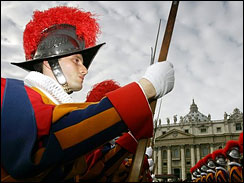
(AP) Pope Benedict XVI thanked the Swiss Guards on Sunday for their 500 years of service protecting the popes, as the Vatican opened its official commemorations of the anniversary of the first mercenaries' arrival from Switzerland.
An honor corps of Swiss Guards, in their full blue- and-yellow bloomered dress uniforms and red-plumed helmets, stood at attention in St. Peter's Square as Benedict addressed them from his studio window. He recalled how Pope Julius II had summoned the mercenaries to protect him and the Vatican. They arrived Jan. 22, 1506.
ŵhank you for your service of 500 years!¡¦Benedict told the guards in a special blessing, to applause from tourists and the faithful also gathered for his traditional Sunday greeting.
More senior guards in red velvet barked out orders as the few dozen guards marched in lock step to the tunes of a marching band and the tolling bells of St. Peter's Basilica.
Earlier in the day, Benedict's No. 2, Cardinal Angelo Sodano, celebrated an intimate Mass in the Sistine Chapel for members of the current corps and their families, the official start of the Vatican's commemorations for the half-millennium the Swiss have been protecting popes.
In his homily, Sodano recalled that Julius had summoned the Swiss because they had proven themselves ÅÅefenders of the freedom of the church.¡¦
Å¢nd thus started the long series of generous and strong young men who wanted to come to defend the Cathedral of Peter,¡¦Sodano said.
The Swiss Guards, known for their traditional halberds, have since protected 42 popes. Some are armed with guns.
Over the next six months, Vatican and Swiss authorities will host ceremonies, concerts, exhibits and commemorations that will culminate with a symbolic re-enactment of the march from Switzerland to Rome of the first 150 Swiss mercenaries.
EU warns Serbia over Mladic hunt
 The EU has warned Serbia that moves towards eventual EU membership may be halted if Belgrade fails to hand over top war crimes suspect Ratko Mladic.
The former Bosnian Serb wartime general has been on the run since 1995. He has been charged with genocide and other crimes related to the Bosnian war.
EU Enlargement Commissioner Olli Rehn said suspending negotiations was an option if Belgrade did not co-operate.
The UN's chief war crimes prosecutor said Gen Mladic was hiding in Serbia.
Carla del Ponte accused elements in the Serbian army of sheltering him.
"Mladic is in Serbia, and as you know, Mladic is protected with power of the army," she said after a meeting with Mr Rehn.
She had urged Belgrade to hand over Gen Mladic to the war crimes tribunal in The Hague in 2005.
The former Bosnian Serb political leader, Radovan Karadzic, also tops the list of suspects most wanted by the tribunal.
Belgrade's choice
Mr Rehn warned it would be extremely difficult for the EU to conclude an association agreement with Belgrade unless Gen Mladic and other wanted war crimes suspects were handed over.
An association agreement would be the first step on the road to EU membership for Serbia.
"I hope Belgrade takes this message very seriously and starts acting accordingly," Mr Rehn said.
"The suspension of negotiations is certainly one alternative... Serbia has to choose now between the nationalist past and a European future. I hope they choose the European future."
Ms del Ponte said she wanted to put Gen Mladic in the dock in July, along with the other suspects indicted for the killing of 8,000 Muslim men and boys in the Bosnian town of Srebrenica - the worst atrocity in Europe since World War II.
The Serbia-Montenegro Defence Minister, Zoran Stankovic, insisted that Belgrade was still looking for Gen Mladic, the Associated Press reported.
He said he had recently met Gen Mladic's wife and son.
"The operation to catch Mladic is under way... All available army personnel are engaged in this," he said.
E.U.'s Patchwork Of Policies Leaves It Vulnerable to 9/11-Style Attack
BRUSSELS -- The capital of the European Union was in the midst of a historic celebration on May 1, 2004, when security officials learned of a sudden emergency: An airliner that had departed Norway with 186 passengers aboard had possibly been hijacked and was headed this way.
On the same day that the union expanded its borders to admit 10 new member countries, an Air Europa Boeing 737 en route to Spain did not respond to an urgent series of radio calls from air traffic controllers as it flew over Denmark, Germany and the Netherlands before entering Belgian airspace.

With fears mounting that the plane might launch a kamikaze attack on E.U. or NATO headquarters in Brussels, three countries scrambled fighter jets but had trouble intercepting the aircraft as it rapidly crossed one national border after another.
Then a flight attendant looked out the window of the airliner and saw two French Mirage 2000s flying alongside, prompting the Air Europa pilots to get on the radio and report that everything was fine. The incident ended peacefully but exposed Europe's vulnerability to a Sept. 11-style hijacking and the difficulties in coordinating a multinational response to a fast-breaking terrorist threat.
The European Union exists in large part to harmonize policy among its members. But when it comes to dealing with a hijacked airliner, those countries cling to a patchwork of contradictory rules and regulations.
In Sweden, it is forbidden to shoot down a civilian plane under any circumstances. Germany recently passed a law that gives the defense minister the authority to open fire on a hijacked plane, but the measure is being challenged in court.
Four East European countries lack their own air forces and rely on neighbors to patrol their skies, making the chain of command still more complicated. Some other countries won't divulge their policies, citing national security.
On a continent where many countries are so small that planes can pass through their airspace in minutes, aviation and security officials say the conflicting approaches make it almost impossible to prepare an adequate defense against hijackers bent on crashing a plane into a target.
"It's a very, very complex issue to come to a conclusion on because there are so many partners involved," said Bo Redeborn, director of security affairs for Eurocontrol, the agency that oversees European air traffic. "We're not there yet, that's clear. Some states are much more ready than others. We are best prepared to fight the last war. We're seldom prepared to address threats we haven't seen before."
Europe has some of the busiest air traffic corridors in the world. With passenger flights on the increase and a heightened sensitivity toward security since Sept. 11, 2001, there's also been a big jump in the number of hijacking false alarms. Reports of traffic controllers losing radio contact with pilots for a prolonged period have roughly doubled since 2002, according to Eurocontrol.
There are no hard statistics on how many such cases in Europe have escalated to the point where military intervention resulted, because countries don't pool the information. But Eurocontrol said fighter jets have been scrambled 19 times in the past two years to intercept airliners that lost touch with its air traffic control center in Maastricht, the Netherlands. The center monitors air traffic in Belgium, the Netherlands, Luxembourg and parts of Germany, tracking about 25 percent of the flights that pass through Europe each day.
During the Cold War, West European nations relied on NATO to defend against a Soviet air attack. While NATO has since expanded to take in many of the former Communist states of Eastern Europe, it lacks the authority to shoot down hijacked civilian airliners, now a far more likely threat than attack by a foreign military. That decision is explicitly left to individual countries.
"This is an awfully difficult subject," Jaap de Hoop Scheffer, NATO's secretary general, said in a September meeting with a small group of reporters in Berlin. "The notion of national sovereignty is very strong. To go after civilian airlines with passengers on them, we'll defer on that."
NATO still monitors the skies for intruders, civilian or military, and will scramble jets on the orders of local officials. It has also supplied AWACS surveillance aircraft to guard against terrorist attacks at more than 20 high-profile international events since the Sept. 11 attacks, such as the 2004 Summer Olympics in Athens and the funeral of Pope John Paul II at the Vatican last year.
"We are very well served by our ability to identify threats. We've got the communications, we've got the radars," said a senior NATO official in Brussels who spoke on condition of anonymity. "Our ability in Europe to see and understand what is going on is probably as good as anywhere in the world. Our ability to put an aircraft in the sky very quickly is also very good. The difficult bit comes when you have identified a renegade aircraft."
The European Union has had little success on this issue. Gijs de Vries, the bloc's counterterrorism coordinator, said security officials are working to improve Europe-wide readiness for a hijacking, but he declined to discuss details. "I can't get into any of that," he said in an interview last year.
Giles Merritt, director of New Defense Agenda, a Brussels research organization that specializes in security issues, said European leaders have placed a higher priority on intelligence-gathering and prevention. Many officials don't see shooting down an airliner as an option under any circumstances, he said.
"Let's assume some jihadist group did get their hands on a civilian plane and they were headed to the Eiffel Tower," Merritt said. "And that there was enough time for a French leader to make a decision on how to respond. No politician wants to be the guy to pull the trigger on 200 innocent people, just on the suspicion that it will crash into something. His career would be over."
European counterterrorism officials said they don't take the threat of a hijacked airplane lightly, however. French investigators believe that an Algerian radical group schemed to fly an airplane into the Eiffel Tower in the mid-1990s; the iconic structure is still considered a major target for a terrorist attack.
British and U.S. officials said last fall that they had uncovered an al Qaeda plot to hijack an airplane in Eastern Europe and crash it into Heathrow Airport in 2003. Details of that case remain sketchy.
After a man commandeered a small plane in Frankfurt in 2003 and threatened to crash it into the European Central Bank in the city's downtown, Germany approved a law that gives its military the green light to shoot down a hijacked airliner. Last year, a suicidal pilot crashed a small plane in front of the Reichstag, the German Parliament building in Berlin. No bystanders were hurt, and investigators ruled out terrorism as the motive.
The German air force said it scrambled jets 20 times last year to chase after planes that had lost radio contact for prolonged periods; none of the incidents turned out to be a hijacking. But many lawmakers have expressed misgivings about the new law, citing a clause in the German constitution that forbids the state to take the life of any German citizen. The Federal Constitutional Court, Germany's highest judicial body, is scheduled to rule on the measure later this year.
Burkhard Hirsch, a former vice president of the German Parliament who is a plaintiff in the case, cited the inherent risk of making a mistake when dealing with a hijacked airliner. He referred to the case of a passenger on a flight to Munich who reported having a bomb and threatened to blow up the plane. Two fighter jets were promptly dispatched, but held their fire. When the plane landed, it turned out the passenger didn't have any explosives, only a mobile phone.
"If I get on an airplane, I don't like the idea that the minister of defense has the right to shoot me down," Hirsch said. "There's a difference between government and God. God knows what our fate is. The military and flight controllers do not. Nobody on earth has the right to play God."
Slovak abortion move worries EU

An attempt by the Vatican to reduce the number of abortions in Slovakia has raised concerns in the European Union about the loss of rights for women.
A draft treaty between Slovakia and the Holy See would allow hospital staff to refuse to do abortions or fertility treatment on religious grounds.
A panel of EU lawyers says this could restrict the rights of those who want them in such a firmly Catholic nation.
Pope Benedict XVI has vowed to take a tough line on issues such as abortion.
The draft treaty, drawn up in 2003, says it is based on "recognising the freedom of conscience in the protection and promotion of values intrinsic to the meaning of human life".
Slovakia is said to be 70% Catholic but abortion is legal up to the 12th week of pregnancy.
Under the draft agreement, the Slovak Republic "undertakes not to impose an obligation on the hospitals and healthcare facilities founded by the Catholic Church... to perform artificial abortions or assisted fertilisations".
Far-reaching deal
But Professor Olivier De Schutter, the head of the panel of lawyers from the EU Network of Independent Experts on Fundamental Rights, says the articles relating to religious conscientious objection raise the most concern.
He said it was "far-reaching, considering a very large majority of healthcare providers in Slovakia are Catholics and might exercise their right to conscientious objection".
He said the treaty did not oblige medical staff in such cases to refer the person seeking advice to another healthcare provider.
Human rights bodies have repeatedly said that when abortion is legal in a country, access to abortion must be provided to all without discrimination.
"The right to religious conscientious objection may be and should be respected, but with safeguards that make it possible for women to seek legal abortion," Professor de Schutter told the BBC's Europe Today programme. "This is the problem the draft text may be posing."
Richard Fides, a spokesman for Slovakia's justice minister, rejected claims in some European media that the document was basically an abortion agreement.
"That is sheer nonsense," he told the Slovak commercial television station TA3.
"The objective of the agreement is to ensure that every individual can apply their right to the objection of conscience. It is neither right nor just for a doctor-gynaecologist, who is for example a supporter of the culture of life, to be forced to perform an abortion."
Holy agreements
But Martin Buzinger, Slovakia's representative on the legal panel, argued that "the agreement stipulates a very broad right to the objection of conscience, without ensuring at the same time that this right is not abused."
The Holy See has similar treaties - or concordats - in place with other member states, including Italy, Latvia and Portugal, but clauses on religious conscientious objections only relate to exemptions from military service.
The draft treaty is yet to be signed. If it is, it will have the status of an international treaty, as the Vatican is a sovereign state.
Professor de Schutter says any political response to the legal panel's report on the draft treaty will be down to the European Commission and parliament.
Bosnia suspect's wife shot dead

The wife of a Bosnian Serb war crimes suspect has been killed in an exchange of gunfire as European Union forces closed in to arrest her husband.
Doctors in Foca, in south-east Bosnia-Hercegovina, said Rada Abazovic died in hospital from bullet wounds.
Her husband, Dragomir Abazovic, and her 12-year-old son, were also injured and have both been admitted to hospital.
A spokesman for the EU force (Eufor) said Mr Abazovic had shot himself when he realised there was no escape.
Mr Abazovic is wanted by Bosnia-Hercegovina's war crimes court for offences he is alleged to have committed in the 1990s around Rogatica, the town in south-east Bosnia where he was arrested.
Operation
Lieutenant Colonel Jem Thomas confirmed the shoot-out had taken place.
"During preparation for the operation with the Rogatica local police on the site, Eufor troops were fired upon and they returned fire," he said.
"During the exchange, two people in the house were injured; the suspect, unable to escape, subsequently injured himself.
"No Eufor troops were injured in the exchange of fire."
Reports say the boy has been operated on and is out of danger, but his father is still in a critical condition.
Mr Abazovic is not on the list of suspects wanted by the United Nations International Criminal Tribunal for the Former Yugoslavia.
Eufor took over peacekeeping in Bosnia from a Nato force in 2004.
| 
|
Merkel criticises Guantanamo Bay
 German Chancellor Angela Merkel says the US detention camp at Guantanamo Bay "should not exist", in an interview days before she meets George W Bush.
In the interview to be published on Monday, Mrs Merkel criticises the US camp in Cuba, saying "different ways" should be found to deal with prisoners.
Her visit to Washington is her first since she took office in November.
Mrs Merkel hopes to improve relations with the US, which were strained when Gerhard Schroeder opposed the Iraq war.
Mrs Merkel told the German magazine Der Spiegel: "An institution like Guantanamo can and should not exist in the longer term.
"Different ways and means must be found for dealing with these prisoners."
At a news conference on Saturday, Mrs Merkel defended her comments, but said she would not demand the immediate closure of the camp when she meets with President Bush next week.
"That's my opinion and my view and I'll say it elsewhere just as I have expressed it here," she said.
 "My talks with leaders of other countries don't consist of my expressing demands but of exchanging views."
The chancellor told Der Spiegel she expected to speak to Mr Bush about the fight against terrorism.
"But I want to accentuate that our relationship with the US will not be reduced to talking about fighting terrorism and the Iraq war," she said.
Mrs Merkel's Social Democrat partners in the coalition government welcomed her condemnation of Guantanamo.
"The Guantanamo camp must be closed. The Guantanamo system was and still is bad," said the party's parliamentary leader Walter Kolbow.
"It was and remains in contradiction with the agreements and standards of international law."
Human rights campaigners have expressed growing concern about the treatment of inmates at Guantanamo.
The Bush administration has denied allegations of abuse at Guantanamo, insisting it does not torture prisoners.
Chirac plans end to colonial law

French President Jacques Chirac has said a controversial law on the teaching of France's colonial past will be overturned.
The law requires teachers to stress positive aspects of French colonialism, especially in north Africa.
But during a New Year address, Mr Chirac said the law was "dividing the French" and should be rewritten.
MPs from the Socialist and Communist parties say rewriting the law is not enough and it should be scrapped.
Victorin Lurel, from Guadeloupe, whose Socialist Party had tried to block the law, said: "The only solution is to repeal this law of shame, pure and simple."
The colonial history law was passed by the conservative-led parliament in February last year.
Overseas minister Francois Baroin told France Inter radio the law was a sore point for French people whose families came from the former colonies.
Around 44,000 people signed a petition calling for the law to be repealed.
Interior Minister Nicolas Sarkozy was forced to cancel a planned trip to France's Caribbean islands of Martinique and Guadeloupe by the risk of angry protests, according to AFP.
Mr Chirac, who ordered the law to be reviewed last month, said the National Assembly speaker would table a bill for the law to be rewritten "and come up with a wording which will bring people together and put their minds at rest".
"I want this approach to be part of a more general thinking process because history must not be written by law," he said.
Slavery day
Mr Chirac, who plans to run for re-election in 2007, also announced the establishment of a slavery remembrance day in France - on a date to be announced later this year.
"The question of slavery is a wound for a large number of our fellow citizens, in particular overseas," he said.
"France has set an example by being the first country in the world - and still the only one today - to recognise slavery as a crime against humanity. I have decided to establish a day of remembrance in France."
The end of 2005 was not a harmonious one for Mr Chirac's France - especially in the largely immigrant suburbs.
The worst unrest in the country in nearly 40 years began when two boys of North and West African origin were electrocuted in a Paris suburb after running from police, believing they were being chased.
Residents of the country's poor suburbs, where most of the unrest took place, complained of racism and heavy-handed policing.
Wednesday also marked the lifting of the state of emergency imposed to deal with the riots.
Ukraine gas row hits EU supplies

EU nations have started to feel the impact of Russia's axeing of gas supplies to Ukraine, as Moscow accused Kiev of stealing EU supplies.
Hungary and Poland were the first EU states to have supplies disrupted.
Russia's state-run firm Gazprom cut Ukrainian supplies from the pipelines on Sunday after talks failed to solve a politically-charged price row.
Exports to the EU are carried through the same pipes, and Gazprom now says Kiev is stealing some of that gas.
"There is information that Ukraine has begun siphoning off Russian gas that is designated for European users," Gazprom spokesman Sergei Kuprianov was quoted as saying some eight hours after the Ukrainian supply was cut.
Ukraine's prime minister denied the allegation, insisting not a single cubic metre of Russian gas was being used.
Earlier, Ukraine's own state-run gas firm blamed Russia for jeopardising Western European supplies.
"Gas is not flowing at all through some transit routes, which can lead to a fall in pressure in all the pipelines and limit the overall supply of gas to Ukraine and Europe," said Eduard Zaniuk, a spokesman for Ukrainian state-run gas giant Naftogaz.
"Naftogaz declares such actions unacceptable because they endanger gas deliveries to Europe."
Ukraine has said it has the right to take 15% of the remaining supplies in the pipelines as payment for transporting the gas to Western Europe.
Europe's Energy Commissioner confirmed the crisis was causing concern, despite previous Russian assurances that EU supplies would not be hit.
"The dispute definitely does not help us and keeps us worried because 20% of our gas supplies go through this route, so if there is a dispute so there are eventualities that could come out," Andris Piebalgs told the BBC.
"So we are not too certain if everything will happen as both sides have promised us."
EU governments are convening a meeting of their gas industry experts in Brussels on 4 January to discuss the crisis.
Some EU countries rely particularly heavily on Russian gas. Germany, for example, gets about 30% of its gas supplies through Ukraine.
Polish concern
In Hungary, gas firm MOL said its supplies from Russia were already down 25%.
The country's economy ministry is advising large consumers to switch to alternative energy sources like oil wherever possible.
Earlier, Polish gas company PGNiG reported that the amount of gas entering its pipeline system from Ukraine was also down, according to the AFP news agency.
Kiev continues to insist that the loss of Russian supplies - which amount to 30% of its own national consumption - will not hit ordinary Ukrainian consumers during the harsh winter.
However, it has warned that supplies to industry may be affected.
The Ukrainian crisis erupted after Gazprom announced it was quadrupling the price of its gas supplies from $50 to $230 per 1,000 cubic metres.
Ukraine rejected the increase, saying it was prepared to pay a higher price but not on that scale.
Kiev has said it is currently prepared to pay no more than $80 per 1,000 cubic metres of gas.
Many Ukrainians believe Russia is punishing them for their Orange Revolution and the election of Western-leaning President Viktor Yushchenko.
Other countries which remain in Russia's sphere of influence continue to receive gas at below-market prices.
French hostage 'shown in video'
 A militant group in Iraq has threatened to kill a French water engineer seized three weeks ago, unless France ends its "illegitimate presence" in the country.
A video apparently showing hostage Bernard Planche held at gunpoint was broadcast by Arab channel Al-Arabiya.
The channel said the previously unknown group had demanded French troops leave Iraq. France has no forces in the country and opposed the US-led war.
Mr Planche was abducted by gunmen from his home in Baghdad's Mansour district.
The video, an excerpt of which was aired on Al-Arabiya, showed a man with a moustache seated on a chair with gunmen to either side.
He spoke in English, saying: "My name is Bernard. I'm 52 years old. I'm French, from Lyons."
Release efforts
The man said he worked on water treatment projects in Baghdad and apologised for "problems" he had caused.
The name of a previously unknown militant group, Brigade of Monitoring for Iraq, was shown in one corner of the footage.
Mr Planche was working for a small non-governmental organisation called AACCESS when he was kidnapped on 5 December in Baghdad.
The French government has said it is working for his release.
"We demand the immediate release of Mr Planche as nothing can justify his being taken hostage in Iraq," said a foreign ministry spokeswoman.
"We are obviously going to examine the images broadcast by Al-Arabiya and we are going to do it very carefully."
France has tried to deter its citizens going to Baghdad since the kidnapping in 2004 of two French journalists, who were eventually freed after weeks in captivity.
Mr Planche's abduction came 10 days after that of a German archaeologist, Susanne Osthoff, who has since been released.
The fate of a group of four Christian peace activists seized a day after her remains unknown.
An armed group has also captured a Jordanian working as a driver for his country's embassy in Baghdad.
German hostage told she was safe as a Muslim
Kidnappers told woman she would not be hurt because she is ¡ÆIraq¡Çs friend¡Ç

DUBAI - A German held hostage in Iraq for three weeks said on Monday that the kidnappers who freed her a week ago promised not to hurt her because she was a Muslim.
In her first interview since the ordeal, Susanne Osthoff, 43, told Al Jazeera television at its Qatar headquarters that they also said they did not want money.
¡ÈThey said ¡ÆMs. Susan, we know you and you are Iraq¡Çs friend¡Ç,¡É said Osthoff, a convert to Islam who speaks fluent Arabic. She is an archaeologist who has spent more than a decade working on excavations in Iraq.
¡È¡ÇWe¡Çre informing you now this was a political reason why we kidnapped you, and we¡Çll inform you later about what will happen, so don¡Çt be afraid, we don¡Çt harm women or children, and you are Muslim¡Ç¡É Osthoff quoted a kidnapper as saying.
¡ÈI was very happy because I knew I wasn¡Çt in the hands of criminals,¡É she said. Her comments were translated into Arabic from English and parts were unclear.
It was uncertain if she plans to return to Iraq, which she left last week for an undisclosed location to spend time with her daughter.
After her release, she chose not to return to Germany, where she has not lived for many years.
Wearing a pinstripe jacket and loose black headscarf during the interview, Osthoff said the kidnappers pushed her into the trunk of a car in what she called a ¡Èprofessional performance.¡É
The fate of her driver remains unclear. Osthoff said she was driven to a place near the Iraqi border but was later taken to Baghdad and released.
¡ÈI wasn¡Çt in tough circumstances and they treated me well,¡É she said. ¡ÈThey understood that I knew about the Iraqi people¡Çs plight.¡É
The German government denied her freedom was linked to Berlin¡Çs release of a Hizbollah member jailed for life in 1985 for the murder of a U.S. Navy diver.
EU-wide warrant over 'CIA kidnap'

An Italian court has issued Europe-wide arrest warrants for 22 suspected CIA agents accused of helping to kidnap a Muslim cleric in Milan in 2003.
The suspects are accused of abducting Osama Mustafa Hassan, also known as Abu Omar, without Italian permission, and flying him to Egypt for interrogation.
The new warrants allow for the suspects' detention anywhere in the 25-nation EU, a prosecutor said.
The authorities had already issued arrest orders within Italy.
The BBC's defence correspondent, Rob Watson, describes the case as one of the best documented alleged cases of the CIA's policy of extraordinary rendition.
Extradition unlikely
Italy says the alleged operation hindered Italian terrorism investigations.
No arrests have so far been made.
All 22 suspects are thought to have returned to the US, a formal Italian extradition request seems unlikely, our correspondent adds.
Italian Justice Minister Roberto Castelli has signed the warrants, a move officials described as a formality.
There was no word on whether Mr Castelli would seek extradition, but he has previously accused the judge involved of being a leftist militant and anti-American.
Italy's Prime Minister Silvio Berlusconi is a close US ally and has said he can see no basis for the case.
'No knowledge'
The extraordinary rendition policy involves seizing suspects and taking them to third countries for questioning without court approval.
It has been the subject of controversy recently, with human rights groups alleging that suspects are tortured, and that the CIA has secret prisons where it keeps prisoners without reference to US or international law.
US Secretary of State Condoleezza Rice recently defended the use of rendition, saying it was an established practice and suggesting it was often carried out with the knowledge, or participation, of European governments.
Mr Hassan, 42, is believed to have been abducted on 17 February 2003, and flown out of the country from a US base in Aviano, north of Venice.
He reportedly called his family last year, telling them he had been tortured with electric shocks during his detention.
The CIA has refused to comment on the case and the Italian government has said it had no prior knowledge of any kidnap plot.
Mr Hassan is believed to have arrived in Italy in 1997, where he was granted refugee status.
Law on teaching rosy view of past splits France
PARIS - As a great maritime and colonial power in centuries past, France relished its role in taking its culture to the far corners of the globe -- French schools, language, trade, modern medicine and various other trappings of its civilization.
But people in those places were not always happy with what accompanied the French largess, including war, slavery, torture and the eradication of their cultures.
Those competing views of history have set off an emotional debate in France and places it colonized, following passage of a law here mandating that French schools give more emphasis to the positive aspects of French colonization.
Critics call the law an effort to obscure abysmal treatment of blacks and other indigenous peoples during colonial times and suggest that it mirrors a similar attitude toward immigrants in France today.
The link between the eras "is very, very great discrimination," said Victorin Lurel, a socialist member of Parliament from the French Caribbean island of Guadeloupe. "The youngsters in the suburbs are sons of immigrants -- they are colored and blacks and Algerian, and their parents were discriminated against in French society, and that is one motivation that was at the foundation of the violence and riots in the suburbs" that rocked France for three weeks in October and November, he said.
The law is part of an otherwise uncontroversial bill that Parliament passed in February to improve conditions for French people who left Algeria after independence there and moved to France.
'Positive role'
The language in question calls for French school programs to "recognize in particular the positive role of France's presence overseas, notably in North Africa, and give due prominence to the history and sacrifices of French army fighters from these territories."
"I wanted to pay homage to all the troops from our overseas territories who fought so valiantly for France during World War II," the measure's sponsor, Christian Vanneste, said in an interview, "and to pay tribute to the one million Frenchmen and some 150,000 repatriates who had to leave Algeria in 1962."
The bill generated criticism in France and its former colonial realm at the time, and the debate was reignited after Parliament reaffirmed the law two weeks ago.
Some history teachers and left-wing politicians contend that conservatives were trying to legislate away massacres and torture perpetrated by French troops during Algeria's 1954-62 war of independence and to whitewash France's role in the slave trade and the subjugation of indigenous cultures in the Caribbean.
Jean-Marc Ayrault, head of the main opposition Socialist Party in Parliament, told lawmakers that the law recalled "the good old times of the colonial troops, when France came to convert the natives to enlightened civilization. This means passing over in silence the acts of violence, the abuses, the oppression with which this period is riddled."
'Mental blindness'
The law derailed plans for the signing this year of a new friendship treaty between Algeria and France. Algerian President Abdelaziz Bouteflika said the law demonstrated "mental blindness" in France. The French "have no choice but to recognize that they tortured, killed, exterminated from 1830 to 1962," he said at a rally. They "wanted to annihilate the Algerian identity," so that "we were neither Berbers nor Arabs nor Muslims. We had neither culture nor language nor history," he told the crowd.
Interior Minister Nicolas Sarkozy, the early front-runner in the 2007 presidential race, was forced by the controversy to cancel a trip to Martinique and Guadeloupe, Caribbean islands that are part of France. Leaders there said they would boycott meetings with him, and dozens of groups called for street demonstrations.
Sarkozy, who caused a storm in October by referring to rioting youths, many of whom were from immigrant families, as "scum," seemed unfazed. "This permanent repentance, which means we have to apologize for France's history, borders on absurdity," he said in an interview with France 3 television.
A week ago, trying to cool tensions, President Jacques Chirac created a commission "to evaluate the action of Parliament in the fields of memory and history" and ordered it to report back within three months. "In the Republic, there is no official history," Chirac said. "The law's job is not to write history. The writing of history is the task of historians."
His conservative Union for a Popular Movement (UMP) has a sizable majority in the National Assembly and was largely responsible for passing the law.
Some of the criticism of conservatives' attitude toward the colonial past parallels recent complaints about treatment of the country's immigrant population -- particularly French youths with parents who came from former colonies in Africa.
'Religion and immigration'
On the one hand, anger over the law "is a prolongation of the debate about religion and immigration" that the riots touched off, but on the other, "it's a way of hiding what France did in terms of slavery and racial discrimination," said Vincent Tiberj, a political scientist at the Institute of Political Studies in Paris.
French history is taught in a much more balanced way today than it was 30 years ago -- when the war in Algeria and the French Vichy government's collaboration with Nazi Germany were typically soft-pedaled or ignored, Tiberj said. The new law seems aimed at rolling back gains made since then, he said.
But during the debate in Parliament, UMP lawmaker Christian Kert said the law was needed more than ever, given the recent unrest around Paris.
"Is it not useful to recall France's positive role to many young French people with an immigrant background, who are most exposed to messages underlining the negative aspects of the colonial period?" Kert said. "How can they feel any pride to be French if historians only present France to them as a state which exploited their countries of origin and tortured their ancestors?"
Powell raps Europe on CIA flights

Former Secretary of State Colin Powell has indicated that Europeans are being disingenuous when they deny knowledge of the rendition of terror suspects.
Mr Powell said the recently highlighted practice of moving people to places where they are not covered by US law was neither "new or unknown" to Europe.
A number of countries where flights allegedly stopped have said they were unaware of their land being used.
Talking to the BBC, Mr Powell also described his difficulties over Iraq.
In an interview with Sir David Frost for the BBC World TV channel, he described his disappointment with the failings of US intelligence on Iraq, and his arguments with Defence Secretary Donald Rumsfeld over the campaign.
'Like Casablanca'
He was speaking after his successor, Secretary of State Condoleezza Rice, faced tough questioning about the use of rendition during a recent trip to Europe.
She admitted that terror suspects were flown abroad for interrogation, but said this was "a lawful weapon", and denied the prisoners were tortured.
 Public opinion worldwide is against us

She refused to address claims that the CIA runs secret prisons abroad where suspects are interrogated without reference to international law.
But Gen Powell was dismissive of the furore in Europe.
"There's a little bit of the movie Casablanca in this, where, you know, the inspector says 'I'm shocked, shocked that this kind of thing takes place'.
"Well, most of our European friends cannot be shocked that this kind of thing takes place... The fact that we have, over the years, had procedures in place that would deal with people who are responsible for terrorist activities, or suspected of terrorist activities, and so the thing that is called rendition is not something that is new or unknown to my European friends."
Impression of unilateralism
He accepted that Washington's moral authority was under pressure at the moment.
"The United States is going through a period right now where public opinion world-wide is against us.

"I think that's a function of some of the policies we have followed in recent years with respect to Iraq and in not solving the Middle East's problem and perhaps the way in which we have communicated our views to the rest of the world, we have created an impression that we are unilateralist, we don't care what the rest of the world thinks.
"I don't think it's a fair impression"
Questioned on the evidence held up by the US as proof that Iraq had a weapons of mass destruction programme, he said: "I was deeply disappointed in what the intelligence community had presented to me and to the rest of us, and what really upset me more than anything else was that there were people in the intelligence community that had doubts about some of this sourcing, but those doubts never surfaced up to us."
'Not pleasant'
He also referred to his relationship with Defence Secretary Donald Rumsfeld and Vice-President Dick Cheney - often depicted as icy.
"Secretary Rumsfeld and Vice President Cheney and I occasionally would have strong differing views on matters. And when that was the case we argued them out, we fought them out, in bureaucratic ways," he said.
"Often maybe Mr Rumsfeld and Vice-President Cheney would take decisions into the president that the rest of us weren't aware of. That did happen, on a number of occasions."
Asked about post-war planning for Iraq, Gen Powell said his state department staff drew up detailed plans, but they were discarded by Mr Rumsfeld's defence department, which was backed by the White House.
"Mr Rumsfeld and I had some serious discussions, of a not pleasant kind, about the use of individuals who could bring expertise to the issue. And it ultimately went into the White House, and the rest is well known."
Plane Spotting
How aviation hobbyists put vital evidence about secret CIA flights
- When I finally got him on his cell phone, Javier Rodríguez had his Canon trained on Tenerife airport in the Canary Islands, and he was zooming in with a 500mm lens. Rodríguez normally works at a bank, but his passion is hunting aircraft, taking pictures, checking tail numbers, posting his findings on the Web. The hobby of plane spotting is sort of like jet-fueled bird-watching; you look for variety, color, rarity. You click off a few shots; you share them with friends. Apart from an occasional scare when a pilot confuses a long lens with a rocket launcher and radios the tower, this is a pretty innocuous obsession. Or so it was until the beginning of this year, when reports in NEWSWEEK and other publications caught up with ¡ÈAir CIA.¡É
Ever since, plane spotters have played a key role keeping the issue of so-called ¡Ètorture flights¡É—and images of the aircraft themselves—in front of the public eye. Last week, they and their pictures were more in demand than ever as Secretary of State Condoleezza Rice toured Europe and found herself dogged at every stop by questions about the aircraft—Boeings and Gulfstreams—using European airports and transiting European airspace.
After countless refusals to talk about the planes and their destinations because, er, they were secret, and repeated denials that the United States practices torture, as narrowly defined by the Bush administration, Rice did quell some of the criticism from NATO allies. After all, many European governments seem to have known what was going on in their air space, or at least knew enough not to want to know. Yet this issue won¡Çt go away. The plane spotters took it out of the hands of government, in fact. They put vital evidence on the Web, unwittingly at first, that human-rights organizations and parliamentarians have used to launch lawsuits and demand explanations.
The Bush administration, as we know, wants to put alleged evildoers beyond the reach of the U.S. Constitution, the Geneva Conventions and, in some cases, common decency. The lucky ones get sent to the legal limbo of Guantánamo. Others wind up being worked over in secret at foreign sites by un-American inquisitors that Rudyard Kipling might have called ¡Èlesser breeds without the law.¡É Of course, if terrible things are done in these places, Washington deplores them and denies responsibility.
¡ÈWe rely on our law to govern our operations,¡É Rice said last week as she started on her European tour. The full text, available on The Shadowland Journal, cynically obscures questions of responsibility behind a cloud of noble intentions (to spread freedom and human rights) and pragmatic purpose (to squeeze vital information out of presumed terrorists at almost any cost).
According to Rice, ¡Èrenditions¡É of one sort or another have been used ¡Èfor decades¡É by ¡Èthe United States and other countries¡É (a bit of condoweasel-wording that thus neatly fudges any discernible timeline). ¡ÈRenditions take terrorists out of action, and save lives,¡É she claimed. Former CIA director George Tenet listed ¡Èthe rendition of many dozens of terrorists prior to September 11, 2001¡É as ¡Èearlier counterterrorism successes,¡É Rice noted. Of course she ignored the most salient fact about those rendition ¡Èsuccesses¡É: they did nothing to stop 9/11. She also failed to mention that two alleged Egyptian terrorists rendered from Albania to Cairo in 1998 were not just detained incommunicado and tortured, according to Human Rights Watch, they were put to death.
Since 2001, the Bush administration has made ¡Èextraordinary renditions,¡É well, pretty ordinary. When a radical Islamist preacher known as Abu Omar was snatched off the street in Milan in February 2003, the team that grabbed him treated the event so casually it left an extensive paper trail and incriminating phone records that tracked straight to the American airbase at Aviano. Italian judges have now issued arrest warrants for a total of 22 known and presumed CIA agents charged with kidnapping and related crimes.
Rodríguez and his buddies in the Majorca chapter of the "Iberian Spotters¡É club say they really had no idea they were plunging into the middle of this mess when they photographed some of the nondescript corporate planes that touched down at their local airport. ¡ÈBusiness jets don¡Çt attract a lot of attention,¡É Rodríguez shouted over his cell phone as an airliner roared above his head last weekend. ¡ÈWe¡Çd take pictures of them when there really was not much else to do.¡É
Then, in January 2004, club member Josep Manchado snapped a white Boeing 737 with the tail number N313P. Soon after he posted the picture on a site called Airliners.net, Manchado started to get strange e-mails from what purported to be news organizations in Sweden, Germany and the United States. They seemed to be more interested in him than in actually buying the photographs. ¡ÈThey were crude,¡É Manchado told me over the phone this morning. ¡ÈThey were asking me for the number of my identity card, my address, my phone number.¡É Manchado, whose day job is urban planning, says he was puzzled by so much interest in this particular picture, and in him. Then—no more inquiries for almost nine months.
The next contact came at the beginning of this year when a German television network contacted Manchado while looking into the case of a naturalized German citizen who told a horrific tale of abduction and torture. On Dec. 31, 2003, Khaled el-Masri had taken a bus from the Germany city of Ulm to Macedonia, where he thought he was going to spend his holiday. Instead, he was detained at the Macedonian border and held incommunicado in a Skopje hotel for 23 days, under interrogation by local security forces. On Jan. 23, 2004, he says he was driven to an airport, handcuffed and blindfolded. There he was beaten by men using their fists and what felt like a stick.
According to a complaint filed last week in U.S. Federal Court by the American Civil Liberties Union on al-Masri¡Çs behalf, ¡Èhis clothes were sliced from his body with scissors or a knife, leaving him in his underwear. He was told to remove his underwear and he refused. He was beaten again, and his underwear was forcibly removed. He heard the sound of pictures being taken. He was thrown to the floor. His hands were pulled back and a boot was placed on his back. He then felt a firm object being forced into his anus.¡É
The complaint says el-Masri was dragged to a corner of the room and his blindfold removed. A flash went off in his face, but he was able to see seven or eight men dressed in black and wearing ski masks. ¡ÈOne of the men placed him in a diaper,¡É according to the ACLU filing. ¡ÈHe was then dressed in a dark blue short-sleeved track suit, and placed in a belt with chains that attached to his wrists and ankles. The men put earmuffs and eye pads on him, blindfolded him, and hooded him.¡É He was marched to a waiting plane where he was ¡Èthrown to the floor face down and his legs and arms were spread-eagled and secured to the sides of the plane. He felt an injection in his shoulder, and became lightheaded. He felt a second injection that rendered him nearly unconscious.¡É
That same day, Jan. 23, 2004, Manchado had taken his picture of N313P on the ground at Palma, Majorca. Aviation records show that it took off that afternoon and landed at Skopje at 8:51 p.m. ¡ÈThe jet left Skopje more than three hours later,¡É according to the ACLU complaint, ¡Èflying to Baghdad and then on to Kabul, the Afghan capital.¡É It appears that by coincidence, Manchado had taken a picture of that particular Boeing on its way to becoming el-Masri¡Çs torture flight. No wonder he started getting mysterious e-mails.
For almost four months, el-Masri was held and grilled at a CIA facility known as the ¡ÈSalt Pit¡É in an old brickworks outside Kabul. Eventually his captors concluded they had the wrong man. They put him on another secret flight, flew him to Albania, drove him out into the countryside, and abandoned him there. When el-Masri finally got home to Ulm and started to tell his tale, it seemed scarcely credible—until Manchado¡Çs picture of N313P, along with Federal Aviation Administration records, provided vital corroboration.
Today you can see snapshots of the aging 737 when it was still in the fleet of Piedmont Airlines during the 1980s; or more recently, in its nondescript white guise, at Frankfurt; Geneva; Oporto, Portugal, and over Tulsa, Okla., in 2003 and 2004. But the story at Palma, Majorca, wasn¡Çt quite over.
On March 10, 2004, Machado noticed N313P again when he was taking a flight to a nearby island. On March 12, it was still there, and another Iberian Spotter named Toni Marimon photographed it taking off. Why it stayed for so long is unknown, but a coincidence of dates disturbs some conspiracy-minded Spaniards. It was on March 11, 2004, that terrorists launched a horrific series of bombings in Madrid that killed 191 people.
After N313P was identified publicly late last year as part of ¡ÈAir CIA,¡É it suddenly changed hands, from one little-known company to another, and got a new tail number: N4476S. Rodríguez remembers staking out the Palma airport last January. ¡ÈI got off work about three. It was a nice afternoon, so I went to see if there were any planes.¡É And there it was. ¡ÈThere was no one around. There were no guards. It had as low a profile as possible; there was nothing to say, ¡ÆThere¡Çs something here'.¡É
Since then, Rodríguez has traveled some considerable distance looking for planes involved with similar intrigues. He was in Tenerife last week, far out in the Atlantic, just about the time an alleged Croatian war criminal was due to be flown from there to The Hague for trial. But it¡Çs unlikely any plane spotters will ever again fix their lenses on as many CIA flights as the ones on the Mediterranean resort of Majorca, and one might ask why? One theory is that it¡Çs a convenient and relatively quiet stopping place on the way to North Africa, where the CIA now has good friends in Morocco, Libya and Algeria, as well as Egypt. Another is that the island¡Çs luxury hotels offer ample rest and relaxation for the crews. Of course the passengers they pick up later are treated a little differently
Pope says torture shouldn't be used against terror
VATICAN CITY (AP) — Pope Benedict XVI's top official for justice issues said Tuesday that torture was unacceptable for extracting information that might thwart a terrorist attack. 
The pontiff denounced increases in military spending and criticized reliance on nuclear arms for national security.
In analyzing what caused terrorism, the pope said in the Vatican's annual review of world conflicts that "consideration should be given not only to its political and social causes, but also to its deeper cultural, religious and ideological motivations."
Benedict also issued a warning about fundamentalism.
"Religious fanaticism, today often labeled fundamentalism, can inspire and encourage terrorist thinking and activity," he said.
His message, which was issued for the approaching new year, also lamented that international diplomacy aimed at eliminating nuclear menace had become "bogged down."
Benedict paid tribute to his predecessor, Pope John Paul II, who vigorously opposed the war in Iraq, and said the church would continue "serving the cause of peace."
At a news conference about the peace message, Cardinal Renato Martino, head of the Vatican's pontifical council on peace and justice, was asked if torture could be a legitimate tool to gain information that might prevent terror attacks.
The prelate replied that there was no justification for using torture, which is the "humiliation of the human person, whoever he is."
"The church does not allow torture as a means to extract the truth," Martino said. Terror suspects "sometimes say what the torturers want to hear. ... There are other ways to obtain the truth."
Benedict noted that the Holy See had called for the prompt implementation of international humanitarian conventions dealing with the effects of wars.
"Respect for that law must be considered binding on all peoples," the pontiff said.
That prompted a reporter to ask Martino if the pope was concerned about allegations of secret CIA prisons in Europe.
The pope "is not condemning anybody, but is inviting them to observe the Geneva Convention" on the treatment of prisoners of war, said Martino, who used to be the Vatican's ambassador to the United Nations.
Benedict urged reforms to make the United Nations "a more efficient instrument" in promoting peace and justice.
The pontiff said he was dismayed about "a continuing growth in military expenditures and the flourishing arms trade, while the political and juridical process established by the international community for promoting disarmament is bogged down in general indifference."
Negotiations are stalled between Iran and the European Union aimed at making Tehran permanently freeze nuclear enrichment. That process can produce material for use in warheads or fuel for nuclear plants to generate electricity.
And tensions have marked much of the diplomacy to persuade North Korea to give up its nuclear programs in exchange for aid and security guarantees.
"The truth of peace requires that all — whether those governments which openly or secretly possess nuclear arms, or those planning to acquire them — agree to change their course by clear and firm decisions, and strive for a progressive and concerted nuclear disarmament," Benedict said.
"It can only be hoped that the international community will find the wisdom and courage to take up once more, jointly and with renewed conviction, the process of disarmament," the pontiff said.
Poles to probe CIA prisons claim

Poland has announced a formal inquiry into claims that the US CIA operated secret prisons or interrogation centres on its territory.>
Announcing the move, Prime Minister Kazimiercz Marcinkiewicz said the issue had to be resolved.
The Polish government has always denied the existence of such facilities.
The BBC's Adam Easton in Warsaw says that over the last few days, the Polish government has come under increasing pressure to be seen to act.
Several newspapers have run successive front-page stories about the issue, with one quoting a spokesman for the US-based group Human Rights Watch saying that Poland had been the main base for interrogating terrorist suspects.
Another said the secret prisons were only closed down after the story first became public last month.
Mr Marcinkiewicz said the detailed investigation would look at all possible locations to determine if there was any evidence to support the allegations.
"This matter must finally be closed, because it could prove dangerous for Poland," he said.
Earlier this week, the prime minister said the country would open its doors to a separate investigation led by the Council of Europe.
Allegations 'ludicrous'
Meanwhile, a senior US official has defended the country's treatment of terror suspects and the transfer of prisoners to third countries for interrogation.
State department senior legal adviser John Bellinger told the BBC that Washington sought reassurance in those countries that prisoners would not be tortured.
We as a state department have got problems with the human rights records of some countries... but this does not mean per se that you may not transfer a person to those countries
He said allegations that hundreds of suspects were sent around the globe to be tortured were "ludicrous".
Mr Bellinger said the US did practice rendition, by which some terror suspects were sent to a third country to be questioned.
But he added that even transferring a prisoner to a country which had been criticised over its human rights record was not a violation of international law.
"We as a state department have got problems with the human rights records of some countries... but this does not mean per se that you may not transfer a person to those countries," he told BBC Radio 4's Today programme.
Mr Bellinger insisted that if there were such questions, the US would seek reassurances that a prisoner would not be subjected to torture.
But he said some practises had been wildly exaggerated.
"Some of the allegations more broadly about all sorts of things are ludicrous, [like one] about hundreds of flights from European cities taking people to be tortured," he said.
He repeated that Washington did not condone or practice torture, but would not comment on whether some prisoners had been subjected to interrogation techniques such as waterboarding - when a suspect is made to feel that they are drowning - to extract information.
The lawyer said he could not comment on speculation about so-called enhanced interrogation techniques or the existence of secret prisons.
Europe fears linger on U.S. torture
U.S. Secretary of State Condoleezza Rice eased European ministers' worries with reassuring denials of allegations of torture by American forces, but many across the continent remained unconvinced as she wound up a European visit Friday.
Rice's tour was dominated by questions about reports claiming the CIA had secret prisons for terrorist suspects in Eastern Europe and alleged flights to nations where torture is common. Many of the officials she met declared themselves satisfied by her assertion that the U.S. does not allow torture and that it respects principles of the Geneva Conventions on the treatment of prisoners of war.
But beyond the corridors of power, questions about U.S. practices were not so easily dispelled.
"Europe's foreign ministers rolled over, stuck their paws in the air and allowed Ms. Rice to tickle their stomachs," columnist Mary Dejevsky wrote in The Independent newspaper.
She noted NATO Secretary-General Jaap De Hoop Scheffer's assertion that "it is my impression that Secretary Rice ... cleared the air. You will not see this discussion continuing."
"To which the only reasonable response should be: Why on earth not?" Dejevsky asked.
In Spain, though, the right-of-center ABC newspaper said Rice "overcame ... the tough challenge of leaving her European partners satisfied with her explanations over the CIA flights."
Sergio Romano, a former Italian ambassador and leading commentator on international affairs, said European governments had appreciated a softening of Rice's comments in the second half of her visit.
"Governments cannot but take note of the change of tone, if not of policy," Romano said.
But he said the deep divide between America and Europe over interrogation methods "is a problem that is destined to re-emerge. It's a fundamental problem."
In Austria, opposition politicians called Chancellor Wolfgang Schuessel "extremely naive" for his acceptance of U.S. President George W. Bush's insistence during a White House meeting Thursday that American forces do not torture detainees.
"The facts and not the promises really matter, and the facts show something different," said Hannes Swoboda, a Socialist legislator in the European Parliament.
Another opposition politician, Johannes Voggenhuber of the Green Party, said Schuessel's statements after meeting with Bush gave a false impression of "Europe's soapiness, appeasement and defenselessness."
Rice said on her trip that no U.S. personnel may use cruel or degrading practices at home or abroad, prompting confusion about whether she was signaling a policy shift.
The Bush administration has previously said the ban on cruel, inhumane and degrading treatment did not apply to Americans working overseas. In practice, that meant CIA employees could use methods in overseas prisons that would not be allowed in the United States.
Rice also said the United Nations Convention against Torture extends to U.S. personnel wherever they are.
The treaty also prohibits treatment that does not meet the legal definition of torture, including many practices that human rights organizations say were used routinely at the U.S. military prison camp at Guantanamo Bay, Cuba.
Her remarks followed intense criticism in Europe over techniques such as waterboarding, in which prisoners are strapped to a plank and dunked in water. Terror suspects held overseas by America also have been chained to the floors of their cells, denied sleep and led to believe they could be killed.
In Germany, the Munich-based daily Sueddeutsche Zeitung was skeptical of what it called Rice's "conciliatory tones."
"Since the U.S. grasped at half-truths and untruths to explain the war in Iraq, it now lacks the necessary trust in the EU and NATO to be able to end the CIA affair through promises alone," the newspaper argued in an editorial.
Poland Links Bid For U.S. Aid to Presence in Iraq
Radoslaw Sikorski, defense minister in Poland's new conservative government, raised the issue in a meeting here this week with Defense Secretary Donald H. Rumsfeld and presented other Pentagon officials with a list of desired spending options. A senior Pentagon official said on Thursday that the list is being reviewed.
The deliberations come at a time when other key partners in the U.S.-led coalition are withdrawing their forces or debating pullouts or reductions.
Several U.S. officials familiar with efforts to hold the coalition together confidently predicted that nearly all of the 30 countries in the multinational force will keep some troops in Iraq next year. But the officials acknowledged that the number is certain to dwindle from the current total of about 21,000, and to change in character from combat infantry to training advisers.
The Pentagon has drawn up plans to begin reducing U.S. troop levels from more than 155,000 to fewer than 100,000 by the end of 2006, if security conditions permit.
Against this shifting backdrop, Poland's aid request puts the Bush administration on the spot. A boost in U.S. military assistance that appears tied to Poland's continued involvement in Iraq could encourage other coalition partners to seek enhanced U.S. aid packages. On the other hand, shortchanging Poland risks alienating an important European ally.
"As we see it, it's in the joint U.S.-Polish interest to show that it's good to be America's friend," Sikorski said in an interview before flying back to Warsaw.
One Pentagon official involved in considering Poland's request noted that the United States has already done much to assist Polish military reforms, providing about $220 million in grants in the past decade. "We've tried to help Poland in a lot of ways," said Peter Flory, the Pentagon's assistant secretary for international security policy.
Flory called Poland a valuable "strategic partner" but said the United States is also trying to weigh aid requests from other allies. He rejected the idea that security assistance would be awarded as any "sort of a quid pro quo" for involvement in Iraq.
"One of the main factors is, we have a finite security-assistance budget," he said in a phone interview. "It still doesn't allow us to do all the things that we might want to do."
Polish troops have played a key role in Iraq, commanding a multinational division in a region south of Baghdad and helping to train part of the new Iraqi Army's 8th Division. Under political pressure at home to end its involvement in Iraq, the Warsaw government trimmed its contingent this year from 2,500 troops to about 1,500 and is due to decide on the rest by the end of this month.
"We're a couple of weeks away from certifying jointly with the U.S. that Iraq's 8th Division is capable of taking command of the area" where Polish forces have operated, Sikorski said. "So we think our mission is pretty much complete. We could hand over control in January and be done with it."
But the Pentagon has requested that Poland continue to provide military trainers and a small combat component, the minister said. He indicated that Poland's decision will rest largely on the situation in Iraq and on a desire to ensure that the effort begun by the multinational coalition eventually succeeds. At the same time, he stressed, his government cannot ignore the price its military is paying.
Sikorski noted that the $600 million spent on Iraq constitutes roughly 10 percent of Poland's annual $6 billion defense budget. The expense has caused Warsaw authorities to delay plans to transform Poland's oversized, outdated Soviet-era military into more streamlined units capable of operating easily in NATO, which Poland joined in 1999.
"It's a very significant drain on resources that could have been spent on upgrading our capabilities," Sikorski said. "I see it as a perverse incentive -- that countries that are helpful to the U.S. in the emergencies it faces are finding themselves out of pocket and delaying their modernization."
In conversations with U.S. officials and public comments, Sikorski has outlined a Polish plan to develop "expeditionary" units designed to deploy quickly to foreign hot spots with other NATO or international coalition forces. As a sign of its commitment to such operations, Poland has agreed to take command of the NATO force in Afghanistan in 2007.
CIA flights 'stopped in Germany'
The German government has a list of at least 437 flights suspected of being operated by the CIA in German airspace, according to a German magazine.
The weekly Der Spiegel said two planes alone accounted for 137 and 146 uses of airspace or landings in 2002 and 2003.
"Such planes could be used to transfer presumed terrorists and place them in secret locations," Der Spiegel said.
The issue is likely to be raised when US Secretary of State Condoleezza Rice visits Germany on Monday.
Ms Rice said earlier this week she would provide an answer to a EU letter expressing concern over reports last month alleging that the US intelligence agency was using secret jails - particularly in eastern Europe.
A US rights group, the American Civil Liberties Union, said it was taking the CIA to court over what it said was the violation of both US and international law.
The highly secretive process is known as "extraordinary rendition" whereby intelligence agencies move and interrogate terrorism suspects outside the US, where they have no American legal protection.
Some individuals have claimed they were flown by the CIA to countries like Syria and Egypt, where they were tortured.
'Unfortunate timing'
The list of suspected CIA flights was handed over by German air traffic controllers at the request of the Left Party, Der Spiegel said in its latest edition to be published on Monday.
It said the aircraft had made landings in Berlin, Frankfurt and the US airbase at Ramstein.
However, the list has not shed any light on what the planes were carrying, the BBC's Tristana Moore in Berlin reports.
A German government spokesman said the list allowed only to know "how many times which planes of which companies flew in German airspace or landed at German airports".
The timing of the report is unfortunate for Ms Rice, as the issue is likely to be raised directly during her talks with new German Chancellor Angela Merkel next week, our correspondent says.
German Foreign Minister Frank-Walter Steinmeier had already expressed concerns about the reports of CIA flights during his meeting with US officials in Washington last week.
EU to query US 'secret prisons'
 The European Union is to formally ask the US to clarify reports that it ran secret CIA prisons in eastern Europe.
The US has refused to confirm or deny the reports, which surfaced in the US earlier this month.
A European investigator is seeking satellite images of Romania and Poland, alleged sites of the secret prisons.
Spain, Sweden and Iceland are looking into separate reports that CIA planes stopped in their territory while transporting terror suspects.
The European investigator, Swiss Senator Dick Marty, is looking into what he called the suspicious movement patterns of flights in the region.
"This is absolutely not a crusade against America," he said.
"I think all Europeans agree with Americans that we must fight terrorism.... but this fight has to be fought by legal means," the Associated Press quoted him as saying.
"Wrongdoing only gives ammunition to both the terrorists and their sympathisers."
The UK Foreign Office has confirmed that Britain will writing to the US, on behalf the EU, to clarify the reports of secret prisons, which were reportedly set up after the 11 September 2001 attacks.
Denials and investigations
The Washington Post newspaper first reported on 2 November that the CIA had been using Soviet-era camps in eastern Europe to detain and interrogate terror suspects.
It did not name the countries, but a day later Human Rights Watch said it had evidence indicating the CIA transported terror suspects captured in Afghanistan to Poland and Romania.
Poland and Romania have denied the allegations.
Last week, the Swedish government began an investigation to establish whether CIA prisoner flights had used Swedish airports.
Spain is investigating similar claims about secret flights from Majorca while Iceland says it has asked the US for an explanation and is still awaiting a satisfactory answer.
The CIA's controversial "extraordinary rendition" programme involves removing suspects without court approval to third party countries for interrogation.
Chirac in new pledge to end riots

French President Jacques Chirac has pledged to create opportunities for young people in an effort to prevent any resurgence of urban violence.
In his first major speech since rioting began, Mr Chirac spoke of a "crisis of meaning, a crisis of identity".
He condemned the "poison" of racism, and announced measures for the training of 50,000 youths in 2007.
Mr Chirac said he would uphold law and order by bring rioters to justice and cracking down on illegal immigration.
He also confirmed that the government of Prime Minister Dominique de Villepin would ask parliament to extend an emergency law allowing the imposition of curfews in towns across the country.
The president spoke as police and local authorities around France waited anxiously for proof that the prolonged period of violence is coming to an end.
Some 284 cars were burned on Sunday night, down from a peak of over 1,000 a week earlier.
A measure of calm has returned to Paris, although there was trouble in Toulouse and some remote towns.
Equality
Speaking at the Elysee Palace in front of the flags of France and the EU, Mr Chirac said the wave of violence had highlighted a "deep malaise" within French society.
"We are all aware of discrimination," the president said, calling for equal opportunities for the young and rejecting suggestions of a US-style quota system.
"How many CVs are thrown in the waste paper basket just because of the name or the address of the applicant?"
He was quick to defend the rule of law, sternly criticising those who turned to violence to vent their anger.
"Many French people have difficulties, but violence never solves anything. [If] one belongs to our national community one must respect the rules."
Fraternity
France would respond to the violence, Mr Chirac insisted, by staying faithful to the values of the Republic.
He called the rioters "sons and daughters of the Republic", but warned that respect among all French nationals was crucial to the long term strength of the nation.
"We will never build anything long-lasting without fighting this poison of racism."
Mr Chirac also warned that parents must work hard to ensure a respect for the law among their children.
"The justice system has been alerted," he added.
"Everyone must know that the law cannot be broken with impunity."
On Monday evening the far-right leader Jean-Marie le Pen led a protest against France's immigration laws.
Addressing a crowd of about 300 National Front supporters he criticised France's immigration policies.
"We let in 10 million foreigners over 30 years - it's wild insanity. No country can handle that invasion," Mr Le Pen said.
He said that France was now "paying the bill" for its "mad and criminal immigration from the Third World."
EU offers France aid after riots
France has been offered 50m euros ($59m; ¤Õ4m) by the European Union to help recover from more than two weeks of rioting in poor city suburbs.
European Commission head Jose Manuel Barroso said up to 1bn euros could be made available eventually for job creation and to help social cohesion.
French insurers estimate that damage claims alone will reach 200m euros.
With incidents dwindling, French police chief Michel Gaudin has said "things could return to normal very quickly".
Unrest on Saturday night mainly occurred in provincial cities like Toulouse and St-Etienne.
According to the police:
The night saw 370 cars burnt compared to 502 on Friday, and nearly 1,500 on 6 November, the worst night of the riots
A nursery school was torched in the southern town of Carpentras and a burning car was pushed up to an old people's home, causing panic among residents
A petrol bomb hit Lyon's grand mosque but did not cause damage.
'Jobs are key'
The French government's response to Mr Barroso's offer, made in a letter to Prime Minister Dominique de Villepin, was not immediately available.
RIOT TOLL SINCE 27 OCTOBER
8,400 vehicles burnt nationwide along with dozens of public buildings
Dozens injured and one death said to be connected
2,652 people arrested, 592 in custody
Insurance claims put at 200m euros
In a radio interview, the head of the European Commission said youth employment was a key challenge.
"The best social politics is to create employment," he told Europe 1.
"When you have 60% of youths unemployed in suburbs it is a problem."
Other big European cities, he said, had similar problems and had come up with their own solutions but it was "up to governments to work out how to address their own problems".
Unrest has continued among mainly Arab and African communities on rundown housing estates for 17 nights since the accidental deaths of two teenagers on 27 October, who were reportedly trying to hide from police.
About 8,400 vehicles have been burnt nationwide along with dozens of public buildings including schools and gyms, according to a tally released by the French state news agency AFP on Sunday.
Dozens of people including residents, police and firefighters have been injured, while one firefighter received serious facial injuries from a petrol bomb and a disabled woman suffered serious burns when a bus was set alight.
The death of a 61-year-old man in a street assault has been connected by some to the riots.
Police have arrested 2,652 people, the youngest of them aged 10, and 592 were remanded in custody.
Europe has been left high and dry, with neither a plan nor a strategy. Blair is proposing to set a course for globalisation by speeding up the free-market process and the reform of its social model... reducing Brussels to the role of a bursar serving the states.
Neither the Plan B(lair), nor the C(hirac) has the support of a majority of Europeans today. A plan needs to be drawn up which combines economic flexibility and social protection, regulation and opening up to the world - and it must be one which can be approved democratically. But while awaiting this Plan D, it is Europe which has suffered a Waterloo this 18 June.
Among the wealthy countries called upon to finance the enlargement, only two member states showed how European they were yesterday: Germany, which is prepared to increase its already large contribution, and little Belgium, which is very Community minded... Tony Blair sang the praises of his free-market, social, British-style Third Way - the best answer, he said, to Europe's problems. Jacques Chirac, for his part, threw himself into a solitary offensive against enlargement, rapidly countered by Germany, Sweden and Austria. The French president has been through one of the most painful European summits of his career.
French voters have overwhelmingly rejected the European
Union's proposed constitution in a key referendum.
Almost 55% of people voted "No, with 45% against, according to final interior ministry figures. The vote could deal a fatal blow to the EU constitution, which needs to be ratified by all 25 members states. President Jacques Chirac accepted the voters' "sovereign decision", but said it created "a difficult context for the defence of our interests in Europe". The French leader had campaigned hard for a "Yes" vote. It reflects a variety of factors:
Dissatisfaction with the current French government ,Worries (mostly misplaced) that the constitution moves the EU in an "Anglo-Saxon" direction economically ,
General concerns at the development of the EU, especially a perceived reduction of France's influence in the enlarged Union ,Concerns at possible future membership of Turkey in the EU. But whatever the mixture of reasons, the French "No" means that, for the first time, a large founder member has directly opposed the current process of European integration. This is a welcome development for both the US and UK that feared a politocal integration of Europe would jeopardize their interests. The British have never wanted give up national soverignty to the Brussels. The US still wants to control Europe as its sphere of influence, which is getting more intractable since the end of the Cold War. The demise of the EU Constitution is the end of European political integration that had been pushed forward with US backing. The problem was exarcabated by the French insistence of the rduction of the British rebate. "When in trouble, blame the British" seems to be Chiac's strategy,taking public attentions away from his own failure. Traditional great power politics is back in the EU
Tony Blair is right to say that the budget talks should not just be about who puts how much money into the EU's coffers and who gets how much out of them... Do we want to continue spending a substantial section of the budget on structures of the past - in other words, subsidising the agricultural sector?... In light of their stagnating economies, it seems strange for Schroeder and Chirac to believe they know exactly what's best for Europe. Blair has at any rate proved in Britain that he knows more about economics than his opponents.
The European Union's problem are not its citizens, but its leaders. The summit has missed an opportunity to send out a strong signal in the midst of this crisis. The current heads of state and government lack the necessary willpower and courage to throw off their habit of seeing Brussels as a battlefield for national interests...
In essence, there is no longer a shared idea of what the EU should be. Normally, this makes no difference, because everyone adheres to the agreed rules. However, it is no coincidence that in these times of crisis those forces, who - like most British - would like to reduce the EU to a free trade area have been strengthened.
The members of the European Council have demonstrated in Brussels that they have fallen into a period of stupor following the French and Dutch "No" votes to the Constitution - if stupor is what is understood by a decrease in the activity of higher intellectual functions... A "breathing space" of a year for reflection is all the leaders had to offer...
Chirac, who is one of the most enthusiastic champions of this breathing space, did not explain what France is going to do to save a constitution which is in a deep coma... Blair, on the other hand, with the approaching European presidency beginning on 1 July, could emerge victorious. In spite of his isolation, he has managed to resist the pressure on the British rebate.
The European Union (EU) is a family of democratic European countries, committed to working together for peace and prosperity. It is not a State intended to replace existing states, but it is more than any other international organisation. The EU is, in fact, unique. Its Member States have set up common institutions to which they delegate some of their sovereignty so that decisions on specific matters of joint interest can be made democratically at European level.This pooling of sovereignty is also called "European integration".
The historical roots of the European Union lie in the Second World
War.
The idea of European integration was conceived to prevent such killing and destruction from ever happening again. It was first proposed by the French Foreign Minister Robert Schuman in a speech on 9 May 1950. This date, the
"birthday" of what is now the EU, is celebrated annually as Europe Day.
European countries found themselves reduced to small powers as the result of the loss of their colonies overseas. They had to find an alternative way to survive, which was an economic integration(The European Coal and Steel Community).
There are five EU institutions, each playing a specific role:
- European Parliament (elected by the peoples of the Member States);
- Council of the European Union (representing the governments of the Member States);
- European Commission (driving force and executive body);
- Court of Justice (ensuring compliance with the law);
- Court of Auditors (controlling sound and lawful management of the EU budget).
These are flanked by five other important bodies:
- European Economic and Social Committee (expresses the opinions of organised civil society on economic and social issues);
- Committee of the Regions (expresses the opinions of regional and local authorities);
- European Central Bank (responsible for monetary policy and managing the
euro);
- European Ombudsman (deals with citizens' complaints about maladministration by any EU institution or body);
- European Investment Bank (helps achieve EU objectives by financing investment projects);
A number of agencies and other bodies complete the system.
The rule of law is fundamental to the European Union. All EU decisions and procedures are based on the Treaties, which are agreed by all the EU countries.
Initially, the EU consisted of just six countries: Belgium, Germany, France, Italy, Luxembourg and the Netherlands. Denmark, Ireland and the United Kingdom joined in 1973, Greece in 1981, Spain and Portugal in 1986, Austria, Finland and Sweden in 1995.
In 2004 the biggest ever enlargement took place with 10 new countries joining. The EU would expand further in the near future. The Turkish membership is on the aganda under US pressure to let Turkey join the European club. There is a strong opposition to the accession of Turkey due to the racial and religious differences from the core states.
In the early years, much of the co-operation between EU countries was about trade and the economy, but now the EU also deals with many other subjects of direct importance for our everyday life, such as citizens' rights; ensuring
freedom, security and justice;
job creation;
making globalisation work for everyone. Moreover, European integration is taking on the characteres of political and military integration. France leads the political integration process to counter US hegemony. The recent clash at the UN Security Council is a good indication of the French ambition to restore the glory of its past as a great power throgh the EU.
The European Union has delivered half a century of stability, peace and prosperity.
It has helped to raise living standards, built a single Europe-wide market,
launched the single European currency, the euro,
and strengthened Europe's
voice in the world.
Unity in diversity: Europe is a continent with many different traditions and languages, but also with shared values. The EU defends these values. It fosters co-operation among the peoples of Europe, promoting unity while preserving diversity and ensuring that decisions are taken as close as possible to the citizens.
In the increasingly interdependent world of the 21st century, it will be even more necessary for every European citizen to co-operate with people from other countries in a spirit of curiosity, tolerance and solidarity.
More EU at a glance information : What does the EU do? |
How is the EU organised?


