crowdedworldhome

globe

aboutrob sullivan

photostreams

SAIGON DINING CHALLENGE // vietnam


» Welcome to Ho Chi Minh City (Otherwise Known as Saigon)
» Things to See in Ho Chi Minh City (A-Z): Cholon
» Cao Dai Temple
» Chu Chi Tunnels
» Things to Buy in Ho Chi Minh City: Modern Vietnamese Art
» Things to Eat in Ho Chi Minh City: Restaurant Guide
» Coffee Shops
» Colonial Cuisine
» Hu Tieu Restaurants
» Hue Noodle Soup Restaurants
» Japanese Restaurants
» Korean Restaurants
» Lotteria Fast Food Chain
» Pham Ngu Lao Restaurants
» Phở Restaurants
» Thai Restaurants
» Vietnamese Fruits

» Places to Party in Ho Chi Minh City: Bars and Clubs
» Vietnamese Girls
» Places to Stay in Ho Chi Minh City: Saigon Hotels
» Getting There: Ho Chi Minh City Airport
» Further Afield: Dalat
» Even Further Afield: Mui Ne
» Hanoi Dining Guide
» Phu Quoc Island
» Costs of Living and Staying in Vietnam
» Buying Real Estate in Vietnam?
» Learning Basic Travel Vietnamese
Mister Asia


Wednesday, July 1, 2009

Vietnamese Bus Stop Cuisine (Packing In At Around $1 A Bowl!)

Nga with her inevitable bags of milk and fruit and stuff at the busport near Sinh Cafe in backpacker Saigon

MOST VISITORS CATCH THE BUS WHEN THEY TRAVEL AROUND VIETNAM. To be sure there is a train system and I caught it once (the Reunification Express) on part of its long route (from Hue to Hanoi if memory serves me correctly), a hard night in a hard seat. Graybrown misty vistas greeted Alison and I blearyeyed on the entrance to Hanoi, bustling dirty and dusty cool on the midwinter's morn. For some reason Hanoi always seems shabby and rundown on its approaches. Nonetheless, once we got downtown we found it refreshingly civilised with the treelined avenues and all the gents in town wearing berets. We found it a whole lot more sophisticated than Ho Chi Minh City, which was positively slumlike at the time (this was back in the 1990s). But anyway, that's another rivalry! As well as the Reunification Express I discovered recently there is also a train connecting Ho Chi Minh City with Phan Thiet (near Mui Ne), which my Japanese buddy Kenichi exploited earlier this year. Kenichi and his hotel Tokyo Ryokan recently got not one but two mentions in the Lonely Planet guide to his home city, so he knows a thing or two about budget travel. Whenever we go travelling or even walking down the street, I can never keep it with him. He is the hardcore traveller penultimate. While I have never railed it on Kenichi's Vietnam route, I have bussed it three visits to/through Phan Thiet in the past 18 months, with my new companion Nga. In fact I have travelled the road to Phan Thiet so often now I know it almost like the back of my hand, with all its bumps and delights, its hornplay and hard braking. The trip starts with a chaotic gathering and farewell from somewhere close to the Sinh Cafe in the heart of backpacker Saigon. You get your luggage thrown into the compartments down below, show your tickets, and dodging the touts step up into the bus. Complimentary bottles of water are handed out, and scented wet tissues which smell of coconut and other tropical spices. With much fanfare the engine is started. Loud music is thrown on the soundsystem, and loud conversations arise to compete with it. It seems to take forever to get out of the city, and it takes just as long (given all the distractions) to drift into sleep. Just as do you manage to fall asleep, the bus pulls into a garage cum noodle shop, and all the passengers are roused for a break stop. The same thing happens on intercontinental flights: they wake you at all the wrong times for all the wrong reasons. But at least the food they serve at the Vietnamese country bus stops are way better than the food they serve on planes!

Chopsticks and spoons and silver tabletops and the general decor inside one of the countless noodle bus/truck stops on the road to Phan Thiet

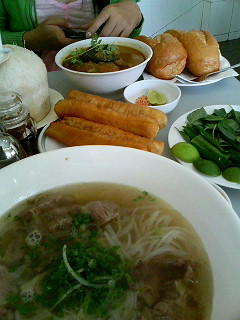
The dish in the photo which follows may look like pho, but it is not pho. I wasn't aware of it at the time, but my girlfriend Nga reckons it is hu tieu. Suffice to say, it was soup with noodles, and seafood played a major taste role. As usual there are plenty of chillies and vegetables and citrus juice to drop into the mix. And it packed in for about $1 a bowl, the standard price in these parts. And when I had finished it mouth stinging from the chillies, it was time to climb back aboard the bus, and resume the voyage to Mui Ne.

What could well be Seafood hu tieu, but could well be something else

Monday, June 29, 2009

Here's Some Saigon Streetfood Not Even Noodlepie Has Scoffed! (Vietnamese Kebabs)

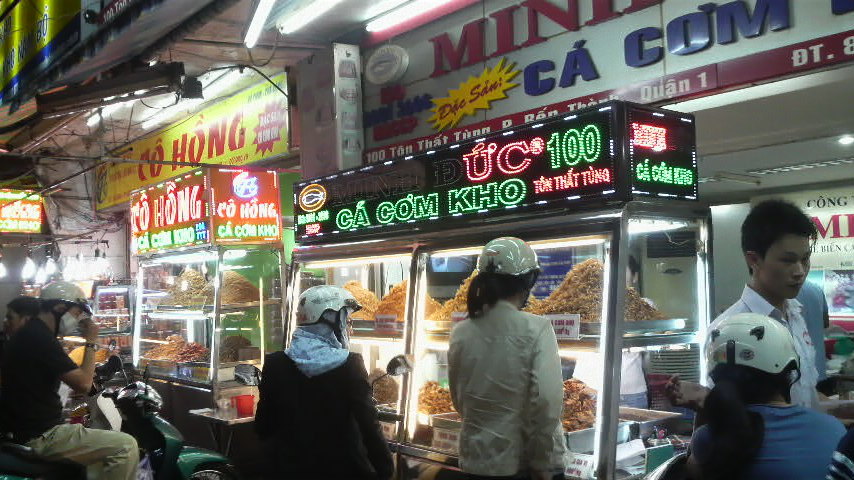
Two smiling staff work a kebab stand in central Sai Gon on a humid Monday night

ALTHOUGH TO BE FAIR TO NOODLEPIE HE HAS DOCUMENTED THE KEBAB SCENE IN FRANCE AND APPARENTLY HASN'T LIVED IN VIETNAM FOR SOME TIME, SO HE CAN BE EXCUSED FOR FALLING OUT OF TOUCH WITH THE STREETS. I first became alerted to the Indochinese kebab scene in September last year, during a visit with my parents to Hanoi. One of the first things I noticed was that they call kebabs kebaps here, or to be more precise banh mi kebap. One of the second things I noticed was that Vietnamese kebabs were not served with the customary pita bread and Mideast herbage (that's why they are called banh mi kebap!) Read The Last Appetite's review of Cafe Goethe in Hanoi for a fuller illumination of what, exactly, a Vietnamese kebab experience is all about. If you want to stray somewhat off topic you can check out my site about the kebab scene in Tokyo, Japan. They don't make kebabs with banh mi bread in Japan, but do sometimes drop wierd stuff into the pita such as mashed bananas. That happened to me one cold night near Yoyogi Park in Harajuku! For more authentic looking and tasting kebabs in Saigon, specifically in District 3, read this Gastonomy Blog review. Interestingly, the kebabs here seemed to be stuffed with chicken; Vietnamese apparently dislike the taste of lamb.
Pizza ate atop a Coop Supermarket in the center of Sai Gon

On the topic of noodlepie, I remember reading him opine once that the possibilities were huge for someone who knew how to make a decent pizza in Ho Chi Minh City. That's because the local pizzas were so poor they wouldn't stand up to the launch of a quality product. Now there may well be a tiny bit of cultural imperialism coming through in noodlepie's assertion (that there is only one way to make a pizza, and that is the Italian/American/European way). Asians have a long history of appropriating foreign foods and reinventing them for their own tastes, in their own style. When I first moved to Japan eight years ago I used to scoff at the strange pizzas there (the ones topped with mayo and squid and acres of sweet corn) and the equally bizarre pasta dishes (although I must confess I fell in love with the squid ink spaghetti, literally, at, first bite!) It took me a while to understand that Japanese pizza should not be compared outright with the pizza you find in the West, but judged as its own unique cultural product in its own ground of referents. To put it blunt, pizza can be about more than cheese and tomato sauce! Given that it's his stated mission to bridge the food worlds of the Occident and the Orient (hence the label: "noodle" + "pie"), noodlepie should understand this. That said, the sophistication of Vietnamese pizzas lag far behind those of Japan in my own experience, so I am not sure my argument really applies here. Maybe noodlepie is right -- maybe Vietnamese pizzas suck! I haven't eaten enough of them to know definitively, for sure. However, I did manage to get down a couple of slices today, just up the road from my hotel, when Nga abandoned me to go run an errand across town. Nga often tells me to wait somewhere while goes often doing stuff (in this case she was getting an injection at a local clinic or hospital!) Instead of getting indignant like I used to, on this trip I am savouring these moments of independence and imagining myself as a free spirit in Vietnam, just like I was those four days I was here in March 2007. For an hour or so the shackles of coupledom drop away, and I am free to entertain myself as I please, until she returns. It has happened four times now in roughly 24 hours: one stint in Lotteria with my shrimp and cheese burger and an Australian girls junior indoor cricket team and a hell of a general racket, two times in the street just watching the madness, and this afternoon (being Tuesday June 30 2009) upstairs in a cheap fly-infested pizza joint above our old familiar Coop Supermarket. I've been dying to eat Saigonese pizza for ages now, but Nga would never stand for it (besides, she would consider it a rip-off at more than 100,000 Dong a pizza). But when the cat's away the mice sure do play... and freedom lies on the margins of the page!

Wednesday, September 17, 2008

Self Catering in Ho Chi Minh City (Vietnamese Supermarkets)

A shopper samples some of the wares at the state-owned Co-Op Mart supermarket in downtown Saigon

HO CHI MINH CITY MIGHT BE CHEAP AS CHIPS WHEN IT COMES TO EATING OUT, BUT PRICES ARE RISING (FOOD PRICES UP ABOUT 40 PER CENT THIS YEAR ACCORDING TO ONE REPORT I HAVE READ), AND A LOT OF FOLK ARE FACING IT TOUGH. Consequently, self catering has developed a certain appeal, and it makes sense for those staying a long time, or thinking of staying a long time. Lonely Planet recommends grabbing a loaf of bread and stuffing it with white Vietnamese cheese and whatever else you can pick up at the market; Crowded World tells you there are plenty more self-catering options than that. If you want cost effectiveness and quality, take a stroll through one of the many supermarkets opening up in the city. We might consider them soulless and barren bastions of corporate greed in the west (especially in Europe), but supermarkets pack a novelty punch in Vietnam, to the Vietnamese at least, and enjoy a department store snob status. I think my girlfriend Nga likes to go to the local supermarket just to check out what is on special, have a look around, and soak up the vibe. It is a place to hang out, to see and be seen, kind of like the classic American mall of the 1980s, circa Wierd Science. Personally, while I loathe shopping at home, I have always been interested in checking out the supermarkets in foreign countries, just to see how they localize the experience. You can judge the taste and temperament of a people by the way they stock their supermarkets. In Spain, there are whole rows devoted to olives. (The security guards once picked me up for stealing a couple of them, in the city of Barcelona I believe.) In Japan where I live at the moment, you can sometimes pick up a slab of whale, perfect for a steaming winter nabe, or at the end of the day find discount trays of sushi and sashimi, or crumbed chicken or octopus or squid, which sometime work as a filler between thick slices of bread (that combo does give you indigestion though.) Apart from that, there are always plenty of mushrooms and fish, soy sauce and sake... grumpy old ladies pushing you out of the way. Icelandic supermarkets are sparse, warm and tasteful, big on bread, cheese and lamb, and numerous specimens from the deep. Go into a supermarket in London, and it is like all the culinary heritage of the world has been assembled under one roof. Moroccan sandwiches and Indian tandoori takeout and so on. I love all that shit!
Coop supermarket in District 1, Ho Chi Minh City

So, how do the supermarkets in Vietnam stack up to those of Barcelona, Tokyo, Reykjavik and London? Well, like Vietnam in general, I find them noisy, crowded, and often chaotic. Wheels on trolleys buckle, causing you to lurch. Last time I went shopping in the state owned Co-op Mart at the end of my adopted street in Saigon, I got followed round the aisles by a pervert. He stood in front of my girlfriend Nga and squeezed two imaginary melons in his hands, to symbolize her breasts. But hey, at least it is air conditioned in there, and there are some interesting things to see. Racks of durians looking like medieval torture implements. A vast array of odd fruits and vegetables, with an earthiness you can feel. No genetically modified, shrink wrapped produce here! But at the same time, no persistent touts or beggars either. And no need to bargain like you do out in the wet markets for a decent price. For complete Vietnamese Supermarkets and Self Catering story, click here.

Monday, September 9, 2008

Sawasdee Restaurant Review (Thai Food Watered Down for the Vietnamese Palate)

Thai salads at the Sawasdee Restaurant in District 1, Ho Chi Minh City

LATE LAST WEEK I HAD MY FIRST CHANCE TO EAT THAI FOOD IN HO CHI MINH CITY, AT THE SAWASDEE RESTAURANT, ON LE LAI STREET, IN DISTRICT 1. I was there with my girl Nga, my Mum and Dad, and their firends from Australia, whom I call Uncle Phil and Auntie Heather even though they aren't really my relatives. I was hoping to drink some Singha beer but they had run out at Sawasdee, and because my Mum and Dad were there, I was only allowed to drink two and a half cans of Tiger Beer from Singapore. The beer was cold... if only the food was hot enough to match it! Sawasdee occupies an entire building on Le Lai Street overlooing the park, with seating comfortably spread over a couple of floors. Beautiful Vietnamese girls wai you as move from floor to floor, something which impressed my Dad, when we visited in the dying days of the Fill In the Blanks vacation. We settled on the balcony on the top floor, where some white dude was on a date with a brown, brown Viet girl. We ordered a table of dishes, which was mostly bland, unexciting fare, big on visuals but sorely lacking on the heat factor. This is Thai food tempered for Vietnamese tastes, and somewhat pretentious to boot. I had to lecture my Auntie Heather not to eat the food with chopsticks, but how could I be so anal, when all the Viet's in the place were using chopsticks too? I was going to order the duck curry but thought I should add a bit of diversity to the table, and went for a spicy beef salad instead. I had memories of the scorching salads I had enjoyed one stoned, cloudy morning in Bangkok in August 2002, but this bland nisemono at Sawasdee HCMC didn't even come close. We all enjoyed the seafood curry in a coconut, but it eventually gave us the shits (well me, anyway.) Maybe it was from all that tuna.
The curry page from the menu at Sawasdee Restaurant in Ho Chi Minh City

As you can see, an extensive menu, with plenty of curry dishes on offer, all coming in roughly under 100,000 Dong a pop. I am still yet to devour a duck curry, which Thai's apparently go ape over. I don't think Vietnam is the place to do it though. For complete Sawasdee Thai Restaurant story, click here.

Thursday, April 5, 2007

Vietnamese Vending Machines (A Welcome Relief from the Hot Sun)

LIVING AS I DO IN JAPAN, THE WORLD LEADER OF CONVENIENCE CULTURE, I HAVE DEVELOPED AN UNHEALTHY INTEREST IN VENDING MACHINES AND THE NIFTY ITEMS THEY PROFFER. I reckon you can tell a lot about a country by browsing through its supermarkets -- or by checking out their vending machines, if they have any. In Japan vending machines dispense everything from batteries to pornos to cooked dinners and used underwear, but most of them specialize in health drinks (green tea, mineral water, Royal Jelly extracts, sports fluids, hangover remedies, the occasional can of Coke or a jumbo sized beer.) In Australia the country of my birth you will find none of this Royal Jelly or green tea nonsense -- vending machines are stuffed instead with rows of Coca Cola, chocolate and flabby potato crisps, and they will usually be broken. I reckon at least half the vending machines in Australia are broken or out-of-order when you try to use them. They will take your money though and give nothing in return, just like all the out-of-order public telephones and ticket machines at the out-of-order railway stations. The whole vibe you get from vending machines in Australia is one of disrespect... disrespect for you as the customer, a general contempt for you as a human being. In Japan the vending machines kind of celebrate you for who you are, with all your quirky habits and tastes, and prod you into spending more. Who are you to judge my interest in used schoolgirl underwear? -- the machine is not going to do that. In Australia vending machines won't even acknowledge that you have a quirk or the possibility that quirk might prove to be profitable. I might be drawing a long bow, or reading too much into things -- but anyway, that's my take on the difference between vending machines in Australia and Japan. Vending machines in Europe are pretty much like the ones in Australia. I don't know about America because I have never been there yet.

That all said: what about the vending machines of Vietnam? what are they like? Well, being such a poor country, you wouldn't expect to find many vending machines here, but I did come upon a couple during my most recent jaunt Vietside -- in the small verdant green park which runs behind the New World Hotel. The park is in itself a welcome respite from the stunning heat and oppression of the streets, with its beds of flowers and lolling couples and African guest workers; for even greater respite, sample one of the wares from these orange vending machines. On the healthy/cultured/interestingness range, Vietnamese vending machines tend closer to their kin in Japan, than the junk food dispensing monsters of Australia -- you won't find any Coca Cola or chocolate bars here. Instead, there are rows of various fruit based concoctions, strange bird soup and fungal nectars, and a square cardboard drink based on soya milk. During my last encounter with the vending machines of Vietnam, I opted for the soy.

This little beauty here was concocted by the mighty Vinamilk company, which not just romps it in when it comes to the Vietnamese dairy goods market, but is also making inroads/inserting fingers into pies as diverse as bird flu vaccine and beer. According to a recent report, South Africa's SABMiller, the second largest brewery company in the world by volume, and Vinamilk have opened a brewery in Binh Duong Province.

The story goes on: "SABMiller Vietnam Joint Venture's US$45 million facility, which began operations a few months ago, is situated in My Phuoc II Industrial Zone and has a capacity of 100 million liters per year.

"Its first beer was introduced earlier this year under the brand name Zorok.

"It is set to make others like Peroni, Pilsner UrQuell and Miller.

"All its products are distributed through Vinamilk's network.

"The listed Vinamilk is the leading producer of dairy products in Vietnam with an overwhelming 75 percent market share of milk and dairy products.

"The total beer market in Vietnam is estimated to be in excess of 1.5 billion liters a year."

Sunday, March 11, 2007

Dog Meat and Sea Horse Wine

ON A PREVIOUS POST ON THIS SITE I HAVE DISCUSSED THE MERITS OF DOG BURGERS AND CAT WINE IN THE CITY OF SEOUL, SOUTH KOREA. At the time of writing I had never personally eaten dog meat or guzzled cat wine, so I had only the third-hand account of others to go by, in the compilation of the report. Well, I still haven't drunk cat wine (or ingested any feline product, whatsoever), but tonight on the steamy streets of Ho Chi Minh City, I passed a major milestone: for the first time ever, I ate dog. And much to my surprise, dog tastes good. It kind of smelt a bit strong at the beginning, but once you were into the crunch, it tasted succulent and porky. To wash down the dog, I downed thimble after thimble of a vile brew called seahorse wine, which was to give me a magnificent hangover the following morn. I also tried my hand at eating one of those duck eggs you see in Viet with the baby ducks still in the shell (trung vit lon), but gave up after a while and spat a wholelot of cartlidge sh$t on the road.

According to the BBC: "Dog is a popular dish in the country, where it is eaten for its protein and also for good luck.

"It is particularly popular in the urban areas of the north where increasing incomes have sparked a search for new and more exotic recipes.

"At a busy restaurant in Hanoi, a woman weighs and chops up small puppies for her customers.

"There are about seven dishes featuring dog meat, and they often include the head, feet and internal organs.

"Dog meat has a strong smell and taste. It is heavily spiced and usually served with alcohol."

Have you ever eaten dog meat (or downed seahorse wine, for that matter?) How was it? If you are interested in having your experiences (or insults) published online on this blog, send me an email to bunyarra@hotmail.com. One Japanese reader, Ken, had this experience to report: "I was in Man-Gui, a small tiny village nearby Sino-Russo-Line, to taste dog in hot-pot, which was ok, not special good, just fine. How did you eat? Teriyaki or Hot-dog???" Ken runs a hotel in Tokyo and if you want to stay there, click here.

Sunday, March 11, 2007

Lotteria in Vietnam (A Japanese Success Story)

WAY BACK IN 2005 ONE JAPANESE GUY POSTED ON HIS BLOG WORDS TO THIS EFFECT: "BETONAMU NI WA, MAKUDONARUDO GA NAI KEDO, LOTTERIA GA ARU!" ("IN VIETNAM THERE IS NO MCDONALD'S -- HOWEVER, THERE IS LOTTERIA!") It is a strange quirk of history and fate that if you visit Vietnam today, the only chain place you will find selling western style hamburgers will be not McDonalds or Burger King or Fat Burgers or the Big Kahoona Burger or those million other US exports, but Lotteria Cafe (origin Japan.) For complete Lotteria in Vietnam story, click here.

Saturday, March 10, 2007

Even Cheaper Than Cheap (In Vietnam)

LET'S FACE IT VIETNAM IS A RIDICULOUSLY CHEAP COUNTRY -- THIS IS THE LAND OF THE $1 PUB CRAWL, A PLACE WHERE $15 TO $20 WILL GET YOU A DEDICATED TAXI + DRIVER FOR THE WHOLE DAY. For a foreigner visiting or living here, the cost of life is peanuts. That all said, I have been surprised since arriving back here yesterday, that for the determined scammer even cheaper than cheap options are available. What do I mean by "cheaper than cheap" possibilities? ... well, basically freebies, and five fingered discounts for those so inclined to take them. For example, down in the center of Ho Chi Minh City near the Sheraton Hotel there is a Government Post Office run Internet cafe -- full of gleaming new computers -- which is completely free (for up to 30 minutes.) Now given that commercial Internet cafes charge a heady one cent per minute for access, I wondered why the Government would even bother offering free Net use. There were no poor Vietnamese in this brand spanking new Internet cafe gratefully accessing the world of online opportunity -- no the only people inside were rich foreign freeloaders.

Bo Vien meatball pho near the New World Hotel in Ho Chi Minh City Today I stopped for lunch at the Dai Phat Phở restaurant near the New World Hotel (275 Le Thanh Ton St, phone 08 829 7292.) As you would expect, the specialities here included pho: specifically Hu Tieu Bo Vien, Hu Tieu Nam Vang and Cac Mon An Hoa Thuan Tuy. I ordered the Bo Vien meatball bowl which came with an array of leafy vegetables, garlic and chillies. I made the mistake of eating one too many of those chillies and got a right sting in the mouth for my troubles. But that is par for the course when dining in Asia! The remarkable thing about Dai Phat, however, was my great trouble in paying the bill there -- an experience which was soon to be repeated at various other Vietnamese restaurants and bars and cafes. It is almost as if the waiters and waitresses are programmed not to want to take your money. I put up my hand, I tried to wave the waiter over, all to no avail. I put on my backpack, stood up, but the waitstaff continued to ignore me. Eventually I decided that if I started walking for the door, that might shock the staff into action. As I crossed the room they barely noticed or acknowledged me, even though I hadn't paid for the wonderful meatball soup they had dished up for me. As I reached the door one of the waiters smiled and said: "Goodbye, sir." They didn't even know that I hadn't paid! I paused on the threshold, thinking: I could get away with not paying. I could scam this. But since the meal would only cost a dollar or two, why would you bother? So I did the right thing, and confessed: "I haven't paid yet." And the dumbfounded waiter replied: "Oh, what you ordered then?"

I had the same trouble convincing the waitstaff to take my money later that afternoon at the Highlands Cafe in the swish Saigon Center, and at some of the bars in Pham Ngu Lao district. The strange thing about Vietnam is that for such a poor country, they have such lousy skills in collecting (and enforcing) payment. It is like they don't even care about money. That could be because it is (at least nominally) a communist country, so employed staff have no real grasp of service in a capitalist style venture like a restaurant or bar...

Friday, March 09, 2007

39 Cafe Saigon (A Symbol of Changing Vietnam)

ON THE WAY BACK TO MY HOTEL IN HO CHI MINH CITY TONIGHT, I ENJOYED A SECOND DINNER AT A CLASSY ESTABLISHMENT CALLED 39 CAFE. With a balcony overlooking the boulevard and Vinh Quang Cinema... I ordered abalone covered beef here which tasted okay (not too bad, but nothing special.) However, according to a story I found in the Christian Science Monitor, this restaurant serves as a symbol of the changing face of socialist Vietnam. Back in the 1960s during the Vietnam War, the address 39 Le Loi St was home to correspondents from the Christian Science Monitor newspaper. Revisiting the address in 2005, one of the correspondents wrote: "Now, more than 30 years later, I can tell the previous occupants of the apartment that the address lives on in high style. As you peer up from Le Loi, still swarming with motorscooters, you will note a large sign, "39 Cafe." The gaping door to the garage is still there, but at the bottom of the remodeled stairway is a modern elevator that carries you two floors up to a restaurant and cafe complex with real pretensions of elegance.

"The cafe fills not only our old apartment but two or three others, and a sweeping balcony provides a view over much of the center of the city. Monitor correspondents will be relieved to know, however, that the noises from below, the fumes from the rushing vehicles, the popping and puffing of motorscooters, remain much the same.

"After years of war and the long, uneasy transition from old to new order, 39 Le Loi not only survives but endures -- a symbol of change and possibly progress. When I tried to explain the meaning and memories of the apartment to the nightclub manager, though, she was polite but not impressed. She acknowledged what I told her with a smile, then asked if I wanted to order a drink from a long list on a menu. I ordered a thick black Vietnamese coffee, over ice, for about $2, gulped it down, and left."

Friday, March 09, 2007

I Am Back in Vietnam (And This Place Sure Has Changed)

WELL, I AM BACK IN HO CHI MINH CITY VIETNAM -- AND THIS PLACE SURE HAS CHANGED! I am also pleased to say that I cured my fear of flying today after my flight from Tokyo to Ho Chi Minh City, which took place aboard Vietnam Airlines. In the past couple of years, I had begun to develop a morbid paranoia regarding air travel, even though statistically it is the safest mode of transport around. Every time we hit turbulence on the way to Mumbai or Reykjavik, I would clutch the armrests in mild terror. It is kind of stupid, but that was how I was. Ever since I read that Naomi Campbell said that she enjoyed jet travel because that was the only time she could really relax, I have been keen to kick my air travel paranoia. And it all ended today. In fact, I enjoyed the flight so much I wanted to stay up there in the sky all day, just "cloud surfing", as my old friend Matt Tumbers put it. I was in good luck on this Vietnam Airlines flight because I had a whole row of seats to myself, allowing me to slump cosily against the window, bathed in warm sunshine (it's always sunny up there once you punch through the cloud cover!) It was all very comfortable and just like Naomi said, you do really feel removed from the problems of the world up there. If I was rich and had my own jet I would spend my life just cruising the clouds, drinking champagne and dropping in at cool cities which I dig -- but I guess people would call me a Global Warming terrorist. Anyway, it was a very pleasant flight and even when we hit a batch of turbulence over The Phillipines, I just shrugged it off -- and went back to sleep.

But now I am back on the ground in Vietnam and in fact I have a date lined up on Sunday (however, she wants to bring her friends along). More about that later! One of the first things which struck as I disboarded my flight (apart from the humidity of course), was the undeniable evidence that Ho Chi Minh City has changed over the past 10 years. When I first jetted in here as a young innocent in 1995, this city was so crazy and primitive I hid like a mouse in my hotel for the first night, too scared to even go outside. Whenever you went to a restaurant in the Pham Ngu Lao backpacker district back in those days, you would get eaten alive by hordes of postcard salesmen, beggars and shoeshiners. You couldn't walk around the block without being verbally harrassed by a chorus of cyclo drivers and taxi touts. The cyclo drivers and taxi touts and shoeshiners and hammock and book salemen/ladies are still here of course, but the difference now is, they take no for an answer. Unlike in the Vietnam of 1995 -- and unlike present day India. Tell them you don't want to go on their Ho Chi Minh City tour or that you don't want to buy their postcards, and they will accept that -- they won't complain or abuse you or follow you around the rest of the day, trying to change your mind. I like that. Perhaps that is a sign that Vietnam has become richer as a nation -- or perhaps the millions of backpackers and travellers who have been through the place since 1995 have educated the Vietnamese on international street business etiquette. If someone wants or needs to buy something, they will buy it. Abusing the customer or stalking them around town all day (as what happened to me in India in 2005) never gets you the sale -- it only pisses everyone off. Surely I am not alone in thinking that!

Apart from the evolution in tout and street hustler behaviour, the skyline of Ho Chi Minh City has also evolved -- upwards. Particularly in the Pham Ngu Lao backpacker district and the downtown area, this city is starting to look like a little Singapore. I have got a photo back in my bedroom in Japan of me drinking with a European woman (maybe Swiss) and an Asian-American guy in bar at the corner of Pham Ngu Lao and De Tham Streets in the middle of 1995. That bar is gone -- it has been turned into a Japanese Lotteria hamburger restaurant. The yellow wall you can see in the background of that photo is also history -- it has been knocked down or whatever and replaced by a beautiful green park. On humid nights lovers and African guest workers can be seen frolicking in the park, hemmed in on both sides by the din of streaming motorbikes. What a cool place Ho Chi Minh City is becoming!

As soon as I had found a hotel in Pham Ngu Lao and had dropped my bags off there, I was keen to challenge Saigon's famous dining scene. I didn't have any particular destination in mind, I just started walking. My first port of call was the Trung Nguyen Cafe, situated on a busy intersection opposite the Van Canh restaurant (perhaps it is on the corner of Nguyen Thai Hoc St and Tran Hung Dao Avenue -- anyway, it is in that general part of town.) I ordered deep fried beef and a Tiger. I flirted with the cute waitress as she tried to squat a fly which kept bothering my food ("You're never going to catch it -- those flies have eyes in the backs of their heads!" I implored.) Nearby me, what looked to be a Singaporean family purveyed the extensive selection of Vietnamese coffee beans on display, in a corner of the cafe.

I didn't know this at the time, but it turns out that Trung Nguyen Coffee is actually one of the big coffee companies in Vietnam, and that the Trung Nguyen Cafe chain is Vietnam's answer to Starbucks! As Greenspun has reported: "Capitalizing on an emerging, affluent middle-class and the simple attractions of aromatic coffee, 31-year-old entrepreneur Dang Le Nguyen Vu has successfully launched Vietnam's first nationwide franchise.

"Call it Starbucks, Vietnam-style.

"Over the past four years, Vu's chain of Trung Nguyen cafes has grown to more than 400 outlets in all of Vietnam's provinces, from the busy Ho Chi Minh City to rural of Sapa on the northern border. In Vietnamese, Trung Nguyen means "Central Highlands", an area famous for its coffee, and Vu now wants to spread the reputation of his coffee label well beyond Vietnam's borders.

"'I want to have the Vietnamese brand name of Trung Nguyen well known in the world. Our coffee is good. There's no reason we can't do it,' Vu said.

"Bold words, but Vu has already bucked the odds by successfully operating in a communist country that still favors state-owned enterprises over private business.

"Trung Nguyen's wildfire growth in Vietnam, the world's second-largest coffee exporter, is testament to Vu's vision, not to mention the notable absence of a certain coffee giant.

"Although Seattle-based Starbucks has made sizable headway in the region, in Japan, Thailand and China, among others, it still has no presence in Vietnam. High tariffs on imported roasted coffee ensured the dominance of the local coffee industry and an opportunity for an enterprising medical student..."

I didn't know this at the time, but apparently Trung Nguyen Cafe is a good place to sample one of the best coffee brews in the world -- the notorious Vietnamese weasel shit coffee. Anyway, I really love Vietnamese coffee but I was scared of sampling the wares at Trung Nguyen Cafe today, because strong caffeine tends to give me migraines. More about this disturbing handicap of mine later! The beef dish was great nonetheless and I hope to return to the cafe later, to see if I can get some of that weasel shit brew!

For the complete evolving guide to the coffee shops of Saigon and Ho Chi Minh City, click here.

Sunday, March 04, 2007

Changing Face of Ho Chi Minh City (Otherwise Known as Saigon)

HO CHI MINH CITY IS WITHOUT DOUBT ONE OF THE CRAZIEST CITIES IN THE WORLD, AND CAN BE TOUGH GOING EVEN FOR THE MOST EXPERIENCED TRAVELLER. The first time I came here back in mid 1995 I was so culture shocked that I hid like a mouse in my hotel room for the first night, too scared to venture outside. Mind you that happened on my first night in India as well, which shows that Vietnam is at the Indian level when it comes to a guaranteed culture shock and the general insanity of the streets. This is one insane place, but it is its good points, and food is one of them. Having been to Mumbai, I wouldn't necessarily call Ho Chi Minh City the best city in the world for food, but it is far from being the worst. There are plenty of good places to dine, and the prices are very competitive. Another point is that Vietnamese food is extremely exotic, by our modern/postmodern western standards -- you can find restaurants serving nothing but dog meat in Ho Chi Minh City (and these restaurants are often fully packed with diners!) On previous trips through Vietnam I have been offered snake, wild boar, rat jerky, and opium. Yes, this is a wild country and a wild city. I can't wait until my next trip there!

For the beginner: what is Vietnamese food, basically, and what kind of food can I expect to find in Vietnam's brash southern urban center? Like all South-East Asian food, rice is pivotal in many Ho Chi Minh City meals, as are noodles, soup and prawns. If you wish to try out some of the local specialities, these include cha which is pork paste boiled over hot coals, ech tam bot ran which is frog meat in batter fried in oil, and bo bay mon which are sugar-beef dishes.

Anyway, here is a list of some of the places to eat in Saigon, covering all kinds of cuisine, from rice and noodles to dog soup and Japanese hamburgers, and all price levels, from the street stall to the luxury hotel restaurant, from all over the city. Let's go!

For a more detailed guide to the pho restaurants and general pho scene of Vietnam, click here.

b a n h + t r a n g

BANH TRANG HAS BEEN CALLED THE VIETNAMESE EQUIVALENT OF RAVIOLI SKINS": IT IS THE THIN TRANSLUCENT RICE PAPER THEY WRAP VIETNAMESE SPRING ROLLS IN. Since even people in the reluctant West go for sping rolls, banh trang is eternally popular. The basic idea is to wrap banh trang around some meat and a suprisingly wide variety of vegetables and leaves. Many of these leaves are not ordinary agricultural specimens at all, but wild weeds plucked by old women on the banks of polluted rivers! Thus there is a health factor to consider eating the more exotic kind of banh trang, but all up I consider the health benefits to outweigh the risks -- some of those strange tropical weeds must contain some potent vitamin combinations and rare nutrients!

I read a story recently on noodlepie concerning one particular elaboration of bang trang which goes in for liberal leafage: this particular critter is called banh trang phoi suong. In the article, noodlepie scoffs his fill at a Saigon restaurant called Quan Co Tam - Banh Canh Trang Bang (at 188 Nguyen Van Thu Street, Phuong Da Kao, District 1.) It is a restaurant which is big on leaves (one item definitely neglected in our modern food lives.) As noodlepie wrote: "This is one of my favourite dishes in Vietnam, Banh trang phoi suong (literally means "rice pancake exposed in the dew (at night)". It's so simple it's rude. Centre stage we have thin slices of boiled pork, nothing fancy going on, just the pork. The surrounding action has the pork trapped, no escape from a fate worth scoffing. Rustic style rice paper, a sweet nuoc mam (fish sauce), pickled carrots and onion-leek type thing, raw beansprouts and lengthways sliced cucumber. And then comes that mighty herb trough. Trang bang, by the way, is the name of the province the dish comes from.

"That's a gargantuan set of greens in anyone's book. It's like no other platter on the Vietnamese table. A plate of this stuff will bring the David Attenborough out of anyone. Dig, delve and forage-mungussly good. Pluck a few leaves of what you fancy, sling them in a rice paper along with your meat, and whatever else you can squeeze in, roll, dip and nibble, munch or hog. I hog, you're probably a bit more polite..."

For the full story, click here.

Acient Town: 211 Dien Bien Phu Street, Dist. 3. Phone: 829 9625.
Mid-range level, Vietnamese cuisine.

Bamboo Chopstick: 594 Ba Hat Street, Dist. 10. Phone: 855 6820.
Some of the world's finest bamboo comes from Vietnam. Much of it gets turned into chopsticks to feed the millions of people who live in this land. Bamboo Chopsticks is also the name of this mid-level restaurant in the 10th District of Ho Chi Minh City (Saigon), whose menus are packed with Vietnamese dishes and goodies. It it is worth checking out.

Image copyright Eating Asia Bun Bo Thanh Noi Hue: 47A Tran Cao Van, near Ben Thanh market. Phone: 829 9473.
As the legendary and well versed Eating Asia wrote: "There's a certain little place down a small alley near Ben Thanh market that serves a mean bowl of tasty bun cua (rice noodles and crab "paste" -- or crab ball -- soup). But I'm not going to toot it's horn here. Call me fussy, but if I grace a table at the same eatery every single Saturday and sometimes Sunday too, for 8 weeks straight, yet still can't elicit so much as a stone-faced nod, or even timely delivery of a packaged wet nap to wipe my grease-smeared mouth, then that's it -- I'm outta there!! Deliciousness is a top consideration, of course ... but a smidge of welcome doesn't hurt.
"The gals waiting table at Bo Thanh Noi Hue deliver in the friendliness department, it's centrally located (a short stroll from Saigon's "Notre Dame" cathedral), and the bun cua is at least as tasty -- if not more so -- than the version served at that "other" place.
"Some of the menu items worth sampling are the cha gio cua (crispy, admirably grease-free spring rolls packed with crab meat), served with the same dainty basket of greens 'n herbs, rice vermicelli, and a dipping sauce of fish sauce, sugar, and daikon radish)..."

Bun Nuoc Leo Soc Trang: 11 Phung Khac Khoan, District 1. Phone: 825 8525.
As my friend J. points out: "Last time, I forgot to tell you about the special food in Tra Vinh. Indeed, there're a lot of delicious food but I like "Bun nuoc leo"(Vermicelli with Savory Broth) best. It can be said that Tra Vinh province and Soc Trang province are two "Capitals" of "Bun nuoc leo". "Bun nuoc leo" is a kind of food which is charming with the Khmer's character. As I know, there're some small restaurants in Ho Chi Minh City where you can eat this kind of Vermicelli. But I've never ever tried it in Ho Chi Minh City before, I just eat it when I get back to Tra Vinh Town :). I think you should eat "Bun nuoc leo" once...it's really delicious!

Cati Club: 46-50 Dong Khoi Street, Dist. 1. Phone: 823 8309.
Luxury Vietnamese cuisine.

Cay Xoai: 15A Thi Sach Street, Dist. 1. Phone: 822 6227.
Featuring seafood and mid-range priced Vietnamese cuisine.

Com Nieu Sai Gon: 6C Tu Xuong Street, Dist. 3. Phone: 820 3188.
Mid-range Vietnamese restaurant. Along with many places listed on this website, this restaurant is bound to serve pho, which is effectively Vietnam's national dish, and is in effect a fragrant bowl of broth with beef or chicken, noodles, spring onions, bean shoots and a garnish of fresh herbs. Traditionally eaten at breakfast, it can be enjoyed at any time of the day...
For the full Com Nieu Sai Gon restaurant review, click here.

Hoa Binh Restaurant: 145 Xo Viet Nghe Tinh Street, Binh Thanh Dist. Phone: 899 6151.
Mid-range level cuisine, Vietnamese food.

Golden Eyes: 65 Cao Thang Street, Dist. 3. Phone: 834 2808.
Mid-range Vietnamese restaurant.

Empress Hotel Restaurant: 131 Bui Thi Xuan Street, Dist. 1. Phone: 832 2888.
Newly-built in 1996, the Empress is a small, modest hotel whose hallmark is service. While not luxurious, it boasts some upscale touches like terra cotta tile and marble. Rooms are cozy but well laid out. The Empress Hotel is conveniently located in district 1, Ho Chi Minh City. Close to the city center, between the bustling downtown area and exotic China Town, the Empress is within easy walking distance of the central business district.
With 40 rooms the Empress Hotel is a charming, small hotel located just 5 minutes by taxi to the downtown. Deluxe rooms are cozy but well laid out, with two twin or one queen size bed. More spacious are the suites, with a small living room and seperate bedroom. The Empress also boast a small fitness center, business center, coffee shop, bar and restaurant, every bit as cozy as the guest rooms.

Lau Mam 140: 140/13 Tran Huy Lieu, F15, Phu Nhuan District. (Off Nam Khy Khoi Nghia Street, halyway between the airport and District 1.)
Specializes in bun mam (fermented fish noodle soup). According to Eating Asia who lived for a while in Saigon, and dined at this restaurant (and in my opinion, she knows much more about Vietnam and food in general than me -- get the hell off my website, and get the hell on hers!): "A plate of lotus root salad with shrimp and pork (goi ngo sen tron tom thit) kept us busy while we waited for our bowls of bun. It's a Vietnamese restaurant standard, and this version served well as a diversion, but we were there for the bun. It arrived, in over-sized soup bowls -- an odoriferous combination of thin rice noodles and a broth of dried snake head fish thick enough with fish shreds to qualify as gravy. Floating among the noodles were cooked snails, squid pieces, and prawns, as well as the occasional chunk of eggplant. Lau Mam 140 lightly blanches the herbs and vegetables accompanying their bun mam -- a nice touch. On our plate we found bitter rau om, or paddy herb, bean sprouts, purple lotus stem, and chunks of a light green, spongy stalk (resembling celery but larger and rib-less) that I've yet to identify. Lime slices and fresh chilies add a bit of zing..."

Ngoc Suong: 19C Le Quy Don St.
Great seafood. This is where the international stars come to get their Viet fix.
Average dishes come to around US$12 or so. The fish and shellfish are particularly fresh at this popular restaurant. The majority of the dishes are Vietnamese specialties. Shrimp may come raw, steamed with beer or in coconut juice (US$14 a kilogram). There is also a smattering of Western preparations -- lobster Thermidor (US$50 a kilogram) and Coquilles St. Jacques (French style baked scallops, US$4).

Ngu Binh Restaurant: 82 CX. Nguyen Van Troi Street, Phu Nhuan Dist. Phone: 844 7230.
A luxury restaurant serving Vietnamese cuisine.

Phu Xuan Restaurant: 128 Dinh Tien Hoang Street, Dist. 1. Phone: 820 0329.
Prices in the mid-range. food on the table is Vietnamese.

Mandarine: 11A Ngo Van Nam Street, Dist. 1. Phone: 822 9783.
One of Saigon's luxury restaurants serving quality Chinese food.

Ra Khoi Restaurant: 5 Me Linh Square, Dist. 1. Phone: 821 6096.
Mid-range restaurant focussing on Vietnamese dishes.

Tan Nam Restaurant: 60-62 Dong Du Street, Dist. 1. Phone: 829 8634.
Mid-range Vietnamese dishes.

The Temple Club: 29-31 Ton That Thiep Street, Dist. 1. Phone: 829 9244.
Mid-range Vietnamese food.

Thanh Tam Restaurant: 24 Truong Dinh Street, Dist. 3. Phone: 829 1610.
Mid-range Vietnamese food.

Van Ho Restaurant: 72 Nguyen Thi Minh Khai Street, Dist. 3. Phone: 825 8842.
Mid-range Vietnamese cuisine.

Tri Ky Restaurant: 478 Nguyen Kim Street, Phu Nhuan Dist. Phone: 844 2299.
Mid-range Vietnamese cuisine.

VY Restaurant: 105 Yersin Street, Dist. 1. Phone: 821 4761.
Luxury restaurant serving a dominantly Vietnamese selection of dishes.

Hideaway Cafe: 41/1 Pham Ngoc Thach Street, Dist. 3. Phone: (08) 822 4222
This somewhat out of the way place is managed by a Vietnamese woman who grew up in Brooklyn, New York, Christine Van. Her experience with both cultures (ie both East and West) has created an awareness of the expectations brought to the table by both Vietnamese and foreign clients.
As the good folks at Vietnam Tourism Info write: "The first thing that strikes one about Hideaway Cafe is that the name fits. Nestled down a small laneway off Pham Ngoc Thach Street in Ho Chi Minh City, Hideaway is tricky to find. And sitting in a generous armchair in the light-filled, Moroccan-inspired dining room, really does feel like being in a haven; far from the noise and havoc of the streets out­side. Very appealing. I predict long after­noons over cups of coffee or freshly squeezed juices, maybe even a deca­dent cake or two; the owners installing WiFi in the building means I could work on my laptop here too!" H20 Restaurant: 216 Pasteur street, Dist. 3. Phone: 08/824 3261.
The menu in this place comes complete with a nutrition guide and a calorie count with every meal -- an idea they should start employing in American restaurants, given the huge weight disparity between the United States of America and the Socialist Republic of Vietnam. This establishment in District 3 is being touted as Ho Chi Minh City's first true health food restaurant, and the emphasis in on vitamins and low calories. As Anh Thu reported: "If you're a bit overweight, you may be interested in taking a close look at the menu's detailed information on each dish?fs calorie count and vitamin content.
"'I like Australian beefsteak with chips, but I had to say no when I discovered the dish's calorie count was 560," said Tran Thanh Nguyen, a recent guest at the restaurant.
"Nguyen chose a rice soup called pineapple leaf and crab rice soup because 'the charming waitress advised me to buy the dish, and with only 280 calories, it's suitable for my diet.'
"Cooked with pineapple leaves, the sweet-smelling soup costs VND12,000 (less than US$1).
"Nguyen says the dish made her feel as if she had 'a sweet sensation in the chest,' a good choice for summer's hot temperatures.
"For those in need of a more nourishing dish, the ginseng crab rice noodle soup is delicious and at VND25,000 has only 360 calories.
"'Using traditional medicinal herbs, including ginseng, dried dates, ginger and garlic, we provide customers with meals that are nutritious and have different treatment uses,' waitress Hoang Anh said.
"Opened since 1996, H2O was named after its owner Viet Hai. His given name, Hai, means sea, denoting water, of course."

e x o t i c + m e a t s

YES, HO CHI MINH CITY IS ONE OF THE BEST PLACES IN THE WORLD TO LOOK FOR WHAT I LIKE TO CALL EXOTIC MEATS -- I AM TALKING OF COURSE ABOUT SUCH SUCCULENT FLESHTYPES AS DOG, CAT, RAT OR BAT. All of these animals are eaten in Vietnam and have their fans among all strata of society. Now I know a lot of folks out there find the consumption of exotic meats strange and obscene. Some people in the West (and also some people in the East) are passionately opposed to the eating of some animals, particularly dogs and cats. I don't want to get into any fights about this issue, it's not worth the aggravation. I just think that travelling should be about opening your mind, and if you want your mind opened, Ho Chi Minh City will split open wider and faster than any other city on Earth. It is good to challenge yourself and exercise your morals a little sometimes. You should take a leaf out of the book of this guy, fellow Aussie, who while travelling in Vietnam was game enough to try the local delicacies:

We visited Cholon, HCMC's bustling Chinese district, and after stopping at one of the many ornate pagodas and a lacquer ware factory, David decided to try a uniquely Vietnamese lunch at one of the area's dog meat restaurants (and if you're wondering, dog tastes somewhat like pork!)

On a more serious note, Ho Chi Minh City is also one of the world leaders in the cosumption of wildlife meat. The Economy and Environment Program for Southeast Asia (EEPSEA) wrote in 2003: "The total estimated volume of live and wildlife meat in and out of Vietnam is about 3,050 tonnes per year, of which about half was for domestic consumption. Trade in wildlife meat accounts for 80% of the total and this is concentrated in Ha Noi and Ho Chi Minh City. The total revenue and profit from illegal wildlife trade in Vietnam are estimated at USD 66.5 million and USD 21 million per year, respectively. In the study sites alone, the estimated total profit is eight times the expenditure on monitoring and enforcing. In the entire country, the estimated total profit is 31 times higher than such expenditures (USD 634,000 to USD 700,000); more than three times the total budget of Forest Protection Department staff (about USD 6.5 million), and four times the total fines collected (USD 5.5 million) per year. The estimated total revenue from illegal trade (USD 66.5 million) is 12 times the total revenue from legal wildlife trade (USD 5.2 million) per year. The study estimated that the average value of official confiscated live wildlife and wildlife meat from 1997 to 2002 accounted for only 3.1% of the total value of illegal wildlife trade per year.

"The main domestic sources of wildlife species in Vietnam are protected areas. The main international sources are Laos, Cambodia, and Myanmar. Both sources travel along Road 1A to Ha Noi, and Ho Chi Minh City markets. From Ha Noi, wildlife species travel out to China through Mong Cai-Quang Ninh, and Lang Son...

"The most popular species are snake, turtle, bear, bird, pangolins, and monitor lizard."

Wildlife or partial wildlife meat restaurants in Ho Chi Minh City are mostly concentrated on Phan Viet Chanh Street. The estimated wildlife meat consumed in the city is about 465 kg valued at VND 116 million (USD 7,750) per day. The favored wildlife meats are those of forest deer, forest pig, pangolin, musk deer, palm civet, monitor lizard and muntjak. These are sourced from Laos, Plateau, Cambodia, the Central subsite and the Mekong River Delta. Although Ho Chi Minh City has 37% of the total number of restaurants in the South subsite, the total revenue and profit is about 79%. This is because of the larger scale and higher price in the area.

If you are game (no pun intended!), then here are some of the strange meats you can eat in Ho Chi Minh City, how to get there, and some of the alleged health benefits that these dishes provide:

Bo Tung Xeo: 81 Ly Tu Trong Street (near the riverfront.)
This is said to be a good place to go to sample scorpions, according to at least one reviewer, Kimmo V. Of course, they have other foods at this place, but scorpions are one of the more unusual additions to the menu -- and one absolutelty not to be missed! Kimmo V writes: "Big hall in two floors, hundreds of seats, noisy, living, crowded and amazing amount of service stuff! The food is extremely good, service is fast and polite and the prices are dirt cheap compared to quality of food and size of the dishes. Extremely good value, also mentioned in Lonely Planet book.
"Well, you really have to try almost anything. Scorpions tastes like pop-corn, really! You can eat the whole scorpion, cause the poisonous parts has (sic) been removed. The body of the scorpion isnt as good as the other parts, so eat the the legs and siccors first... "

Luong Son Restaurant: 31 Ly Tu Trong Street.
Said to be a lively and popular place, especially renowned for its barbeques. As well as some more delicious beef barbecue dishes such as Bo Tung Xeo, the restaurant also does a little walk on the exotic meats side. Inside the restaurant are tanks full of live scorpions and snakes.

There is more to the exotic meat market scene in Ho Chi Minh City than wildlife meat. Farmed exotic meat --particularly frog meat -- is really taking off. The interest in frog production in Vietnam is growing by leaps and bounds (once again pardon the pun -- and this time the pun is not mine -- it comes from SUSPER). Frog is a popular food in the country, where it is generally eaten in the form of frog legs and frog soup. It is a healthy meat that is low in cholesterol. As consumer worries over bird flu continue, the demand for frog is expected to rise here and abroad.

Thai frog is a special type of frog introduced from Thailand that is easy-to-grow with minimal costs. The large, brown, bumpy-skinned frog has quickly emerged as an attractive enterprise for farmers.

BLOGGERS CHOICE:

Professional food photographer and exotic meats connoisseur Owen Franken sounds like a man I would love to have by my side on a southeast Asian dining challenge -- on his blog he recounts munching spider and scorpion noodles on a Bangkok street with his 15-month-old daughter (and his daughter allegedly took a liking to the spider and its shrimplike flavor, according to Franken!) One month later both father and daughter dined on roast wild cat in neighbouring Burma! "We think it was lynx," wrote Franken with complete Politically Uncorrect aplomb. "It was too small for snow leopard." And out of habitat, because there are not too many snow leopards in tropical Burma!
When in Vietnam, Franken consumed dog sausage in Hanoi... and had this to say about a mystery exotic meats restaurant in Ho Chi Minh City: "There is also an amazing menagerie restaurant of wild animals outside of Ho Chi Minh City. Cages rather than menus, kind of like going to the zoo for dinner. I remember keeping it simple and having cobra, rather than fruit bat. A large fruit bat, I discovered, has a very cute face, hard to imagine eating it. On the other hand, I love rabbit. I make a mean rabbit with olives, although the best was made for my birthday dinner by the wife of a Tuscan ceramic artist..."

s w e e t + s t u f f

SOME OF THE SWEETEST SELECTIONS IN SAIGON/HO CHI MINH CITY, GOOD PLACES FOR DESERT AND JUICE AND WHATNOT:

Kem Bach Dang: 26-28, Le Loi Street (opp. Russian Market), Dist. 1. Phone: 829 2707.
I am only a beginner at Vietnamese but my guess is that "Kem" in this name means "cream" or "ice cream". I could be wrong though so I don't want to bet a testicle on it! Now this is a good place to go uf you like ice cream and sweet sh=t, but be warned, the prices are not cheap -- arasnosliw in one of his/her articles claimed?@some items on the menu creep towards US$10, which is a ripoff in Vietnam. Nonetheless, I have never been a sweets lover. Arasnosliw is, and he/she said in his/her article: " by arasnosliwThis is some of the best ice cream in Saigon. There are lots of exotic flavors, making this place an ice cream lover's paradise. Toppings consist of many fresh fruits. This is a long withstanding shop within proximity to Ben Thanh Market. It is always swarming with people, so it is hard to find a table. Service is quick, the staff is efficient.
"Coconut ice-cream comes in a young coconut shell topped with strawberries, dragonfruit, raisins and longan. If you are not that adventurous, there is plain and simple choices available."

v e g e t a r i a n + c u i s i n e s

DESPITE BEING A BUDDHIST COUNTRY THERE ISN'T A LOT OF VEGETARIAN FOOD IN VIETNAM -- BUT THERE IS SOME, AND I WANT TO INFORM ABOUT THE BEST PLACES TO GO. Here is the latest selection:

Com Chay Nang Tam: 79 bis Dien Bien Phu, District 1.
One of the new vegetarian eateries in the city, and becoming popular, especially among foreigners. It boasts some classic pieces of vegetarian kitsch on the menu -- fake chicken and beef made from soya, for example. Nonetheless, the food is said to be excellent -- and costing under 40,000 Dong a dish. Grover Reidi wrote in Vietnam News: "The food, like the restaurant, is simple and well-presented... The sweetcorn cakes and snowballs stole the show. The sweet-corn cakes have a creamy flavour and smooth texture, well complimented by the lightly breaded and fried crust. Honestly, when you say sweetcorn I can only think of babyfood puree. But this was definitely adult food, solid but viscous, just sweet enough, with a lasting aftertaste."

Giac Duc: 492 Nguyen Dinh Chau, Dist. 3.
Chau from America says this place has the best vegetarian food in town.


UNCLONED WORLD
Contact us by email:
coderot@gmail.com  
phone: (090) 6039-9341 (JAPAN)