|

On
January 5, 1925 the field was officially named
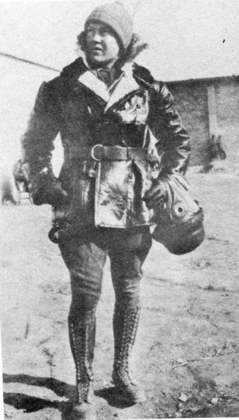
"Biggs Field" after Lieutenant James Berthea
"Buster" Biggs. Lt. Biggs was an El Paso
native killed in a plane crash October 27, 1918 at
Beltran, France.
On June
30, 1926 the original Biggs Field was closed and
Camp Owen Beirne was renamed Biggs Field on
July 1, 1926. Camp Owen Beirne had been a
National Guard post and was the location of the
large airship hangar that would be a Biggs landmark
for many years.
Between the two World Wars, Biggs served as a refueling stop for transient aircraft, but during World War Two it became a hub of training activity for B-17, B-24 and B-29 crews. The base came under the command of the 2nd Air Force and was headquarters for the 20th Bombardment Command. In 1945 a detachment of B-29s from the 16th Bombardment Operational Training Wing arrived at the base.
With the end of WW II the 16th BOTW was deactivated and Biggs became home of the 19th Tactical Air Command, with the 20th Fighter Group and the 471st Air service group taking up residence. These last two units left Biggs for Shaw Field, South Carolina in 1948. On February 1, Biggs Field became Biggs Air Force Base. The 47th Bomb Wing and the 544th Air Service group moved from Lake Charles, Louisiana in October of that year. The 47th only stayed until December, 1949, when it left for Barksdale AFB.
Biggs AFB became a Strategic Air Command asset when the 97th Bomb Wing moved to the base from Smokey Hill AFB, Kansas, in May 1948. In 1950, the 1st Strategic Support Squadron was assigned to Biggs, and on June 10, 1952 the 95th Bomb Wing was activated. To administer the groups the 810th Air Division was also activated in June, 1952. During this time, the various units operated B-29s, B-50s, B-36s, B-47s, B-52s, C-97s, C-124s, KC-97s and KC-135s to name a few.
From 1939 until 1966 one unit was based at Biggs, changing designations several times. That unit was at various times the 1st Tow Target Squadron, 6th TTS and finally the 4758th Defense System Evaluation Squadron. In its lifetime, the 4758th starting with a lone B-10 in 1939 operated at various times: A-26s (which the USAF redesignated B-26s), C-47s, T-6s, F-80s, B-29s, B-45s, B-57s and F-100s.
The 1st SSS
was deactivated in 1959, the 97th BW moved to Eaker
AFB that same year and in 1966 the 95th BW was
deactivated and the 4758th DSES moved to Holloman
AF, NM. With that last action Biggs AFB closed
and the airfield reverted to the U.S. Army where it
remained closed until once again became Biggs Army
Airfield in 1973. USAF aircraft and units are
only visitors now. In 1973 the 3rd Armored
Cavalry Regiment moved to Fort Bliss and for a very
brief time UH-34 Choctaw
helicopters operated out of Biggs, but it was
not too long before they were phased out of
service. From 1973 until 1994 AH-1 Cobra and UH-1
Iroqouis helicopters,
along with some fixed wing assets were based
at Biggs to support the 3rd ACR. When the 3rd
ACR moved to Ft Carson, Colorado Biggs was home to
only a few UH-1s and later UH-60 Blackhawks in
the role of MAST transport. In 2005 the
Department of Defense announced that the 1st Armored
Division would relocate to Ft Bliss from
Germany. That happened over several years and
by 2013 UH-60 Blackhaw, AH-64 Apache,
OH-58 Kiowa and CH-47 Chinook aircraft
took up residence at Biggs.
I have
yet to identify what Rescue Squadrons (though it
appears that the 5th Rescue Squadron may have been
at Bigg) provided search and rescue support at Biggs
and what Fighter Interceptor Squadrons provided
detachments to stand alert.
Biggs is also host to the annual Amigo Airshow, which is usually held in October and through the years has boasted some great demonstration teams and displays.
All
organizations only function due to a number of
individuals that provide support. Airplanes
fly because someone maintains them, fuels them and
provides various other services. Jimmy Stewart
was only able to climb into his B-47 and deploy to
Japan because various ancillary functions were
performed by teams of support personnel off
camera. In looking back on history, it is
sometimes easy to overlook the fact that military
installations are communities unto themselves.
People on base have all the basic needs that anyone
else does. Groceries still have to be bought,
cars have to be serviced. Families go the
movies, church, or have picnics. All sorts of
events occur from day to day. And often
forgotten is that children grow up and go to
school. While searching online for information
about Biggs, I came across a site for kids (that
slang every grade school teacher hates!) that
attended Biggs AFB's Ben
Milam Elementary School. It provides a
touch of normality that is often missed and helps in
its own way to show how Biggs was able to function
in an every day manner.
As time goes
by, I hope to have histories available for all the
flying units at Biggs. Currently though I only
have the 95th BW online. If anyone that reads
this has information and especially photos of
aircraft with the 1st SSS, 95th and 97th BWs and the
4758th DSES (and its predecessors) please contact
me.

To go to...







For comments and suggestions....

My guest book is on the main page.