Today's Word
You are welcome to use the writings on these pages or pass them on to others who might find a touch from God in the words. Our purpose is always to share the Gospel of Jesus Christ with the world. Please remember to give credit to the Author who has given you everything, and keep in remembrance the vessel which He used to bring these words to you. We pray that this site may be a blessing to you and anyone with whom its been shared. All rights reserved. Peggy Hoppes
Christian Bible Study Pages
Proverbs 31,
A Study on Christian Living
Archives
Travel Pages
Salisbury PlainClimb a Hill, Look at a Rock Day

Our Lord is so good, He grants us many blessings. We can see Him in the daily course of events, in our homes, our jobs, our lives. I pray that these words help you to grow in your faith and recognize His hand in even the most mundane circumstances.
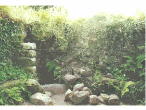
The picture to the right is of a Celtic Chapel located in Cornwall England. This building is approximately 1700 years old, and contains a holy well known for its healing powers.
(Click for enlarged)
“Praise Yah! I will give thanks to Yahweh with my whole heart, in the council of the upright, and in the congregation. Yahweh’s works are great, pondered by all those who delight in them. His work is honor and majesty. His righteousness endures forever. He has caused his wonderful works to be remembered. Yahweh is gracious and merciful. He has given food to those who fear him. He always remembers his covenant. He has shown his people the power of his works, in giving them the heritage of the nations. The works of his hands are truth and justice. All his precepts are sure. They are established forever and ever. They are done in truth and uprightness. He has sent redemption to his people. He has ordained his covenant forever. His name is holy and awesome! The fear of Yahweh is the beginning of wisdom. All those who do his work have a good understanding. His praise endures forever!
John Jacob Niles, folklorist and singer, was in Appalachia when he overheard a young girl singing a few lines from an old folk song. He took those words and expanded them into a song for Christmas in 1933. “I Wonder as I Wander” is a haunting melody, which draws the listener into the wonderment of the reason for Jesus' birth.
I wonder as I wander out under the sky,
How Jesus the Savior did come for to die.
For poor on’ry people like you and like I...
I wonder as I wander out under the sky.
When Mary birthed Jesus ‘twas in a cow’s stall,
With wise men and farmers and shepherds and all.
But high from God’s heaven a star’s light did fall,
And the promise of ages it then did recall.
If Jesus had wanted for any wee thing,
A star in the sky, or a bird on the wing,
Or all of God’s angels in heav’n for to sing,
He surely could have it, ‘cause he was the King.
I wonder as I wander out under the sky,
How Jesus the Savior did come for to die.
For poor on’ry people like you and like I...
I wonder as I wander out under the sky.
It is so easy for us to get caught up in the hustle and bustle of holiday preparations. I was thinking about my schedule for this week, all the things I have to get done, and I don’t know how I'm going to finish all my preparation Oh, I’m sure that a few things on that list can wait, but I’m sure I’ll push myself into a frenzy until it is all complete. I’ll forget to spend time in wonderment, considering all that Jesus gave up to be my Savior. He left heaven for a stable, the glory of God for the company of men. Isn’t this an amazing thing to ponder? Shouldn’t we stop during this Advent season to think on these things?
All the while, however, we are also reminded by Bing Crosby of the beauty of the season. His song “White Christmas” has been a favorite for generations. Yet, in the midst of the hustle and bustle, let’s remember that it is not just about the stuff we do or the stuff we buy or the stuff we make, it is about the people with whom we get to share those blessings. Bing once said, “Unless we make Christmas an occasion to share our blessings, all the snow in Alaska won’t make it ‘white.’”
So, let us wonder as we wander through the holidays what it means to be a Christian. Who is Christ, what has He done, what is He doing and what will He do in the future? What did He give up for our sake? How can we follow in His footsteps? I don’t think that Jesus was thinking that our holiday schedules should be filled with things to do, but instead be filled with music as we sing His praise. Take time this advent to just wonder and wander, to commune with God in silence and prayer, praise and son, and then share God’s grace with the world.
If you would like to contact me, please use the following address, replacing the bracketed words with the symbol. Thank you for your continued interest, prayers and messages of encouragement.

A WORD FOR TODAY is available daily through a mailing list. Visit the link below and you will receive the WORD in your box Monday through Friday.
“Charge those who are rich in this present age that they not be arrogant, nor have their hope set on the uncertainty of riches, but on the living God, who richly provides us with everything to enjoy; 18 that they do good, that they be rich in good works, that they be ready to distribute, willing to share; 19 laying up in store for themselves a good foundation against the time to come, that they may lay hold of eternal life.” 1 Timothy 6:17-19, WEB
We don’t have many little ones in our family anymore, so we’ve “adopted” several families in our church and act as an extra “grandma.” The list of these children is growing, and so are the children. It is getting harder to buy presents for them because it is so hard to know what they would enjoy. We have budgeted much less for each child this year since there are so many. I finished that shopping today, and hope that they will enjoy the gifts. I love to buy Christmas presents; I guess that's why I’ve “adopted” those families. It is a joy to think about my little friends as I am shopping and to see their smiles when they open their presents. Sometimes I have to remember that the dollar value is not the real focus, that gift giving is really about “the thought.”
There was once a commercial for a local jeweler that asked if the listeners were having trouble finding the perfect gift for their loved ones. The speaker then assured us that we would find the perfect gifts at the store. “Diamonds, gold, silver...” they have it all. Every other store makes similar appeals to the shopping public. They all have the perfect gift. They all have the one thing that will make all our loved ones happy. The ads are filled with claims, “Best presents” and “Perfect gifts!”
It can be hard to decide which gifts to give. It is even hard to decide for whom we should buy presents. When Bruce and I were first married, we purchased gifts for everyone in our families. That was eventually reduced to family gifts and then the family gifts became homemade ornaments. We bought gifts for the nieces and nephews when they were younger, when it was easy to purchase a small toy or book. It became much harder as they grew older. We did not know them very well since they live so far away, so we had no idea what things they had or their interests. We eventually stopped buying gifts and sent money or gift cards instead. We all went through the transition because we had ridiculous piles of presents under the tree and shipping became much too expensive.
Sometimes it felt silly to send those gift cards. None of us could afford so many presents; it was a struggle to buy for every child. Besides, our gift cards just passed in the mail. We’d send gifts cards to their kids; they’d send gift cards to ours. This is not to say that gift cards are bad gifts. Sometimes money and gift certificates are the perfect present, especially for those who have very specific needs. By giving them a gift card from a store where they can purchase exactly what they want, you’ve remembered them in a very special way while giving them the freedom to have the right thing.
The problem is in our motive. Why are we buying these gifts? Are we buying them out of duty or for some reward? Do we purchase gifts for someone in the hopes that they’ll give us something back? Or are we repaying a gift with our gifts? Are there better ways to share our love with our friends and family? Do we really need to find the “perfect” gift to continue having a relationship with them? I love to give presents, and I particularly love to give presents that I know will make people happy.
So, as we work out our preparation for Christmas Day, it is good to think about the gifts we give and the reason we do so. It has long been said that children prefer the boxes to the presents. Sometimes they do, because a box uses imagination. Many people would rather a handmade ornament than an expensive piece of jewelry. Do we really need to buy a big dollar gift for our friends, or would it be better to spend time with them? What is the perfect gift, really? Is it an item that fulfills some duty or reaps us enough praise? Does saying “I love you” require a lot of money? And do we really need to buy things for everyone we know? Are we really making them happy?
So, let’s remember what it is all about. Yes, the greatest gift is Jesus, and the season is about Him. But we can’t forget that giving gifts among God’s people has been a long-held part of the celebration. The wise men gave gifts. People from every generation have had traditions they have upheld from year to year. But we need to remember why we give gifts. We share what we have to make others happy. We give as we have been given to glorify God. We don’t have to buy that big screen TV or that diamond necklace. The gift that will really make a difference is love, time, and presence in the lives of those we love. We can follow the example of God, who has not promised us castles and gold, but a babe in a manger. He gave us His son to dwell among us, to love us and to lay down His life for us. So, too, we can be generous and willing to share all we have with those we love, not just at this time of year in packages covered with bows, but with our lives and resources every day.
The following links provide some specially chosen scripture that tell the stories of the Birth and Passion of our Lord as Savior Jesus Christ, as well as a fictional perspective of the Crucifixion. Spend time in God's Word, read about His life and learn of the wonderful gifts He has for you. Know Jesus Christ and honor Him today. Thanks be to God.
The Story of our Savior's Passion
The Crucifixion, a fictional perspective
When researching, I use several versions of the bible, including the New International Version and English Standard Version. Due to copyright restrictions, I have not included quotes for the scriptures on some of the archives, but highly encourage you to open your own bibles to read the scripture passages for yourselves. Where scripture is quoted, it is usually the American Standard Version or World English Bible which belong to the public domain. Any other versions used in quotes are identified.
The devotion posted on Wednesday is based on the Lectionary texts used by millions of Christians each Sunday. The Lectionary consists of four texts: an Old Testament passage, a Psalm, a passage from one of the Epistles and a Gospel text and follows the church calendar. Archives for these writings are found at Midweek Oasis.
You are welcome to use these words to share the Gospel of our Lord Jesus. Please remember to give credit to the Author who has given you these gifts, and keep in remembrance the vessel which He used to bring them to you. We pray that this site may be a blessing to you and anyone with whom you've shared it. Peggy Hoppes
 |