|
|
| |
|
|
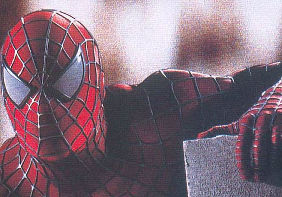
Mark R. Leeper finds that Sam Raimi does a comic
super hero story that is more character-driven than fight
driven. Toby McGuire plays Peter Parker, the boy
bitten by a spider and finds himself with special spider
powers. The film is fairly faithful to the comic book and
at the same time is fast-moving and fun.
Music Review: Dark Days (Coal Chambers)
by Mark R. Leeper
I have not read a lot of comic books since I was in Junior
High.
At that time Spider-Man was still a new comic, but I read
several issues and have read a few since. To be honest it was
neither sufficiently weird, nor sufficiently science-fictional to
hold my interest at that time.
I did like that the characters portrayed were a little better
developed than the DC super heroes. I have, however, read
enough Spider-Man and X-Men comic books to know that
the new film SPIDER-MAN seems closer to the original
comic books than the recent X-MEN did.
But that is not the only reason I think this is the better of the
two films. For my taste the characters of X-MEN did not
seem as well-developed and to a much greater extent that
film was fight-driven and while SPIDER-MAN is more
character-driven. Peter Parker is something of a cliche, much
like the title character of CARRIE, but at least we get a
better idea of who he is than we did with the characters of
most comic book based films.
Peter Parker (played by Tobey Maguire) is his school's
science nebbish. He can tell you anything about science, but
he cannot work up the courage to talk to his attractive
next-door-neighbor and classmate, Mary Jane Watson
(Kirsten Dunst). An orphan, he is lives a frustrating life in a
minor key in a lower-middle class neighborhood of New
York.
Then Peter is bitten by a spider that was altered by DNA
research. (Originally in the comic it was altered by atomic
radiation, but writer Stan Lee seems to use whatever science
that is current, mysterious, and topical.) Parker is very sick
for a few hours, but when he recovers he gets considerably
better than just well.
He finds he has the power to shoot webs from his wrists.
(Why would he develop this at his wrists? I suppose it would
be a very different film if he had inherited spinnerettes in the
same anatomical location where a spider has them.)
Now, after hundreds of years when presumably nobody in
New York City had super-powers, the same day that Peter
Parker becomes spiderized by sheer coincidence someone
else gets super-powers also. (What are the chances?) It is
Norman Osborn (Willem Dafoe), the father of Peter's best
friend (another twist of fate!) who becomes a super-powered
schizophrenic.
Osborn is much like Jekyll and Hyde, but instead of Hyde he
turns into lurid Green Goblin. Actually, his most amazing
power seems to be to keep his balance on a sort of
high-speed anti-gravity speeder. But while the film does have
fight scenes between him and Spider-Man, they do not drag
on as they do in some films like the current BLADE II.
Instead, the film focuses on how Parker's relationships
change as he discovers his powers.
Parker interacts with Ms. Watson as well as his aging aunt
and uncle. The latter is played by the venerable Cliff
Robertson. (That is an interesting casting choice. Robertson's
signature role was Charley Gordon who also finds his
relationships changing when he is altered by a scientific
experiment.)
Actually, the special effects of SPIDER-MAN may be of a
lower average quality than most other blockbuster fantasy
films of late. In spite of this being one film where wirework
might work well, too often the film makers rely on digital
effects that do not convince the eye. The images create look
three-dimensional but frequently will accelerate in ways that
look more like cartoon figures.
Also, the fact is that while SPIDER-MAN may have a nifty
suit, the whole concept does not work well for a movie
super hero. Spider- Man's powers are that he is strong and
fast, he throws sticky webs, and he sticks to things. His sort
of rescue is generally limited to throwing a web to stop
someone from falling.
But to make a sequence long enough to be interesting on film
the person has to fall from a very great height. People fall
from very high up indeed in SPIDER-MAN. I will discuss
more limitations of the Spider-Man character after the
review. And in addition to conceptual limitations, he has
another restriction imposed by the writers.
As my wife has observed in films, apparently super heroes are
frequently not allowed to kill their opponents directly any
more, even in fights to the death. Notice that SPIDER-MAN
does not kill his opponents. Instead he frazzles them to the
point that they make some stupid blunder and conveniently
kill themselves. We see this happen at least twice in this film.
The writers apparently do not want to risk losing audience
sympathy. In fact, these "frazzle-to-death killings" seem to
have become standard in many action films.
Tobey Maguire simply does not look like the Peter Parker of
the comic books, but he does a reasonably convincing job. I
am a little reluctant to see him in a mass market film since he
has been very good in some art house films and now he may
not return to that sort of film.
Dunst does fine as the attractive friend of Parker. But having
recently seen her in THE CAT'S MEOW as an actress who
hides her intelligence behind a veneer of perky childishness, I
think she is wasted in this simple role. J. K. Simmons is
terrific as Parker's nasty boss J. Jonah Jameson. Sam Raimi
known for THE EVIL DEAD and DARK MAN directs.
SPIDER-MAN was more fun than I was expecting.
I'd give it a 7 on the 0 to 10 scale and a low +2 on the -4 to
+4 scale.
As long as we are on the subject, there are some things I
have never known about Spider-Man. The first observation I
would have is that there are marked similarities between
Spider-Man and the introverted villain in the episode "Spider
Boy" of the radio series "The Shadow" (November 11,
1945) I would be curious how much Stan Lee knew of that
episode.
In the comic book Spider-Man looks really dramatic
swinging among tall buildings, but I have never established
how Spider-Man is able to travel very well with his
web-swing approach. Necessary (but not sufficient) would
be to have buildings at least thirty feet higher than his plane of
travel. Actually, depending on the distance between
suspension points, it would probably have to be much higher
than that.
Even in Manhattan he would be extremely limited in where
this means of locomotion could take him. He has to alternate
suspension points first on one side of his line of travel, then
the other or he would end up flattening himself in the plane of
the face of the building. He probably would find that it is very
difficult to find a sequence of buildings he could use without
finding one recessed too far from his line of travel.
Web-swinging would of necessity be a very limited means of
travel. My guess is that a real Spider-Man would simply walk
most places he went. That is a lot less spectacular.
Spider-Man's wall climbs would also be impossible. I am not
an expert on spiders, but I think that even tarantulas have
problems climbing a vertical surface because they are just too
heavy. Parker is A LOT heavier than a tarantula.
The film suggested that Parker grows hooks on his hands, but
even with fishhook gloves one could never get enough
purchase to support a human's weight.
Not only would ha probably not be able to get to where the
crime is, it is not at all clear how he knows where the crime
is. Apparently Parker usually just happens on crimes being
committed. Most of the crimes he seems to stop are in broad
daylight and not in high-crime parts of the city. If it were so
easy to find crime, police would probably be better at doing
their job and stopping it. It seems to me that the comic book
refers to so- called "spider sense."
My question is what "spider sense?" Most spiders have a
hard time knowing what is going on one or two leg- spans
from their body. Web spiders can sense movement further
away, but that is really because it causes web vibrations
under their bodies. Some hunting spiders, very distant
relatives of the spider in the film, have considerably better
eyesight, but nothing to match the eyesight of a mammal. If
Peter Parker inherited spider senses about all he would need
is a tin cup.
All this is not to say that spiders cannot do some pretty
impressive things--most of which have probably never been
used in the Spider-Man comic. Spiderlings use strands of silk
to catch the wind and get carried into the air.
Live spiders have been found floating in this way in the upper
levels of the stratosphere and come down miles out to sea.
Most of the impressive things Spider-Man can do he does
not get from his spider inheritance. Oh, and at this stage of his
maturity he seems to be looking for a mate. Male spiders do
this also, of course, but many do not survive the mating ritual.
I hope his human side helps him to make a better choice.
Disclaimer:The expressed views and the opinions of any content/columns/articles
within Gx Webzine is not neccessarly the expressed views and opinions of Gx Webzine. All
information provided on this site is offered 'as is', without warrenty. All authors/columnist are
responsible for their own articles/columns and Gx Webzine is unaware of any acts of unlawfulness
and/or plagerism. If plagerism is found within the content of Gx Webzine, the author of the article/column
will be responsible for any legal action that maybe taken by the original author of the content and
Gx Webzine will be held blameless thereof.
All contents copyright © 2002
Gx Webzine. All Rights Reserved.
|
|