PARADE/CHROMOSPHERE
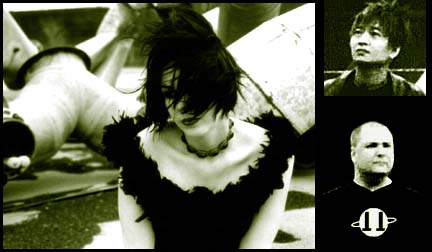 Parade have been enigmatic sound pioneers on the fringes of the Canadian music scene for over a decade. Emerging from the industrial underground in the late '80's, Parade have been forging odd soundtracks to the imagination that have lead listeners on a fantastic journey that has yet to conclude (and perhaps never will).
Comprised of David S. Faris (keyboards, electronics), Stephen Seto (guitars, programming), and Julie S. Faris (vocals, lyrics), Parade incorporate multiple sonic influences and styles into their own, deconstructing music and noise with a restless urge to create something new. Their unique sound is a fusion of innovative electronic textures, effected guitars, sequenced drum machine rhythms, sweeping sythesizers, and passionate female vocals. Parade are also well known for integrating their background as visual artists into their live performances, which are multi-media events, merging projections, stage design, and costuming with their atmospheric music.
Parade's latest album, "Floating Here," was released in October, 1999 on their own label, Plan Eleven, and was hailed by Exclaim! as "an album of utter beauty that has almost no equal."
They are joined by labelmates Chromosphere on June 4th at Wavelength.
WAVELENGTH’s Paddy O’Donnell came up with some amazingly ordinary questions for them to answer in whatever capacity any of them decided.
 David S. Faris: I've always felt that the final result was what was important, not necessarily the means. Whether music is created using electronic instruments or acoustic instruments is pretty much immaterial to me, as long as the results are interesting. I'm just as happy listening to Kraftwerk or Panasonic as I am listening to Nick Drake or Charlie Parker.
The biggest downfall to electronic music is that it can almost be created automatically now, just by turning on a few pieces of equipment and hitting play - the computer program "Rebirth" is a perfect example. Anyone with a computer and this piece of software can produce generic techno tracks that sound very authentic, but have little individuality. By the same token, how many countless 3-chord hardcore bands have you heard that also have no identity? You have to start somewhere, but where you arrive is the interesting point.
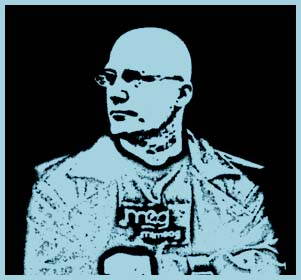
Chromosphere: Does it matter? I can’t honestly say I’d recognize anyone from any band, unless their video/s is/are consistently in my face all the time. And that can’t be good at all.
Elaborate on the importance/non-importance of art/design and the creation of a mood, mystique or association for the listener & observer.
DSF: Everyone in Parade has a background in visual arts, so we are all really interested in the visual side of the group, and music in general. Stephen and I have both designed record covers for years, as well as posters, flyers, etc. Because music is essentially an abstract artform, it lends itself to interpretation. Music and imagery combined create a larger entity, and we try to achieve this in some way through our live shows, combining our own images with the music, in the same spirit as Warhol's collaborative shows with the Velvet Underground. In terms of other bands and labels, I have always been drawn to labels and bands with a strong visual identity, and I'm sure this has had an influence on the way I approach music and design. Factory records, 4AD, and early Nettwerk were all outstanding in this respect, especially bands like Skinny Puppy, New Order, and Cocteau Twins. A more recent example would be the Blood and Fire label.
CS: I’m convinced that art/design are essential in presenting a mood, mystique… [etc.] But I’m not visual * at all in creating music. Perhaps I should be, but what are you gonna do?
* Visually stimulated or influenced.
What does Plan 11 mean to you?
DSF: It is a tribute to the spirit of the great Edward D. Wood Jr. The man knew how to get things done, and make a lasting work of art, against all odds (and boy where there alot of odds!). He envisioned Plan Nine From Outer Space in the 50's. We estimated that Plan Ten was most likely disco in the '70's, so we continued the conspiracy in the '90's with Plan Eleven, a systematic restructuring of your listening habits!
CS: They’re a voice I can trust. They allow me to be heard. We’ll see if that is a good thing later, and who should be held responsible.
Drum machines... programming... curse or blessing? (Ie. Does a set structure make you freer or limit you more?)
CS: You create your own curses or blessings. Drum machines are merely one instrument. I trained as a drummer since early childhood; so I’ve never lacked rhythmic options. Set structure is the architecture you create. You can be as free as you want if you’re smart enough to know your own limits. Our whole live thing is basic improvisations and chance music. I’ve never had any performance present me with limits. However, that is not to say that all have been the way I had wished them to be, or good for that matter. Occasionally the night starts to suck 5 minutes before you arrive and continues to suck until well into the next week. Those gigs just can’t be helped.
DSF: We grew up in the early '80's, so the use of drum machines and synthesizers was very common place in the pop music of our youth. We like the sound of electronic drums - it is a different approach to rhythms altogether, and while it has limits, it also has a unique feel that can be a real asset. We often use a basic rhythm track or sequence as the basis for improvisation and noise excursions - in the end, it is just a question of choices. It's a lot easier to get to shows when you don't have to lug a drum kit around, and you can turn the machine down if you really want to!
How much change is there from live show to live show?
DSF: Since we don't play live that often, our live shows tend to vary quite a bit. We create new visuals quite often for use in our live show, and try to come up with a unique stage setup for each show, based on the space we're working in. Sometimes we just perform as a band, without any visual accompaniment - that is bare bones Parade! We try to keep things interesting for ourselves and the audience. Otherwise, what's the point of doing it? We're not a bar band running through our "set."
CS: We’ll see.
Vocals vs. Vocal Samples... what should be said about this?
CS: Nothing. They’re two entirely different things.
DSF: Listen to the song "Sexcrime" by the Eurythmics. This is a good study on the subject!
Tell us a funny story.
CS: No.
DSF: Dammit Jim, I'm a musician, not a comedian!
If you only had one sentence in which to make an impression, and had to impress upon someone what you personally thought life was all about, what would your sentence be?
DSF: Drinks for all my friends!
CS: Life is what occurs during “downtime” for the chromosphere; so for me, it’s the time I use to rest up.
What is your favourite music?
CS: Audible.
DSF: Anything that moves me, inspires me, impresses me, or makes me want to drink during the late/early hours. Some top bands over the years have been Joy Division, The Cure, Bowie, Rush, Skinny Puppy, Red House Painters, David Sylvian, Miles Davis, Eno, The Beatles, Velvet Underground, The Clash, The Wolfgang Press, Cocteau Twins, Dead Can Dance, The Legendary Pink Dots, Slowdive, and Swans, amongst many, many others (it's really criminal to even try to make a list, with all of the amazing music out there). However, if I gave a list of recent records that I've bought, it would include Dissidenten, The Carpenters, Chic, Weather Report, and a Scottish folk album called "A Toast To The Haggis." Variety is music to my ears, and I'm always on a quest for something new (or old) and exciting. And lets not forget those Hawaiian records...
Where will your band be a year from now?
CS: Where are we now?
DSF: Hopefully still playing cool nights like Wavelength, although with a completely new set!
Do you feel where you are from affects your music?
DSF: Yes, in an inexplicable way. Canadian music has a unique, undefinable quality to it, and I think that our music shares some of those characteristics. Also, being from Toronto, I think that the surrounding music community over the years has always been inspiring and supportive, which has helped us develop in a positive way.
CS: Of course. If it doesn’t, you’re a plagIarist.
Studio recording/Home recording...why one and not the other?
DSF: Both! All of our CDs have combined music recorded at home and in the studio. We just go into the studio so we can hang out with Rob (Sanzo). Otherwise, we'd never see him!
CS: What’s the difference anymore?
What was the one event that made you happiest in the context of your artist endeavours?
DSF: I try to be continuously happy as I'm working on music and art. I think putting out the first Parade tape, and doing our first live show were landmarks, although releasing our most recent album, and the shows that we've done in the past year have also been highlights. Also, the tours that we did with Perfume Tree, and the shows with the Legendary Pink Dots were quite special. It's a constant quest for more that keeps us going, and once that desire is gone, we will be too.
CS: I don’t believe there was only one, and if there was, I was probably passed out at the time.
What's the future? (This question is intentionally vague.)
CS: +/-x+/-x+c2 or in layman’s terms, the same as the past, only in reverse.
DSF: To quote the infamous Criswell from the opening to Plan Nine, "My friends, we are all interested in the future, for that is where you and I are going to spend the rest of our lives..." I couldn't have said it better myself.
back to wavelength