
Nassau class battleships

At the beginning of the 20th century, the German Imperial Navy was in the process of enlarging its fleet with a great number of ships, which were all modern to that days technical standard. But with the introduction of the "All-big-gun-battleship", the British Dreadnought, even the newest ship got obsolete from on day to another, since the steam turbine powered, one caliber battleships was one step ahead of the common multiple caliber warships.
As a reaction to this, the latest German battleships under development, a 14000 tons ship with 30,5 cm an 24 cm guns, was modified to match the new British design. Enlarged to 19000 tons with twelve 28 cm guns mounted in "Hexagonal" positions, but still with expansion engines instead of turbines, the Nassau class was the first class of "All-big-gun-battleships" of the Imperial Navy.
Although they seemed to be a bit more conservative than contemporary British designs, they had a much better internal protection, giving the ships a much better chance to survive even heavy damage as it was proven in several occasions.
All four ships of this class were part of the 1st Battleship Squadron and shared a quite similar operational live. They all took part in the battle of Jutland and besides the Westfalen, which ran aground in 1918 and was very difficult to get afloat again, the other ships were taken over by other countries after the war and scrapped in the early 1920s.
Their careers:
Nassau:
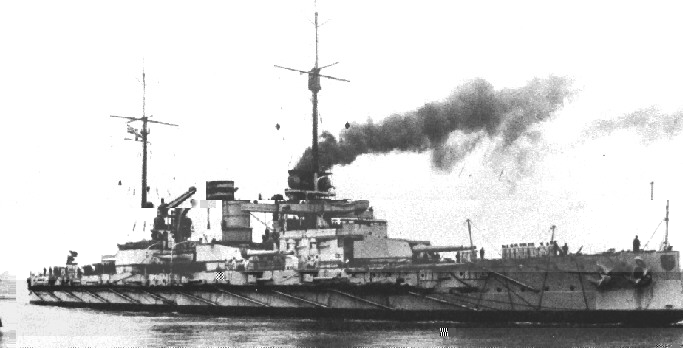

Laid down at Wilhelmshaven Navy Shipyard on 22 July 1907; launched on 1 July
1908; commissioned on 1 October 1909; ceded to Japan for reparation in April
1920; scrapped at Dordrecht 1921.
Westfalen:
Laid down at Weser AG 12 August 1907; launched 26 September 1908;
commissioned 16 November 1909; used as gunnery training ship September 1918;
ceded to Great Britain for reparation in August 1920; scrapped at Birkenhead 1924.
Rheinland:
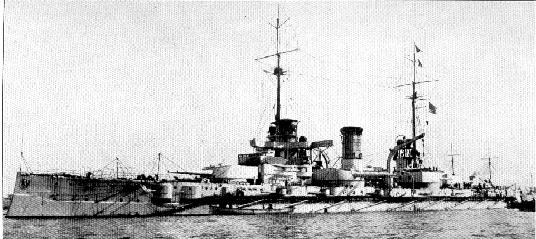
Laid down at Vulcan, Stettin, 1 June 1907; launched 26 September 1908;
commissioned 30 April 1910; run aground 11 April 1918, guns and armor removed
before floating; used for accomodation until 1918; scrapped at Dordrecht 1921.
Posen:
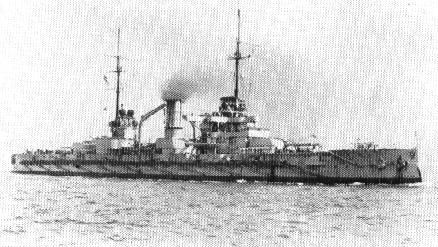

Laid
down at Germaniawerft, Kiel, on 11 June 1907; launched on 12 December 1908;
commissioned on 31 May 1910; ceded to Great Britain 1920; scrapped at Dordrecht
1922.
|
Specifications |
||
| Complement: | 1000-1180 | |
| Length: | 479.9 ft | 146.3 m |
| Waterline: | 465.6 ft | 141.8 m |
| Beam: | 93.5 ft | 28.5 m |
| Draft: | 26.5 ft | 8 m |
| Displacement: | 18569 tons (Standard) / 20210 tons (Max) | |
| Boilers | 12 coal fired Shultz-Thornycraft auxiliary oil firing added 1915 |
|
| Turbines: | 3 three cylinder vertical triple expansion engines (VTE) | |
| No of Shafts: | 3 | |
| Endurance: | 9,400nm @ 10kts 8,300nm @ 12kts 4,700nm @ 16kts 2,800nm @ 19kts |
|
|
Armament |
||
| Main Armament: | 12 x 11.1"(283mm)/45 cal SK C/07 Krupp-made in 6 twin turrets | |
| Secondary Armament: | 12 x 5.9"(150mm)/45 cal SK C/16 in 12 single casemate mounts: 6 port 6 starboard (increased to 16 in 1915) | |
| Anti-Aircraft Armament: | 16 x 3.5"(88mm)/45 cal SK C/13 added 1915 | |
| Torpedo tubes: | 6 x 17.7" (450mm) 1 bow 1 stern two beam submerged | |
