
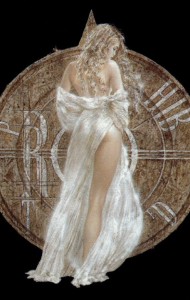
"The dressing of slaves, incidentally, is an interesting and intricate pastime. The slave is almost never totally nude. Her body is marked almost always with some token of her condition, which is bond. This is usually a collar, but it may also be an anklet, sometimes belled, or a bracelet. Her brand, of course, fixed in her very flesh, deep and lovely, is always worn. There is no mistaking it. The iron has seen to that. Beyond theses things, much depends on the individual girl and on her particular master of the time. Individual taste is here supreme. To be sure, there are natural congruencies and proprieties which are generally observed."
"Guardsmen of Gor" p. 105-109
Silks
White Silk- Usually found upon new girls.. annotates the virginity of the girl..
Yellow Silk - No direct quote as to any denotation of this silk.. though it was mentioned in Assassins of Gor...
Gray Silk - represent a state owned slave…
Red Silk - represents a pleasure slave, or in another words.. a girl who is no longer a virgin to Gor..
That night, at a great feast, he displays the captive, now suitably attired by his sisters in the diaphanous, scarlet dancing silks of Gor. Bells have been strapped to he ankles, and she is bound in slave bracelets. Proudly, he presents her to his parents, his friends and warrior comrades.
Then, to the festive music of flutes and drums, the girl kneels. The young man approaches her, bearing a slave collar, its engraving proclaiming his name and city. The music grows more intense, mounting to an overpowering, barbaric crescendo, which stops suddenly, abruptly. The room is silent, absolutely silent, except for the decisive click of the collar lock.
It is a sound the girl will never forget.
As soon as the lock closes, there is a great shout, congratulating, saluting the young man. He returns to his place among the tables that line the low-ceilinged chamber, hung with glowing brass lamps. He sits in the midst of his family, his closest well-wishers, his sword comrades, cross- legged on the floor in the Gorean fashion behind the long, low wooden table, laden with food, which stands at the head of the room.
Now all eyes are on the girl.
The restraining slave bracelets are removed. She rises. Her feet are bare on the thick, ornately wrought rug that carpets the chamber. There is a slight sound from the bells strapped to her ankles. She is angry, defiant. Though she is clad only in the almost transparent scarlet dancing silks of Gor, her back is straight, her head high. She is determined not to be tamed, not to submit, and her proud carriage bespeaks this fact. The spectators seem amused. She glares at them. Angrily she looks from face to face. There is no one she knows, or could know, because she has been taken from a hostile city, she is a woman of the enemy. Fists clenched, she stands in the center of the room, all eyes upon her, beautiful in the light of the hanging lamps.
She faces the young man, wearing his collar.
'You will never tame me!' she cries.
Her outburst provokes laughter, skeptical observations, some good-natured hooting.
'I will tame you at my pleasure,' replies the young man, and signals to the musicians.
The music begins again. Perhaps the girl hesitates. There is a slave whip on the wall. Then, to the barbaric, intoxicating music of the flute and drums, she dances for her captor, the bells on her ankles marking each of her movements, the movements of a girl stolen from her home, who must now live to please the bold stranger whose binding fiber she had felt, whose collar she wore.
At the end of her dance, she is given a cup of wine, but she may not drink. She approaches the young man and kneels before him, her knees in the dictated position of the Pleasure Slave, and, head down, she proffers the wine to him. He drinks. There is another general shout of commendation and well wishing, and the feast begins, for none before the young man may touch food on such occasions. From that moment on, the young man's sisters never again serve him, for that is the girl's task. She is his slave.
As she serves him again and again throughout the long feast, she steals glances at him, and sees that he is even more handsome than she had thought. Of his courage and strength she had already had ample evidence. As he eats and drinks with gusto on this occasion of his triumph, she regards him furtively, with a strange mixture of fear and pleasure. 'Only such a man,' she tells herself, 'could tame me.'"
---Outlaw of Gor, page 51-53
Black Silk - (sometimes blue) represents an unowned, unpurchased slave in training
Purple Silk(Not really silk) - slaves of the Priest Kings
Camisk - made of common cloth, with slits on both sides, with a slit in the middle for the head, worn like a poncho, tied at the waist with a cord (slave girdle)…the hem comes just below the bottom and the groin, so a slaves flesh is always easily accessible.
It was a sleeveless, pullover tunic of brown rep cloth. It was generously notched on both sides at the hem, which touch guarantees an additional baring of its occupant’s flanks.
I saw that Phoebe wanted to reach out and seize the small garment but that she, under discipline, kept her hands, as she had been directed, at her sides.
The cord over Marcus’ shoulder, of course, was the slave girdle, which is used to adjust the garment on the slave. Such girdles may be tied in various ways, usually in such ways as to enhance the occupant’s figure. Such girdles, too, like the binding fiber with which a camisk is usually secured on a girl, may be used to bind her.
Magicans of Gor, page 22
Chalwar - worn by slave girls of the Tahari region, similar to the baggy pants worn by the harem girls of earth.
Chatka - worn by the Wagon People’s slave girls, it’s a piece of black leather about six inches by five feet long, worn like a breech clout over the curla, it is looped in the front, then pulled between the legs and looped in the back…leaving a small flap in the front and back…it is easily pulled to the side for a girls use.
"Kajira is perhaps the most common expression for a female slave. Another frequently heard expression is Sa-Fora, a compound word, meaning, rather literally, Chain Daughter, or Daughter of the Chain. Among the Wagon Peoples, to be clad Kajir means, for a girl, to wear four articles, two red, two black; a red cord, the Curia, is tied about the waist; the Chatka, or long, narrow strip of black leather, fits over this cord in the front, passes under, and then again, from the inside, passes over the cord in the back; the Chatka is drawn tight; the Kalmak is then donned; it is a short, open, sleeveless vest of black leather; lastly the Koora, a strip of red cloth, matching the Curia, is wound about the head, to hold the hair back, for slave women, among the Wagon Peoples, are not permitted to braid, or otherwise dress their hair; it must be, save for the Koora, worn loose. For a male slave, or Kajirus, of the Wagon Peoples, and there are few, save for the work chains, to be clad Kajir means to wear the Kes, a short, sleeveless work tunic of black leather."
Nomads of Gor, page 29-30
Curla - a red waist cord used to hold up the chatka, worn by the girls of the Wagon People
“Gracefully, insolently, the silken yellow sheet moved about and across her body and fell from her. She stood facing me, in pretended anger, graceful and beautiful. She wore the Sirik and was, of course, clad Kajir, clad in the Curla and Chatka, the red cord and the narrow strip of black leather; in the Kalmak, the brief vest, open and sleeveless, of black leather, and in the Koora, the strip of red cloth that bound back her brown hair. About her throat was the Turian collar with its chain, attached to slave bracelets and ankle rings, one of the latter attached to the chain running to the slave ring. I saw that her left thigh, small and deep, bore the brand of the four bosk horns.
Nomads of Gor, page 282
Kalmak - a small black leather vest, it does not fasten, and barely conceals the breasts, letting them slip from the bare cover frequently, it is worn by the Wagon People’s slave girls *the above two quotes apply to this garment as well*
Kes - a short black leather tunic, worn by the male slaves of the Wagon People *the above two quotes apply to this garment as well*
Kirtle - worn by the Torvaldsland bond-maids, it’s a soft woolen dress, tied in the front under the breasts, very short…shows a lot of leg, and bossom…
Koora - a head band of red fabric, worn by the Wagon People’s slave girls…(can be worn to keep the hair from the face or across the forehead) *the above two quotes apply to this garment as well*
Pleasure Silk - wraps around the body with a disrobing knot at the left shoulder, made of sheer, clingy silk, very short….
"No man who has seen a woman in Pleasure Silk, or watched her dance, or heard the sound of a belled ankle or watched a woman's hair, unbound, fall to her waist can long live without the possession of such a delicious creature."
---Outlaw of Gor, page 249
Slave Rag - a piece of material, used to conceal the slave heat of a girl, pulled between the legs, then tied tightly at the waist to emphasis it’s slimness..
Slave Veil - a small piece of sheer yellow silk, tied round the face over the bridge of the nose, concealing the bottom half of the face