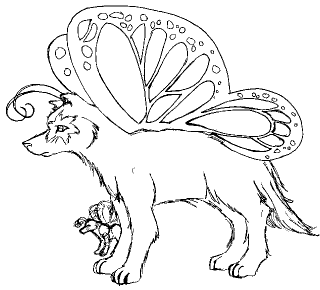
The Asahiko and the Sakura: There are actually two different papillon species: the Asahiko and Sakura. The major difference is in size, although one species may have a predisposition to certain attributes more than another.
Height:
Asahiko: 3'-4' 6"
Sakura: 6"-1'3"
Body Structure: As they are meant to fly, Papillons are usually built leanly rather than solidly. Of course, those Asahiko who opt to be wingless (explained later) often develop larger muscles than their winged siblings if living flightless from the time they are young. If one of these stockier papillon switch clans (from flightless to flying), they will often be more clumbsy in flight.
Wings and Flight: It is speculated that there is some magic involved in getting a papillon in the air, as their wings do not seem capable of holding them... but, scientifically speaking, a bumblebee should not be able to fly, either. So, whether magic is used to aid flight is unknown, though it is known a papillon without wings cannot fly.
As papillons are considerably larger than butterflies and do things a butterfly would never do, their wings suffer a different kind of wear and tear. This is most pronounced with the Asahiko, and their wings grow useless about a month after they are grown. This is why papillons can shed and regrow their wings at will.
An Asahiko can shed and regrow wings, without expending any extra effort, in a matter of days. During these days, the wings start growing from the shoulder blades, and look somewhat like crumpled, vaugley-wing-shaped pieces of paper, due to the fact blood is not circulating through them. At the end of the average 3 days (note: growth in the wings occurs most quickly during sleep), the papillon begins to circulate blood through the wings, and they expand and turn into what we are used to seeing. This process can be sped up (usually by the vain papillon who hate the look of half-grown wings) into a 24 hour period, but leaves the papillon drained.
As mentioned, wings are grown and shed at will, not by cycle. This is why some Asahiko go wingless, for they choose not to renew their wings. Therefore, if there is an accident and the wings become useless before the average one month, then it is a simple matter to shed and regrow.
With the Sakura, as their wings are much smaller, the entire process takes about 6 hour maximum, without extra effort, and the average wing lifespan is 6 months. Due to their size, it is usually only by wing that they can get around in a reasonably timely manner; because of this, and the fact their wings are much easier to maintain, no Sakura opts to remain wingless.
Eyes: Some papillons have normal eyes, and others have insect-like fractured eyes. Those with the insect-like eyes are said to have many-vision, and this can be a good and bad thing.
Maybe you've noticed how a fly can land effortlessly on the rim of a teacup, or how a butterly delicately lands on a small flower and remains perfectly balanced. Many-vision papillon are the most graceful, effective, and precise of flyers. They never seem to miss, nor misjudge how their weight will affect a thing they are landing on (in the case of the Sakura, say a branch).
But, Many-vision also robs a papillon of seeing details. The world is a constant blur, and so they have to rely more heavily on scent to tell them what is around them. While it is difficult to understand why they can be such precision flyers with such horrid vision is a mystery, it is so. Also, though they still fly with the same precision at night, during nightfall they are practically blind.
It is difficult to see the fragmentation of a many-vision eye, and as the many-vision eye is the exact same size of the normal eye, the only way to tell the difference is that many-vision eyes have no whites or pupils: they appear to be one solid color. Many-vision is much more common in Sakura than Asahiko.
Those with normal eyes usually have excellent vision, equal in the day and the night.
Eye colors include: red, red-gold, gold, gold-green, green, green-blue, blue, blue-violet, violet, brown, black, and grey. Grey is rare.
Antennae: Though they come in many different styles, no specific type is superior to another. Papillon antennae fuction like most insect antennae: they are used as both smell and touch sensors. Touch with the antennae is a different experience than touch with the skin, as the antenna can sense even the slightest change in texture on whatever it is touching. Also, it's scent-fuction adds even more spectrum to the already excellent wolf sense of smell the papillon possess. The most unusal, and probably useful, of all the antennae's fuction, though, is to sense magic. Papillon antennae can sense what type of magic (elemental, black, blood, ect.) and when it was performed (or detect it while it is being performed).
Antennae are extremely sturdy, despite their delicate look. To rip one off, it would take a much force as it would take to rip off an ear. Even so, Papillon antennae will regrow, but only once for each side. The regrown antennae will not be as senstive as the original pair. Additionally, with antennae, size does matter... the larger, the more sensitive.
Fur Colors and Patterns: Butterflies come in all colors of the rainbow, and so do Papillon. The sky is the limit when it comes to coloring. Also, like the unusal patterns appear on butterflies, unusual fur patterns appear on papillon. Vaguely heart-shaped and star-shaped patches occur, as well as false eyes... Sakura tend to be the more outrageously colored, though, as they rely less on hunting to survive. Asahiko tend to be the regular earthy wolf colors.
Gender Differences: Female papillon tend to be larger than male papillon, and they also have more noticible eyelashes. Males, on the otherhand, usually have longer antennae and are the more colorful.
Of course, when dealing with papillon, there are also the neuters to consider. Papillon mothers will sporatically throw neuter pups, supposedly due to the inherent incompatibility between a wolf and butterfly. Neuters have any combination of gender traits...
Toxins: As some of their butterfly cousins, papillon are immune to many plant toxins, and can even eat toxic plants to make their own flesh, saliva and blood poisonous to most animals. Many Papillon can also incorportate venoms of certain animals into their systems, like those of spiders or snakes.
A papillon who ingests poisons's fur will begin to brighten to warn other predators of their toxic flesh. If a papillon does not have brightly colored fur in the first place... if all their fur is the earthy colors of the wolf... then their brighter colored wings should send the warning signs in the fur's stead. If there are no wings to speak of, sometimes stripes of the same color of the wing will appear on the papillon's back, where the wings normally would grow. This can be hidden by Hikari using the hide wings power (discussed below) and Jitsuko can use their limited camoflauge ability to disguise these bright warnings while hunting.
Toxin strength can vary papillon to papillon, depending mainly on the plants and animals they ingest. Usually, a bite from an Asahiko who has been eating poisions will cause sickness in a creature as large as a saberwolf, though it will last only a few days to a maximum of 2 weeks, depending on the severity of the bite and its location. A saber ingesting too much papillon blood or flesh will likely get enough toxins in their blood to cause permanent damage or death, depending on the amount transfered. A saber could probably survive biting a poisonous papillon without being crippled, but a severe bite, such as one to the juggular, will probably kill/cripple the saber even if s/he tries to spit out the blood as too much of the poison has come in contact with the saber.
Telepathy: Papillons are mildly telepathic. They can speak mentally to species to whom they cannot communicate with their language (or other animal laguages they inheritly know); mainly, this would mean bipedal species. They also form a mindlink with their pack, should they be in one, and this mindlink enables them to have a basic sense to where their pack memebers are and if they're in trouble.
The Sakura have an ability to permanently establish a mindlink stronger than even one with a pack with a twolegger of their choice (this link cannot be forced). The twolegger and Sakura will not be able to completely shield the other out... this is usually not a problem since their mindsets are so alien from each other, and the mindlink shares much love and understanding. Should either half die, the remaining will be devistated.. and often, if it is the Sakura remaining, commit suicide. If the Sakura lives, it is possible for him/her to create another such mindlink, but it is very rare: usually they completely integrate themselves into pack life. On even rarer occations, a Sakura will repudiate their chosen twolegger, should the twolegger's very nature be changed in some way. In this case, the termination will usually affect the twolegger more than the papillon.
Mind: One thing about the papillon, though, is that they are extremely forgetful. This is probably the largest weakness of their race, as they could not simply take only the good attributes of the butterfly. Details are almost always lost on them, and they have difficultly remembering the names of those outside their pack. Also, they are quite flightly, and can be distracted from a converation by a leaf falling down in the corner of their eye. They can pay attetion (usually) on serious matters. Their fickleness and forgetfulness do not dominate their personalities/behaviors/interactions, but they do play a role.
Magic: As butterfly wings make them quite obvious wherever they go, all papillon have the ability to magically disguise their wings. Their wings are still physically there, though, and suffer normal wear and tear, but none can see them. This ability does not work when actually in flight, though, so the Sakura rarely use it.
While papillon are powerful hunters, even Asahiko can fall victim to larger, stronger predators. In these cases, flight is often their best option. However, Jitsuko cannot fly. Instead, they have learned to change the hide-wings power to camoflauge their bodies and disperse their scents. As this ability of theirs was not meant for such a job, it takes a Jitsuko a significant amount more energy to use this power than it takes for a Hikari to hide her/his wings. Due to this, a Jitsuko typically can only hold the camo for an hour, and then is exhaused afterward. In extreme circumstances, Jitsuko have streched that time out to 2-3 hours.
Most Hikari do not know how to do the above camo magic, and those who do (always former Jitsuko) rarely use it. The amount of energy required causes their wings to dry up and fall off, and, if used too frequently, may cause permanent damage causing wings to grow back malformed or an inability to use the original hide-wings power.
Also, since the Sakura are a great deal more helpless due to their size, their magic abilities are a little more developed than an Asahiko's. They have a spell that hides their entire body when they are sitting still, and uses such little magic energy it is hard to detect, even by the practitioners of magic.
They are also able to use pure engery bolts to ward off enemies, though a creature the size of a saberwolf ( ^_^ ) would probably only feel a tingling. In these cases, a Sakura could convert years of their life into extra energy to really give an attacker something to remember. Afterwords, though, the Sakura would be drained and helpless, so it is usually only used as a last-ditch effort.
Finally, a Sakura can sacrfice itself in an attack called Final Strike. Final Strike releases all emotional energy (and as this attack is only brought out in times of extreme desperation, this is usually quite potent) and potential life energy (ie, the papillon's lifeforce, present and future) in a single magical strike. Such attacks were used in the fight for Firesky (see Beginning Time), and were known to destroy up to a mile radius. Truely a last resort; one which leaves nothing remaining of the user.
All papillon have another power, but it is only awakened when a papillon is mindbonded to a pack. This is rudementry healing, and usually it is quite weak. If a papillon is injured, but can heal naturally without becoming invaild, then others will not intervene with the healing power. It is often only used to save a papillon from becoming crippled, if this is at all possible. Then, after this amount of healing has been done, the papillon is allowed to rest while others make kills/gather for and protect him/her.
Average Lifespan:
Asahiko: 30 years
Sakura: 20 years
 Height: