Behavior
While most papillon behavior is influenced by clan, these particular behaviors are pretty much shared by all of them...
Antennae Touching/Crossing
Papillon antennae do not accidently brush up against each other. Such behavior is a common display of affection, most often practiced by mated pairs. Even so, sometimes mothers and fathers touch antennae with pups before they begin to eat solid foods, and occationally between siblings as a sign of support.
Diet
All papillon are omnivorous. But, as there is a drastic difference in size between the two, their dietary tendencies are quite different.
Asahiko perfer meat to vegitation. They enjoy the occational fruit, but derive main nutritional needs from the large herd beasts in the forests they inhabit, with smaller game supplimenting their meals. Fish are also a vaild opition, though many-vision papillon basically have no hope of ever catching a fish...
Sakura mainly eat plantlife. They suppliment this with the occasional insect (usually mealworms, grasshoppers and the like...though they find the mere idea of eating a butterfly appaling), rodent, or small bird.
Neuters and Lifebonding
Neuter papillons lack any type of sexual organs, and therefore, any sex drive. At birth, a mother will decide on whether to call the pup a 'he' or a 'she'. This gender assignment may change later when the pup's characteristics more fully develop, and the change will be made by the pup itself on the day of the first kill.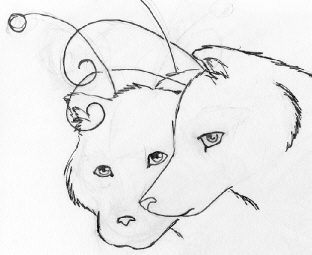
Depending on clan, neuters are treated equally or are somewhat ostracized, being doomed to stay withing the lowest levels of a pack (should they be in one). Whatever the case, neuters do tend to long for a counterpart, if only platonically. This began the tradition of lifebonding.
Lifebonding is when two neuter papillon decide they wish to intertwine their lives and wellbeings. They willingly mesh minds, and form a link stronger than that of the pack (it is equal to that a Sakura can from with a hoomyn). This link does not interfere with the pack link, and non-pack lifebonded neuters do have the ability to tap their healing powers. Due to the intamate nature of the lifebond, it is ofen debated whether a mate is preferable to a lifebond.
As lifebonded pairs cannot produce children, they are allowed in any number in a pack (where as only Alphas and Betas may have mates). Lifebonds are permanent, and should one half of the bond die, the other usually suicides.
Pack Ranking
Alpha-- The leader of the pack, or leaders if mated. Only in Jitsuko packs can neuters rise to this position, and only then when a pack is large and prosperous.
Beta-- Second in the chain of command, they usually attend to more detailed matters in the larger packs, and in smaller packs they tend to act as advisors to the alpha. When I say 'they', I am assuming a mated pair. There is only one Beta if he/she is not mated. Again, neuters can rise to this rank only in Jitsuko packs, and, even then, only when the pack is large and there is no need for many pups to be born.
Members-- These make up the bulk of the pack, and each has his/her own postion in the great order of things. The most switching of rank occurs here.
Low-Rank-- As the name implies, the lower ranked wolves. This rank is usually made up of newer members (who, usually, climb out of this rut) or neuters (who, depending on clan, remain stagnant).
Omega-- The absolute bottom of the pile. While not the most pleasant role to fullfill, it is important; omegas keep the pack at ease, if only to make sure they don't take out their fustrations on his/her hide.
Pups/Adolescents-- Are exempt from many ranking rules. They can steal from the alpha's share of meat and not have their heads removed, but can be rebuked by the omega. Their social standing is an odd one and only enjoyed for approximately one year after birth.
Dominance and Submission...no, not like that!
To maintain pack order and stability, reminders of just who is in charge and who isn't are often nessicary...
To demonstrate dominance, a papillon will stand tall and stiffly, with the ears erect and the tail held high. The dominate papillon will stare directly into the eyes of another, daring the subordinate papillon to challenge. Sometimes the muzzel of the lower ranking wolf is lightly held in the mouth, or given a short squeeze (though not so hard as to cause injury).
Signs of submission include laying the ears flat, lowering the talk to tunking it between the legs, lowering the head (or whole body) below that of the dominating papillon. If the suborinate meets the gaze of a papillon aserting his/her dominance, he/she is in for a sharp reminder of who is who.
In a completely submissive posture, a papillon will roll onto his/her back, tail tucked between the legs, displaying the vulnrable throat and belly. This type of submission is most commonly seen in Jitsuko packs, as they have no wings to be rolled on and potentially damage. Other dominate papillons rarely push for this type of submission.
Fighting
Papillons fight to maintain or gain rank in packs. Ranking fights are often initiated by a lower ranking wolf failing to look away from a higher ranking wolf's challenging stare. Each papillon tries to look as large and frightening as possible, while growling and displaying the teeth.
All winged papillon are loath to take the challege farther than this, as wings are quite fragile, and while they're easy to replace, they're very painful to lose or tear. So, instead of fighting, sometimes a flying 'contest' is used instead, where a papillon show prowess with superior aerial skills, measuring things such as endurence, maximum height, stunts, ect... though, if neither side will accept this, a fight breaks out. Fights between winged papillon are still somewhat watered down, as attention is paid to not damaging the wings. Usually the victor is the one with the most endurance, who ends up pinning the loser against a tree or to the ground. Wing damage and spilled blood very rarely occur over a mere dominance fight.
With the wingless Jitsuko, dominance fights are entered immediately when dominance displays fail. Jitsuko fighting involves a lot more rolling, ramming, and nipping than the kinder, gentler fights of the other papillon. Still, spilling blood is an extremely rare occurance.
In both fights, attacking the antennae is forbidden. Papillons who purposely damage the antennae are often driven from the pack entirely.
Loners
Lone papillon are at the end of the papillon social hierachy. On and off pack land, they are submissive to pack wolves (or they will soon find out the consequences). Sometimes lone wolves will find a mate. Strangely enough, lone pairs have a high chance of producing neuter pups, should they reproduce.
Switching Clans
It is rare for a papillon to switch from the clan he/she was born into without practical reason... among the Sakura, it is extremely rare, as there are few reasons for a Sakura to want to switch. The main reason it even happens among the Asahiko is due to the fact that many vision wolves are located almost entirely within the Hikari (flight) clan, as it is incredibly difficult for them to hunt without their wings.
Also, even though neuters do have better prospects in Jitsuko and Kenjin clans than the alternative, they do not usually switch (though, while other switching in rare, neuter switching is only uncommon). This is probably because they are firmly rooted in their interpretations of papillon religion, as each clan has its own.
But, when switching of clans does occur, the decision is usually confirmed on the day of the papillon's first kill (can you tell yet this is an important day?). When this occurs, the papillon is usually banished from his/her pack's territory, and left to find wolves of his/her chosen clan. In the most rare form of pack switching, an adult papillon will simply pick up and leave their clan.
Papillon are usually very nice about teaching new members of the clan about all there is to know about it, though some clans are more aloof than others.
Basic Beliefs
Each papillon believes in what they call the Great Cycle of Being. They accept that everything that is has its own place in the Cycle, and that reaching one's full potential is only possible when one accepts one's place. To keep the Cycle continuous, Balance must be maintained. When a soul is recalled to the Cycle (death), then it is encompassed within the very heart of the Cycle, in which the soul knows nothing but bliss. Then, depending on how much a soul has grown or regressed, it is sent back out to one of the many realms to fill a position the Cycle needs for the continuation of the Eternal Rotation. Should a soul ever reach its full potential, then it shall become a part of the heart of the Cycle, and a new soul will be born to take its place.
Of course, different clans interpret these basic beliefs differently.
Death
Death is seen as the natrual outcome of life, and another step in the soul's long journey to seeking its full potential. While papillon still experience grief, it is grief that they have been separated from the wolf that has died, not over the death of the wolf. If possible, mourning pack wolves form a ring around the deceased wolf's body. Together, they use a sort of reverse healing power to speed decay, until there is nothing left (this takes in excess of an hour). Each says a last goodbye. Only the mate of, or, in some cases, bonded (see lifebond) is allowed to howl their farewell.
.:back to basic info: back to main:.