
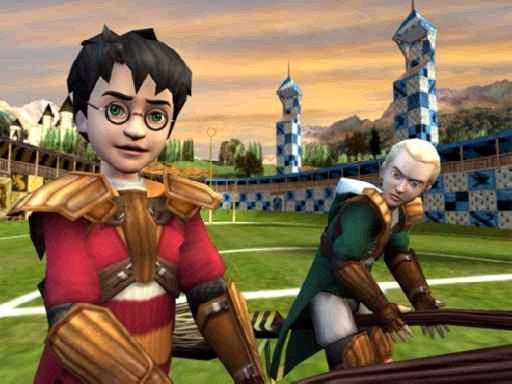
Quidditch, "the sport of warlocks," is the premier sport of the wizarding world. Everyone follows Quidditch. The World Cup matches attract hundreds of thousands of fans from all over the world. Quidditch is a fast, dangerous, exciting game in which two teams flying on broomsticks compete for points scored by throwing a ball--the Quaffle--through hoops on either end of a large grassy pitch.
~PORT KEYS!~
Quidditch falls under the jurisdiction of the Department of Games and Sports, part of the Ministry of Magic. The professional organization is called the International Association of Quidditch. Professional matches are attended by trained mediwizards and while there are many injuries, there are few deaths from Quidditch accidents. However, referees have been known to disappear completely only to turn up weeks later in the middle of the Sahara Desert. There are seven hundred possible ways to commit a foul in Quidditch, all of which occurred in a World Cup match held in 1473.
The name "Quidditch" comes from Queerditch Marsh, the place where the game originated in the 1000s.
Rules of play
Quidditch is played up on broomsticks up in the air. There are four goal posts at either ends of a field. That field is called a Quidditch Pitch. Quidditch has three balls. The ball that scores the points is the Quaffle. The Quaffle is 12 inches in diameter and is made of leather bindings. The Quaffle has made some different changes over the years. The Bludger is probably the most dangerous ball of all of them. It flies through the air being hit by players called beaters. Serious injuries have been caused by Bludgers hitting people and causing them to fall off their brooms. The third and most important ball is the Golden Snitch. The Golden Snitch is a tiny ball that has wings and is enchanted. The first Snitch was a tiny bird that was very small and very tiny, but changes to the rules made it illegal to use the actual bird. The current enchanted, winged ball version of the Snitch was invented by Bowman Wright of Godric's Hollow. If the Seeker catches the Golden Snitch, their team earn 150 points and usually the win.
At either end of the Quidditch Pitch are three hoops through which the Quaffle can be scored. In the center of the Pitch is a circle where the balls are all thrown into the air and the match begins. As the balls are thrown, the players all gather on the ground and then kick off as the referee blows his/her whistle. During the game a player can get a foul or break a rule. Here are some fouls that a player can receive: blagging (applies to all players, it is when a player seizes opponent's broom tail to slow or hinder), blatching (applies to all players, it is when a person is flying with the intent to collide), bumphing (applies to beaters only, it is when a Beater is hitting a Bludger towards the crowd, necessitating a halt of the game as the officials rush to protect bystanders. Sometimes used by unscrupulous players to prevent an opposing Chaser from scoring).
--------------------------------------------------------------------------------
Quidditch equipment
Pitch
The Quidditch pitch is a grassy oval field, 500 feet long by 180 feet wide. There is a small circle in the center of the field where the balls are released. Three 50-foot-tall poles with hoops on them stand at either end as goals. There is a scoring area marked off at each end, around the area of the hoops.
Quaffle red ball, enchanted with Gripping Charms so it can be handled easily and a special charm to make it fall slowly if dropped Bludger heavy iron ball which is enchanted to attack any player nearby Golden Snitch
walnut-sized golden ball with silver wings, bewitched to avoid capture for as long as possible bats
enchanted bats used by the Beaters to "redirect" the Bludgers toward opposing team members broomsticks
ridden by the players and referee.
--------------------------------------------------------------------------------
Famous plays and maneuvers
Hawkshead Attacking Formation
Three Chasers together, one in the center and slightly ahead of the other two.
Porskoff Ploy
A Chaser makes as if to dart upward with the quaffle, drawing an opposing Chaser upwards, then dropping the Quaffle to another Chaser
Wronski Defensive Feint
Seeker dives toward the ground as if he sees the Snitch, only to draw the opposing Seeker into a similar dive and drive him into the ground.
--------------------------------------------------------------------------------
Terms
Beaters
Players who protect other players from bludgers while attempting to hit the Bludgers toward opposing players using a small bat blagging.
Foul: Grabbing onto the broom tail of another player
blatching
Foul: flying to intentionally collide with another player
Blooder an early term for the Bludger, used in Goodwin Kneen's 12th century letter.
Bludger heavy black iron ball that is encanted to attempt to knock players off their brooms
originated in Queeditch Marsh in the 1000s as a chamed rock, but as years went by the rock proved too breakable against enchanted Beater bats--the players found themselves chased by flying gravel as the game wore on.
Bludger Backbeat
Foul: blurting
Foul: locking broom handles with another player to pull them off course
Bumphing
Foul: intentionally hitting a Bludger toward the crowd in order to halt the game momentarily and thereby denying an opposing Chaser a score.
Catcher probably an old term for Seeker, used in Goodwin Kneen's 12th century letter.
Chasers players who pass the quaffle, trying to throw it through the goal; there are three on a Quidditch team.
Cobbing
foul, excessive use of elbows
Cuaditich old term for Quidditch c. 1269
Flacking
Keeper foul: pushing any part of their body through the goal hoop to prevent a score.
Goals
Three on each end, fifty-foot poles with hoops on them
Golden Snitch
Tiny golden ball with wings, when caught it ends the game and gives the team whose Seeker caught it 150 points. Invented in 1300s by Bowman Wright of Godric's Hollow as a replacement for the Golden Snidget bird, which was used in the game of Quidditch until banned in the 1200s.
Haversacking
Chaser foul: when the Quaffle goes through the hoop before it is released from the Chaser's hand (it must be thrown to score)
Hunter old term for the Seeker from the mid-1200s
Keeper player who guards the goal hoops
Kwidditch
Early spelling of Quidditch in the 1100s letter by Goodwin Kneen
Quaffle
Biggish red ball, used to score goals, about the size of a soccer ball
Quafflepocking
Chaser foul: Tampering with a Quaffle to make if fly differently
Quidditch Cup
Won by a Hogwarts house each year (Quality Quidditch Supplies store in Diagon Alley)
Quijudge
14th Century term for the referee scoring area
areas of the field marked off by curved lines around the goals where only one Chaser at a time may be.
Seeker
Player whose goal is to spot and catch the Golden Snitch
Skinning
Foul, flying to deliberately collide with another player
Snitchnip
Foul: any other player than the Seeker touching the Snitch
Stooging
A tactic once allowed where two of the Chasers would ram the Keeper aside so the third Chaser could score a goal. This was outlawed in 1884 and Stooging is now a foul.
Broomsticks
"Stick out your right hands over your brooms and say 'Up!'"
-- Madam Hooch
A flying broomstick is not simply a "normal" broomstick pressed into service as a mode of transportation. The tail, for example, is made of twigs, not broomstraw, which would make for a poor cleaning tool. The flying broomstick is a magical item with built-in charms.
Flying on a broomstick, particularly one which accelerates as quickly as the Firebolt, must necessarily involve some form of magic protective field holding rider to broom and shielding against wind and inertial forces. Without this, it seems unlikely that anyone could hang on when a Firebolt accelerates from zero to 150 mph in only ten seconds. It also seems likely that flying a broomstick doesn't involve actually sitting on the handle, which would be uncomfortable indeed. As a matter of fact, most illustrations we see in the books show the rider floating a little ways above the handle. The spell which creates this effect is called the Cushioning Charm, invented by Elliot Smethwyk in 1820.
Broomsticks are certainly charmed objects. They even seem to be at least semi-sentient. The best ones seem to respond to thoughts. When Harry was nearly thrown from his broom, Hagrid stated that a simple collision couldn't have caused it to act that way because "can't nothing interfere with a broomstick except powerful Dark magic--no kid could do that to a Nimbus Two Thousand." This magic doesn't replace the skill of the flyer, of course, but rather protects and enables them to fly with amazing speed and dexterity. Even when the rider has fallen off the broom, it doesn't fall from the sky, but rather it drifts off on its own.
Quidditch broomsticks
Cleansweep 5
Cleansweep 7-(Ravenclaw team's brooms)
Comet 260-(Cho Chang's broom, Draco's broom at home)
Firebolt(the newest and fastest on the market)
Nimbus 2000-Racing Broom
Nimbus 2001- came out August 1992
Shooting Star- Ron's broom, old school brooms
Silver Arrow-(Madam Hooch fondly remembers this)
Chronology of sport brooms
1820 invention of the Cushioning Charm
1879 Oakshaft 79
1901 Moontrimmer
unknown year - Silver Arrow
1926 Cleansweep One
1929 Comet 140
1934 Cleansweep Two
1935 first Atlantic broom crossing (Jocunda Sykes, on an Oakshaft 79)
1937 Cleansweep Three
1938 Comet 180
1940 Tinderblast
1952 Swiftstick
1955 Shooting Star
1967 Nimbus 1000
1990 Twigger 90
August 1992 Nimbus 2001
August 1993 Fire Bolt
The Firebolt
Released in the summer of 1993, the Firebolt is currently the fastest racing broom in the world. Harry saw a prototype in Quality Quidditch Supplies the summer it came out and was sorely tempted to empty his Gringotts vault to buy one. He resisted the temptation, however, and to his surprise received a Firebolt for Christmas from his godfather, Sirius Black (PA11). The Irish International Side flew Firebolts in the Quidditch World Cup.
Streamlined, superfine handle of ash, treated with a diamond-hard polish hand-numbered with its own registration number tail twigs of birch, individually selected and honed to aerodynamic perfection
unsurpassable balance pinpoint precision
acceleration of 150 mph in 10 seconds
unbreakable Braking Charm, when you pick it up then let go, it hovers at exactly the right height to mount turns with the lightest touch, seems to obey thought rather than grip superbly smooth action
non-sport model.
Bluebottle
A broom for the family with a built-in anti-burgler buzzer.
Miscellaneous broom stuff
Brooms are stored in a broomshed near the Quidditch pitch. Hagrid, on a particularly cold morning, can be seen defrosting the brooms. Filch uses non-magical brooms for cleaning, of course, and there are broom closets here and there in the castle. Peeves tries to put chewing gum in the lock of one and Harry and Ron lock Crabbe and Goyle into the one in the Entrance Hall. Harry and Hermione hide in that same closet when they've gone back three hours in time using the Time Turner, waiting for themselves to pass.
You can buy a "broomstick servicing kit" which includes a Handbook of Do-It-Yourself Broom Care," a tin of High-Finish handle polish, and a clippers to trim crooked tail twigs. Hermione bought one for Harry for his 13th birthday.
If you're in the market for a broom, the best source for information and pricing is Which Broomstick. There's an order form right in the back of the book. When Harry's Nimbus was destroyed by the Whomping Willow and his Firebolt was confiscated, he half-heartedly perused Which Broomstick looking for a replacement.
Besides the Quidditch team members, we see the following people ride broomsticks:
Hermione in the Chamber of the Flying Keys
Ron several time, including pick-up Quidditch games at the Burrow, trying out the Firebolt, and in the Chamber of the Flying Keys, Snape when he referees the Quidditch match, Neville (for a few moments, anyway)
broom magic
Anti-Burgler Buzzer - since electrical devices don't work alongside magic, this must be a spell of some kind.
Cushioning Charm - invented by Elliot Smethwyk in 1820.
Horton-Keitch Braking Charm (patented, named after the founders of the Comet Trading Company, which makes the Comet Racing Broom) inbuilt Warning Whistle (spell included on the Twigger 90)
Self-Straightening Brush (spell included on the Twigger 90)
Quidditch Teams of Britain and Ireland
--------------------------------------------------------------------------------

Robes: pale blue with a silver arrow on the chest
Home: Appleby
Appleby is near the east coast of England, SE of York (NE of Scunthorpe)
Founded in 1612
Defeated the then-champion Vrasta Vultures in a 16-day upset match in 1932
Supporters fire arrows into the air from their wands, but this was banned in 1894
Fierce rivals of the Wimbourne Wasps
--------------------------------------------------------------------------------

Robes: black with scarlet bat on the chest
Home: Ballycastle
Ballycastle is on the north coast of Northern Ireland.
Picture of them playing the Cannons in the book Flying With the Cannons
Mascot: Barny the Fruitbat
--------------------------------------------------------------------------------

Robes: vertical stripes, light green and scarlet
Home: Caerphilly
Caerphilly is in southeastern Wales, N of Cardiff.
team formed in 1402
Famous victory over the Norwegian Karasjok Kites in 1956
Most famous player: "Dangerous" Dai Llewellyn
--------------------------------------------------------------------------------

Robes: orange with black speeding cannon ball and double 'C'
Home: Chudley
Probably Chudleigh, 9 miles SW of Exeter in Devon. (The Burrow is also located in Devon)
Ron's favorite team (logo: two black Cs and speeding cannonball) tend to lose quite a bit
Joey Jenkins - Beater, hits a Bludger toward a Ballycastle Bats Chaser in the book Flying With The Cannons
Won the league 21 times, the last time being in 1892
Club motto: "We shall conquer" (pre-1972), "Let's all just keep our fingers crossed and hope for the best" (after 1972)
--------------------------------------------------------------------------------

Robes:dark gray with white, falcon-head emblem on chest
Home: Falmouth
Falmouth is on the southern coast of Cornwall
known for hard play
Famous (and violent) Beaters Kevin and Karl Broadmoor (1958-1969)
Motto: "Let us win, but if we cannot win, let us break a few heads."
--------------------------------------------------------------------------------

Robes: dark green with a golden talon on the chest
Home: Holyhead
Holyhead is on the northwestern coast of Wales
founded 1203
Only hires witches
Famous match: defeat of the Heidelberg Harriers in a seven-day match in 1953, widely considered to be the finest games ever seen
Seeker: Glynnis Griffiths (1953)
Captain: Gwendolyn Morgan using a Cleansweep 5 (1953)
--------------------------------------------------------------------------------

Robes: emerald-green with two yellow Ks back to back on the front
Home: Kenmare
Kenmare is in southwestern Ireland, at the mouth of the Kenmare River.
Irish team, founded in 1291
Leprechaun mascots
Supporters play harps
Darren O'Hare, Keeper 1947-60, invented the Hawkshead Attacking Formation
--------------------------------------------------------------------------------

Robes: black and white, with one magpie on the chest and another on the back
Home: Montrose
Montrose is on the east coast of Scotland, between Aberdeen and Dundee.
Most successful team in history, won the British and Irish League thirty-two times
European Champions twice
Famous players:
Eunice Murray (Seeker, d. 1942)
Hamish McFarlan (Captain, 1957-68)
--------------------------------------------------------------------------------

Robes: deep purple with gold star
Home: Portee
Portree is a town on the Isle of Skye, one of the Inner Hebrides, off the northwestern coast of Scotland
founded in 1292
Known as "The Prides"
Two league wins in the 1960s
Famous player: Chaser/Captain Catriona McCormack, played for Scotland thirty-six times
daughter Meghan currently plays Keeper
son Kirley is lead guitarist for the Weird Sisters
--------------------------------------------------------------------------------

Robes: Unknown
Home: undetermined
There is no town named Puddlemere in Muggle Britain, although there is a Puddletown.
Dumbledore is a fan of this team
--------------------------------------------------------------------------------

Robes: Unknown
Home: Tutshill
Tutshill is in southeastern Wales, E of Newport.
--------------------------------------------------------------------------------

Robes: Unknown
Home: Wigtown
Wigtown is on the southwestern coast of Scotland, on Wigtown Bay
Kennilworthy Whisp is a fan of this team.
--------------------------------------------------------------------------------

Robes: black and yellow, with a picture of a wasp on the front
Home: Wimbourne
Possibly Wimborne Minster in East Dorset, 6 miles N of Poole.
Ludo Bagman a Beater c.1980

Historical teams
Banchory Bangers
Robes: unknown
Home: Banchory
Known for their appallingly awful Quidditch skills
also known for their extremely reckless shenanigans which led to the disbanding of their team in 1814
--------------------------------------------------------------------------------
Barnton
Robes: unknown
Home: Barnton
Barnton is located southeast of Liverpool in Cheshire.
In 1883, an amateur Barnton team had goals made of different sized baskets. Those for their opponents were tiny while their own were "great wicker caves" which were easy to score into.
--------------------------------------------------------------------------------
Ilkley
Robes: unknown
Home: Ilkley
Ilkley is located to the northwest of Leeds, west of York
The Ilkley team, in the 1100s, played a game againt a Yorkshire team which was described in a now-famous letter from Goodwin Kneen to his cousin Olaf in Norway.
National Quidditch Teams
England fields a team which lost to Luxemburg in 1994 in the lead up to the World Cup. The Irish team, however, went on to win the cup in a very exciting match against Bulgaria.
Ireland National Team (1994)
Robes: unknown
Mascot: Leprechauns
Connolly - Beater
Aiden Lynch - Seeker
Moran - Chaser
Mullet - Chaser
Quigley - Beater
Ryan - Keeper
Troy - Chaser
Teams in order of founding (where date is given):
1163 - Puddlemere United
1203 - Holyhead Harpies
1291 - Kenmare Kestrels
1292 - Pride of Portree
1312 - Wimbourne Wasps
1402 - Caerphilly Catapults
1422 - Wigtown Wanderers
1520 - Tutshill Tornados
1612 - Appleby Arrows
