Wood Duck |
|
 Identification
Habitat
Food
Cover
Home Range
Improving
Habitat
Wood Duck Box
Diagrams
Species that
Benefit
My 1999 CWA Wood Duck Box Program Page (click here to see the latest news and updates)
I am currently participating in the 1999 California Waterfowl Association's Wood Duck Management Program. I am a member of a team assigned to charging, maintaining and monitoring Wood Ducks here on Beale AFB. This program will run from now until the middle of July. The team will be monitoring the Wood Ducks (and other species that use the boxes) actions by checking the boxes approximately every three weeks. I will be updating our observations and other interesting occurances on here all through the program. A similar program has been established in many states. Contact your local Department of Natural Resources or Fish and Game Department. They will be able to help you out. Or contact:
| California Waterfowl Association |
| 4630 Northgate Boulevard, Suite 150 |
| Sacramento, CA, 95834 |
| Telephone: (916) 648-1406 |
This page I put on here for you to get some backround information on the Wood Duck. They're a very colorful bird and I'm hoping this program will help me learn some more. You can stop back every few weeks and see what I have learned.
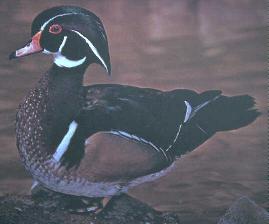
Unless you are on the lookout for this handsome bird, you may hear rather than see it as it flies off quickly through the woods, crying weep, weep, weep. Wood Duck females nest in tree cavities or in man-made nest boxes. Up to 15 eggs are laid on a bed of white down and incubated by the female for about four weeks. Soon after hatching, the ducklings jump from the nest hole in responce to the call of their mother. If the nesting tree is in an upland area, she then leads her brood to water. Wood Ducks are not the only tree-nesting ducks; Buffleheads, Hooded Mergansers, goldeneyes, and several kinds of whistling (tree) ducks also nest in trees.

Wood Ducks depend upon forested wetland habitat for food and cover, although marshes are also used. Breeding range must have trees for nesting cavities and food near permanent freshwater lakes and streams. Brushy borders are important for nesting and brooding. Swampy areas with cypress and gum are premium for roosting. The best habitat contains mast-producing hardwoods that border streams and permanent fresh-water lakes. Many beaver ponds provide ideal Wood Duck habitat.
The diet of the wood duck includes hard and soft mast, insects, aquatic invertebrates (mollusks, snails, etc.), aquatic plants and seeds. Mast is the fruit of trees and shrubs, such as acorns, nuts, & berries. Wood Ducks feed on land considerable distances from open water.

Nesting habitat requires areas of flooded shrubs, trees, or both, in approximately 1:1 ratio of plant cover to open water. Trees or shrubs overhanging water will suffice. Cover should remain available from February through May. Nesting cavities should be within 1/2 mile from water. Mature trees of 16" in diameter or more are the primary source of cavities, although nest boxes make a good substitute. Maintain at least one cavity for every 5 acres of woodlands. Adequate food must be available.
Nesting requires cavities or nest boxes. Wood Ducks prefer to use cavities already made by woodpeckers and squirrels, although any cavity is acceptable. The entrance should be no larger than 4" and the cavity large enough to support an average of 11 young. Protecting previously used nests is very important. Once successful, a female will nest in the same cavity year after year.
Due to the migratory and mobile nature of the Wood Duck, home range is difficult to define. The average feeding radius is 25 to 30 miles every day. Annual migrations reach hundreds of miles.
Because of the mobility and migratory habits of waterfowl, home range is not a consideration in forest habitat management except in terms of the brood-rearing and nesting requirements discussed above, and feeding radius.
Mature Hardwood:
Mast Production:
Intermediate Treatments:
Direct Improvements:
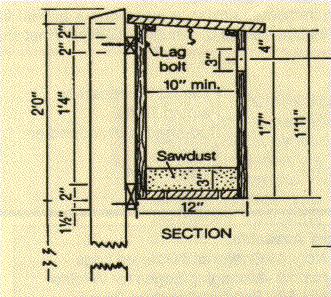
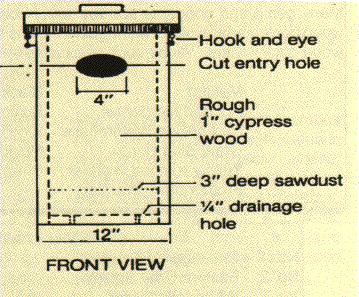
Erect nest boxes where cavity trees are lacking
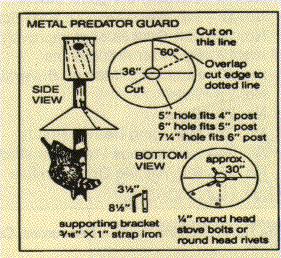
Measurements and instructions for erecting a Wood Duck nest box.
Species That Benefit From Wood Duck Management
Many game and nongame species with habitat requirements similar to wood ducks benefit from Wood Duck management. Management plans should emphasize the community of species that share Wood Duck habitat. Wood Duck associates include:

Most of
the information on this page was found in the
Reader's
Digest Guide to North AmericanWildlife,
Microsoft
Encarta Encyclopedia
or was found somewhere on the net.
Back to my HOME page
Last Updated: 13 Feb 1999