

"Shroomin' " is one of my favorite hobbies. It's challenging , relaxing, and can even be quite tasty, if you are able to find and identify the right mushroom. Mushroom hunting can be dangerous, though, especially if you are in doubt about the mushroom you picked. If you don't know what it is don't eat it! I had quite an experience when I was first starting out identifying mushrooms. I ate one that I wasn't quite sure of, and come to find out, its poisonous! Make sure you know what you're eating!
Below I have pictured just a few of the thousands species of mushrooms you can find in the forests of Wisconsin. They are by no means an identification guide. If you are interested in mushroom hunting, I suggest buying field guides on the subject. Most notably "Mushrooms Demystified" by David Arora, and The Audobon Field Guide to Mushrooms, edited by Gary Lincoff.
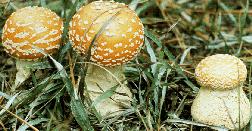 Amanita muscaria
Amanita muscaria are common in pine, oak, and maple forests. They are often called The Fly Agaric, because the poison from the mushroom was used by farmers to kill houseflies. Amanita muscaria is poisonous, the symptoms ranging from mild stomach cramps to delerium and profuse sweating. It's a beautiful mushroom, but not one for the table.
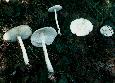 Amanita virosa
Amanita virosa is one of the deadliest mushrooms known to man, hence its common name "Destroying Angel". It is easily recognized by its all white color and smell, which becomes nauseating as the mushroom ages. This one's a no brainer: you eat it, you probably will die.
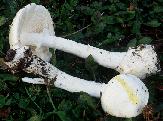 Another photo of Amanita
virosa
Another photo of Amanita
virosa
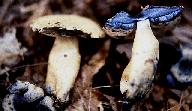 Gyroporous cyanescens
Gyroporous cyanescens is one of my favorite mushrooms to find and to eat. It is recognized as having pores instead of gills under its cap. It is usually white to tan colored. And, possibly the coolest feature, it turns dark blue when touched. For instance, if you traced your name on the mushroom cap with a stick, you would see your name appear almost instantly in blue. I usually write dirty messages on them and leave them for other hunters to find. Gyroporous cyanescens is also quite tasty and is great with a burger!
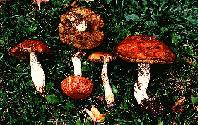 Leccinum auranticatum
Leccinum auranticatum rules! In my opinion, the best tasting of the Boletaceae (mushrooms with pores under the cap). Many don't like the tough stalks, but I think they are the best part of this mushroom. Kinda remeniscent of asparagus....Yum!! Also called Scaber Stalks, Leccinum spp. have characteristic "scabers" on the stalk. Kind of like small pieces of its flesh were peeled away and left to hang.
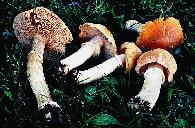 Rozites caperata
Rozites caperata is found mostly in mixed forests among maple and oak trees. These are another one of my favorite musrooms to eat. Best sauteed and mixed with rice! Don't confuse these with deadly Amanitas! Rozites caperata does not have a volva (saclike structure at base of stalk) like Amanita spp. and it gives a brownish sporeprint!!
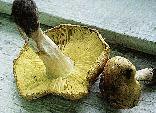 Tricholoma flavovirens
Also known as "Man on horseback", Tricholoma flavovirens fruits almost always in late Sept. to mid Oct in Wisconsin. It is found usually under pine. It is one of the best cooking mushrooms in my opinion, cooking firm and very tasty! I suggest lightly breading, then sauteeing. Don't confuse with Tricholoma sejunctum (below) which is poor tasting and may be possibly poisonous. T. flavovirens is nearly all yellow in the gills, unlike T. sejunctum
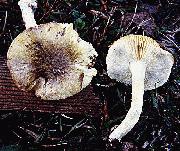 Tricholoma sejunctum
Back to my HOME page
