My Travels in South East Asia
Laos
China Vietnam Cambodia Laos Thailand
 Information and travelogue written by Erik Wienese
Welcome to my South East Asia homepages. I made a few trips to China, Cambodia, Vietnam, Laos, Thailand. For my family, friends and the friends I met during my trips I made these pages with some travelinformation, stories and pictures.
 My Travel in Laos

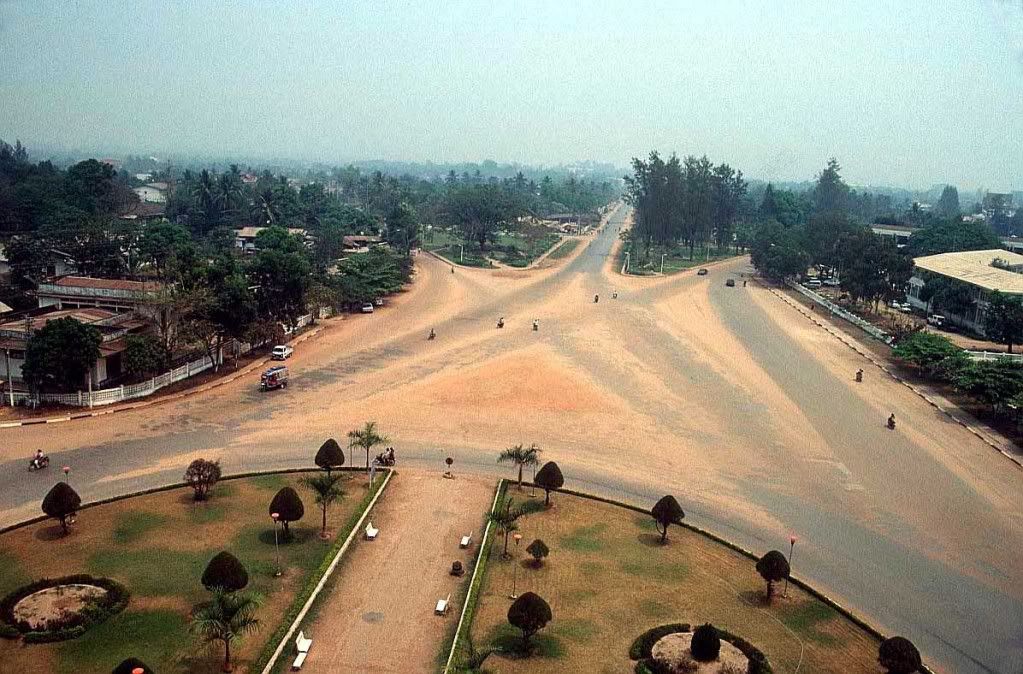
I rode on my bicycle down wide boulevards lined with
trees, past old comfortable parks, and saw old
buildings with French style balconies and shutters.
On the street, much of the traffic was still on
bicycles. It was like visiting an era in the past,
simple but charming, and I was quite moved by the
whole experience.
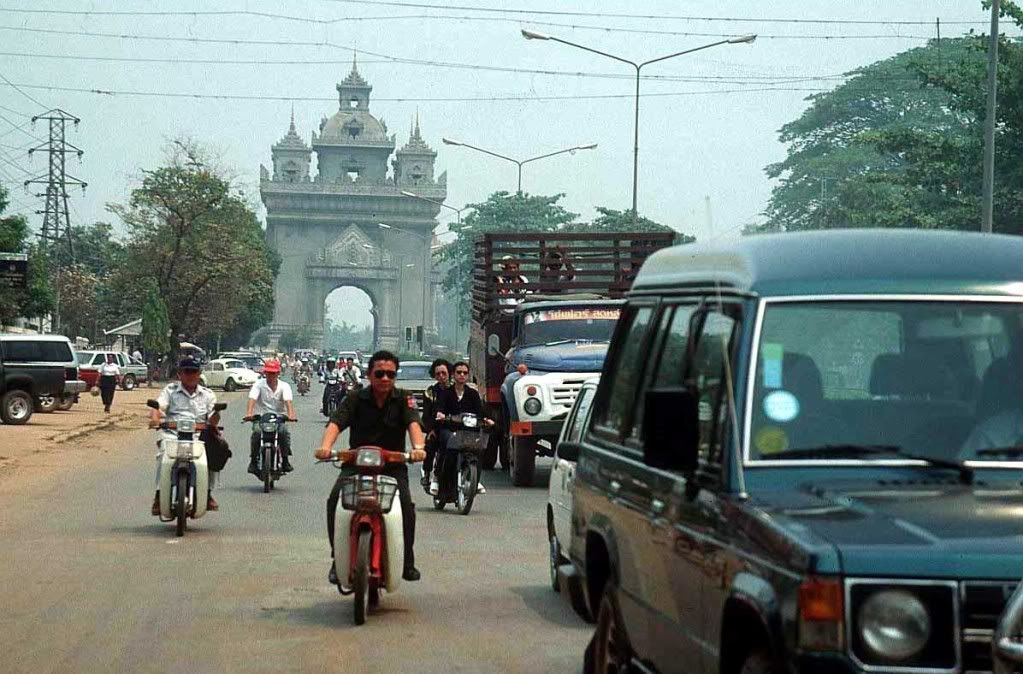
Vientiane also spelled VIANGCHAN,is the largest city and capital of Laos, situated on a plain just northeast of the Mekong River. The city's central river port location in a country relying heavily on its rivers for transportation and its surrounding hinterland of intensive rice cultivation have made Vientiane the major economic centre of Laos. The city has a tropical monsoon climate, every month having an average daytime temperature above 80º F (27º C) and more than 80 percent of Vientiane's annual precipitation on the average falling in the five months May-September.
The town was founded during the late 13th century, and in the mid-16th century the capital of the Lao kingdom (a state known as Lan Xang) was moved to Vientiane from its previous traditional location at Luang Prabang (now Louangphrabang). In 1778 Vientiane came under Siamese control; in 1828 it was sacked and destroyed when the subject Laotian king revolted against Siamese hegemony. From 1899 to 1953, with the exception of the Japanese occupation (1945), Vientiane was in succession the seat of the French governor and the French administrative capital.
Vientiane still has some of its older wooden structures, despite its government offices, foreign embassies, and schools. Its modern industries include brewing, lumber processing, and the manufacture of brick, tile, textiles, cigarettes, matches, detergents, plastic bags, rubber sandals, and iron and steel. The Lao farmers of the surrounding area tend rice, corn (maize), and livestock in some of the best alluvial lowlands of Laos. Before 1975 the city was the principal stock shipping and slaughtering centre of the country. Since the shift in the country's import trade from Vietnam to Thailand, Vientiane has replaced Pakxé to the southeast as Laos's principal port of entry.
The Sisavangvong University (founded 1958) in Vientiane has faculties of agriculture, art, education, forestry and irrigation, and medicine. Affiliated bodies include Fa-Ngum College, Lycée Vientiane, Polytechnic, and Pali and Sanskrit institutes. Ho Phakeo, the national museum, is located in the city, as are the Dongsaphangmeuk Library and the National Library.
At Vientiane
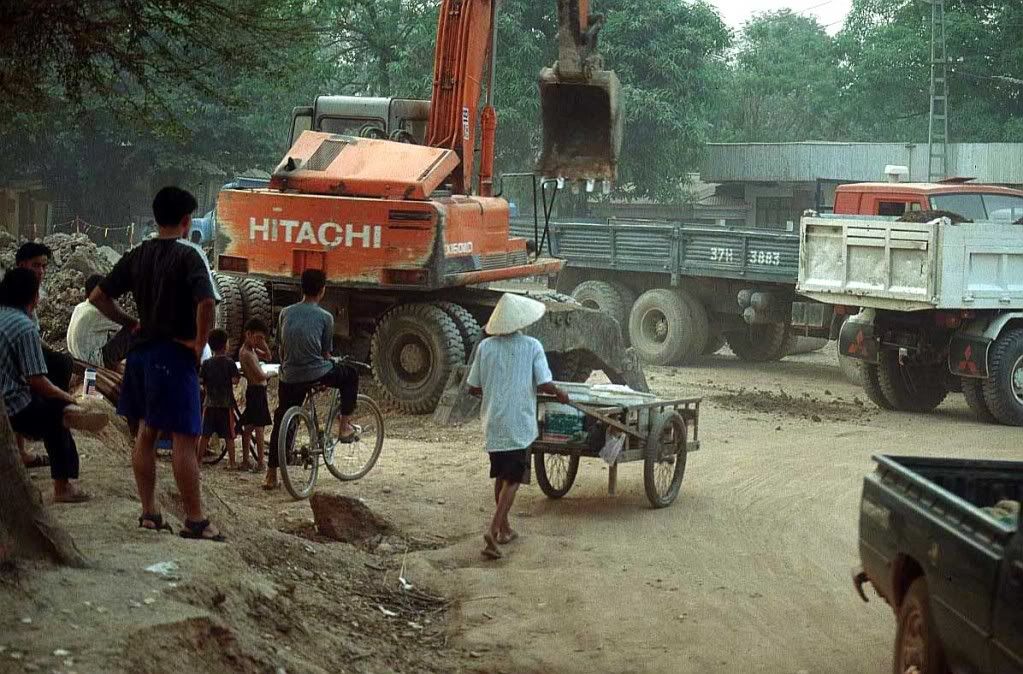 the Mekong River is navigable only by small craft; passage to the right bank and the Thai railhead of Nong Khai was solely by ferry until 1994, when a highway bridge was opened. Vientiane has an international airport, and highways link the city with Louangphrabang and Savannakhet in Laos and with Ho Chi Minh City in Vietnam. The Nam Ngum Dam north of Vientiane provides enough hydroelectric power for the surrounding areas and for export to Thailand as well. Vientiane's outstanding building is the That Luang, a stupa (temple), dating from about 1566 and restored by Lao civil servants under Prince Phetsarath during the French colonial period.
In the 18th and at the beginning of the 19th century
, Xieng Khouang was the center of a kingdom of the Hmong Meo. In 1832, it was conquered by the Vietnamese,
annexing the entire region.
 The town of Xieng Khouang was totally destroyed during
the Vietnam War. Even though it has been rebuilt in
1975, the name Xieng Khouang is now primarily used
in reference to the province of the same name.
The provincial capital is Muang Kham. The most
important place near the Plain of Jars is Phonsavan
with a small airport serving the region.
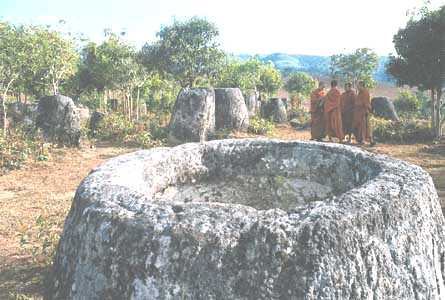
The Plain of Jars is some 10 kilometres southeast of Phonsavan, at about 1,000 metres above sea level.
The town of Xieng Khouang was totally destroyed during
the Vietnam War. Even though it has been rebuilt in
1975, the name Xieng Khouang is now primarily used
in reference to the province of the same name.
The provincial capital is Muang Kham. The most
important place near the Plain of Jars is Phonsavan
with a small airport serving the region.
The Plain of Jars is some 10 kilometres southeast of Phonsavan, at about 1,000 metres above sea level.
Scattered over the plain are hundreds of enormous clay
jars, each about 1 to 2.5 metres high, with a diameter
of about 1 meter. There is still no explanation as to
how the clay jars found their way onto the plain,
nor what purpose they served. Archaeologists have come
up with the wildest theories, among them a claim
declaring them brewery cauldrons. More likely, the
jars are enormous urns. Many jars have been destroyed
or damaged during the Vietnam War, when American planes
bombed positions of the communist Pathet Lao.
 The village gong awoke me at 6am. After breakfast of
Chinese donuts and honey I set off to meet the little
boat which I had hired for the day.
The village gong awoke me at 6am. After breakfast of
Chinese donuts and honey I set off to meet the little
boat which I had hired for the day.
We traveled down river for about an hour to a village
on the other side, where the boatman was unsuccessful
in finding the motorbikes and their drivers, which were
to take me to the falls. He took me further on to
Ban Nakasong, which is the last village before Cambodia
, where he found them.
I rode on the back of a motorbike for nearly an hour.
It was quite hair raising as the track was very full of
pot holes and mud and it was raining. My driver was
very careful. There was no other traffic, there is
hardly any in Laos, and we did not see any people or
houses.
The Falls are the biggest cascades in South East Asia
and with the flood water it was very impressive and
well worth seeing. This is the point where the Mekong
is 14km wide and the area is known as 4000 islands as
the river splits over such a large area.
After returning to the boat we set off to Li Phi
Falls which are near the edge of Cambodia. The scenery
on the way was lovely. The river was enormous and
powerful, but quite silent. There were countless tiny
islands, many with a few people living on them, with
their animals. Everyone came out to wave. There were
also the tops of trees sticking up out of the water
where islands had been submerged. Our boatman must have
been very skilled and have known the area very well to
be able to find his way safely.
I was dropped on an island. The owner of a guest
house had drawn a small map which showed the paths to
take. A monsoon started, with thunder, and we sheltered
by a Wat in the middle of jungle-like vegetation.
A woman joined us, and wanted to show us the way.
We walked a long way down small jungle paths, crossing
wobbly little bridges and planks. There were a lot of
termites eating the wood here, but no leeches or
mosquitoes. The cascades are where the fresh water
dolphins come, but not in Oktober. We ate our packed
lunch of sticky rice and omelet at the falls. It took
much longer to get back because it was against the
current of the river.
 I left the island the following day and remember the
journey back to Pakse because of the frogs. People
living near the road were catching frogs in the
flooded ditches and popping them into sacks. As the
lorry approached they would tie up the sacks and load
them on. The whole lorry was full of bags of frogs.
I had two piled under our feet and worried about them
getting damaged them all the way back to Pakse.
I left the island the following day and remember the
journey back to Pakse because of the frogs. People
living near the road were catching frogs in the
flooded ditches and popping them into sacks. As the
lorry approached they would tie up the sacks and load
them on. The whole lorry was full of bags of frogs.
I had two piled under our feet and worried about them
getting damaged them all the way back to Pakse.
I can speak just enough Vietnamese to make Lao
people think that it is okay for them to rattle off in
Lao at about 100 words per minute, and then I have to
say in Thai, "Mai Khao Jai" or Vietnamese Toi khong
biet (I don't understand). Then, they have to try and
say it in English.
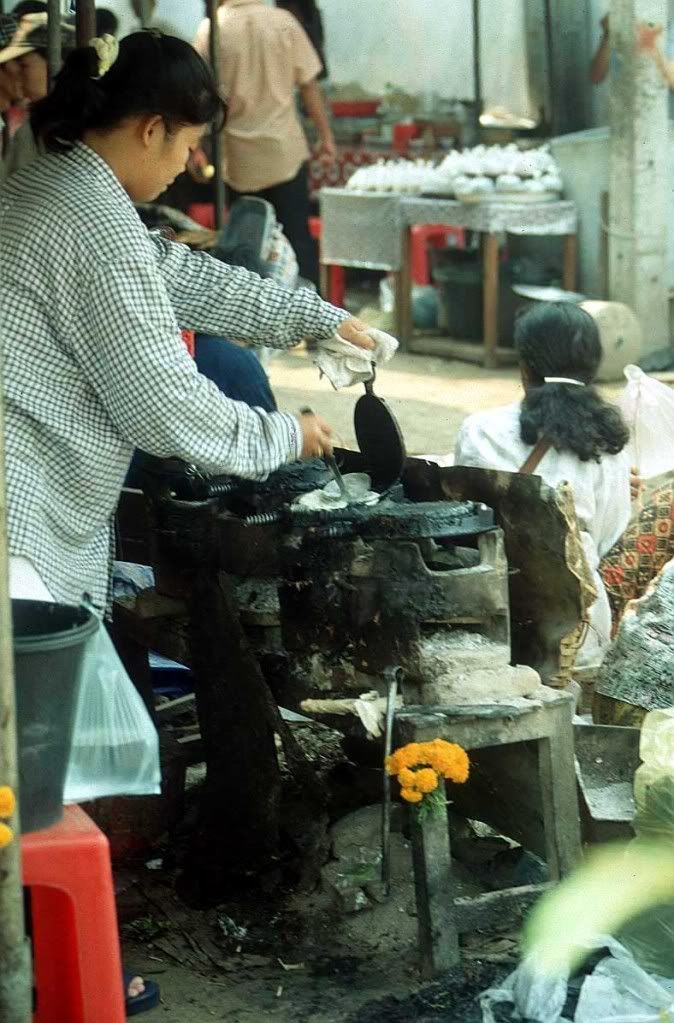
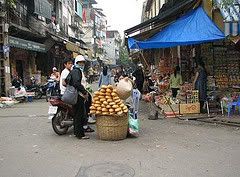
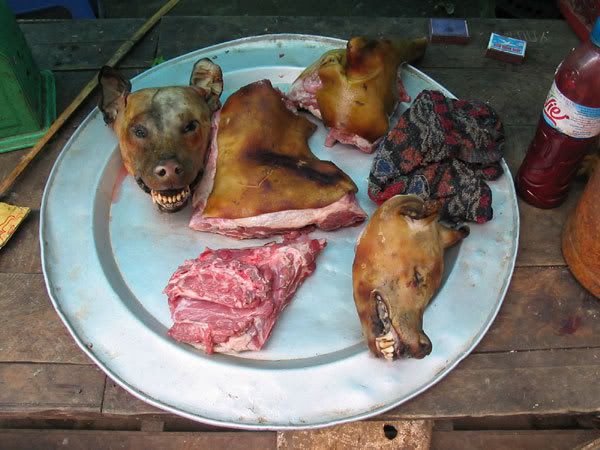
If you go to a market, there are many open-air markets,
each with many vendors. They may be under a huge tent,
or inside a big building, but everyone is in one big
room. They may sell clothing,handbags, and housewares
in addition to food. The food they have in these
markets ranges from raw ingredients to food that is
already cooked and ready to eat.
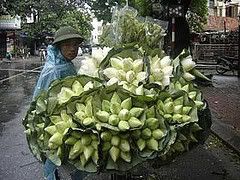
There are fruits, such as papaya, oranges,apples,
bananas, and pineapples, and vegetables, such as
carrots, string beans and spinach.
They also have grilled chicken and fish, and stews and
curry dishes. They also have sweets, made from bananas,
rice, or coconut milk, and which are not as rich as
western desserts. There is some green stuff I really
like, called namprik num. This is sort of like a salsa
except it is a little bit thicker, and it is very
spicy, a lot like Mexican green chile sauce, and it is
eaten with sticky rice.
It is a kind of rice very popular and it is not fluffy
like regular white rice, but rather dense instead.
As the name suggests, it sticks together so that when
you grab it, you can hold a clump of it in your
fingers and dip it in.
 Tropical rain forests cover more than half of Laos.
Its densest forests, in the southern monsoon region,
contain stands of bamboo, rosewood, sandalwood, and
teak. The most valuable of these woods is teak because
it is hard, resists rot, and is exquisitely grained.
Thus teakwood is used for building ships,wharves,
bridges, and furniture. Although the industry is very
important in Laos, the government recently
restricted teak harvests in an effort to prevent
further deforestation.
Tropical rain forests cover more than half of Laos.
Its densest forests, in the southern monsoon region,
contain stands of bamboo, rosewood, sandalwood, and
teak. The most valuable of these woods is teak because
it is hard, resists rot, and is exquisitely grained.
Thus teakwood is used for building ships,wharves,
bridges, and furniture. Although the industry is very
important in Laos, the government recently
restricted teak harvests in an effort to prevent
further deforestation.
