
Unlike many people, I enjoy reading, as long as I'm not forced to read anything excruciatingly dull (this has happened many a time, and surely in college it will happen a lot more). Anyway, as I was saying, I've always enjoyed reading, and through the years I have developed a list of "favorites." So in my world, some of the greatest writers are Ayn Rand, Jack London, Ray Bradbury, T.S. Eliot, Jorge Luis Borges, and Clare Bell.
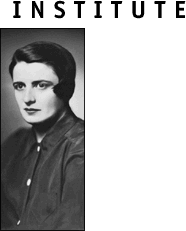 Ayn Rand wrote Atlas Shrugged, one of the greatest (if not THE greatest) novels of all time, over one thousand pages of pure philosophical brilliance. I will use her own words to explain her philosophy, objectivism:
"My philosophy, in essence, is the concept of man as a heroic being, with his own happiness as the moral purpose of his life, with productive achievement as his noblest activity, and reason as his only absolute." --Ayn Rand, in the Afterward to ATLAS SHRUGGED.
Rand was born in Russia, but moved to the United States because she believed it was the only country built on values remotely resembling hers. I recommend Ayn Rand's writings to some people--but not all. Her so-called radicalism will invariably offend some people. However, I think that the world would literally be a much better place if everyone read some Ayn Rand and adopted at least some of her core principles. Really.
A note: I've been reading a lot of Rand lately, so don't be surprised if you find random, unintentional Objectivist propaganda slinking around through my site. Also, I think I may add an "Objectivism" page at a later, unforseeable date.
 Jack London was one of my childhood favorites. I fell in love with the movie versions of Call of the Wild and White Fang when I was young, and grew attached to the novels a few years later. Jack London was popular during the late 1800s and early 1900s, and his writings criticized the dog-eat-dog lifestyle characteristic of the Industrial Revolution. Even Call of the Wild, a book about a dog's descent into savagery, is a veiled attack on capitalism, although I didn't know it when I first read it at age nine. (Side note: Ayn Rand would NOT approve of London's attacks on Capitalism. But he had good stories anyway.) London's writing influenced my own style heavily, and, even now, traces of his style can be found in much of what I write.
 Ray Bradbury was (and still is) a master of science fiction. His style is vibrant and imaginative, his stories are wonderfully bizarre, and his very love of writing radiates from every written page. Fahrenheit 451, in my opinion, is his greatest novel. It is the story of a man who challenges a futuristic world in which reading and independent thought are punishable crimes. But I only think that Fahrenheit 451 is his greatest novel because The Martian Chronicles is more a collection of related short stories than it is a novel. "And the Moon be Still as Bright" is the best story (or chapter); it tells the story of Spender, a romantic, who loses his self-control when he realized that Mars would be destroyed by an inconsiderate race. The October Country and The Illustrated Man are other good collections of short stories.
 T.S. Eliot, my favorite poet, was considered a member of the "Lost Generation"--artists of the 1920s who grew bitterly disillusioned because of the decade's shallowness, and because of the unforeseen horrors of WWI. I think I can best do Eliot justice by quoting his greatest poem, "The Love Song of J. Alfred Prufrock."
It begins like this:
Let us go then, you and I,
When the evening is spread out against the sky
Like a patient etherized upon a table;
Let us go, through certain half-deserted streets,
The muttering retreats
Of restless nights in one-night cheap hotels,
And sawdust restaurants with oyster shells,
And streets that follow like a tedious argument
Of insidious intent
To lead you to an overwhelming question...
Oh, do not ask, "What is it?"
Let us go and make our visit.
And it ends like this:
Shall I part my hair behind? Do I dare to eat a peach?
I shall wear white flannel trousers, and walk upon the beach.
I have heard the sea-girls singing, each to each.
I do not think that they will sing to me.
I have seen them riding seaward on the waves,
Combing the white hair of the sea blown back
When the wind blows the water white and black.
We have lingered in the chambers of the sea
By seagirls wreathed in seaweed red and brown,
Till human voices wake us, and we drown.
But to get the full effect of the poem, you'd have to read it all. And if you're wondering just what this poem means...I'm not telling you! Ha ha! You'll have to figure out yourself. By the way, "The Hollow Men" is nearly as good a poem as this one is; according to some, it's even better.
A note: Wow. Eliot is awesome.
 In short, I love Latin-American literature, and Borges is the best of the best. His style is unique and highly intelligent; of all the authors who I have named, I believe that Borges is(was), technically, the most skilled. Borges could be counted among the Ayn Rands and T.S. Eliots of this world based solely on his greatest short story, "The Circular Ruins". It is about a man who went to a group of ancient ruins with the purpose of creating a man by dreaming of him. Incredible stuff; and I highly recommend it. Other great Borges stories include "The South", "The Secret Miracle", and "The Book of Sand." Although his writings are wonderful in English, they're better in Spanish, for those who know the language
 Clare Bell was my other childhood favorite, and I made certain that I read everything that she ever wrote (although I know I failed in my quest). The first Clare Bell book I read was Tomorrow's Sphinx, the story of the hunting-cheetah who accompanied a young Egyptian king through his life, and his death. I loved it for its fantastical elements; the cheetah, for example, had the capability of merging psychically with his master. Bell also wrote the wonderful "Ratha" series: Clan Ground, Ratha's Creature, Ratha and Thistle-Chaser, and Ratha's Challenge. These books are about a clan of intelligent felines, the Named, who existed several million years ago. They tamed fire, herded livestock, spoke philosophically, and had complex personal relationships. I know the "talking animals" premise is, more often than not, ridiculous, but in this series, it works, and the reader forgets about it. Regardless of how good Clare Bell's books are, I believe that they are out of print, but they are well worth checking out at a local library.
I could only include so many authors on my page. Other favorites, however, include George Orwell, Hermann Hesse, Gabriel Garcia Marquez, Emily Dickinson, Allen Ginsberg (hey, I know he wasn't the best writer or the most Objectivist, but his stuff is VERY entertaining), Stephen Crane, and Walt Whitman.
HOME THE ENEMY: HOLE CHILD THE ALLY: PINK FLOYD HUMOR GOOD LITERATURE A LITTLE STORY I MADE UP QUOTE(S) OF THE DAY A BIT ABOUT ME RANDOMNESS PHOTOS LINKS GUESTBOOK CREDITS
