
Wagglers are generally floats that are attached to the line, bottom end only hence the name "waggler".There are three ways to attach the waggler, via a rubber float ring, the eye of the float itself or by means of a float adaptor (this is a half inch piece of silicone rubber tube with a swivel in one end). Below I have drawn some diagrams of some very basic rigs, just to give you an idea of how to use wagglers. In most waggler set-ups two thirds of the floats shotting capacity, should go round the base of the float. Note the different shotting breakdowns in Fig 1, this will give you a rig that is more adaptable to suit changing conditions and can be used on any float . I'll post a shot conversion chart soon.
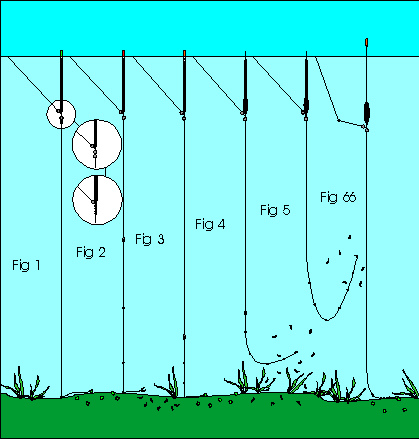
Fig 1. This setup I would use in shallow water (0-3 Foot), for fishing on the
lake bed.
Fig 2. I would use this rig in deeper water (3-6 Foot) and put some of the shot down the line to get the hookbait to the lake bed a bit faster, perhaps to avoid surface/midwater feeding fish. Rather than putting all of the weight at the "Dead depth" mark, I've spaced them out a bit. The first two shot (midwater) gets the terminal tackle to midwater reasonably quickly, the next two singles also take the bait down, but slower (this will then not plunge your bait into weed, but allow it to settle gently). The final shot is the "Telltale" shot, the one that helps register the bite.
Fig 3.This one is for swims 6 foot deep or more and is for getting hookbait to the lakebed fast
All 3 of the above rigs are exactly the same in their construction, but by moving the shot around on the line, altering the depth of the float, you can quickly change tactics. For example, your fishing in the margins in 2 foot deep water and the bites dry up, you notice some feeding bubbles 20 yds out and all you need to do is adjust the float depth, move some shot around and now your fishing in water seven feet deep. And catching again.
Fig 4. Is an "On the drop" rig. The float is still locked on the line as the previous rigs and a bulk shot used to get the bait to a certain depth, but then smaller spaced out shot are used to the hook (normally No's 8s & 10s). A slightly different waggler is needed for this and is called an insert waggler. This has a finer tip (approx one third the thickness of the float) which will show the passage of the hookbait down through the swim. Once setup like this, cast in bitless at first and as soon as the float hits the water, start counting 1...2...3...etc. Watch how at various "counts" the float settles more in the water and remember this. As each shot reaches full depth, the float will settle. Now bait up and count the float down, if the float does not settle at the required count, strike! This is fishing on the drop.
Fig 5. Actually shows the hookbait in mid drop.
Fig 6. Is a little bit different, this is a drift-beater or wind-beater. The thick oval "sight bob" helps keep the float tip visible by its sheer bouyancy whilst below the surface (at the lakebed) I use a string of lightly spaced (quarter inch spaces) shot to drag and grip the bottom when combating heavy undercurrents. The bulbous part at the base of the float helps to stabilise it in rough conditions.The extra shot above he float, helps to sink the line
Shotting Breakdowns
As a usefull guide, I use the following approximation.
1SSG (Swanshot) = 2AAA
1AAA = 2BB
1BB = 2 No4
1 No4 = 2 No8
More Accurate Breakdowns
1xSSG 1.89 gr = 2AAA + 1 No 1 or 4BB +1 No 1 or 6 No 1 + 1 No 3 or 9 No 3 + 1 No 6 or 11 No 4 or 18 No 6 or 30 No 8 |
1xAAA 0.81 gr = 2BB or 3 No 1 or 4 No 3 or 4 No 4 +1 No 6 or 7 No 6 + 1 No 8 or 13 No 8 |
1xBB 0.40 gr = 1 No 1 + 2 No 8 or 2 No 3 or 2 No 4 + 1 No 8 or 4 No 6 or 6 No 8 |
1 x No 1 0.28 gr = 1 No 3 + 1 No 8 or 1 No 4 +1 No 6 or 2 No 6 + 1 No 8 or 4 No 8 |
1 x No 3 0.20 gr = 1 No 4 +1 No 8 or 2 No 6 or 3 No 8 |
1 x No 4 0.17 gr = 1 No 6 + 1 No 8 |
Hooklength Attachment
The standard for this is loop to loop ie, a loop in the end of the mainline
and the hooklength also. Having these two ready, pass the hooklength loop through
the mainline loop, and now pass the hook through the hooklength loop and draw
closed slowly, lubricating as you do so.
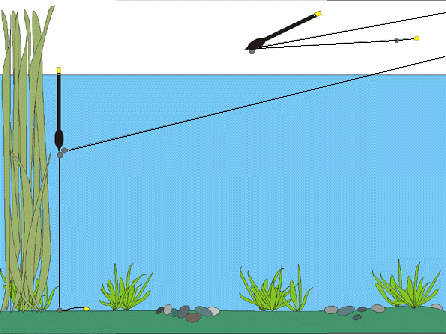
The zoomer is a float where all of the weight needed to "cock" it, is built into the base of the float. This gives us a setup that can be cast very accurately and more importantly, tight to features such as the reed bed above. Only one shot is required for that all important bite indication (usually a BB or No 1). Once cast tight to the reeds the weight and bait will swing in towards the reeds, giving you the best possible presentation for wary fish, who may be hiding in them (In bright daylight or clear water or both).
There are specially made floats for this job, but as I like to remain flexible in my setups, I use the waggler for this task. This stems back to my match fishing days, where you would be feeding and fishing two or three lines in your swim, and due to finances had only the one rod to set up.
There is a much smaller version of the zoomer that is called the dart, this float is slimmer in profile with an anttenae tip and requires only a No4 or No8 dropper shot. This float is really for Canals or small pits/ponds.
Both of these floats can be fished on the drop aswell.
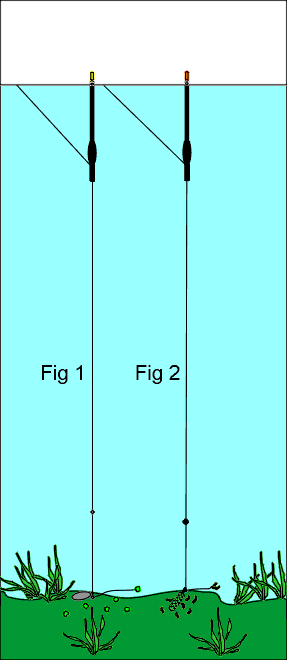
The polaris leger float has been around for some time now, but it has replaced the bigger floats that I used to use for float legering, with added benefits.
The line is threaded through the base of the float that contains a "friction" device. The base of the float has four tiny holes in it, two at the top and two at the bottom on either side of the float from each other.One set (top and bottom) is for light lines whilst the other set is for heavier ones.Threading the line through the top of the base and out through the bottom is the way to do it.This line then goes to the terminal tackle, which can be a straight lead or feeder.The makers recommend that a single shot is placed approx 12-18 inches above the terminal tackle, to help stop the float tangling. I dont like this recommendation as it is feasibly a tether rig (see Fig 1), instead I use a bead and I have had no problems with tangling using this (see Fig 2).The makers also suggest a minimum weight that is required to make the float cock properly, so a tip here is to write that weight on the float body and varnish over.
Once set-up, cast out and pay out some slack line. The weight sinks and gradually
the float will drift up the line to the surface. When you see the float come
out, reel down on it to tighten the line. You will find you can determine how
much of the tip remains visible by forward/reverse winding. The float is now
locked in place. When reeling in your tackle from deep water (say 15ft or so)
the float remains locked untill it touches the rod-tip, careful slow winding
will push the float back down the line. The chief advantage of these floats
are that they accurately find the lakebed, every time and if a fish so much
as breathes on it, you will know. It is, in effect a long range "lift method"
Here I will attempt, with the use of animation to explain, how the lift method works, and more importantly, why.
The lift method was first described (to my knowledge) by the late, great Dick Walker.
I will describe it from here: Use a piece of Peacock Quill 4-6 inches in length, and attach it at one end only by the means of a wide fitting rubber band. The reason Peacock Quill is used is because of its superb buoyancy, if you use something else, you will detract from this rigs sensitivity. The importance of knowing the depth of your intended fishing spot, cannot be over emphasized, in fact it is absolutely essential. That aside, the rest is sheer simplicity.
ALL of the weight that is required to cock this float, must go in one place (usually 3-4 inches from the hook).The floats depth is set so that one quarter, to a half an inch of the tip remains visible. The whole rig is cast out and the line drawn in tight to the float, and the waiting game starts.
As can be seen from the animation, a fish will usually swim along, 6-12 inches off the bottom of the lake. To feed, it has to turn itself towards the vertical, to enable it to pick up food from the lake bed. Once it has picked up its food (your bait) it will "right" itself.. turn back to the horizontal, and in doing so, lifts the "bulk" of your weights.
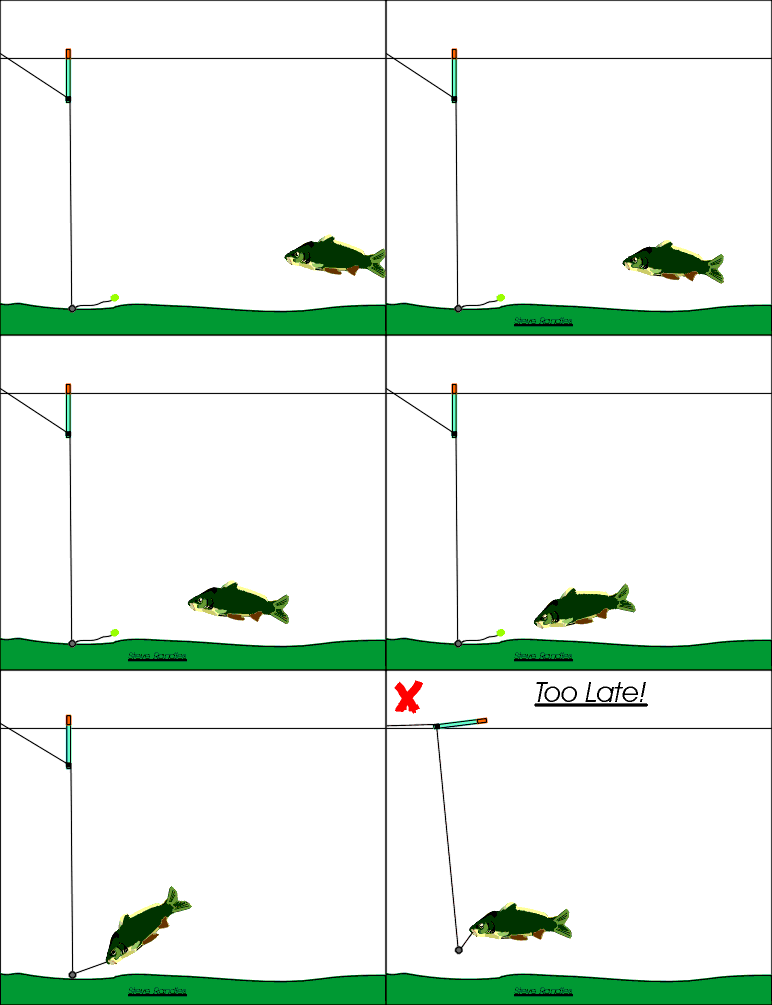
While it is "leveling off" it is lifting the weight aswel, in turn this is lifting the float out of the water, signifying a bite. When you think about it, the float is suspending the weight, as it rises. Therefore the rig is extremely sensitive as the fish feels no resistance at all, until that is, the float has laid flat, then if it can, the fish will eject the hook and bait.
It is important to strike as the float is rising, so setting the rod in two rests is imperative, as is "hovering" over the rods waiting for that bite.
If done correctly, this is probably the most deadly method of all.
